
ByJake Rossen|Sep 14, 2020, 8:00 AM EDT
 Add us as a preferred source
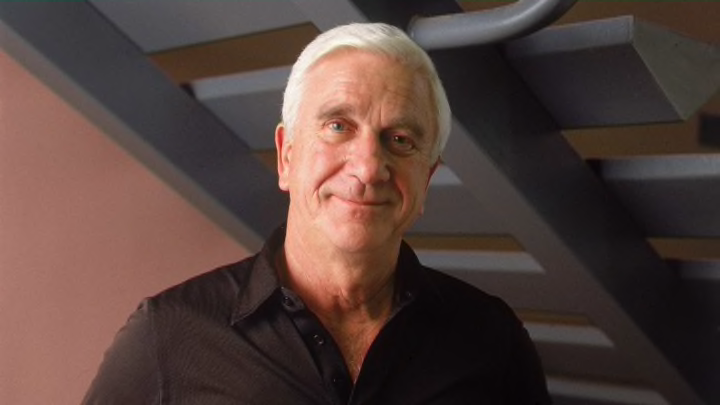
While he was originally best-known for his straight-faced leading man roles in films like 1956’s Forbidden Planet and 1972’s The Poseidon Adventure, actor Leslie Nielsen (1926-2010) experienced a late-career resurgence as a deadpan comic with impeccable instincts with films like 1980’s Airplane! and The Naked Gun franchise. For more on Nielsen, including his early career and his love of fake fart noises, keep reading.
1. Leslie Nielsen grew up near the Arctic Circle.

Born on February 11, 1926 in Regina, Saskatchewan, Canada, Leslie Nielsen was one of three sons of a Royal Canadian Mounted Police officer. The family lived in a small area named Fort Norman, just 200 miles south of the Arctic Circle. “There were 15 people in the village, including five of us,” Nielsen later said of the isolating environment. “If my father arrested somebody in the winter, he’d have to wait until the thaw to turn him in.”
2. Leslie Nielsen was a gunnery sergeant.
Nielsen talked about having an unhappy home life as a youngster, saying his father was physically abusive. When Nielsen turned 17, he decided to join the Royal Canadian Air Force, where he became a gunnery sergeant despite being legally deaf (he wore hearing aids for most of his life). After his service, Nielsen worked as a disc jockey at a Calgary radio station and attended the Academy of Radio Arts in Toronto before earning a scholarship to the Neighborhood Playhouse School of the Theatre in New York. The move led to opportunities in television, where he eventually racked up more than 100 credits on shows like Rawhide and Peyton Place.
3. Leslie Nielsen believed Forbidden Planet cost him television opportunities.

In 1956, Nielsen starred in Forbidden Planet, a well-crafted science fiction film about a spaceship crew that goes to the planet Altair IV in search of a missing group of scientists. While the movie is considered a high watermark for sci-fi of the 1950s, Nielsen believed being so identified with the film cost him opportunities in television. “It’s the reason I was never asked to do Star Trek or The Twilight Zone for TV,” he said. “I carried too much baggage with me from that movie.”
4. Leslie Nielsen was very fond of farting.
Nielsen toiled for decades in dramatic roles in both movies and television before directors David Zucker, Jerry Zucker, and Jim Abrahams hired him for 1980’s disaster movie parody Airplane! The idea was to use his serious demeanor for comic effect. (The directors also cast actors Robert Stack, Lloyd Bridges, and Peter Graves for similar reasons.) Despite Nielsen’s string of stern characters, he immediately understood the spoof style of the film. In turn, cast and crew understood that Nielsen was not a very serious person. “He had that little fart machine of his, so that every time he was interviewed on a show or something—and in real life—he would be talking with a straight face, and then he would appear to be farting,” David Zucker recalled in a 2015 interview with The A.V. Club. “That’s just what he liked to do.”
Nielsen once bragged that he had cut artificial wind in elevators, in Japan, and even in the White House.
5. Leslie Nielsen’s brother was a deputy prime minister in Canada.
Nielsen’s performing aspirations weren’t shared by his older brother, Erik. Instead, Erik got into politics, becoming a deputy prime minister for Brian Mulroney’s Conservative government and representing the Yukon for the Progressive Conservatives from 1957 to 1987. Leslie Nielsen said that Erik had a “fantastic” sense of humor.
6. Leslie Nielsen made a series of fake instructional golf videos.
Capitalizing on the success of The Naked Gun series, in 1993 Nielsen appeared in Leslie Nielsen’s Bad Golf Made Easier, a spoof of golf instructional tapes full of sight gags and puns. The actor made two follow-up videos, 1994’s Bad Golf My Way and 1997’s Stupid Little Golf Video.
7. Leslie Nielsen played Clarence Darrow on stage.
Following Airplane! and 1988’s The Naked Gun, Nielsen was forever typecast as a comic actor, which he was perfectly willing to embrace. But the performer had a soft spot for defense attorney Clarence Darrow, who earned fame in the early 20th century for his bombastic court appearances and his defense of teacher John T. Scopes and his right to teach evolution in public schools. In the 1970s and again in 1999, Nielsen appeared in Darrow, a touring one-man stage show that examined many of the lawyer’s most famous cases. Nielsen said he was often moved to tears reading many of Darrow’s summations.
Nielsen felt the stage would be the only way he would be taken seriously again. “Someday I want to play Willy Loman in Death of a Salesman, and I know I’ll be able to do it on stage because of the footlights,” he said in 1994. “They separate you from the audience and they can’t see your eyes. On film, they can see your eyes and I know I’ll never be able to play drama again in front of a camera.”
8. Leslie Nielsen used his headstone for one final joke.

Following Nielsen’s passing at age 84 in 2010 from pneumonia, the actor’s tombstone in Fort Lauderdale, Florida, was engraved with a message near and dear to the actor’s heart. It’s a reference to his eternal affection for faux flatulence: “Let ‘er rip.”
What Is Effective Altruism? The Philosophy That Shaped FTX’s Founder, Explained
The Netflix series ‘The Altruists’ explores how Sam Bankman-Fried, once the poster child for a movement focused on doing good, wound up losing billions of dollars.
ByEden Gordon|Nov 19, 2026, 7:00 PM EST
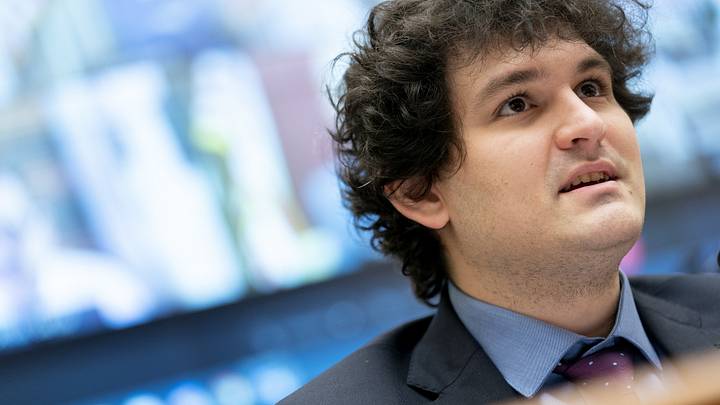
How did an organization whose founder followed a philosophy based on doing the greatest amount of good possible for the world end up in prison for misappropriating billions of dollars of customer funds?
That’s the central question at the heart of The Altruists, the Netflix series that explores the rise and fall of the cryptocurrency exchange company FTX. Before FTX’s collapse, its founder, Sam Bankman-Fried, was a poster child for effective altruism, a philosophy that uses research and evidence to identify the world’s biggest problems and find strategies to solve them.
He openly cited effective altruism as the reason he entered the crypto industry, and had vowed to eventually give away most of his wealth to charity. Yet Bankman-Fried is currently serving a 25-year prison sentence. So how did this all play out, and how did effective altruism influence Bankman-Fried’s actions?
What is effective altruism?

Effective altruism is both a philosophy and social movement. It is based on using reason and logic to identify major global problems and solutions, and helping people to figure out how they can do the most good possible with their lives.
“Effective altruism is about using scientific evidence and careful reasoning to find the best ways to help others, and putting those findings into practice,” reads the program’s website. “It’s both an ongoing research project and a global movement of people working to do good.”
The movement draws much of its inspiration from the philosopher Peter Singer, who has long argued that people have a moral obligation to help people in poverty. It has mobilized billions of dollars in donations over the years. The movement generally encourages people to either dedicate their time or careers to improving specific social issues, or to “earn to give”—making as much money as possible and donating it to charity.
What was Sam Bankman-Fried’s relationship to effective altruism?
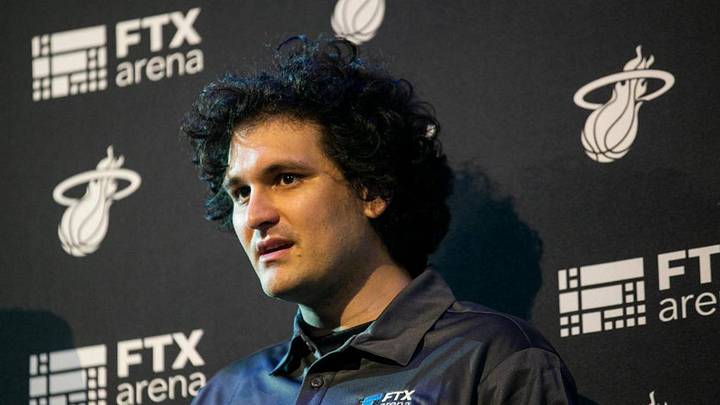
Bankman-Fried was first introduced to effective altruism after meeting William MacAskill, one of the movement’s founders, when he was an MIT undergraduate. Less than a decade later, he had promised to donate the entirety of his net worth—at one point some $26 billion—to charity. Bankman-Fried also publicly said his desire to help as many people as possible through donations drove his decision to take significant financial risks.
FTX’s collapse was devastating for effective altruism proponents and gleefully celebrated by many of its critics. “Bankman-Fried’s behavior went against values central to effective altruism, such as honesty, humility, integrity, and concern for other people,” reads a statement on the Centre for Effective Altruism’s website. “In the years since, leaders in the effective altruism movement have consistently condemned Bankman-Fried’s actions.”
It would be incorrect to say that effective altruism directly caused Bankman-Fried’s actions. Yet his connection to the movement certainly shows the potential pitfalls of fixating on a potential future outcome—no matter how beneficial for the world—while failing to act with integrity in the present.
Read More:
•
The Book That Inspired George Harrison to Write “While My Guitar Gently Weeps”
•
The Most Common Scams in Every State, Mapped
•
Science Fiction or Silicon Valley? 7 Books That Foresaw Our Digital Lives
•
6 Discontinued ’90s Gadgets People Still Miss
Home/BIG QUESTIONS