Some photographs do more than preserve a moment. They open a doorway to another time.
This rare image of Charles Bronson and Jill Ireland brings back an era when Hollywood stars seemed larger than life, movie theaters glowed beneath bright marquees, and audiences waited eagerly for the newest picture to arrive in town.
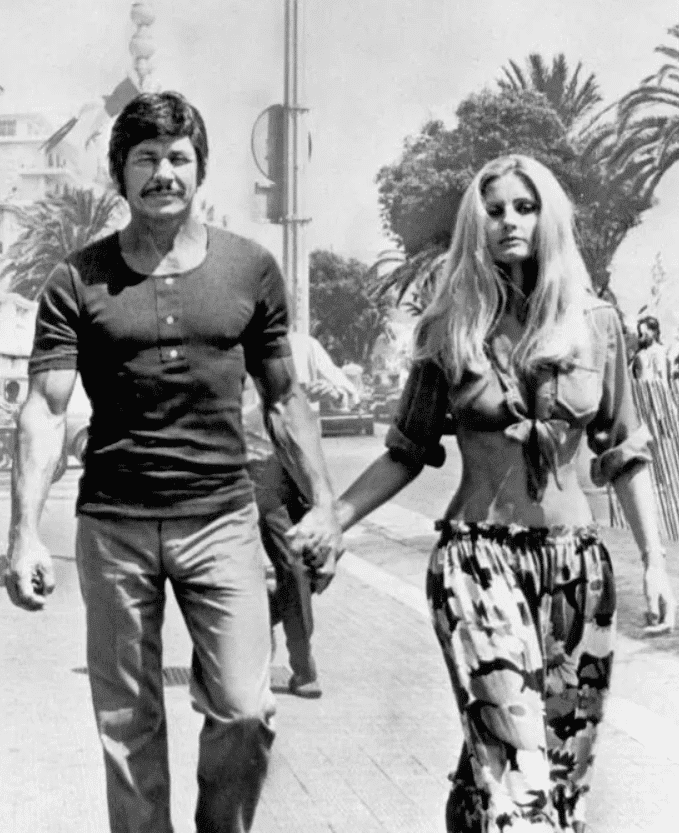
For longtime film fans, the couple may be recognizable almost immediately. Bronson’s unmistakable mustache, weathered features, and quiet confidence made him one of the most distinctive leading men of his generation. Beside him, Ireland carried the graceful presence and natural elegance that audiences remembered from her many film and television appearances.
Together, they became one of classic Hollywood’s most familiar husband-and-wife teams.
A Photograph From a Different Hollywood
The picture appears to come from the early 1970s, a fascinating period in American entertainment.
The traditional studio system was fading, younger filmmakers were experimenting with new styles, and movie audiences were embracing stars who did not resemble the polished leading men of earlier decades.
Charles Bronson fit that changing landscape perfectly.
He was never presented as an untouchable matinee idol. His strength came from looking like someone who had experienced real hardship. He often played men who spoke sparingly, observed carefully, and relied on determination rather than charm.
Jill Ireland offered a compelling contrast. Her calm expression, poised manner, and English sophistication brought warmth to the screen. When the two appeared together, their differences created an unmistakable chemistry.
Charles Bronson’s Journey From Coal Country
Long before his face appeared on theater posters around the world, Bronson grew up far from Hollywood.
Born Charles Buchinsky in Pennsylvania coal country, he was the eleventh of 15 children in a working-class family of Lithuanian heritage. Money was scarce, and his early years were shaped by the difficult realities of life in a mining community.
As a young man, he worked in the coal mines before serving in the United States military during World War II. Those experiences helped shape the screen presence audiences would later recognize: reserved, resilient, and seemingly unshakable.
After the war, he studied acting and slowly began building a career. His unusual appearance and serious manner initially placed him in supporting roles, often as soldiers, lawmen, outlaws, or men of few words.
Over time, the very qualities that once made him unconventional became his greatest strengths.
Bronson represented a different kind of movie star. He looked believable holding a shovel, riding a train, walking through a dusty frontier town, or facing danger without saying a word.
Jill Ireland’s Quiet Strength
Jill Ireland had already established herself as an actress before beginning her life with Bronson.
Born in England, she entered the entertainment industry during the 1950s and appeared in British films before moving into television. American viewers may remember her from appearances on popular programs such as The Man from U.N.C.L.E.
Her beauty was immediately noticeable, but Ireland brought more than elegance to her roles. She could be warm, playful, serious, or quietly determined, depending on the character.
Her personality also seemed well suited to Bronson’s reserved nature. Where he appeared guarded, she often seemed open and expressive. Their partnership worked because neither person appeared to compete with the other’s presence.
Their paths crossed during the period when Bronson was making The Great Escape. They married in 1968 and remained together until Ireland’s death in 1990.
Partners at Home and on the Screen
Charles Bronson and Jill Ireland eventually appeared together in about 15 films, an unusually long collaboration for a married acting couple.
Among their shared pictures were The Mechanic, The Valachi Papers, Breakout, Hard Times, Breakheart Pass, and From Noon Till Three.
In many of these films, Bronson played the hardened central figure while Ireland brought emotional depth or humanity to the story. Their real-life familiarity helped make even small scenes feel natural.
They did not need grand romantic speeches to convince an audience that two characters cared for one another. A glance, a quiet exchange, or the way they stood together could communicate more than a page of dialogue.
Their professional partnership was also practical. As Bronson’s international fame increased, he reportedly used his influence to create opportunities for the couple to continue working together. TCM notes that a major contract connected with The Valachi Papers gave him a voice in choosing his female co-star, allowing him to work alongside Ireland.
For them, making movies was not simply a career. It became part of their family life.
The Films Older Audiences Still Remember
For viewers who grew up during the 1960s and 1970s, a Bronson film carried certain expectations.
There would probably be danger, difficult choices, and a central character who refused to surrender. Bronson rarely needed lengthy dialogue. His silence became part of his appeal.
Films such as The Magnificent Seven, The Great Escape, Once Upon a Time in the West, Hard Times, and Death Wish helped define his enduring image.
Yet his movies with Ireland often revealed another side of him.
One of their most unusual collaborations was the 1976 western comedy From Noon Till Three. Rather than presenting Bronson only as a hardened action hero, the film allowed him and Ireland to explore romance, humor, and the way ordinary events can grow into legends.
Ireland also performed the film’s theme song, “Hello and Goodbye,” which received a Golden Globe nomination.
It remains a fascinating picture for viewers who enjoy seeing familiar stars step beyond the roles that made them famous.
A Marriage Tested by Real Life
Behind the movie premieres and location shoots, Bronson and Ireland built a large blended family.
Like many families, theirs experienced joyful moments as well as serious challenges. Ireland later faced breast cancer and chose to speak publicly about her experience at a time when many people still avoided discussing the illness openly.
She wrote about her journey and became an advocate for cancer research. Her willingness to share her story gave encouragement to families facing similar uncertainty.
Ireland died in 1990 at the age of 54. She and Bronson had been married for more than two decades.
For admirers of the couple, knowing what came later gives their vintage photographs an added emotional weight. The images preserve them before those difficult final years—walking together, working together, and building a shared life.
Why This Rare Photograph Still Matters
Modern celebrity photographs often disappear within hours, replaced by the next headline or social-media update.
Vintage images feel different.
They invite us to pause and notice the details: the clothing, the hairstyles, the sunlit street, and the unguarded expressions of two people who could not have known how the photograph would be viewed decades later.
Bronson and Ireland are not dressed for a formal premiere in these pictures. There is no elaborate red carpet or carefully arranged studio backdrop. They simply appear to be moving through an ordinary day together.
That sense of normalcy makes the photographs especially memorable.
More Than a Famous Hollywood Couple
Charles Bronson and Jill Ireland belonged to a generation of entertainers whose careers developed slowly.
There were no overnight viral moments. Actors often spent years accepting minor parts, traveling between productions, and waiting for the role that would finally connect with audiences.
Bronson’s rise from a Pennsylvania mining community to international movie stardom remains one of Hollywood’s most remarkable success stories. Ireland’s journey from British films and television to a long American screen career was equally notable.
But their lasting appeal is not based only on fame.
People remember them because their partnership appeared steady in an industry known for constant change. They worked together, raised a family, faced hardship, and left behind films that continue to introduce them to new generations.
A Memory Preserved in Black and White
A photograph cannot tell an entire life story.
It cannot show the difficult childhood that shaped Bronson, the years Ireland spent developing her craft, the crowded movie sets, the family journeys, or the private conversations between them.
Yet it can preserve something simpler.
It can capture two familiar figures walking side by side during a time when their greatest adventures—on screen and in life—were still unfolding.
For viewers who remember waiting in line beneath the theater marquee, hearing the rustle of candy wrappers before the lights dimmed, or watching Bronson’s films on a family television years later, this photograph offers more than Hollywood history.
It offers a small journey back to an era when movies felt like events, screen stars seemed unforgettable, and one legendary couple could tell a story without saying a single word.