
Born Norma Jeane Mortenson on June 1, 1926, in Los Angeles, Marilyn Monroe’s story reads like a fable carved into the very fabric of Hollywood—a tale of struggle, transformation, triumph, and tragedy.
Her early life was marked by instability: her mother, Gladys Pearl Baker, suffered from mental illness, leaving Norma Jeane to spend much of her childhood in foster homes and orphanages.
She never knew her father, and the sense of abandonment followed her for years. In those uncertain early days, she developed not only resilience but also a longing for love, safety, and recognition—needs that would shape her relationships and career.
Out of this fractured childhood emerged a woman who would become not only one of the most famous actresses of all time but also a cultural symbol of glamour and vulnerability.

Her journey into the spotlight began almost by chance. As a teenager, Norma Jeane worked in a munitions factory during World War II. It was there that she was first discovered by a photographer seeking to document women in the workforce.
Her natural beauty, luminous smile, and ability to engage the camera turned those first photos into a stepping stone. Soon she was modeling professionally, and by the mid-1940s she was appearing on magazine covers.
Yet Norma Jeane Carpenter, as she was briefly known after her first marriage, knew that modeling would not be enough. Reinventing herself as “Marilyn Monroe” was not a superficial decision but a profound act of self-creation: the birth of a persona that embodied both the fantasy and fragility of Hollywood.
By the 1950s, Monroe had become the embodiment of cinematic glamour. Signed to 20th Century Fox, she quickly rose from supporting roles to leading lady status. Her platinum hair, breathy voice, and disarming blend of innocence and sensuality made her instantly unforgettable.
Films like Niagara (1953), Gentlemen Prefer Blondes (1953), and The Seven Year Itch (1955) solidified her as the ultimate screen siren. The famous image of Monroe’s white dress billowing over a subway grate in The Seven Year Itch remains one of the most enduring images in film history.
But Monroe was not content to be a one-dimensional symbol of sex appeal. Behind the studio-crafted roles, she yearned to be taken seriously as an actress.
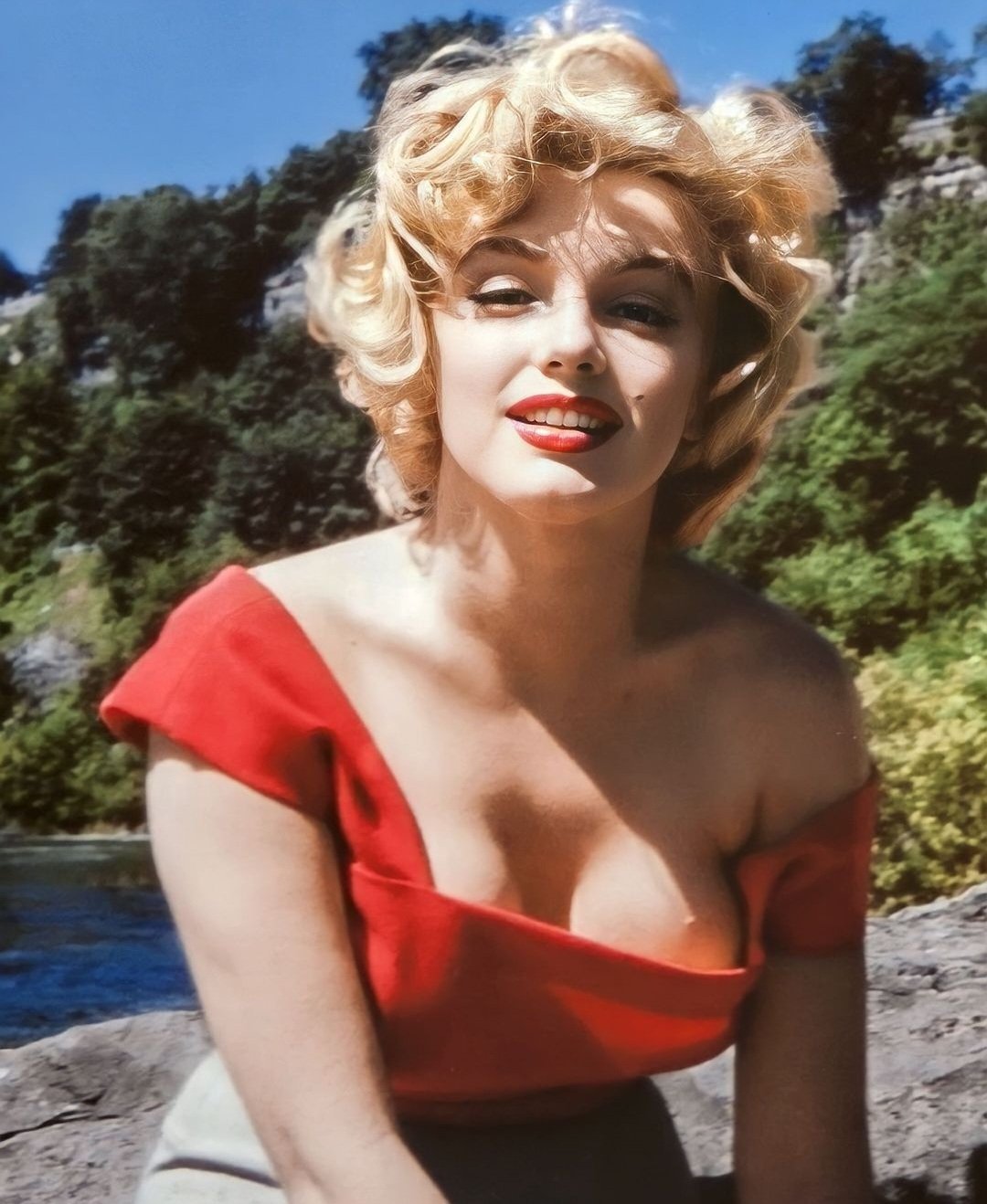
Determined to refine her craft, Monroe studied at the Actors Studio in New York under Lee Strasberg, immersing herself in method acting. This pursuit was met with skepticism from critics who dismissed her as little more than a blonde bombshell.
Yet her performances in Bus Stop (1956) and Some Like It Hot (1959) revealed surprising depth, nuance, and comedic brilliance. Billy Wilder’s Some Like It Hot became one of the most celebrated comedies of all time, and Monroe’s performance was central to its enduring success.
Even as her star burned brighter than ever, Monroe struggled behind the scenes. She faced constant battles with studio executives who sought to control her image, and her personal life was scrutinized with relentless intensity.
Her marriages reflected her search for stability and love: first to baseball legend Joe DiMaggio, whose protective nature clashed with her public persona, and later to playwright Arthur Miller, whose intellectual world both fascinated and isolated her.
Each relationship revealed Monroe’s yearning for acceptance beyond the glamorous façade. Rumored liaisons with political figures, including President John F. Kennedy, further fueled the mystique surrounding her, blurring the line between fact and legend.

What the world saw was a radiant star, but what Monroe felt was often loneliness and self-doubt. She struggled with insomnia, anxiety, and the pressures of an industry that demanded perfection while offering little compassion.
Prescription drugs, initially meant to ease her pain and exhaustion, soon became both a crutch and a curse. By the early 1960s, her health and reliability on film sets became a source of tension with studios.
Still, she remained an adored figure, captivating audiences with her blend of fragility and resilience.
On August 5, 1962, Monroe’s life came to an abrupt and devastating end at the age of 36. Found in her Brentwood home, her death was ruled a probable suicide due to barbiturate overdose.
The shock reverberated across the globe. To millions, she was more than a film star—she was a symbol of longing, desire, and the bittersweet cost of fame. Her passing cemented her status as one of Hollywood’s most enduring icons, her face forever frozen in time as both dazzling and tragic.

More than sixty years later, Marilyn Monroe’s influence remains undiminished. Her films are still celebrated, her image endlessly reproduced, and her life dissected in biographies, documentaries, and films.
Yet beyond the icon lies a more complex legacy: that of a woman who fought against typecasting, who hungered for respect as much as for love, and who lived with raw vulnerability beneath the glitter of stardom. She was, in every sense, human—a fact that makes her story all the more poignant.

Marilyn Monroe did not simply light up the screen; she changed the very notion of celebrity. She revealed that stardom is not only about beauty and charm but also about the courage to be seen in all one’s complexity.
In her brief 36 years, she created a myth that has outlasted her mortal life. She remains not just a product of Hollywood’s golden age, but a timeless reminder that even legends are fragile—and it is in that fragility that their true power resides.