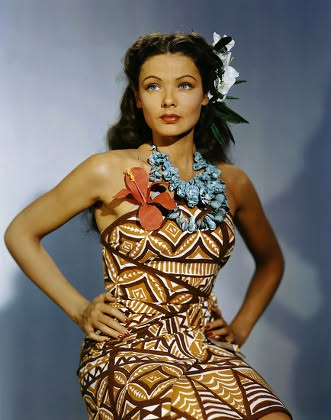
When people think of Gene Tierney, the immediate images that come to mind are her unforgettable turns in Laura (1944) or Leave Her to Heaven (1945). These films immortalized her as one of Hollywood’s most luminous stars, an actress of striking beauty and enigmatic sophistication.
Yet, before she stepped into the noir shadows of Laura or embodied the dangerous allure of Ellen Berent, Tierney’s career took her to a far more unexpected place: the deserts of British East Africa in Sundown (1941).

At just twenty-one years old, Tierney was still carving out her place in an industry that often typecast ingénues into glamorous but limited roles.
For a rising actress of her age and appearance, audiences might have expected cocktail dresses, satin gowns, or the polished drawing rooms of a studio melodrama.
Instead, under the direction of Henry Hathaway, she donned khaki fatigues and weathered the scorching desert sun in a wartime adventure film set against the backdrop of global turmoil.
It was an unconventional role, a daring choice for someone so new to the screen, but one that gave an early glimpse of the talent and range that would later define her career.
In Sundown, Tierney portrayed Zia, a woman of mysterious heritage who becomes entangled in espionage and political intrigue during the Second World War. Unlike the decorative roles so often given to actresses early in their careers, Zia demanded a certain gravitas.
She was enigmatic, self-possessed, and deeply layered—simultaneously alluring and inscrutable. Tierney brought to the character a unique mixture of strength and vulnerability, grounding Zia with quiet authority while allowing glimpses of the loneliness and burden she carried.
The performance required her to move beyond beauty alone, to create a character whose strength was as compelling as her mystery.
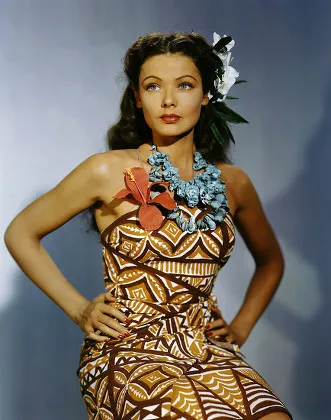
For audiences at the time, seeing Tierney in dusty desert gear instead of glittering gowns was itself a surprise.
Yet this setting allowed her natural beauty to emerge in an entirely different way—less polished, more organic, and undeniably magnetic. In her stillness, her measured delivery, and her commanding presence, Tierney hinted at the kind of dramatic intensity that would later astonish audiences in more celebrated works.
Even in this early role, she demonstrated an instinctive understanding of how to make restraint feel as powerful as grandeur.
Sundown itself was very much a product of its historical moment. Released in 1941, before the United States formally entered World War II, it carried the marks of both adventure cinema and wartime propaganda.
The film was filled with exotic landscapes, tense battles, and anti-fascist messaging designed to resonate with contemporary anxieties. It was nominated for three Academy Awards, including Best Cinematography and Best Art Direction, praised for its sweeping visuals and atmosphere.
Yet despite these accolades, the film did not maintain the same cultural longevity as other wartime dramas. Its dated depictions of Africa and its propagandistic overtones have caused it to fade from prominence in the decades since.

But what has endured is Tierney’s performance. For her, Sundown was more than a film; it was a proving ground. It gave her a chance to display emotional depth in a role that resisted the conventions of ornamental starlet parts.
Where many young actresses of her era might have been sidelined into smiling ingénues, Tierney carved out something different—something with substance.
This early choice in her career proved telling. Just a few years later, she would give life to one of cinema’s most haunting images in Laura, where her character exists simultaneously as an idealized portrait and a flesh-and-blood woman.
In Leave Her to Heaven, her performance as the obsessive and chilling Ellen Berent was so powerful that it earned her an Academy Award nomination.
These roles revealed her ability to embody contradictions—cool yet passionate, fragile yet unyielding, ethereal yet grounded. And the seed of that artistry can be traced back to films like Sundown, where she first displayed her ability to transcend surface expectations.

The legacy of Sundown is not simply as a wartime curiosity, but as an early step in the evolution of an actress who would leave an indelible mark on Hollywood. In revisiting it, one doesn’t just see an adventure tale set against desert sands.
One sees the outline of a star beginning to emerge, a performer whose subtlety and presence hinted at the iconic career yet to come.
Today, Gene Tierney’s name evokes an almost mythical image of classic Hollywood beauty—an actress who seemed both untouchable and deeply human. Yet her legacy rests not only on her appearance, but on her extraordinary ability to infuse characters with quiet power and emotional depth.
Sundown may not rank among her most famous works, but it remains essential for understanding the trajectory of her career.
It showed that even at twenty-one, long before the world would know her as Laura, Tierney possessed the resilience, intelligence, and artistry to rise above the constraints of the studio system.

In the blazing sun of an African desert set, Gene Tierney proved she could shine as brightly as she would under the elegant chandeliers of noir classics.
And though Sundown has been overshadowed by the films that followed, it stands as an important reminder: the brilliance of Gene Tierney was evident from the very beginning.