In the golden age of Hollywood, when the silver screen glimmered with icons whose beauty seemed almost untouchable, true vulnerability was seldom seen — and even less often preserved.
The stars of that era were crafted into ideals: immaculate in public, flawless in photographs, and carefully groomed to uphold the fantasy of glamour. But in 1955, a single candid image of Natalie Wood quietly challenged that myth.
Far from the studio lights and publicity machines, it revealed a teenager caught in a rare and fleeting moment of peace, straddling the line between youth and stardom.

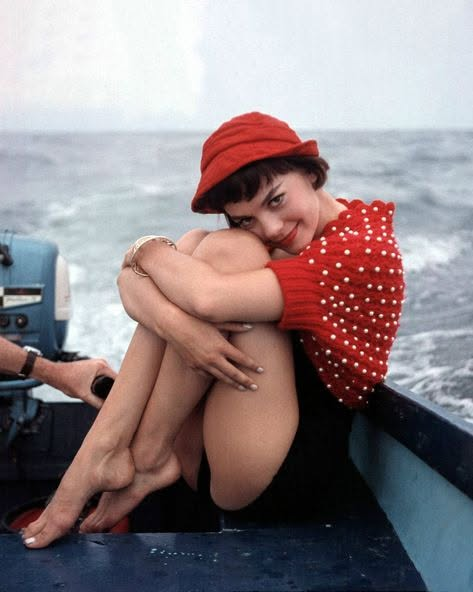
The photograph was taken aboard a small boat, during a brief escape from her ever-demanding Hollywood schedule. Natalie, just 17, sits barefoot with her knees pulled close, dressed simply in a pearl-dotted sweater and a jaunty red hat.
The look on her face is soft, unposed, and utterly genuine. There are no stage directions here, no director calling “action” — just the serenity of a girl momentarily freed from the noise of fame.
In that instant, she was not the dazzling actress being groomed for greatness, but a young woman savoring solitude, wrapped in a calm that fame seldom allowed her.
By the mid-1950s, Natalie Wood was already a rising star whose name carried weight in Hollywood. Beginning as a child actress, she had transitioned seamlessly into mature roles, displaying an emotional depth that belied her age.
That very year, she was preparing for Rebel Without a Cause, the film that would not only define her career but also cement her place in cinematic history alongside James Dean. Directors marveled at her ability to convey both fragility and resilience with a single glance.
Audiences adored her relatability — she wasn’t just beautiful, she was real. But that relatability, ironically, was something she was rarely allowed to experience for herself.

Hollywood in the 1950s was not merely an industry — it was a machine, one that demanded perfection and punished any hint of imperfection. Stars like Natalie carried immense pressure to uphold carefully cultivated public images.
There were studio contracts dictating behavior, photographers eager to capture staged glamour, and gossip magazines ready to dissect even the smallest misstep. For Natalie, who was still only a teenager, the expectations were crushing.
She was coming of age not in the privacy of adolescence but under the microscope of stardom.
That is what makes this photograph so extraordinary. More than just a pretty picture, it is an artifact of freedom. Out on the water, surrounded by nothing but sky and sea, Natalie could breathe without performance.
Her pose — knees tucked, arms folded loosely, eyes gazing into the distance — suggests a moment of reflection. Perhaps she was dreaming of her future, or perhaps she was simply enjoying the silence. Whatever the thought, the image speaks of authenticity, of being wholly herself, unfiltered by Hollywood’s demands.

The 1950s themselves add layers of meaning to the photograph. It was an era that celebrated postwar prosperity and idealized the “perfect” American life, with Hollywood serving as the cultural epicenter of that dream.
Stars were expected to embody wholesomeness and glamour simultaneously.
Yet Natalie’s candid portrait offers a quiet rebellion against those ideals. It reminds us that even icons craved reprieve, that behind the sequined gowns and studio portraits were human beings in need of stillness. For Natalie, the boat ride was not simply leisure — it was sanctuary.

Her life, as history would later show, was as complex and layered as the characters she portrayed. Natalie would go on to star in films that defined generations — West Side Story, Splendor in the Grass, Gypsy — while also enduring struggles with identity, love, and loss.
Her untimely death in 1981 would forever cast a shadow of mystery and heartbreak over her legacy. But this 1955 photograph predates all of that. Here, we see her at the cusp of adulthood, before tragedy, before heartbreak, before the full weight of stardom pressed down.
It is an image that lingers because it captures not just Natalie Wood the actress, but Natalie the person — the teenager with a soft smile, barefoot on a boat, momentarily free from scripts and expectations.
In its simplicity, it tells a story that no film or magazine cover could convey: that even in the golden age of Hollywood, the brightest stars longed for something real.
Nearly seventy years later, the photograph endures not only for its beauty but for its honesty. It offers us a glimpse into a soul that was learning how to balance the relentless demands of celebrity with the universal desire for authenticity.
And perhaps that is why it resonates so deeply. It reminds us that stars, no matter how dazzling, are still human — and that sometimes, the most timeless portraits are born not of performance, but of peace.