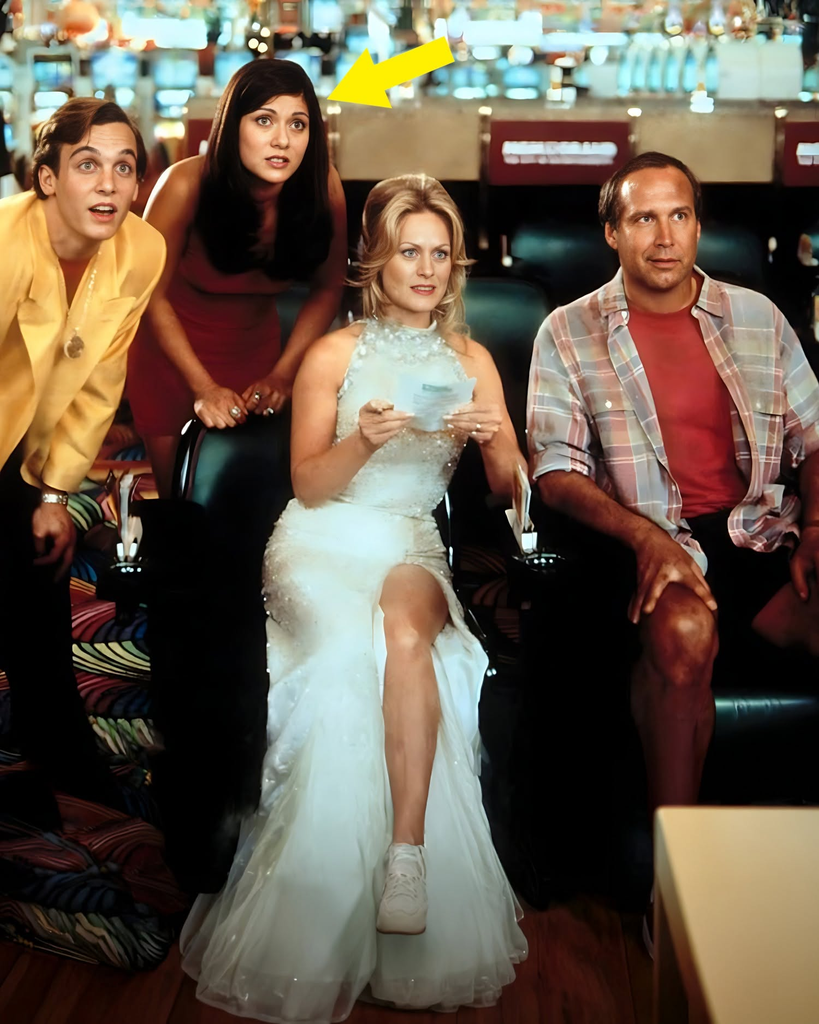
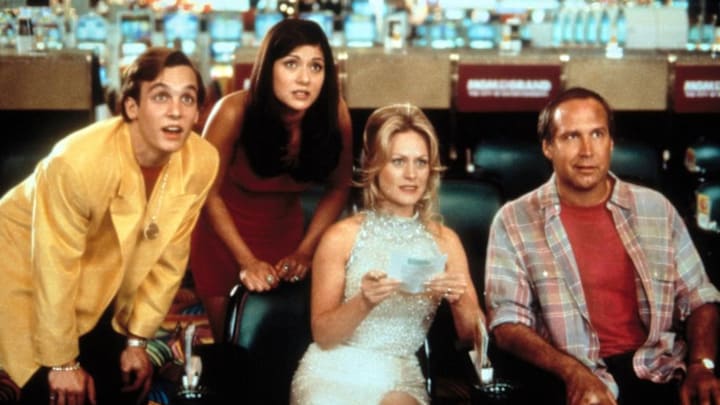
Pack your bags for a Las Vegas family vacation with the Griswolds—and don’t forget these 15 little-known facts!
1.Vegas Vacation is the fourth movie in the Griswold’s series of vacations, but it isn’t technically the last.
A made-for-TV sequel to Christmas Vacation, titled National Lampoon’s Christmas Vacation 2: Cousin Eddie’s Island Adventure, was made in 2003 and features the character Audrey Griswold.
2. Vegas Vacation is the first Vacation movie not written by John Hughes.
It’s also the first in the series to lose the “National Lampoon’s” moniker.
3. This film marks the fourth time that the Griswold kids, Audrey and Rusty, were recast.
In the four movies, Rusty and Audrey have been played by Anthony Michael Hall and Dana Barron; Jason Lively and Dana Hill; Johnny Galecki and Juliette Lewis; and Ethan Embry and Marisol Nichols. Barron reprised her role as Audrey in National Lampoon’s Christmas Vacation 2: Cousin Eddie’s Island Adventure.
4. Comedy legend Sid Caesar makes his last on-screen appearance in a theatrically released film in Vegas Vacation.
He plays Mr. Ellis, the character at the Keno game at the end of the movie.
5. 1992 Playboy Playmate of the Year Corinna Harney is one of the women Clark hits on at the blackjack table.
Vegas Vacation was her first theatrically released film appearance.
6. Vegas Vacation is the first Vacation movie to be rated PG.
The rest of the movies in the series are either rated R or PG-13.
7. Vegas Vacation is the lowest grossing movie in the Vacation franchise.
It had a theatrical gross of $36,400,360. Christmas Vacation is the highest grossing installment with $71,319,526.
8. Jilly from Philly is played by the film’s producer, Jerry Weintraub.
9. Weintraub’s connections helped him shoot in one Vegas’s swankiest hotels.
The production was granted access to the Mirage Hotel and Casino in Las Vegas because Weintraub was close friends with Steve Wynn, the billionaire who owned the Mirage at the time.
10. Fans of classic Nickelodeon might recognize the fake I.D. salesman and Frank Sinatra impersonator.
He’s played by Toby Huss, aka Artie the Strongest Man in the World from The Adventures of Pete & Pete.
11. Wayne Newton’s house in the movie is actually Wayne Newton’s house in real life.
Called “Casa de Shenandoah,” the property went up for auction in 2013 for $70 million.
12. The cast boasts more than one Saturday Night Live alum.
The reception desk employee at the Mirage is played by Julia Sweeney, who appeared on Saturday Night Live from 1990-1994. Chevy Chase famously appeared in the original SNLcast from 1975-1976.
13. This is the third Vacation movie to incorporate Lindsay Buckingham’s song “Holiday Road.”
It was left out of Christmas Vacation.
14. Clark plays a number of fake games with Uncle Eddie at the rundown casino.
Pick a Number Between 1-10; Coin Toss; War; Rock, Paper, Scissors; and Guess Which Hand were all made up. Only a version of War is played in actual casinos.
15. The sign at the end of the movie says Chicago is 1,880 miles from Las Vegas.
In fact, Chicago is only a little over 1,700 miles from Las Vegas.
Related Tags
How Bruce Springsteen Turned One of America’s Darkest Crimes Into a Haunting Classic
Springsteen composed and recorded his celebrated “Nebraska” by himself, in his bedroom.
ByTim Brinkhof|Jul 24, 2026, 7:00 PM EDT

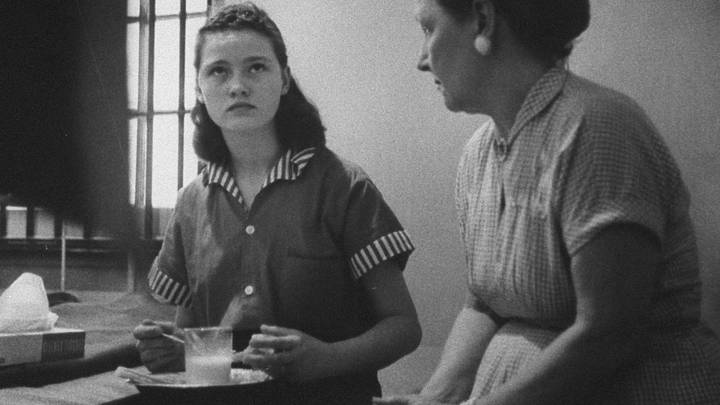
Between January 21 and 29, 1958, a 19-year-old garbageman from Lincoln, Nebraska, called Charles Starkweather went on a killing spree with his 14-year-old girlfriend, Caril Ann Fugate.
Described as a “swaggering good-for-nothing in blue jeans and a black motorcycle jacket” known to yell “go to hell” at strangers, Starkweather killed 11 people—including Fugate’s mother, stepfather, and half-sister—before he was caught and sent to the electric chair.
News of the seemingly random serial killings—a prelude to the likes of Ted Bundy, John Wayne Gacy, and Jeffrey Dahmer—shocked many Americans, including singer-songwriter Bruce Springsteen.
Today, the event is best remembered through the song “Nebraska,” the first in Springsteen’s album of the same name. Though told from Starkweather’s own perspective, it never properly explains his motives—and that’s precisely the point.
How a Murder Spree Inspired a Musical Masterpiece
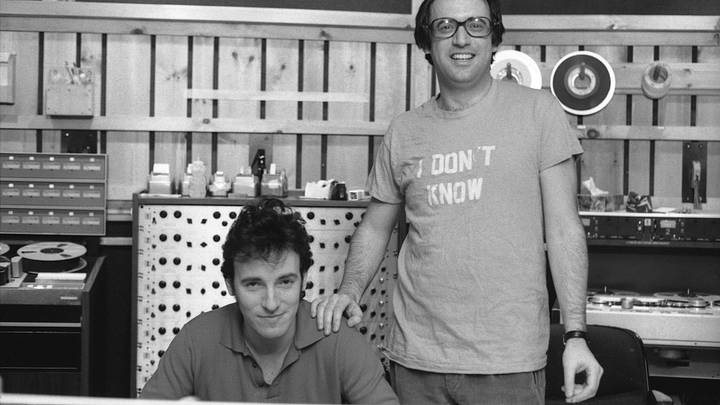
Though widely regarded as the best album in Springsteen’s long and industrious career—including by Springsteen himself—the singer-songwriter didn’t know if any of its songs would resonate with people. His doubts weren’t unreasonable. Contrary to his previous albums, which were recorded in a studio alongside his E Street band, the songs on “Nebraska” Springsteen recorded by himself, in his bedroom.
Springsteen had tried recording them with his band, but felt that the high production quality didn’t suit their dark, intimate nature. Ultimately, he decided that his own recording—originally intended to be little more than a demo—was superior.
“Nebraska” marked an important turning point in Springsteen’s career. Although dashed dreams and harsh realities had always been a prominent part of his repertoire, this new album sounded much more hopeless.
Unlike with many of the songs on “The River,” Springsteen’s focus was less on celebrating man’s resilience in the face of unyielding hardship, and more on bemoaning the seemingly cruel nature of the universe.
As he sings in the opening song, which is best listened to with the knowledge that Starkweather never gave a proper confession of his crimes: “They wanted to know why I did what I did / Well sir I guess there’s just a meanness in this world.”
Springsteen later claimed that he did not create “Nebraska” with a political agenda in mind, concentrating instead on achieving a particular sound. True or not, his music is often placed in a political context—one that continues to resonate today.
Donald Trump frequently plays Springsteen’s music at his rallies, particularly “Born in the USA.” This he does to the great chagrin of Springsteen himself, who knows better than anyone that his songs do not applaud or criticize American nationalism.
The Album That Almost Stayed a Demo
Though certainly a response to current events, “Nebraska” also came into existence because of developments in Springsteen’s own career. Having become a superstar, he wanted to close the gap between him and his fans, and avoid turning into a sellout.
“All popular artists,” Springsteen wrote in his 2016 memoir Born to Run, “get caught between making records and making music.” Once he found himself in this very spot, he chose to make music.
Despite Springsteen’s doubts, “Nebraska” became both a critical and commercial success, topping U.S. and U.K. charts and selling millions of copies. Ultimately, though, it’s remembered for closing that aforementioned gap.
As E Street guitarist Steve van Zandt later said: “An artist could never get closer to his audience than this. Not because it was done with an acoustic guitar, but because he was literally singing for himself.”
More Like This:
•
20 Things Millennials Grew Up With That Are Already Obsolete
•
20 One-Hit Wonders From the 1980s You Still Know Every Word To
•
6 Classic Rock Hits That Almost Went to Different Artists
•
The Elvis Presley Encounter That Changed Tom Petty’s Life
•
Quiz: Can You Name the Tom Petty Song From One Lyric?
7 Songs You May Not Know Smokey Robinson Wrote
The “King of Motown” was behind major hits by The Supremes, The Temptations, and the Jackson 5.
ByEden Gordon|Jul 28, 2026, 4:00 PM EDT
 Add us as a preferred source

Smokey Robinson is one of the best-known figures in R&B. Often referred to as the “King of Motown,” Robinson was the founder and frontman of the group The Miracles. He also served as the vice president of Motown Records for years, and went on to launch a legendary solo music career.
Along the way, Robinson has penned a huge number of major hits for other artists. The artist, who once called songwriting his “gift from God,” has written over 4,000 songs, dozens of which have reached the Billboard Top 40. A member of both the Songwriters Hall of Fame and the Rock ‘n’ Roll Hall of Fame, he has a knack for getting to the heart of the human experience with his songcraft.
“What makes a song is a timeless thing,” Robinson once said. “That’s why I very seldom write songs about dances, cars, or political stuff because all that stuff is passé. What’s here today, politically or with cars or dances may be gone tomorrow. I basically write about love and live things because they are always current.”
Here are seven hit songs you may not know Robinson penned.
- “My Girl” // The Temptations
- “Since I Lost My Baby” // The Temptations
- “Ain’t That Peculiar” // Marvin Gaye
- “Who’s Lovin’ You” // The Jackson 5
- “My Guy” // Mary Wells
- “Don’t Mess With Bill” // The Marvelettes
- “Your Heart Belongs to Me” // The Supremes
“My Girl” // The Temptations
This beloved soul classic has soundtracked countless first dances and sweet moments ever since it was released in 1965. It was written by Smokey Robinson and Ronnie White of The Miracles, and helped The Temptations ascend to pop stardom.
For Robinson, the song was a chance to pay tribute to his wife, Claudette. It was also a response of sorts to “My Guy,” the hit song he had written for Mary Wells.
“We were at the Apollo in New York and Smokey came and ran the track down and we rehearsed it,” Temptations member Otis Williams recalled. ‟At the time when he ran the track down, I said, ‘That sounds like it might be something.’ But it really didn’t hit me until we came all the way home [to Detroit], recorded it, and then Smokey put the strings on it. We sat there listening to the playback, and it really sounded like a No. 1. But, you know, it’s very seldom that you can predict a No.1 tune. But at that time, we really felt it would be more of a record that would be a No. 1 than the songs we had recorded before then. And luckily enough, it was.”
The song was The Temptations’ first single with David Ruffin as lead vocalist, and his tender vocals helped give the song some of its signature warmth. Billboard called the song the 10th biggest hit of the year it came out, and the song has remained in regular rotation ever since.
“Since I Lost My Baby” // The Temptations
Another hit that Robinson wrote for The Temptations was “Since I Lost My Baby,” which was a collaboration between Robinson and Miracles member Pete Moore. The song was the third Temptations track to feature Ruffin on lead vocals.
It was also one of Robinson’s personal favorites. “There’s something about that tune that I just set it aside. It wasn’t the biggest commercially, and I can’t put my finger on what I love about it,” Robinson told Loraine Alterman of the Detroit Free Press after the song’s release. Of course, the song did make some waves on the charts, hitting the Top 20 on the Billboard Hot 100 in 1965.
“Ain’t That Peculiar” // Marvin Gaye
In 1965, Marvin Gaye—himself a consummate songwriter—recorded two songs by Robinson: “I’ll Be Doggone” and “Ain’t That Peculiar.” The latter was written with Pete Moore, Bobby Rogers, and Marv Tarplin, and it tells the story of a heartbreaking relationship seemingly built on more lies than truth. It became a huge hit for Gaye, following in the footsteps of the similarly successful “I’ll Be Doggone” and hitting No. 1 on the Billboard Hot R&B Singles chart that year.
“Who’s Lovin’ You” // The Jackson 5
This song was originally recorded by The Miracles in 1960, but it was famously covered by the Jackson 5 in 1969. In a speech at Michael Jackson’s memorial service in 2009, Robinson recalled the first time he heard the cover.
“Berry (Gordy) had this gathering at his house. He said, ‘Come here, I want you to see somebody very special,’” Robinson recalled. “I went over and these five young guys were there, and they sang and danced up a storm. A couple weeks later they recorded my song. I thought to myself: Now they have pulled a fast one on us, because this boy cannot possibly be 10 years old…I quickly went over to him because I wanted to see his birth certificate. I could not believe that someone that young could have that much feeling and soul. He had to know something to sing a song like that. It was wonderful—as a songwriter that’s a dream come true to have someone sing one of your songs like that.”
“My Guy” // Mary Wells
Just weeks after turning 21 in 1964, Mary Wells’ “My Guy” hit No. 1 on the Billboard Hot 100. The Robinson-penned tune became her biggest hit and cemented Wells’ position as one of Motown’s brightest early stars. The song, which was also produced by Robinson, displaced Louis Armstrong’s “Hello, Dolly!” at the top of the charts, and was replaced two weeks after it hit the top by The Beatles’ “Love Me Do.” The Beatles, as it turned out, were major fans of Wells, and she would later go on to tour with them in the UK.
“My Guy” incorporates a calypso rhythm and also drew melodic inspiration from Eddie Heywood’s 1956 instrumental track “Canadian Sunset.” It also became Motown’s first major hit in England. Wells would go on to leave the Motown label, and her career never quite reached the heights of “My Guy” again,