ByMatthew Jackson|Jun 22, 2020, 4:00 PM EDT
 Add us as a preferred source

Superhero movies are bigger than they’ve ever been before, but we arguably wouldn’t be here at all without 1989’s Batman. Produced at a time before comic book movies were considered big business, Tim Burton’s dark look at a superhero then best known for a goofy TV show is a pop culture landmark, and the story of how it was made is almost as interesting as the film itself. With reports now surfacing that Michael Keaton may be ready to don Batman’s cape once again (more on that below), let’s take a look back at how the original film came to be.
1. An early Batman movie idea relied on the campiness of the character.
As development of a Batman movie began, studio executives were still very tied to the campiness embodied by the Batman television series of the 1960s. According to executive producer Michael Uslan, when he first began attempting to get the rights to make a film, he was told that the only studio who’d expressed interest was CBS, and only if they could do a Batman In Outer Space film.
2. Batman took 10 years to make.
Uslan lobbied hard for the rights to Batman, and finally landed them in 1979. At that point, the fight to convince a studio to make the film ensued, and everyone from Columbia Pictures to Universal Pictures turned it down. When Warner Bros. finally agreed to back the film, the issue of developing the right script had to be settled, and that took even more time. In 1989, after years of battling, Batman was finally released, and Uslan has been involved in some form in every Batman film since.
3. An early Batman script featured both the Penguin and Robin.
When Uslan finally got the chance to develop the film, he drafted legendary screenwriter Tom Mankiewicz, who had been a consultant on Superman, to write the script. The Mankiewicz script included The Joker, corrupt politician Rupert Thorne, a much greater focus on Bruce Wayne’s origin story, The Penguin, and the arrival of Robin late in the film. The script was ultimately scrapped, but you can see certain elements of it in Batman Returns.
4. Tim Burton wasn’t Batman‘s first potential director.
Though Warner Bros. ultimately chose Tim Burton to helm Batman, over the course of the film’s development a number of other choices emerged. At various points on the road to Batman, everyone from Gremlins director Joe Dante to Ghostbusters director Ivan Reitman was in line for the gig.
5. Many of Hollywood’s biggest stars at the time were considered for the title role.
The casting process for Batman was a long one, and involved a number of major stars of the day. Among the contenders for the title role were Mel Gibson, Bill Murray (yes, really), Kevin Costner, Willem Dafoe, Tom Selleck, Harrison Ford, Charlie Sheen, Ray Liotta, and Pierce Brosnan, who later regretted turning down the role.
6. Tim Burton had to fight to cast Michael Keaton.
At the time, Michael Keaton was best known for his comedic roles in films like Mr. Mom and Night Shift, so the thought of casting him as a vigilante of the night seemed odd to many. Michael Uslan remembers thinking a prank was being played on him when he heard Keaton’s name pop up. Burton, who’d already worked with Keaton on Beetlejuice, was convinced that Keaton was right for the role, not just because he could portray the obsessive nature of the character, but because he also felt that Keaton was the kind of actor who would need to dress up as a bat in order to scare criminals, while a typical action star would just garner “unintentional laughs” in the suit. Burton ultimately won the argument, and Keaton got an iconic role for two films.
7. Jack Nicholson was the first choice for The Joker, but he wasn’t the only choice.
From the beginning, Uslan concluded that Jack Nicholson was the perfect choice to play The Joker, and was “walking on air” when the production finally cast him. He certainly wasn’t the only actor considered, though. Among Burton’s considerations were Willem Dafoe, James Woods, Brad Dourif, David Bowie, and Robin Williams (who really wanted the part).
8. Tim Burton won Jack Nicholson over by agreeing to ride a horse.
When Nicholson was asked to discuss playing The Joker, he invited Burton and producer Peter Guber to visit him in Aspen for some horseback riding. When Burton learned that was what they’d be doing, he told Guber “I don’t ride,” to which Guber replied “You do today!” So, a “terrified” Burton got on a horse and rode alongside Nicholson, and the star ultimately agreed to play the Clown Prince of Crime.
9. Eddie Murphy was in contention to play Robin.
Though the character of Robin was ultimately scrapped because it simply didn’t feel like there was room for him in the film, he did appear in early drafts of the script, and at one point producers considered casting Eddie Murphy—who, you must remember, was one of the biggest movie stars of the 1980s—for the role.
10. Sean Young was the original Vicki Vale.
Burton initially cast Blade Runner star Sean Young as acclaimed photographer Vicki Vale, who would become Bruce Wayne’s love interest. Young was part of the pre-production process on Batman for several weeks until, while practicing horseback riding for a scene that was ultimately cut, she fell from her horse and was seriously injured. With just a week to go until shooting, producers had to act fast to find a replacement, and decided on Kim Basinger, who essentially joined the production overnight.
11. Tim Burton wasn’t officially hired until Beetlejuice became a hit.
Though he was basically already a part of the production, Burton wasn’t officially the director of Batman right away. Warner Bros. showed interest in him working on the film after the success of Pee-wee’s Big Adventure, but according to Burton they only officially hired him after the first weekend grosses for Beetlejuice came in.
“They were just waiting to see how Beetlejuice did,” Burton said. “They didn’t want to give me that movie unless Beetlejuice was going to be okay. They wouldn’t say that, but that was really the way it was.”
12. Danny Elfman thought he was going to be fired … then he played the main theme.
Danny Elfman is now considered one of our great movie composers, but at the time Batman was released he didn’t have any blockbuster credits to his name. He recalls meeting with Burton (with whom he had worked on Pee-wee’s Big Adventure) and producer Jon Peters to go over some of the music he’d already written for the film, and feeling “a lot of skepticism” over whether he should be the composer for Batman. It wasn’t until Burton said “Play the march,” and Elfman went into what would become the opening credits theme for the film, that he won Peters over.
“Jon jumped out of his chair, really just almost started dancing around the room,” Elfman said.
13. The Joker wasn’t always going to kill Batman’s parents.
In the final film, The Joker (then named Jack Napier) is revealed to be the gangster who guns down Bruce Wayne’s parents in the streets of Gotham City. It’s a twist that some comic book fans still dislike, and according to screenwriter Sam Hamm, it definitely wasn’t his fault.
“That was something that Tim had wanted from early on, and I had a bunch of arguments with him and wound up talking him out of it for as long as I was on the script. But, once the script went into production, there was a writer’s strike underway, and so I wasn’t able to be with the production as it was shooting over in London, and they brought in other people.”
Hamm also emphasizes that it was also not his idea to show Alfred letting Vicki Vale into the Batcave.
14. The climactic scene was written midway through shooting.
Though much of the film is still derived from Hamm’s script, rewrites continued to happen during shooting, and one of them involved the final confrontation between Batman and The Joker in a Gotham City clock tower. According to co-star Robert Wuhl, the climax was inspired by Jack Nicholson and Jon Peters, who went to see a production of The Phantom of the Opera midway through filming and watched as the Phantom made his final stand in a tower. Together, they somehow determined that a final fight in the tower was what Batman needed.
“The next day, they started writing that scene … the whole ending in the tower,” Wuhl said.
15. Michael Keaton’s Batman movements were inspired by the restrictions of the costume.
Batman fans still love to make jokes about the original costume, and Michael Keaton’s inability to turn his head (there’s even a dig at that in Christopher Nolan’s The Dark Knight), but the restrictions of the costume actually inspired how Keaton performed as the Dark Knight. In 2014, Keaton revealed that his performance as Batman was heavily influenced by a moment when, while trying to actually turn his head in the suit, he ended up ripping it.
“It really came out of the first time I had to react to something, and this thing was stuck to my face and somebody says something to Batman and I go like this [turning his head] and the whole thing goes, [rriipp]! There was a big f***ing hole over here,” he said. “So I go, well, I’ve got to get around that, because we’ve got to shoot this son of a bitch, so I go, ‘You know what, Tim [Burton]? He moves like this [like a statue]!’”
“I’m feeling really scared, and then it hit me—I thought, ‘Oh, this is perfect! This is perfect.’ I mean, this is, like, designed for this kind of really unusual dude, the Bruce Wayne guy, the guy who has this other personality that’s really dark and really alone, and really kind of depressed. This is it.”
16. Gotham City was real, and it was expensive.
Production designer Anton Furst put a lot of work into the incredibly influential designs for the film’s version of Gotham City, and the production was committed to making them pay off. The production ultimately spent more than $5 million to transform the backlot of London’s Pinewood Studios into Gotham City, and you can see the dedication to practical effects work in the final film.
17. Prince was part of the production even before he officially joined it.
Batman famously features original songs by Prince, who wrote so much new material for the production that he basically produced a full album. Even before the Purple One was drafted to write for the film, though, he was influencing it. Burton played Prince songs on set during the parade sequence and the Joker’s rampage through the museum.
18. The film’s marketing was so effective that it inspired real-life crimes.
By the time Batman was actually on its way to release, it was becoming a phenomenon, and the marketing for the film was inspiring a frenzy among fans. People were buying tickets to other films just to see the first trailer, and selling bootleg copies of the early footage. The poster, featuring the iconic logo, was so popular that, according to Uslan, people were breaking into bus stations just to steal it.
19. It was a box office landmark.
Though studio executives resisted the idea of a “dark” Batman movie for years, the film ultimately set a new standard for box office success. It was the first film to ever hit $100 million in 10 days, the biggest film in Warner Bros.’ history at the time, and the box office’s biggest earner of 1989—and that’s not even counting the massive toy and merchandising sales it generated.
20. Michael Keaton might reprise his role at the Caped Crusader.
Just as all the noise surrounding Robert Pattinson becoming the newest actor to don the Batsuit in Matt Reeves’s upcoming The Batman started to quiet down, new rumors that Pattinson may have some competition in Gotham City have started to surface. On June 22, 2020, word began to spread that Michael Keaton is currently in talks to reprise his famous superhero role in the upcoming big-screen edition of The Flash. While neither the actor nor the studio (Warner Bros.) is talking, The Hollywood Reporter wrote that if Keaton did come back it wouldn’t just be a quick cameo—and it wouldn’t just be for The Flash:
“If a deal makes, Keaton wouldn’t just return for Flash but possibly for several other DC-oriented film projects. Sources tell THR that the role being envisioned for the veteran actor is akin to the role played by Samuel Jackson as Nick Fury in the Marvel Cinematic Universe, something of a mentor or guide or even string puller. Batgirl is one the projects in development that could fall under that win.”
This story has been updated for 2020.
Quiz: Can You Name the Halloween Costume From These Three Clues?
See how many classic costumes you can construct before the clock runs out.
ByNitya Rao|Oct 28, 2026, 7:00 PM EDT
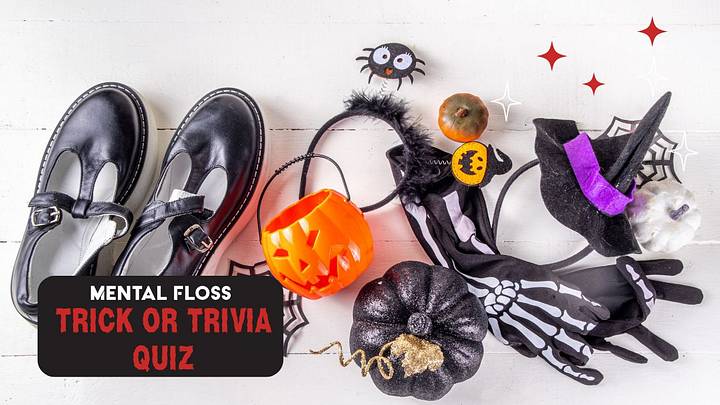
Anyone can copy a Halloween costume with the right reference photo, but can you assemble one in reverse from just a handful of random accessories? From wand-wielding wizards to iconic movie monsters, someone, somewhere, has worn it all. Now it’s your turn to put your costume designer hat on and see how quickly you can build a costume from three key components and sheer creativity. Put your pop culture memory and Halloween fashion sense to the test below.https://www.sporcle.com/framed/?v=10&pm&gid=41faab33X4&fid=6ae23fc6d6f32
More Halloween Quizzes:
manual.
How did your styling session go? Are you ready to open your Spirit Halloween franchise, or did some of those clues leave you (or at least your hypothetical Halloween Sim) naked and afraid? Whether you nailed every look on the first try or had to call it quits after the third ambiguous cape, challenge a fellow Halloween fanatic to see if they can beat your score!
The Most Popular Halloween Costumes Through the Decades
If piecing together costumes from random props made you realize just how deeply pop culture is embedded in our October traditions, take a look at how Halloween fashion has evolved over the last century (according to The Daily Meal):
1920s: Clowns, Witches & Farmers
As trick-or-treating started gaining traction, homemade costumes like witches, farmers, and the Pierrot clown—complete with iconic black-and-white face paint—became instant classics.
1930s: Mickey & Minnie Mouse
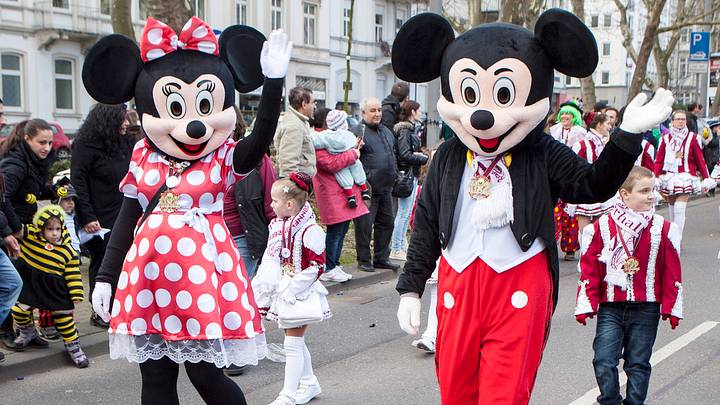
Mass-produced costumes hit the scene thanks to Ben Cooper after landing a major Disney license. Kids could easily transform into Mickey, Minnie, and Snow White in simple slip dresses and rubber masks right alongside traditional ghosts and goblins.
1940s: Witches & Cats
With the rise of pinup culture, classic costumes like witches and cats got a flirty makeover featuring things like fishnet stockings, dark makeup, and shorter hemlines.
1950s: Hula Dancers & Cowboys

Years before Hawaii officially became a U.S. state in 1959, a postwar hyperfixation on all things tiki and luau took over the country. Combined with the massive popularity of Western films, this inspired hibiscus prints, grass skirts, and cowboy hats to join the mix of spookier characters on Halloween night.
1960s: Superheroes
Comic book icons like Superman, Batman, and Catwoman surveyed the streets as rubber masks and capes made cosplaying your favorite crime-fighter easy.
1970s: Peanuts & Star Wars
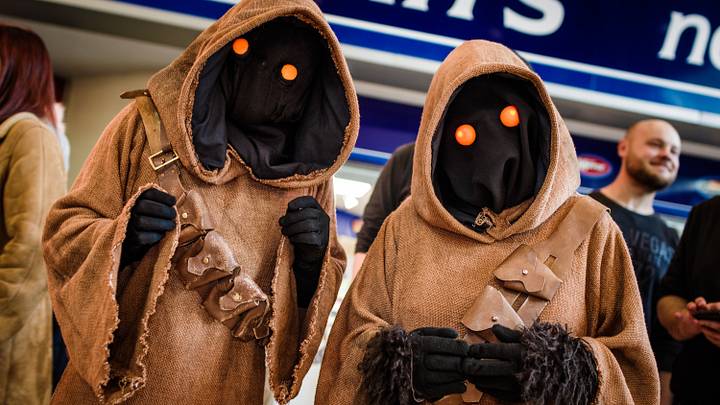
TV, cartoons, and pop culture ruled the decade, with trick-or-treaters sporting plastic masks and ’70s staples to emulate the Peanuts gang, Star Wars characters, and Charlie’s Angels.
1980s: Elvira & Hulk Hogan
Higher-budget costumes let fans lean hard into pop culture on Halloween, whether channeling vampy Elvira hairdos, Hulk Hogan onesies, or slasher villains like Freddy Krueger and Michael Myers.
1990s: Power Rangers & The Simpsons
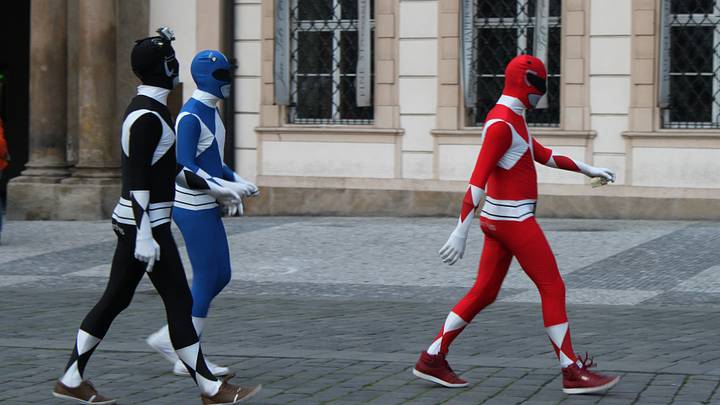
The Mighty Morphin Power Rangers, Teenage Mutant Ninja Turtles, and The Simpsons were the easy answers to the group costume dilemma. Think colorful nylon onesies, yellow face paint, and many, many masks.
2000s: Y2K Stars & Harry Potter
Halloween costume inspiration shifted toward real-life Y2K icons like Britney Spears and Michael Jackson, with just as many fantasy favorites like Harry Potter and SpongeBob SquarePants down the block.
2010s: Frozen & Pop Culture
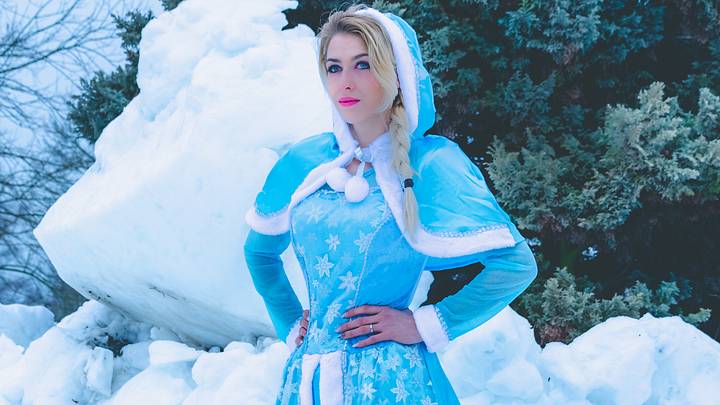
Elsa, Anna, and Marvel heroes reigned supreme amongst the new generation of trick-or-treaters. The digital era also saw the rise of meme costumes and political election outfits featuring even more uncanny valley face masks.
If you love testing your pop culture trivia and Halloween knowledge, check out the Mental Floss quiz page daily for more spooky challenges.
The countdown to Halloween is on, and we’re challenging our readers here at Mental Floss with our Trick or Trivia quiz giveaway. For 13 nights between October 19-31, we’re putting your knowledge of all things spooky to the test. Think you know Halloween? Take at least one quiz and enter to be in the running to win a $200 Barnes & Noble gift card.
More Halloween Reads:
feed.