ByKaeli Conforti|Jun 15, 2022, 10:00 AM EDT
 Add us as a preferred source

After falling into disrepair and undergoing serious renovations since closing its doors in 2011, New York City’s notorious Hotel Chelsea is finally reopening (special “hard hat” rates are currently available from $375 a night if you want to take a peek before the official grand reopening this summer). Guests can expect shiny new amenities like a French-style bistro, a swanky new Lobby Bar, a luxury event space called the Bard Room (named for Stanley Bard, the hotel’s former co-owner and longtime manager), and a rooftop fitness center and spa. El Quijote, an updated version of the hotel’s iconic 1930s restaurant, is now open, serving up Spanish-inspired food and cocktails.
Since its original opening in 1884, Hotel Chelsea has made news for everything from its intriguing celebrity encounters, appearances in popular books and movies, and for past events that can only be described as downright macabre. Here’s a look at some of the most interesting facts about the legendary Manhattan landmark.
1. It’s one of the most haunted hotels in New York City.
Hotel Chelsea is constantly listed as one of the most haunted buildings in New York City, and for good reason. The Living with Legends: Chelsea Hotel Blog keeps tabs on ghostly encounters throughout the property, including The Sopranos star Michael Imperioli’s brush with Mary, a Titanic survivor who died by suicide in her room after hearing her husband had perished; she is often seen checking her appearance in mirrors. Another lingering spirit, Larry the Hipster Ghost, is a talkative type known for interrupting other ghosts as they try to tell their stories to visiting mediums, imparting his endless stream of wisdom on whoever will listen.
2. A number of strange deaths have occurred at the hotel.
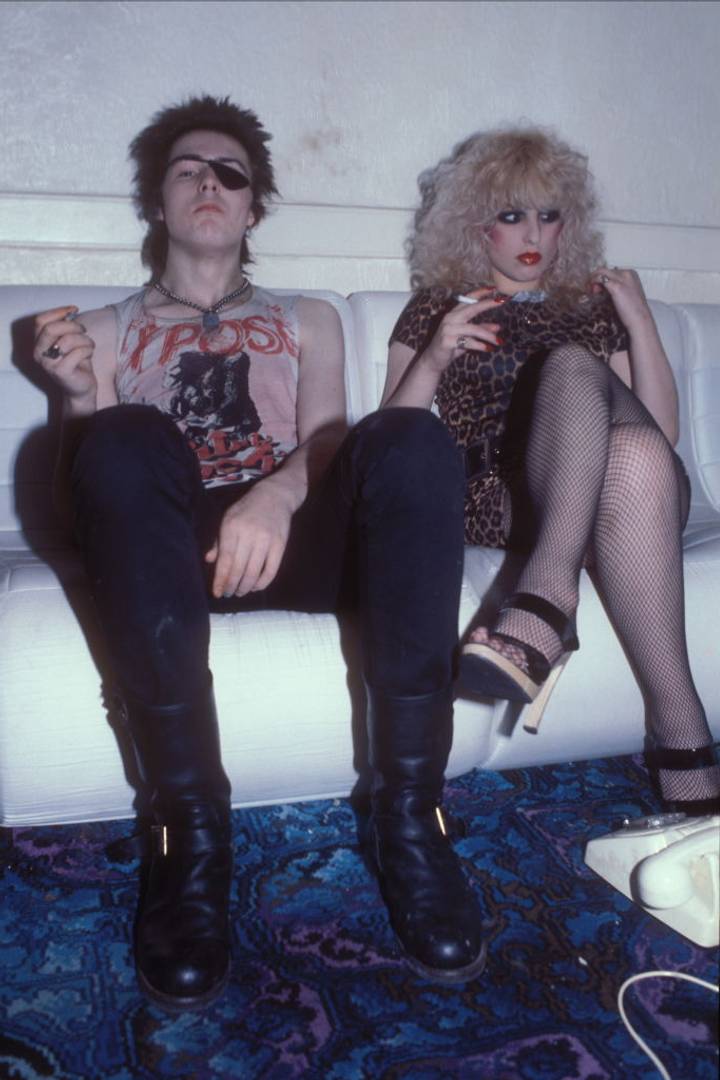
Perhaps the reason the Hotel Chelsea is so haunted is due to the amount of bizarre fatalities that have occurred here over the years. Welsh poet Dylan Thomas famously died in room 205 after saying he had consumed 18 shots of whiskey (his death was actually caused by brain swelling due to pneumonia), while Nancy Spungen was infamously stabbed to death by Sid Vicious of the Sex Pistols in room 100 (he died there four months later of a drug overdose).
3. Many celebrities have called Hotel Chelsea home.
Oftend referred to as “The Last Bohemian Haven,” the list of celebrities who have called the Hotel Chelsea home is long and includes musicians—Bob Dylan, Bette Midler, Jim Morrison, Patti Smith, Madonna, Rufus Wainwright, the members of Pink Floyd, and Jimi Hendrix, among others—as well as artists such as Andy Warhol and Jackson Pollock. Literary luminaries including Mark Twain, Tennessee Williams, Allen Ginsberg, Charles Bukowski, Jean Paul Sartre, Thomas Wolfe, Dylan Thomas, and O. Henry all took up residence in the hotel over the years as well. It’s where Janis Joplin and Leonard Cohen conducted their affair; Arthur Miller lived there after his marriage to Marylin Monroe; Sir Arthur C. Clarke penned the 2001: A Space Odyssey screenplay within the hotel’s walls; and Jack Kerouac is said to have cranked out his Beatnik masterpiece On the Road in three weeks while living there.
4. Jimi Hendrix was once mistaken as a member of the hotel’s staff.
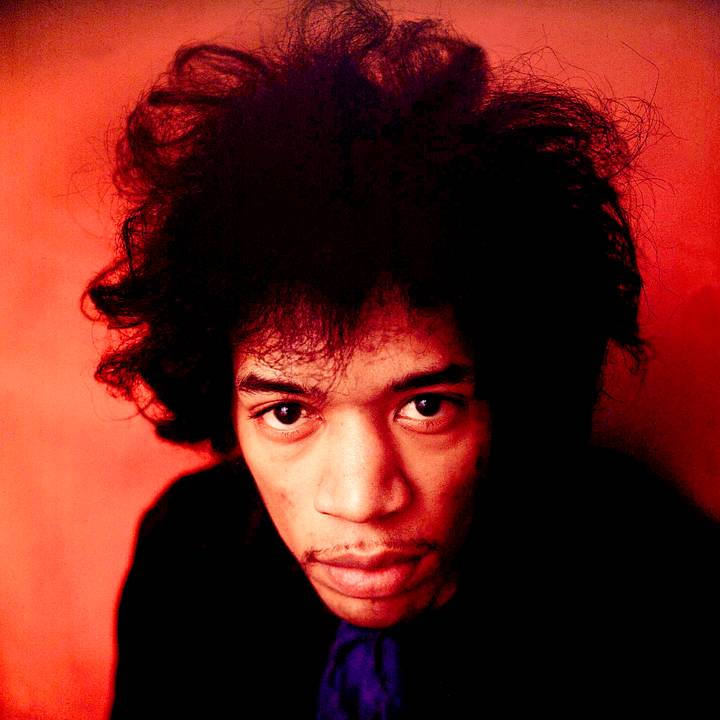
According to Hotel Chelsea lore, legendary guitarist Jimi Hendrix—a longtime resident—was once accidentally mistaken for a bellboy by an elderly female guest who failed to recognize him. Hendrix, ever the gentleman (and seemingly amused by the mixup) graciously obliged, and carried the woman’s luggage up to her room.
5. It used to be the go-to place for orgies.
One of the things Hotel Chelsea was most known for was its lack of rules and utter disregard for inhibitions among guests and residents alike. Nothing was considered remotely shameful here, so folks flocked to this place with wild abandon. During the 1970s, sex workers frequented the first floor, while famed sex party queen Ms. Palagia hosted her monthly One Leg Up gathering there for more than a decade, inviting celebrity guests, residents, and even the hotel’s managers to join in the erotic fun. They only stopped happening there in 2011, after new management took over.
6. Hotel Chelsea has appeared in books, movies, and music videos.
Over the years, Hotel Chelsea’s appearance became famous in its own right. Madonna conducted her scandalous-at-the-time photoshoot for her book Sex in room 822 in 1992, after living there in the 1980s. Portions of Andy Warhol’s film Chelsea Girls were filmed within the hotel’s hallowed halls, and it served as the backdrop for Bon Jovi’s music video for “Midnight in Chelsea.” The singer-songwriter can be seen strumming his guitar out front and from the window of one of the rooms. The property also appears in the films 9½ Weeks, The Interpreter, House of D, and Hotel Chelsea, among countless other titles.
7. Eccentric tenants have kept interesting pets at the hotel.
In addition to more typical pets like cats and dogs, one tenant in particular was known for keeping an array of interesting creatures in his Hotel Chelsea apartment. George Kleinsinger, an American composer known for his 1940s children’s song, “Tubby the Tuba,” reportedly had several turtles, a monkey, a prized Patagonian lizard, and snakes, which were known to hunt cockroaches in the hotel’s stairwell.
8. Dreaming Walls, a new documentary, sheds light on the hotel’s intriguing past.
If you’re interested in learning more about the storied history of the Hotel Chelsea as well as its current residents’ fight to restore the building to its former glory, don’t miss Dreaming Walls: Inside the Chelsea Hotel, a new documentary that premiered at the Berlin International Film Festival in February 2022. Filmed amid the ninth year of the property’s drastic renovations, the film follows several residents as they prepare for the unknown, looking back on the property’s counter-culture past and the reckoning it faces under new ownership and the beckoning call of commercialism.
Related Tags
8 Old West Slang Words That Deserve a Cowboy Comeback
These frontier expressions are fixin’ to ride their way back into your vocabulary!
ByLogan DeLoye|Oct 30, 2026, 4:00 PM EDT
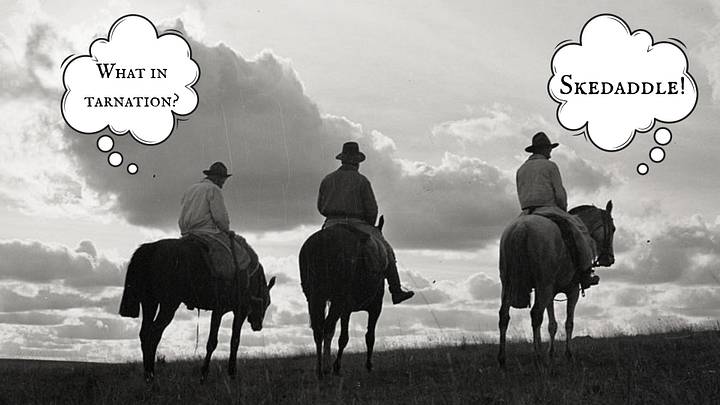
The American frontier, specifically the cattle drive era, inspired a slew of cowboy slang that captured the rugged, untamed, and unpredictable nature of life in the Old West.
Putting on boots and a hat didn’t make you a cowboy in the mid-to-late 1800s. During the heyday of the open range, real cowboys were ranch hands: herding cattle, tending horses, and fixing whatever needed repairing. According to History Hit, many lived in frontier towns and spent their free time at rowdy saloons, contributing to the nightly ruckus.
During the Civil War, cattle “bred excessively” across Texas. When the soldiers returned, someone had to drive the booming herds north, and so the western legend of the cowboy was born (and forever glamorized in pop culture).
In 2026, it’s fashionable to slip on Tecovas and a Stetson without considering their original purpose. But in the late 1800s, every bit of cowboy gear served a purpose. Boots were pointed-toed so cowboys could “easily slip in and out of stirrups” because getting stuck could mean being dragged to death. Wide-brimmed hats protected their eyes from the bright sun, and a folded crown could be a pillow in a pinch. Bandanas tied over their faces kept dust away during tiresome days on the trail.
Along with gear, the era brought a cowboy collection of slang words, some still used today, mostly on ranches and in the South and West regions. Though these words live on, they’re not nearly as common as they used to be.
So, saddle up and get ready to reintroduce eight Old West slang words into your vocabulary for a proper cowboy comeback, according to C Lazy U Ranch’s cowboy slang guide.
OLD WEST SLANG WORDS THAT DESERVE A COMEBACK AND A ‘YEE-HAW!’
TARNATION
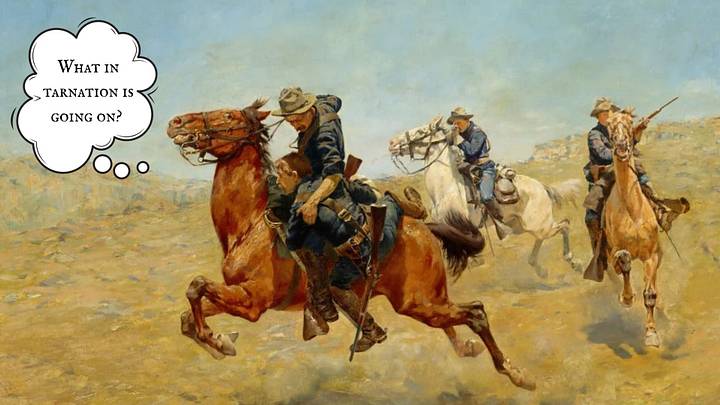
What it means: An expression of “surprise or frustration.” Similar to “what the heck?”
In a sentence: What in tarnation is going on here?
ACE-HIGH
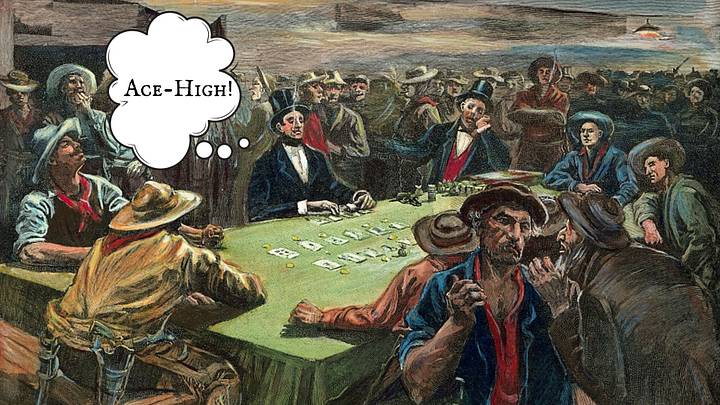
What it means: Something “luxurious or respectable.” Similar to the poker terminology for a valuable “ace-high hand.”
In a sentence: This hotel is ace-high with its espresso machine, giant flat-screen TV, and balcony views.
SKEDADDLE
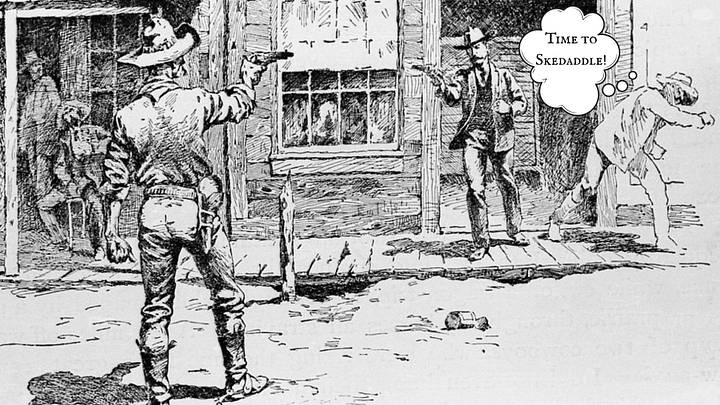
What it means: To exit hastily “or run away.”
In a sentence: Let’s skedaddle before this storm gets worse!
SIDEWINDER
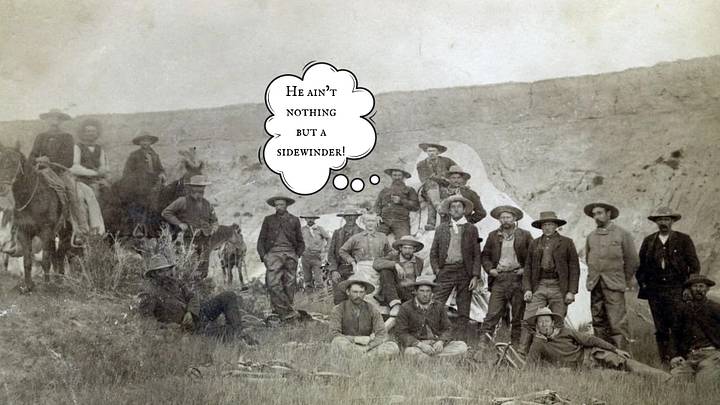
What it means: A sly “untrustworthy person.” Similar to the Sidewinder snake and its “deceptive movement pattern.”
In a sentence: He’s a sidewinder; I wouldn’t trust him.
BELLYACHING
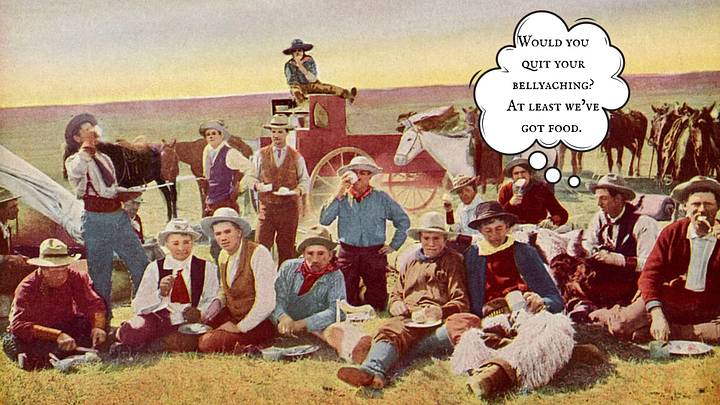
What it means: Continuous complaining or “whining about something.”
In a sentence: Stop bellyaching; we’ve still got 20 miles to go!
HOWDY
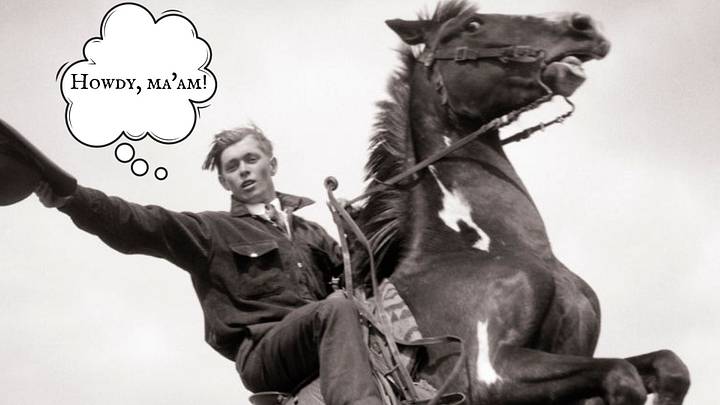
What it means: Cowboy shorthand for “How do you do?” “Hi, how are you?” It can also replace “Good morning!” depending on the time of day.
In a sentence: Howdy, partner!
YEE-HAW
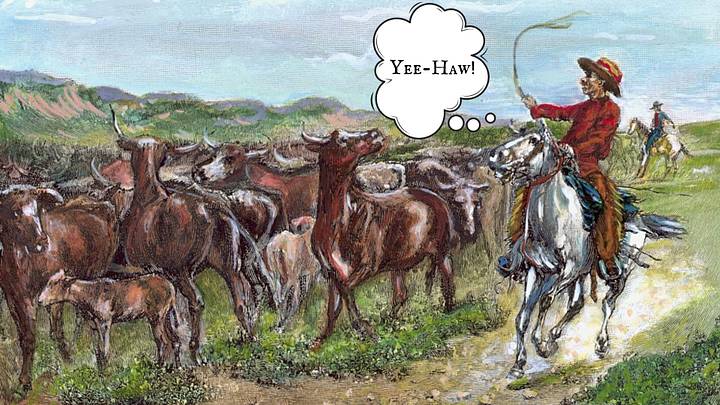
What it means: An expression of excitement and “the ultimate expression of Western enthusiasm.”
In a sentence: She jumped on the horse, put her feet in the stirrups, and yelled “yee-haw” as she rode into the sunset.
ABOVE BOARD