
Disney’s most mature movie from its renaissance era is also one of its most underrated.
ByMark Mancini|May 29, 2024, 3:53 PM EDT
 Add us as a preferred source
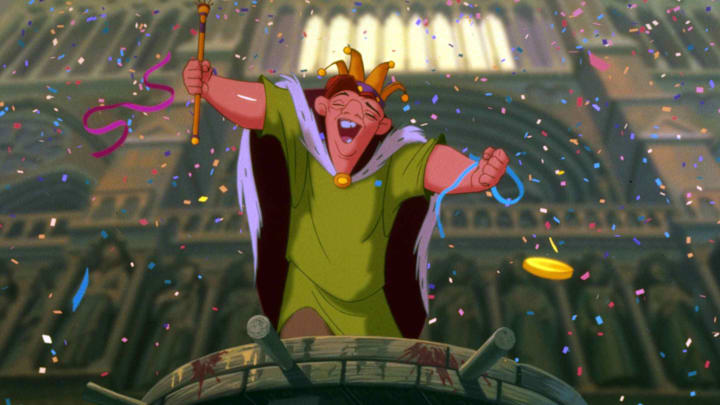
Lust, racism, and religious bigotry aren’t topics that are usually broached in family films. That may explain why Disney’s 1996 take on The Hunchback of Notre Dame didn’t make much of a splash at the box office. Despite this underwhelming response, the movie has since found its audience and now commands a loyal fan base.
- Frollo’s job was changed to avoid offending religious groups.
- “The Bells of Notre Dame” was a late addition to the score.
- Those singing gargoyles were inspired by the novel.
- 4. Quasimodo could’ve been voiced by Mandy Patinkin.
- Some scenes were enhanced with computer-generated townspeople.
- “Hellfire” was modeled after an Italian opera song.
- Disney assumed the film would get a PG rating.
- Victor Hugo’s descendants hated it.
- Jason Alexander wouldn’t let his own son see the movie.
- Belle from Beauty and the Beast makes a cameo.
Frollo’s job was changed to avoid offending religious groups.
In the original Victor Hugo novel, Claude Frollo is Notre Dame’s Archdeacon. However, Disney feared that an evil priest wouldn’t sit well with Christian organizations. As such, Frollo was transformed into a judge. Furthermore, the plot’s theological underpinnings were downplayed. “[We] were told not to make the movie too religious—a pretty daunting task when you consider how much of this story takes place inside a big church,” animator Floyd Norman later said. Still, some Bible references couldn’t be avoided. Consider this: The Hunchback of Notre Dame was Disney’s 34th full-length animated feature. Just two of the film’s songs—“God Help the Outcasts” and “Heaven’s Light/Hellfire”—contain more references to the words “Lord” and “God” than all 33 of Disney’s previous films combined.
“The Bells of Notre Dame” was a late addition to the score.
The opening number can make or break a musical. Usually, it’s the song that both captures an audience’s attention and sets up the story. Yet, surprisingly, Hunchback almost didn’t get one. The original plan was to start the film with spoken exposition and a flashback montage. However, this didn’t satisfy production boss Jeffrey Katzenberg. Feeling that something was missing, he asked lyricist Stephen Schwartz and composer Alan Menken to create a new song for the sequence. Singing duty mostly went to Clopin, a theatrical Romani person voiced by Paul Kandel, who recalls that “we were about a third of the way through the process of making [Hunchback]” when this ballad was completed.”
Those singing gargoyles were inspired by the novel.
Quasimodo’s on-screen sidekicks are three wise-cracking statues named Victor, Hugo, and Laverne. Where did Disney get such a wild idea? From the source material. In the Hunchback novel, our lonesome protagonist often talks to the cathedral’s gargoyles. “He sometimes passed whole hours crouching before one of these statues, in solitary conversation with it” reads Chapter III. To create some comic relief, directors Kirk Wise and Gary Trousdale simply expanded upon this concept.
4. Quasimodo could’ve been voiced by Mandy Patinkin.
In The Princess Bride (1987), Patinkin took a stab at movie immortality by playing sword maestro Inigo Montoya. Several years later, Disney offered him a very different role. After Patinkin left the medical drama Chicago Hope, the studio asked if he’d consider voicing Quasimodo. He immediately said yes, but soon ran into trouble. Hunchback had already been converted into several live-action movies—including a 1939 classic starring Charles Laughton as Quasimodo. Since Laughton is Patinkin’s favorite actor, he wanted to emulate that performance. But the producers insisted on a friendlier bell-ringer. “They had their own Disney needs,” Patinkin told the Los Angeles Times. In the end, Quasimodo was voiced by Academy Award nominee Tom Hulce.
Some scenes were enhanced with computer-generated townspeople.
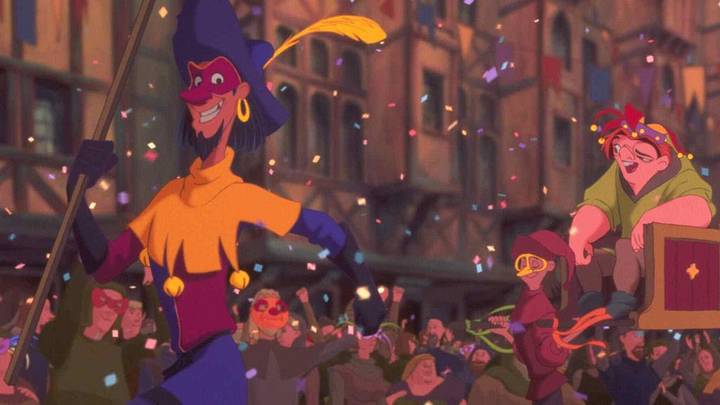
Back in the mid-1990s, hand-drawn animation was still Disney’s favorite technique. Nevertheless, the studio had been integrating computer effects into their feature films ever since 1986. For Hunchback, a special program was used to generate large crowds of people. Both the Feast of Fools scene and the climax are riddled with digital Parisians. Six different body types (male and female) were created to pull this off. Each individual bystander was given a unique set of motion instructions. These were randomly drawn from a set of 72 predetermined movements such as clapping and jumping.
“Hellfire” was modeled after an Italian opera song.
Composed by Giacomo Puccini between 1899 and 1900, Tosca is now one of the world’s most popular operas. Act I ends with a song that’s guaranteed to give goosebumps. Called “Te Deum,” it belongs to the villain, Scarpia, who sings about his diabolical plans with a chorus of churchgoers. Almost a century later, Disney gave us the equally unforgettable “Hellfire”—Frollo’s epic solo. “Te Deum” was the song’s main source of creative inspiration.
Disney assumed the film would get a PG rating.
The Hunchback of Notre Dame deals with very taboo subjects, from sexual fantasies to eternal damnation. (There’s also scene where the female lead pole dances.) Naturally, Disney executives didn’t think the MPAA ratings board would apply their “general admission” stamp. Screenwriter Tab Murphy “fully expected it to get a PG.” As he told the , “It felt like a PG movie to everyone, including everybody who signed off on it, from Michael Eisner to Roy Disney.” News of the board’s decision to rate it G was met with widespread disbelief. “Maybe it was the gargoyles,” Murphy suggested.
Victor Hugo’s descendants hated it.
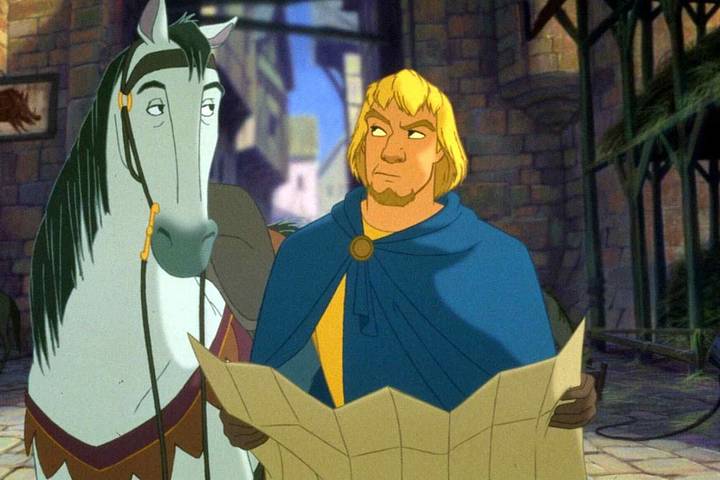
Released on June 21, 1996, The Hunchback of Notre Dame garnered considerable criticism from Hugo scholars—as well as from Hugo’s family. In an open letter to the French newspaper Liberation, the author’s great-great grandchildren—Charles, Jeanne, Sophie, Adele, and Leopoldine Hugo—dismissed the movie as “vulgar commercialization by unscrupulous men.” A particular bone of contention was Hunchback’s aggressive marketing campaign. “[The] story used in this film is borrowed from the work of Victor Hugo,” they noted, “but his name is not even mentioned on the posters that now cover the planet.”
Jason Alexander wouldn’t let his own son see the movie.
Hunchback may have defied the odds and nabbed that G rating, but many parents still chose to keep their little ones away. Among them was Alexander, who voiced Hugo the gargoyle. “Disney would have us believe this movie’s like the Ringling Bros., for children of all ages,” said the Seinfeld star. “But I won’t be taking my four year-old. I won’t expose him to it, not for another year.”
Belle from Beauty and the Beast makes a cameo.
Keep your eyes peeled: When Quasimodo sings “Out There,” Belle can be seen wandering through the streets of Paris—and, true to form, she’s got her nose stuck in a book. Look carefully and you’ll also spot a peasant shaking out Aladdin’s magic carpet during the same sequence.
Read More About Disney Movies:
•
America’s 20 Favorite Classic Disney Movies, Ranked
•
8 Cool Facts About Disney’s ‘Frozen’
•
The Reason Why the Genie From Aladdin Is Blue
•
These Are the Most Inappropriate Animated Disney Movies, According to Adults
•
25 Surprising Facts About ‘The Lion King’
•
What Exactly Is the ‘Grey Stuff’ From Disney’s ‘Beauty and the Beast’?
A version of this story originally ran in 2016; it has been updated for 2024.
Related Tags
The 5 Best Indian Restaurants in the U.S., According to Guy Fieri
Chicken vindaloo in Alaska and lamb curry in New Mexico? These are the unexpected Indian restaurant picks that made Guy Fieri’s list.
ByNitya Rao|May 12, 2026, 8:34 PM EDT

Guy Fieri has spent decades behind the wheel of his red Camaro, proving that you don’t need a plane ticket to Delhi to find world-class curry. From the high-desert heat of Santa Fe to a hidden gem inside a Utah gas station, the Mayor of Flavortown has uncovered a “real deal” map of Indian cuisine right here in the U.S.
We aren’t just talking about your standard, lukewarm lunch buffets or the neon-red chicken you find at the mall. We’re shouting out five standout restaurants where the spices are toasted fresh, the tandoors are roaring, and the flavors are, in Fieri’s words, “off the hook.”
If you’re ready to trade the burgers for biryani and see how the spice trade meets the American Main Street, explore this mouthwatering list of Fieri’s top five Indian restaurants in the U.S.
- Paper Dosa – Santa Fe, NM
- Tandoori Oven – Logan, UT
- Gandhi Mahal – Minneapolis, MN
- Hari Om Cuisine of India – Fairbanks, AK
- Al Noor – Baton Rouge, LA
Paper Dosa – Santa Fe, NM
Lamb Curry
Santa Fe is world-renowned for its green chile, but Paper Dosa is successfully putting South Indian comfort food on the New Mexican map. This isn’t your typical rich, cream-based fare; instead, Chef Paulraj Karuppasamy offers an aromatic, authentic approach to the subcontinent’s lesser-known culinary region.
While their namesake paper-thin fermented rice crepes are a work of art, Fieri was specifically floored by the lamb curry. The dish features a lighter profile than most Northern Indian stews, relying on fresh curry leaves and toasted mustard seeds rather than heavy dairy. The result is a vibrant, aromatic dish with layers of flavor—”spice,” “smoke,” and “acid,” to be specific—that allow the tenderness of the lamb to shine through. After sampling the spread, from the potato-stuffed masala dosa to the fragrant lamb curry, Fieri noted that a visit here “isn’t just a meal; it’s an experience.”
Tandoori Oven – Logan, UT
Chicken Tikka Masala
In the world of Diners, Drive-Ins and Dives, some of the best culinary treasures are found in the most unassuming places. Case in point: Tandoori Oven, which is famously tucked inside a Utah gas station. While travelers might stop for a tank of unleaded, locals know to head inside for a “smorgasbord of flavors” that the Arora brothers have been perfecting for years.
When giving Fieri the lowdown on the restaurant’s offerings, Chef Sham Arora clarified that Northern Indian food is typically richer than its Southern counterparts, and the signature chicken tikka masala he later whipped up is a prime example. The secret to this creamy, spicy “Indian stew,” as Fieri describes it, lies in a rigorous two-day marination process that breaks down the proteins until the meat is so tender that your teeth simply sink into it.
After a trip into a traditional clay tandoor oven, the chicken is smothered in a vibrant, orange-red tomato-onion gravy and served with rice, naan, or—if you’re doing it right—both. Between the “perfect blend of spice” and the high-heat char from the clay tandoor, Fieri found himself struggling with the etiquette of eating something so delicious. He joked that his only real anxiety was figuring out how to “shovel it in fast enough” without looking like a dog who had never seen food before.
Gandhi Mahal – Minneapolis, MN
Dal with Naan
Gandhi Mahal is a Minneapolis legend that proves you can be “green” while serving up red-hot curry. Before its original building was lost in 2020, the restaurant was a marvel of urban sustainability, featuring a full aquaponics system in the basement. This high-tech setup allowed the kitchen to grow its own fresh produce and raise fish right on-site. Today, that commitment to fresh ingredients continues through their “Curry in a Hurry” concept.
When Fieri visited, he was immediately floored by the “outstanding” chicken tikka masala, noting it had “such a depth” of flavor. He specifically praised the “richness” of the ground almonds in the sauce and the juiciness of the chicken, which he likened to butter.
But the “next level” experience didn’t stop there. Fieri also got a taste of the plant-based side of the menu, continuing his Indian feast with a helping of earthy dal and blistered naan. The lentils are simmered for hours before being finished with a tarka—a traditional technique where whole spices are tempered in hot ghee to create an explosion of flavor.
Fieri was so impressed by the bite of smooth dal and pillowy naan that he declared the combination “multi-layered perfection.” For Fieri, the soulfulness of the cooking made it the perfect entry point for any skeptic: “If you don’t think you like Indian food, let this be your visa.”
Hari Om Cuisine of India – Fairbanks, AK
Chicken Vindaloo
If you think you have to be in a major metro area—or even the mainland—for authentic spice, Hari Om in Fairbanks is here to prove you wrong. Located just a few hours south of the Arctic Circle, this eatery provides a fiery contrast to the Alaskan chill thanks to the expertise of Chef Amit Paul.
With nearly three decades of experience, Paul has mastered the Dum Pukht tradition—a specialized slow-cooking method where the pot is sealed, allowing the food to steam in its own juices. This technique is likely why Fieri was so impressed with the texture of the chicken vindaloo, noting that the chicken was so tender it “just fell apart.”
The dish features a thick sauce built from a potent paste of red chiles and vinegar, a combination that hits all the right notes for the Mayor of Flavortown. “I love the spice, and I love the acidity,” Fieri remarked, adding that the dish has a “really nice mix of spices” and a distinct “zip.” While the vindaloo brought the heat, Fieri also sampled the lamb korma, a rich, nut-based curry that showed off the kitchen’s range.
Ultimately, Fieri concluded that the meal is “everything you want it to be, especially on a cold day in Fairbanks.”
Al Noor – Baton Rouge, LA
Lamb Kebabs
Baton Rouge might be the land of gumbo and crawfish, but Fieri found a culinary powerhouse tucked away in a suburban strip mall at Al-Noor. Chef Khalad Al-Noor famously walked away from a career in corporate engineering to return to his roots, and the result is what Fieri calls “Indian Soul Food.”
The lamb sheekh kebabs are a masterclass in tandoori cooking. The process starts with fresh ground lamb mixed with a total of 16 flavorful ingredients, including fresh ginger, garlic, and a custom blend of toasted spices. Next, the supple meat is hand-molded onto long metal skewers and lowered into a roaring clay tandoor. The intense heat renders the fat perfectly, creating a kebab that is incredibly juicy with a signature charred exterior.
While Fieri called the restaurant’s unique espresso-rubbed venison “off the hook,” it was the lamb that he deemed truly “outrageous,” noting that the spices aren’t just on the meat—they’re in it.
More Like This:
•
5 Best Restaurants in the U.S., According to Guy Fieri
•
The 5 Best Mexican Restaurants in the U.S., According to Guy Fieri
•
Flavortown Across America: An Interactive Map of Guy Fieri’s Restaurant Empire
•
5 Best Donut Shops in North America, According to Guy Fieri
•