
Just months after winning an Oscar for her work in ‘Ghost,’ Whoopi Goldberg scored another major hit with ‘Sister Act.’
ByStacy Conradt|Mar 11, 2024, 4:28 PM EDT
 Add us as a preferred source

From The Sound of Music to Dead Man Walking, nuns have always had a place on the silver screen—but none of those movies have given personality to the women behind the habits quite like Sister Act. If Sister Mary Clarence and the sisters of St. Katherine’s made your toes tap, here are 14 facts you’ll give praise for.
1. Sister Mary Clarence was partially inspired by a real nun.
As part of his research, screenwriter Paul Rudnick visited the Regina Laudis Abbey in Bethlehem, Connecticut, to meet Mother Dolores Hart. Hart had been a Hollywood actress, singer, and dancer, starring in movies such as Where the Boys Are and King Creole. Though she left the industry to become a nun when she was just 24, she’s a voting member of the Academy of Motion Picture Arts and Sciences to this day.
2. Bette Midler war originally attached to star.
Though the Divine Miss M was originally onboard, she later backed out for reasons she came to regret: “I said: ‘My fans don’t want to see me in a wimple.’ I don’t know where I got that from. Why would I say such a thing? So Whoopi did it instead and, of course, she made a fortune.”
3. The name of the main character was changed when Middler left.
The original name of the singer-turned-sister was Terri Van Cartier. It was changed when Whoopi Goldberg was cast, because, according to Rudnick, “She’d always wanted to play someone named Deloris.”
4. Carrie Fisher helped rewrite the script.
When Midler backed out, script adjustments went far beyond a name change—but Disney only allowed writers two weeks to overhaul the script after the lead actress change. Additional writers were brought in to help doctor the script; in addition to Carrie Fisher, other contributors included Nancy Meyers and Robert Harling. Fisher, by the way, has a long history of fixing scripts—she also worked on last-minute rewrites to Hook, Lethal Weapon 3, and The Wedding Singer.
5. The writer “Joseph Howard” is not a real person.
By the time the movie was released, it had been rewritten so much that Rudnick didn’t consider it his work anymore. He suggested the work be credited under the name R. Chasuble after the priest in The Importance of Being Earnest. That was rejected, so Rudnick tried for “Screenplay by Goofy.” Another no-go. Finally, “Joseph Howard” was accepted. “It sounds like the name of someone who helped found the Mormon Church,” Rudnick later wrote.
6. Kathy Najimy based her character on Mary Hart.
Kathy Najimy wasn’t totally sure how she was going to portray such a bubbly, cheerful nun—until she happened to catch anchor Mary Hart on Entertainment Tonight. “I turn on the TV. It’s something with me and Sally Field running around, and they come back to Mary Hart, and she went, ‘That Sally Field, ya gotta love her!’ And I said, ‘Oh my God, that’s my nun!'”
Najimy later sent Hart a bouquet of roses. “[But] I didn’t say why.”
7. Some of the actresses got up to some mischief on the set.
The production spent some time filming in a Reno casino, which the actresses loved. “That was great, because I love gambling,” Najimy said. “Wendy [Makkena, who plays Sister Mary Robert] smokes, and we’d sit at the 21 table in our nun outfits with drinks in front of us. That was hilarious.”
8. No, that’s not really Whoopi singing Mary Robert’s part.
One of the subplots of the movie is Deloris’ efforts to bring the timid Sister Mary Robert out of her shell. We eventually realize that the soft-spoken sister can really belt one out—but it’s not really actress Wendy Makkena singing. She was dubbed by singer Andrea Robinson. Whoopi, however, did her own singing.
9. One of the scenes was changed at Najimy’s behest.
There was originally a scene that called for Najimy’s character, Sister Mary Patrick, to protest against a pornographic bookstore. Najimy felt it encroached on her First Amendment rights and asked the director to come up with something different. Instead, Sister Mary Patrick ended up selling raffle tickets.
10. The production was sued for plagiarism.
In 1993, Donna Douglas (better known as Elly May Clampett on The Beverly Hillbillies) filed a $200 million suit against Whoopi Goldberg, Bette Midler, their production companies, Creative Artists Agency, Walt Disney Pictures, and more. Douglas had optioned a book called A Nun in the Closet, which they turned into a screenplay and submitted to the studio. They were turned down—and then Sister Act came out. The plaintiffs declined $1 million from Disney to settle, which was a mistake; eventually, the judge found in favor of Disney.
11. They were sued again in 2012.
This time, a nun by the name of Delois Blakely claimed that Disney and Sony Pictures sourced from her autobiography without permission. The filing stated that Blakely was a “young, Black, singing nun serving the street people and youths of Harlem,” which was the focus of her 1987 book The Harlem Street Nun.
12. Despite appearances, the church scenes were shot in an upper middle-class neighborhood.
The church scenes were shot at St. Paul’s Catholic Church in San Francisco, which is in an affluent area of town. To make it look rundown, which was important to the plot, the street was dressed with trash and cars that appeared to be abandoned.
13. The movie was made into a Broadway musical.
Sister Act opened on Broadway in 2011 and received several Tony Award nominations that year. Unfortunately, it was often up against The Book of Mormon, which took the Tonys by storm. When the show went to London’s West End, Whoopi Goldberg made a limited appeareance—but this time, she played Mother Superior.
14. A remake is in the works.
Could there be more sister shenanigans on the way? Maybe. Variety reported that writers and producers had signed on for the remake. Whoopi might be up for it:
“I generally say no to that, because so many of the nuns have passed and it just wouldn’t feel right for me,” she said on Watch What Happens Live. “I’m kind of old for it now. That’s not to say I wouldn’t do it, but it feels like there’s a new generation for Sister Act and so maybe I can be a nun now.”
Related Tags
The Real-Life Serial Killer That Might’ve Inspired ‘Dexter’s Dark Passenger
Brazil’s most notorious killer of killers has been called the real Dexter for years, but ‘Dexter’s’ creator tells a different origin story.
ByMatt Hoffman|Oct 30, 2026, 9:00 PM EDT
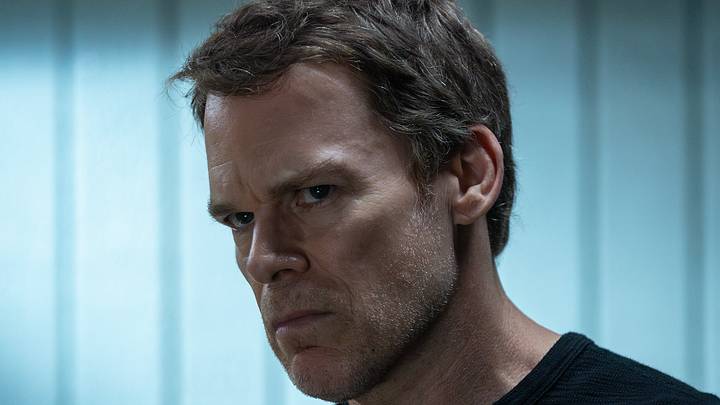
Back in July 2004, Jeff Lindsay introduced readers to Dexter Morgan, a Miami police blood-spatter analyst who kills only people who deserve it, egged on by a voice in his head he calls the “Dark Passenger.” Two years later, Showtime turned Darkly Dreaming Dexter into a hit series with Michael C. Hall.
Somewhere along the way, the internet decided Dexter had a real-life model: Pedro Rodrigues Filho, a Brazilian who claimed to have killed more than 100 people, most of them criminals. Entertainment sites now call him “the Brazilian Dexter,” and ScreenRant describes the show as loosely based on his crimes. No quote from Lindsay or the show’s producers backs that up, but the similarities are hard to miss.
The Boy Who Settled Scores
Filho was born in 1954 on a farm in Santa Rita do Sapucaí, in the Brazilian state of Minas Gerais, with an injured skull: his father, he said, had kicked his pregnant mother during a fight. He told the magazine Época in 2003 that he first wanted to kill at 13, when he shoved an older cousin into a sugarcane press. A year later, after his father lost his job as a school guard over accusations that he was stealing school lunches, Filho shot the official who had fired him, then shot the guard he believed was the real thief. (Accounts disagree on who that first victim was: some Brazilian outlets say the mayor of his hometown, others the deputy mayor of Alfenas, also in Minas Gerais.)
He fled to Mogi das Cruzes, outside São Paulo, where he robbed drug dens, killed traffickers, and took over a dead drug boss’s business. When his pregnant girlfriend was shot dead, he went looking for the man who ordered it and, with four friends, hit a wedding party, leaving seven dead and 16 wounded, according to Época. He was arrested shortly after turning 18 and entered prison on May 24, 1973; in the van on the way there, he killed a fellow prisoner he said was a rapist.
Where the Comparison Holds
Like Dexter, Filho had a code, or said he did. He told Época he killed only people who were no good, and that he never killed children, women, or family men. He also had a father story to rival Harry Morgan’s, though a much darker one: Filho claimed he killed his own father in prison, in revenge for his mother’s stabbing, and chewed a piece of his heart. (Época noted that he gave a psychiatrist a completely different account of how his father died.)
The resemblance mostly ends there. Dexter’s code, as Mental Floss has laid out before, includes “don’t get caught,” and Filho spent roughly four decades behind bars, much of it bragging. He had “Mato por prazer” (“I kill for pleasure”) tattooed on his left arm. He claimed 47 victims inside prison alone, though Época found just 18 charges against him on file in 2003; by his death, Brazilian outlets counted 71 homicides on his record.
What Dexter’s Creator Actually Said
Lindsay has told his origin story many times, and it starts nowhere near Brazil: at a Kiwanis Club lunch where he sat at the head table waiting to speak and, as he told BookPage in 2005, “the idea just popped into my head that sometimes serial murder isn’t a bad thing.” He then built the character out of research: he collected books on sociopaths and murderers, interviewed psychologists and crime scene investigators, and got cop friends to turn him loose in their dead-files room. He also rejects the very label that made Filho famous: “Dexter’s not a vigilante,” he told Middlebury Magazine in 2011. “Vigilantes are trying to perform an act of justice. Dexter just likes to kill people.”
The Ending Dexter Survived
Filho walked out of prison in 2007, went back in 2011 for crimes committed during his sentence, and was released for good in 2018. Within months, he had reinvented himself as a YouTube personality who commented on crimes in the news and lectured about his past. On the morning of March 5, 2023, he was on a sidewalk in Mogi das Cruzes holding a small child when men in a black car opened fire, according to the news site G1. The child was unhurt, but according to the police report, one of the attackers stabbed Filho in the throat as he lay on the ground. He was 68.
Read More:
•
•
Dexter: New Blood: 7 Things We Know
Where Did the Phrase “See You Later, Alligator” Come From?
Bill Haley made the phrase famous in 1956, but its true roots trace back much further.
ByPaul Anthony Jones|Oct 31, 2026, 12:00 PM EDT
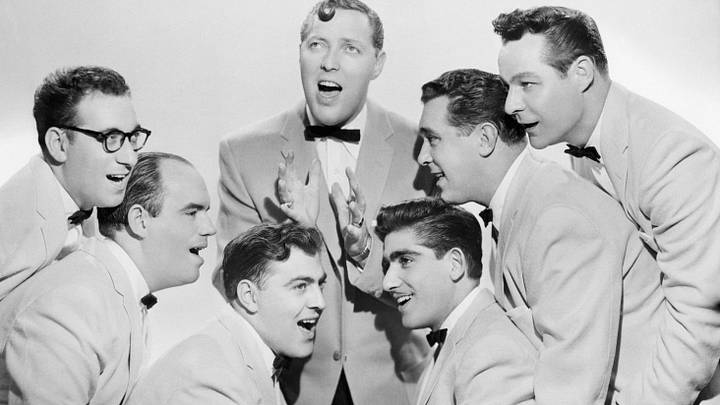
In 1955, rock and roll legends Bill Haley and His Comets recorded a 12-bar blues standard, written and first recorded earlier that year by Louisiana singer-songwriter Bobby Charles, called See You Later, Alligator.
Haley’s track was released early the following year, and although it didn’t hit the top of the charts, See You Later, Alligator nonetheless proved successful enough to become his third and final million-selling record in the U.S. Its popularity was later cemented by Haley performing the song in his 1956 big-screen musical Rock Around the Clock (filmed to cash in on the success of his earlier 1954 hit) that likewise became a global phenomenon—not least thanks to reports of unruly teenagers dancing in cinema aisles and causing riots wherever it was shown.
Before the Beat Dropped
Given both the song and the tie-in movie’s success, it might be tempting to presume that it is responsible for “see you later, alligator” becoming a snappy, slangy way of saying goodbye to someone—and some etymological sources might even claim precisely that. But in fact, the opposite is true: Haley’s song merely helped to circulate and further popularize a phrase that had already long been in use by the time his record was released.
The Oxford English Dictionary‘s earliest record of this phrase dates from just a year before Haley and Charles’ song, when “see you later, alligator” was explained as “meaning goodbye” in a guide to contemporary slang that appeared in a Nevada newspaper article. The linguist and etymologist Pascal Tréguer has since unearthed an earlier record, from a newspaper in Hawaii in 1952, which likewise listed “see you later, alligator” as an example of “the everyday ‘slang’ many high school students use.” But earlier still, the same phrase was used in an article in the Lincoln Heights Bulletin from Los Angeles, California, way back in December 1945:
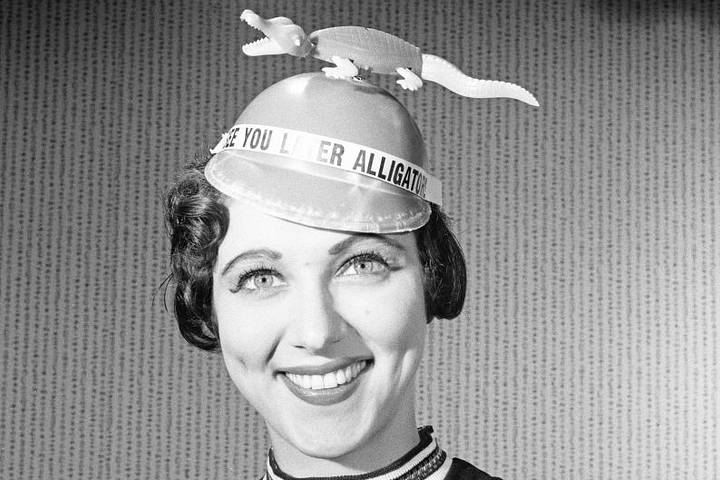
JINGLE BELLS!! JINGLE BELLS!! Christmas is just around the corner … There are just two weeks shopping time till Xmas Day … so don’t forget all those luscious presents you are buying for the family and friends. See you later alligators!!
Rhyming Slang Roots
Tellingly, this article doesn’t feel the need to explain the phrase’s meaning, but simply uses it as a jokey sign-off. That suggests that way back in the mid 1940s “see you later, alligator” was already a familiar enough way of saying goodbye. So if it doesn’t come from Haley’s song, and it was already in established use a decade earlier, where did it come from? Well, until any further earlier evidence comes to light, the most likely theory here is that “see you later, alligator” is a hangover from a 19th and early 20th century fad for so-called rhyming slang.
Thought to have emerged in London in the mid 1800s, rhyming slang was a faddish way of talking in which commonly used words were replaced with snappy rhyming equivalents. Stairs, for instance, became “apples and pears.” A wife was a husband’s “trouble and strife.” To believe something was to “Adam and Eve” it. Later, during Britain’s transportation era, when convicts were routinely shipped from the UK to see out their sentences elsewhere, rhyming slang spread to Australia too and quickly caught on there. And as any Brit or Aussie will doubtless tell you, many of these phrases are still well known (if not perhaps quite so well used) as they were almost two centuries ago.
In the 20th century, however, a wave of postwar Australian immigration appears to have brought this technique to the western United States. “See you later, alligator” was presumably either imported from Australia or, as is more likely, coined in the U.S. around this time. Rhyming slang itself doesn’t seem to have caught on for long in America, yet it was a fad just long enough—especially among students or teenagers—for a handful of these phrases to fall into use. So, as well as “See you later, alligator,” and its stock reply “In a while, crocodile,” you might once have heard the likes of “Do you know what I mean, jellybean?,” “Don’t get tough, powder puff,” and “What’s buzzin’, cousin?”
Not all of these have stood the test of time, but “see you later, alligator” did. And it’s likely the success of Haley’s record and the movie in which it appeared that helped to reinforce its use and the popularity it has had ever since.
Read More:
•
15 Slang Words From the 1970s We Still Use Today
•
Where Did the Phrase “See You Later, Alligator” Come From?
•
8 Old West Slang Words That Deserve a Cowboy Comeback
•
8 Expressions Our Grandparents Used That Are Disappearing
•
6 Slang Words From the 1950s We Still Use Today
Every Season of ‘The Twilight Zone’ Ranked From Best to Worst by Rotten Tomatoes
There is a fifth dimension beyond that which is known to man, and it holds a ranking of every ‘Twilight Zone’ season.
ByLogan DeLoye|Oct 31, 2026, 8:00 AM EDT
You unlock this door with the key of imagination; beyond it is another dimension where Rotten Tomatoes has ranked all five original Twilight Zone seasons.
The Twilight Zone took over television screens from 1959 to 1964, inviting the people of Earth into “a dimension of sound, a dimension of sight, a dimension of mind,” of “both shadow and substance, of things and ideas.”
The science-fiction series, hosted by Rod Serling, spanned 156 episodes, each with different characters and plots that drew you deeper into The Twilight Zone. Just when viewers thought they had the story figured out, a supernatural (sometimes horrific and psychological) plot twist transpired, leaving you with a moral lesson.
The series as a whole received a 92 % on Rotten Tomatoes, earning top praise from the review site. They also ranked each season individually, with a few scoring higher than others. But which season was the best, and which fell short on the Tomatometer?
SEASON 1 – 100%
The first episode of The Twilight Zone premiered in October 1959 and immediately captivated viewers with a storyline they would never forget, though not the case for the main character. Mike Ferris wanders into the small town of Oakwood, with no idea who he is or why he is there. Hours go by, and he realizes he is entirely alone, but is it all just a simulation?
The season continues with favorites like “Mr. Denton on Doomsday,” “The Four of Us Are Dying,” “The Fever,” “The Monsters Are Due on Maple Street,” “Mr. Bevis,” and “A World of His Own.”
Rotten Tomatoes gave Season 1 of The Twilight Zone a perfect rating.
SEASON 2 – 100%
Rotten Tomatoes also gave Season 2 a perfect score, which upheld the horror and speculative appeal of the first season.
The second season of The Twilight Zone opens with “King Nine Will Not Return,” in which World War II pilot James Embry is on a plane that crashes into the desert. When he wakes up, his crew is gone. Wandering through the desert and seeing strange visions in the sky, he wakes up in a hospital 17 years later, triggered by news headlines of the incident. Was Embry experiencing PTSD, or was there actually something supernatural occurring in his hospital room?
The season proceeds with “Eye of the Beholder,” “A Most Unusual Camera,” “A Penny for Your Thoughts,” “Will the Real Martian Please Stand Up?,” and the finale, “The Obsolete Man.”
SEASON 3 – 90%
Premiering in 1961, the third season of The Twilight Zone begins with an episode about an apocalyptic battle and two enemy soldiers. Throughout the episode, the soldiers, a man and a woman, learn to like each other despite being on opposing sides. With no one left on Earth, they must work together to survive, though hostile and tense.
Other episodes from this season include “The Shelter,” “The Mirror,” “It’s a Good Life,” “To Serve Man,” “Little Girl Lost,” “Nothing in the Dark,” and “The Changing of the Guard.”
Rotten Tomatoes gave the third season a 90%, with the Critics Consensus being that the season “manages to overturn an uneven structure with some superb writing that borders on profound and some of the finest half hours in the series’ history.”
SEASON 4 -86%
Season 4 of The Twilight Zone ranked lower than previous seasons with an 86% on the Tomatometer (tied for last).
The first episode of this season, “In His Image,” follows 35-year-old Alan Talbot, who struggles with homicidal urges and memory issues. He discovers he is actually an android with a malfunction. In the end, Alan is deactivated, and the scientist who created him assumes his identity… and his fiancée!
Other episodes in Season 4 include “Valley of the Shadow,” “Printer’s Devil,” “On Thursday We Leave for Home,” “No Time Like the Past,” and “The Bard.”https://www.youtube.com/embed/SXapeCPpyeo?feature=oembed
Season five of The Twilight Zone premiered in 1963 with “In Praise of Pip,” which follows bookie Max, who learns his son has been wounded at war. Max becomes mortally wounded himself and finds his way to an amusement park where he relives happy memories with a younger version of his son and prays to God to spare his son’s life in exchange for his own. Pip recovers and finds himself in the same park by the end of the episode.
Rotten Tomatoes scored this season an 86%, like the fourth season, once again tied for last, saying that “portions of these episodes are diminished by unfortunate clichés.”
Other Season 5 episodes include “Nightmare at 20,000 Feet,” “Living Doll,” “The Old Man in the Cave,” “Ninety Years Without Slumbering,” “The Masks,” and “The Bewitchin’ Pool.”
Read More:
•
•
18 Celebrities Who Appeared on ‘The Twilight Zone’
•