
On December 9, 1983, Paramount released Terms of Endearment, an adaptation of Larry McMurtry’s 1975 novel (and his personal favorite). It follows the tumultuous relationship of Aurora Greenway (Shirley MacLaine) and her daughter Emma (Debra Winger) over a 30-year period.
James L. Brooks—who had co-created The Mary Tyler Moore Show, Taxi, and Rhoda, but never directed before—managed to take home three Oscars for the film: Best Director, Best Picture, and Best Adapted Screenplay. MacLaine and Winger, who famously feuded on set, competed for Best Actress (MacLaine nudged out her younger co-star), and Jack Nicholson, who had a supporting role as Aurora’s neighbor/lover, took home the Best Supporting Actor Oscar.
Terms of Endearment spent several weekends as the number one film at the box office and ended up grossing $108 million on a $10 million budget. The movie is also known for kick-starting Jeff Daniels’s career, and for MacLaine’s powerful “give her the shot” scene. The dramedy ends on a rather devastating note, but the story lived on in The Evening Star, the 1996 sequel based on McMurtry’s 1992 novel. In honor of the film’s 35th anniversary, here are 10 endearing facts about the film.
1. James L. Brooks created Jack Nicholson’s astronaut character.
In Larry McMurtry’s book, Aurora has a suitor who was 30 years older than her, which didn’t sit right with Brooks. “[B]eing in Houston, you know, that’s astronaut central and I thought that would be great,” Brooks said of his decision to tweak McMurtry’s characters. “And then I thought of some perversion of the boy next door and what that would mean and I liked that.”
2. Shirley MacLaine wanted to give Aurora a Texas accent.
James L. Brooks had been looking for a fiftyish woman to play Aurora but couldn’t find the right woman—until legendary talent agent Sue Mengers mentioned Shirley MacLaine. They met at a beach, and he hired her.
“She wanted a Texas accent and after rehearsals I thought a Texas accent was not right, that we shouldn’t do it,” Brooks told The Hollywood Reporter. “I had done my research and I had hung out in Houston, Texas and, you know, people talk with every accent you can think of and no accent at all there. And I thought it would be a mistake to make it that regional with her. So I changed the stage direction at the beginning, and I put off-off screen dialogue that said she was from Boston. And she’s such a pro and she’s so legitimate and her thinking is so good that once she had to say the word she was from Boston in off-screen dialogue she dropped the accent.”
3. Debra Winger based Emma on Norman Rockwell.
“I do American characters,” Debra Winger told The Washington Post. “Norman Rockwell was the inspiration for most of Terms of Endearment. And whenever I ran into trouble with Emma, I mean the walk is all Norman Rockwell. The whole look was Norman Rockwell. Some of the dresses I had made for the film are exact replicas from the pictures of Norman Rockwell.”
In portraying Emma, Winger wanted to depict a middle-class mother in an honest way. “But the true crime, some of the worst psychic abuse, is on the middle class,” she said. “So here was this perfectly middle class girl who turned into a housewife with children, and I really felt the responsibility. It was very important to me to make a hero of this class of women.”
4. Burt Reynolds was originally cast to play Garrett Breedlove.

Brooks had originally cast Burt Reynolds for the part of Garrett Breedlove, but Reynolds dropped out to star in another movie. Nicholson told Roger Ebert that after reading the script, he became “the first enthusiast” and that it made him cry. “I read dozens if not hundreds of screenplays every year, and I don’t read that many parts where I can say, like I did with Easy Rider, that, yeah, sure, I could play that guy. I know just how that guy feels.”
Though Nicholson was already a huge star, he didn’t mind the supporting role. “My whole career strategy has been to build a base so that I could take the roles I want to play,” he said. “I’d hate to think that a shorter part might not be available because I was worried about my billing.”
5. Nicholson liked to improvise scenes with MacLaine without her knowing it.
When Aurora and Garrett finally go out to lunch together, afterward he takes her for a drive in his sports car, and they end up in the Gulf. Garrett kisses Aurora and then gropes her. “When he put his hand on my boob, I thought, ‘Wait a minute,’” MacLaine told USA Today. “All of that was improvised.”
In a speech for the American Film Institute, MacLaine revealed that during the scene in which Aurora goes to Garrett’s front door and discusses going out to lunch, with every take Nicholson did a different improvisation. “Once he did it with a bathrobe on. Once he did it with a hooker. Once he did it with nothing on. Another time he did it as though he was drunk. That was the brilliance in working with Nicholson, because you could never tell what he was going to bring out in the other actor.” The bathrobe made it into the final cut.
6. MacLaine said Winger did weird things to her on set.
In her book My Lucky Stars, MacLaine wrote about how Winger “farted in my face” and mentioned she “dressed in combat boots and a miniskirt … I thought, ‘Oh my goodness.'” In an interview, MacLaine said while she and Nicholson filmed a post-coital scene, “Debra Winger was under the covers. I didn’t know she was going to be there. That kind of tension was going on on the set.”
Over the years, Winger has neither confirmed nor denied the rumors. But during an appearance on Watch What Happens Live with Andy Cohen in October 2018, Winger told Cohen “there’s something true in there.”
7. MacLaine referred to Winger’s “turbulent brilliance” in her Oscar speech.
In April 1984, MacLaine finally won her first Oscar, for Best Actress. During her acceptance speech, she said: “I wanted to work with the turbulent brilliance of Debra Winger. She literally inhabited the character so thoroughly that I thought for four months I had two daughters.” The camera cut to Winger, who can be seen laughing at the comment, but in 1990, Winger told the Los Angeles Times she wasn’t happy with the adjectives.
“I have a T-shirt that Shirley gave me the day after the Academy Awards when she felt the necessity to call me turbulent and brilliant instead of just brilliant,” said Winger. “She heard I was a little rattled, and the T-shirt said, ‘Turbulent Means Brilliant.’ Oh, give me a break! If it needs an explanation, don’t say it.”
8. Nicholson had “doubts” about showing his gut.
In an interview with Roger Ebert, Nicholson confessed he had “a lot of vanity.” In one scene, Aurora interrupts his lap swimming and invites Breedlove—who’s only wearing swimming trunks and an unzipped hoodie—into her bedroom to look at a Renoir painting, and, well, to have sex. “When I stuck the old gut out there in the crucial scene, I had doubts about it on the set when I did it, and in the editing, and last night at the premiere I had a lot of doubts, and I was wondering if for my next picture I should play Tarzan.”
9. MacLaine is a lot like Aurora.
In an interview with the Miami Herald, MacLaine stated that Aurora was her favorite part to play and admitted that she and the character share many similarities. “That’s the closest I’ve come to being like a character,” MacLaine said. “I mean, I don’t know, frankly, how difficult it was to play her. I think I just played myself.”
10. It inspired an Off-Broadway production.
From October to December 2016, Terms of Endearment the play went up at 59E59 Theaters, off-Broadway. Molly Ringwald played Aurora, and Hannah Dunne (Griffin Dunne’s daughter), played Emma.
Home/ENTERTAINMENT
The Extreme Measures Authorities Took to Keep Kids From Seeing ‘The Exorcist’
The ratings board said children could see it with a parent, but the police in Washington had other ideas.
ByMatt Hoffman|Oct 21, 2026, 1:00 PM EDT
 Add us as a preferred source
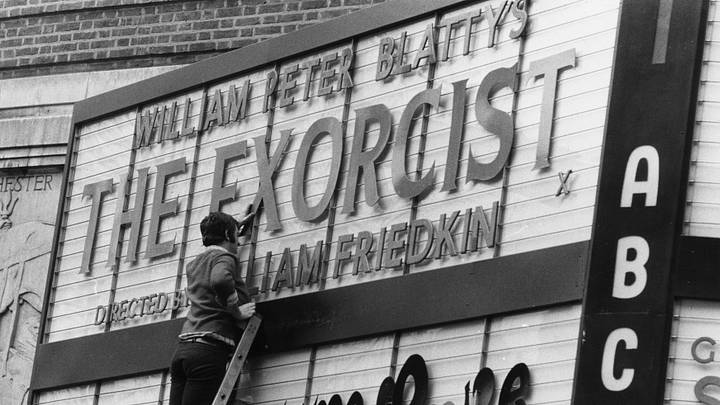
Back in October 1973, the Motion Picture Association of America gave The Exorcist an R rating, which meant anyone under 17 could get in as long as a parent or guardian came along. When the movie opened in Washington, D.C., the day after Christmas, parents took that literally: Roy Meacham, the arts critic for the local Metromedia TV station, later wrote in The New York Times that parents brought children as young as 6 and 8, that one woman herded 10 kids into a showing, and that he watched a boy slip $3 to an adult in line to buy him a ticket. Within hours of the opening, Meacham’s co-workers “watched as a girl was removed from a showing at the Cinema theater and placed in an ambulance.”
A First for Washington

On New Year’s Eve, MPAA president Jack Valenti phoned the ratings board, and the board kept the R, reasoning that the movie had no nudity and no overt sexuality. Only the studio could ask for a stricter rating, and its chief, Ted Ashley, declined to request an X, a rating that would have kept the film out of many theaters and, in some cities, out of the newspaper ads.
So Washington acted on its own. “Early in the morning on New Year’s Day, Washington became the first city ever to bar children from a film the review board said they could see,” Meacham wrote. After consulting the US Attorney’s Office, officers from the police department’s morals division warned the management of the Cinema Theater that arrests would be made if any more tickets were sold for use by minors. A sign went up at the box office: “No one under the age of 17 will be admitted,” parent or not. Mental Floss has covered the warning before, but the legal hook is stranger than the threat. The police didn’t move on the movie’s violence or its scares: they used a provision of the District’s code that barred minors from seeing scenes of certain sexual conduct, “even when the actors are fully clothed,” and the scene in question was the two-minute crucifix sequence. Meacham admitted he had personally urged the police to see the movie, and that sex wasn’t what bothered him: “The film’s violence was.”
Mississippi Went After Everyone
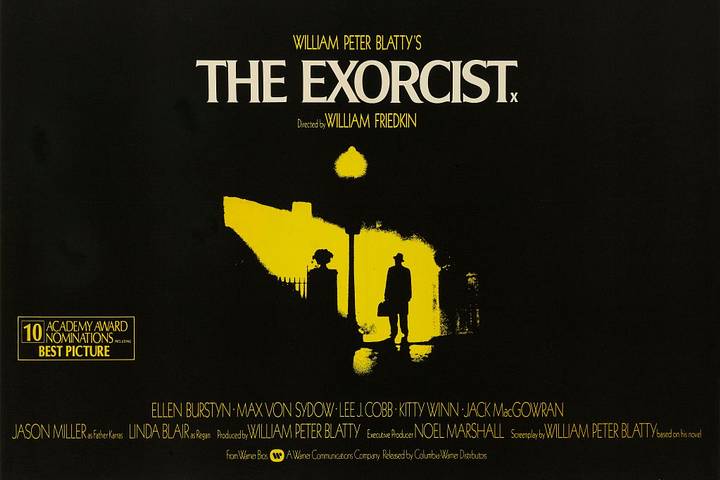
Other places didn’t stop at children. In April 1974, several police officers and a justice of the peace went with the district attorney to the Saenger Theatre in Hattiesburg, Mississippi, to watch The Exorcist. Afterward, the print was seized, and the theater’s manager and projectionist were arrested. Their charges were dropped, but the company that owned the theater was convicted under a state law against “obscene, indecent, or immoral” pictures. The Mississippi Supreme Court threw out the conviction in January 1976, ruling the law too broad, over a dissent from a justice who wrote, “I have neither read ‘The Exorcist’ nor seen the movie,” before concluding, from the briefs alone, that it was obscene anyway. In Boston, where 5,000 people a day lined up at the Sack 57 Cinema, according to TIME, an attempt to ban the movie reportedly ended when a judge dismissed the case.
Britain’s Long Wait
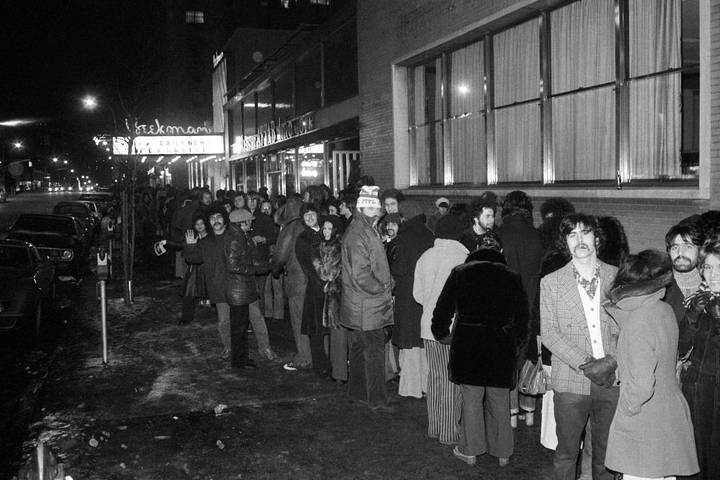
The British Board of Film Classification passed The Exorcist uncut in 1974 with an X certificate, which already kept out everyone under 18. Secretary Stephen Murphy’s verdict: “It is a powerful horror movie. Some people may dislike it, but that is not a sufficient reason for refusing certification.” That didn’t satisfy everyone. The Christian campaign group the Festival of Light protested, a small number of local councils banned the film outright, and in Tunbridge Wells, 15 people fainted during its first week at the Classic Cinema, so the St John Ambulance service was put on call.
The measure aimed squarely at kids came later, on home video. The movie went out on tape in 1981, and when a 1984 law required videos to be certified, the BBFC balked. Its concern, in its own words: “the protagonist of the film was aged 12, and the film might therefore have appeal to underage viewers.” The tape was pulled at the beginning of 1988, and The Exorcist didn’t come back on video in Britain until after its 25th-anniversary re-release, when the board passed it with an 18 certificate, uncut.
Read More:
•
26 Fascinating Facts About The Exorcist
•
The Story of ‘The Exorcist’s Cursed Set Is Way Scarier Than the Movie
•
The Terrifying Subliminal Image Hidden in The Exorcist
Home/ENTERTAINMENT