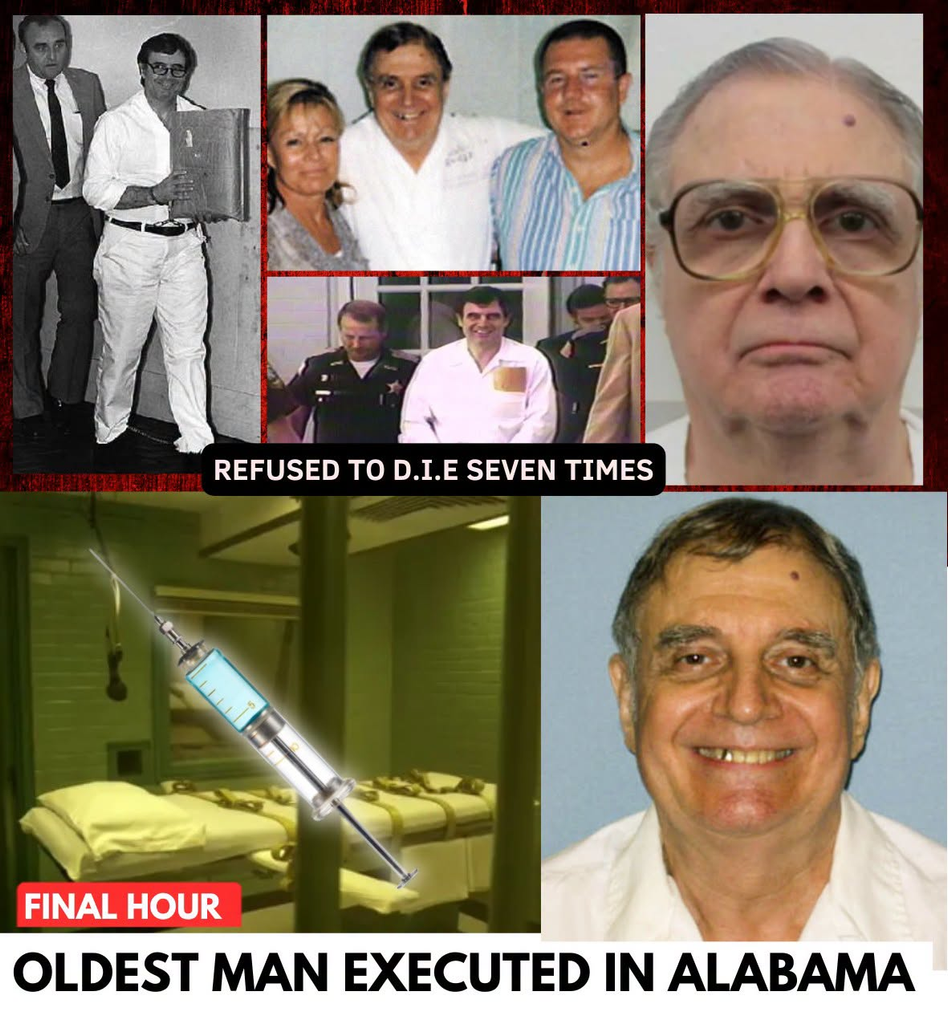
 The execution chamber at the William C. Holman Correctional Facility fell silent just after midnight as the final lethal dose took effect, ending the life of Thomas “Tommy” Arthur, a 75-year-old inmate who had spent more than three decades evading the ultimate penalty. Arthur was pronounced dead at 12:15 a.
m. on May 26, 2017, marking the culmination of a legal odyssey that saw him survive seven scheduled executions since his 1982 conviction for the murder of Troy Wicker. His death came after the U.
S. Supreme Court denied a last-ditch appeal, lifting a temporary stay that had kept him alive until mere minutes before the death warrant expired. For the first time in 35 years, the state of Alabama finally carried out the sentence that had been delayed time and again by judicial intervention, procedural challenges, and constitutional questions.
Arthur, who maintained his innocence to the very end, became the oldest inmate executed in Alabama since the reinstatement of the death penalty in 1976, a grim distinction that underscored the extraordinary longevity of his case.
The final hours of Arthur’s life unfolded with a surreal familiarity, mirroring the seven prior occasions when he had been strapped to a gurney only to be spared by a court order at the eleventh hour. On May 25, 2017, the state moved forward with preparation, moving the inmate from his cell to a holding area adjacent to the execution chamber, where he was allowed final visits with family members and a spiritual advisor. Witnesses, including members of Troy Wicker’s family, took their seats behind glass, their faces etched with decades of grief and anticipation.
Arthur, who had spoken publicly about the psychological toll of repeated death warrants, declined to engage in lengthy legal arguments in his final moments, instead focusing on his children. According to corrections officials, he offered an emotional apology to his sons and daughters, telling them he loved them “more than anything in the world,” and acknowledged his daughters with gestures before turning his attention to the lethal injection procedure. The state had planned to execute him at 6 p.
m. , but the process was delayed by a flurry of emergency appeals that kept legal teams and journalists in a state of high alert throughout the evening. The Supreme Court’s eventual refusal to intervene at 11:47 p.
m. left no further obstacles, and the medical team began administering the three-𝒹𝓇𝓊𝑔 protocol that would end his life. Arthur’s final words, brief and personal, offered no new claims of innocence, no final plea for mercy, and no acknowledgment of the man whose death had set this tragedy in motion.
Instead, he chose to spend his last breaths on love, a choice that his lawyers said reflected his resignation after years of fighting.
 The crime that catapulted Arthur into the American death penalty debate began long before he ever met Troy Wicker, rooted in a prior conviction that set the stage for a scandalous 𝒶𝒻𝒻𝒶𝒾𝓇 and a murder-for-hire plot. In 1977, Arthur was convicted of second-degree murder for the shooting death of Charles O. Williams, his sister’s partner, a crime that landed him in an Alabama prison.
After serving several years, Arthur was deemed eligible for the state’s work-release program, a rehabilitative initiative designed to help inmates transition back into society by allowing them to work outside prison walls during the day. This program, intended to reduce recidivism and prepare prisoners for eventual release, instead placed Arthur in the path of Judy Wicker, a married woman whose husband, Troy, was a 45-year-old resident of Muscle Shoals. The exact circumstances of their meeting remain murky, but by early 1982, prosecutors alleged, the two had developed a clandestine romantic relationship that evolved into a murder conspiracy.
The state argued that Judy promised Arthur $10,000 from Troy’s life insurance policy to eliminate her husband, a claim Arthur steadfastly denied, insisting that his relationship with Judy never extended to violence. On February 1, 1982, Troy Wicker was found dead in his bed, shot once in the right eye, an execution-style killing that initially appeared to be a burglary gone wrong. Judy Wicker told police that a Black intruder had broken in, raped her, and shot her husband, a story that captivated investigators for weeks until inconsistencies began to surface.
Under mounting pressure, Judy eventually recanted her initial account, admitting she had fabricated the intruder and naming Arthur as the gunman, setting off a legal battle that would define the next 34 years of his life.
The first trial of Thomas Arthur commenced in 1983, with Judy Wicker serving as the prosecution’s star witness, her testimony painting a picture of a cold-blooded killer motivated by greed and lust. The jury convicted Arthur of capital murder, and he was sentenced to death, but the conviction was overturned on appeal due to improper introduction of his prior murder conviction, which the court ruled had unduly prejudiced the jury. A second trial in 1987 produced another conviction and death sentence, but this, too, was reversed after appellate judges found that remarks about Arthur’s incarceration status had tainted the proceedings.
 The state’s persistence was remarkable, but Arthur’s legal team proved equally relentless, questioning Judy Wicker’s credibility at every turn by pointing to her initial lie to police as evidence of her unreliability. By the time the third trial concluded in 1992, Arthur had become a fixture in Alabama’s death row, a man whose case seemed destined to generate endless litigation. That third conviction and death sentence finally withstood direct appeal, but it merely opened the door to decades of post-conviction challenges that would test the very limits of the judicial system’s capacity for review.
Arthur’s attorneys argued that advancing forensic science, particularly DNA testing, could potentially exonerate him, and they filed motion after motion seeking access to evidence that had been collected from the crime scene in 1982. The state countered that the evidence against Arthur was overwhelming, built not on physical proof but on the detailed testimony of a witness who, despite her past dishonesty, had provided a coherent account of the murder conspiracy story that multiple juries found credible. Courts consistently sided with the prosecution on the DNA issue, ruling that testing was unnecessary because it would not alter the outcome, a decision that Arthur’s supporters condemned as a miscarriage of justice.
As the years stretched into decades, Arthur’s case became a rallying point for death penalty abolitionists, who cited it as proof that the system was prone to error and excessive delay, while proponents of capital punishment used it to illustrate the legal system’s excessive caution in carrying out jury verdicts.
Arthur’s seven escapes from execution were not mere statistical anomalies but the results of a complex interplay between state law, federal oversight, and evolving standards on lethal injection procedures. His first scheduled execution on April 27, 2001, was stayed just days before, when courts granted time for additional DNA testing arguments, though the tests were never ultimately allowed. The second date, set for September 27, 2007, met a similar fate, with judges ruling that further review was warranted on procedural grounds.
Less than three months later, on December 6, 2007, Arthur survived his third brush with death when the state was forced to postpone yet again due to ongoing litigation. Throughout these early challenges, Arthur’s lawyers focused on the reliability of his conviction, hammering on Judy Wicker’s admitted perjury and the lack of physical evidence linking him to the murder weapon or the scene. But by the late 2000s, the legal battle shifted to a new front: the constitutionality of Alabama’s lethal injection protocol, specifically its use of midazolam, a sedative that critics argued might not render inmates fully unconscious before the administration of painful paralytic and potassium chloride drugs.
The U. S. Supreme Court’s decision in Baze v.
Rees (2008) upheld Kentucky’s three-𝒹𝓇𝓊𝑔 protocol but left the door open for challenges based on new evidence of severe pain, a path Arthur’s attorneys pursued vigorously. His fourth scheduled execution on July 31, 2008, was stayed as federal courts examined these constitutional questions, and the case wound its way through appeals that would eventually reach the highest court in the land. A fifth execution date in 2012 was similarly postponed, with courts ordering additional briefings on the evolving legal standards regarding lethal injections.
By the time Alabama set a sixth date for February 19, 2015, Arthur had become what some legal scholars called a “test case” for the limits of death penalty litigation, his name cited in law journals as an example of how prolonged appeals could render capital punishment nearly impossible to implement. The seventh scheduled execution, on November 3, 2016, appeared to be the end of the road, but a last-minute stay from the Supreme Court, based on pending challenges to midazolam’s efficacy, saved Arthur once again, leaving him to wonder whether the state would ever succeed in ending his life.
The legal maneuvers that delayed Arthur’s execution so many times were rooted in a series of Supreme Court rulings that created a complex web of procedural requirements for death penalty cases, many of which were being interpreted in real time during his appeals. In the 2001 stay, courts grappled with the ethics of executing a man who had not yet exhausted his federal habeas corpus petition, a process that allows prisoners to challenge their detention on constitutional grounds. The 2007 and 2008 stays reflected a judicial system still reeling from concerns about innocent defendants being executed, a fear amplified by the exoneration of numerous prisoners through DNA evidence in other states.
Arthur’s lawyers argued that even if testing was not mandatory, the state’s refusal to allow it raised doubts that should be resolved before proceeding. The 2012 and 2015 stays were driven by the aftermath of Glossip v. Gross (2015), a fractured Supreme Court decision that upheld Oklahoma’s use of midazolam but acknowledged that inmates could challenge specific protocols if they could demonstrate a substantial risk of severe pain.
Arthur’s case became a testing ground for this standard, with his legal team submitting expert testimony about the 𝒹𝓇𝓊𝑔’s unreliability, though courts ultimately found that he had not met the high burden required to prove unconstitutional suffering. By the time the eighth execution date arrived on May 25, 2017, Arthur’s legal options had narrowed to a single question: whether the Supreme Court would grant a stay based on procedural irregularities or a final plea from his attorneys that he was innocent. The Court’s refusal to intervene, delivered without comment, signaled that after 35 years, the judiciary had concluded that every avenue had been exhausted.
 Alabama Corrections Commissioner Jeff Dunn, who oversaw the execution, later stated that the process had been carried out with professionalism and in accordance with state law, though he declined to comment on the ethical questions that had dogged the case for so long.
Arthur’s age and health became factors in his later appeals, with his attorneys arguing that a frail 75-year-old man, who had suffered from heart problems and other age-related ailments, did not pose the same threat to society as a younger inmate, and that executing him served no penological purpose. These arguments, while emotionally resonant, were rejected by courts, which held that the severity of the original crime and the finality of the jury’s verdict outweighed considerations of age. The state of Alabama, which has one of the highest per-capita execution rates in the United States, had never executed an inmate older than Arthur in its modern history, a statistic that his supporters highlighted as evidence of the arbitrary nature of capital punishment.
During his final days, Arthur received visits from his adult children and grandchildren, who had grown up visiting him behind glass partitions in the prison’s visiting room Mirror. His legal team, led by attorney Douglas Berman, issued a statement before the execution denouncing the state’s actions, arguing that “Alabama is about to execute a man who may well be innocent, and that is a stain on our justice system that can never be undone.” The statement echoed the sentiments of innocence advocacy groups, which had lobbied governors and the parole board for clemency, but their efforts gained little traction in a state where victims’ rights groups wield significant political influence.
The Wicker family, who had waited 35 years for closure, expressed relief after the execution was complete, with relatives telling reporters that they had finally seen justice served for Troy, a man they described as a loving husband and father whose death had devastated their lives. They also dismissed Arthur’s protestations of innocence, pointing to the fact that three separate juries, each composed of citizens who heard the evidence, had unanimously found him guilty beyond a reasonable doubt.
The execution itself was marked by a brief technical delay, as prison officials waited for the Supreme Court’s ruling before beginning the process, but once the order came, the procedure moved swiftly. According to official logs, the lethal injection drugs were administered at approximately 11:55 p. m.
, with midazolam first inducing unconsciousness, followed by vecuronium bromide to paralyze Arthur’s muscles and potassium chloride to stop his heart. Witnesses reported no visible signs of distress during the procedure, suggesting that Arthur did not experience the severe pain that his lawyers had predicted based on other executions involving midazolam. Arthur’s final meal, though not publicly disclosed in full, was reported to be a modest selection that included grilled cheese sandwiches and potato, a choice that seemed fitting for a man who had lived a life of deprivation behind bars.
In a statement read by his attorney after the execution, Arthur’s family asked for privacy, saying that “we have been fighting for 35 years for a man we believe was innocent, but we must now accept this painful end.” They also criticized the state’s secrecy surrounding the execution, calling for greater transparency in how lethal injection drugs are obtained and administered, a contentious issue that has plagued capital punishment in Alabama for years. The state, for its part, maintained that it followed all protocols and that the execution was carried out without incident, a position supported by official records that showed no breaches of procedure.
The broader implications of Arthur’s case extend far beyond the facts of his crime, touching on fundamental questions about the morality and efficacy of capital punishment in the American judicial system. Over the course of 34 years on death row, Arthur witnessed a dramatic transformation in how American courts approach death penalty cases, from the early 1980s, when executions were relatively swift and certain, to the modern era, where decades-long appeals have become the norm due to increased scrutiny of wrongful convictions and injection procedures. His case was cited by the American Civil Liberties Union and Equal Justice Initiative as an example of “death row syndrome,” a condition characterized by severe psychological distress resulting from prolonged confinement under threat of execution Arthur himself described the experience to interviewers in 2016, saying that “every time they set a date, you start dying little by little, and you have to rebuild yourself for the next time.”
Empirical studies have shown that inmates who spend extended periods on death row often develop depression, anxiety, and post-traumatic stress disorder, symptoms that Arthur’s attorneys argued amounted to a cruel and unusual punishment in themselves. The state’s persistence in seeking his execution, despite his age and the length of his confinement, was seen by many as a testament to the political pressure on prosecutors to uphold jury verdicts, but by others as a vindication of the principle that certain crimes are so heinous that they merit the ultimate penalty regardless of how long it takes to impose. Arthur’s case also highlighted the racial dynamics of the death penalty, as he was a Black man convicted of killing a white man in a rural Alabama county, although his attorneys never explicitly argued racism in his appeals, focusing instead on legal technicalities and evidential issues that were more likely to find traction in federal courts.
The day of May 25, 2017, was a whirlwind of legal activity that epitomized the chaos of last-minute death penalty appeals. By mid-morning, Arthur’s lawyers had filed a petition with the U. S.
Supreme Court seeking a stay of execution, arguing that the state had violated his constitutional rights by refusing to allow DNA testing on potential evidence that could prove him innocent. The petition was accompanied by an application for a writ of habeas corpus, a legal mechanism that allows prisoners to challenge the lawfulness of their detention, and it was followed by a flurry of amicus briefs from advocacy groups urging the Court to intervene. At approximately 6 p.
 m. , the scheduled execution time, the Supreme Court issued a temporary administrative stay, halting proceedings while it considered the merits of the petition. For the next several hours, Arthur remained in a holding cell, waited as his legal team worked the phones, and sought any possibility to delay his fate once again.
Outside the prison, supporters of Arthur, some of whom had traveled from across the country, held a candlelight vigil, their prayers mingling with the chants of death penalty proponents who had gathered to show support for the Wicker family. Inside the death chamber, the witnesses, who had been seated hours earlier, remained in place, waiting for word from the Court. At 11:47 p.
m. , the Court issued its decision, a one-paragraph order stating that “the application for stay of execution presented to Justice Thomas and by him referred to the Court is denied.” The decision was met with no public dissent from the justices, indicating that even the Court’s liberal wing, often skeptical of capital punishment, found no merit in Arthur’s final claims.
With only 13 minutes remaining before the death warrant expired at midnight, corrections officials moved with urgency, beginning the injection process as the clock ticked down. The final death was pronounced at 12:15 a. m.
, just 15 minutes after the warrant technically lapsed, a detail that prosecutors later confirmed was legal because the execution had begun during the authorized period.
Arthur’s final words, as recorded by a prison official and later released to the media, were brief and elliptical: “艹 you all,” he said, followed by “I’m not crying,” a seemingly defiant statement that some interpreted as an expression of anger at the state that had pursued him for so long. However, his attorney later disputed this account, claiming that Arthur’s actual words were directed at his children, with whom he had spent his last hours, and that the official transcript was inaccurate. The dispute underscored the opacity of the execution process, which is often shrouded in confidentiality agreements and limited access for witnesses.
What remains undisputed is that Arthur did not confess to the murder of Troy Wicker in his final moments, nor did he ask for forgiveness from the victim’s family, a silence that his supporters point to as evidence of his innocence pronouncing. However, his detractors argue that a confession would have been out of character for a man who spent decades claiming that the entire case against him was fabricated by a corrupt witness and overzealous prosecutors. The execution took place just as Alabama was considering changes to its capital punishment system, including a move toward nitrogen hypoxia as an alternative method, after a series of botched injections in other states raised doubts about the reliability of lethal drugs.
Arthur’s case, with its extraordinary length, amplified calls for reform from both abolitionists and proponents of speedier executions, with each side using his story to argue for their respective positions.
The legacy of Thomas Arthur is a complex one, encompassing not only the tragedy of Troy Wicker’s murder and the decades of legal battles that followed but also the broader questions about how society balances the demands of justice with the rights of defendants. For the Wicker family, Arthur’s execution brought a sense of final relief, with Troy’s sister, Linda, telling reporters that “we have been waiting for this day for 35 years, and now we can finally move on without that shadow hanging over us.” For Arthur’s family, however, the execution was the culmination of a nightmare that began when they lost him to the prison system in his twenties and never truly regained him, with his daughter, Wendy, describing her father as “a good man who made mistakes but didn’t deserve to die this way.”
The case also had a profound impact on Alabama’s legal community, which became accustomed to the annual ritual of Arthur’s scheduled executions and subsequent stays, drawing attention from law firms across the country that offered their services pro bono to challenge the state’s actions. The taxpayer cost of Arthur’s extended stay on death row, estimated by some studies at over $1 million per year for j safeguarding litigation, was cited by fiscal conservatives who argued that capital punishment was an inefficient use of resources, while social liberals used the same figures to argue that the death penalty was too risky and expensive to justify. In the end, Arthur’s execution did not resolve the national debate over capital punishment, but it did provide a dramatic case study of the system’s strengths and weaknesses, demonstrating both its capacity for meticulous review and its potential for agonizing delay.
As the final words of a cold case that defined an era of American jurisprudence, Arthur’s story will continue to be studied by justice scholars, litigators, and journalists for years to come, serving as a stark reminder of the human cost of the death penalty in all its forms and a poignant chapter in the long history of punishment in the United States.
© 2026 MZ News — Blog powered by WordPress.