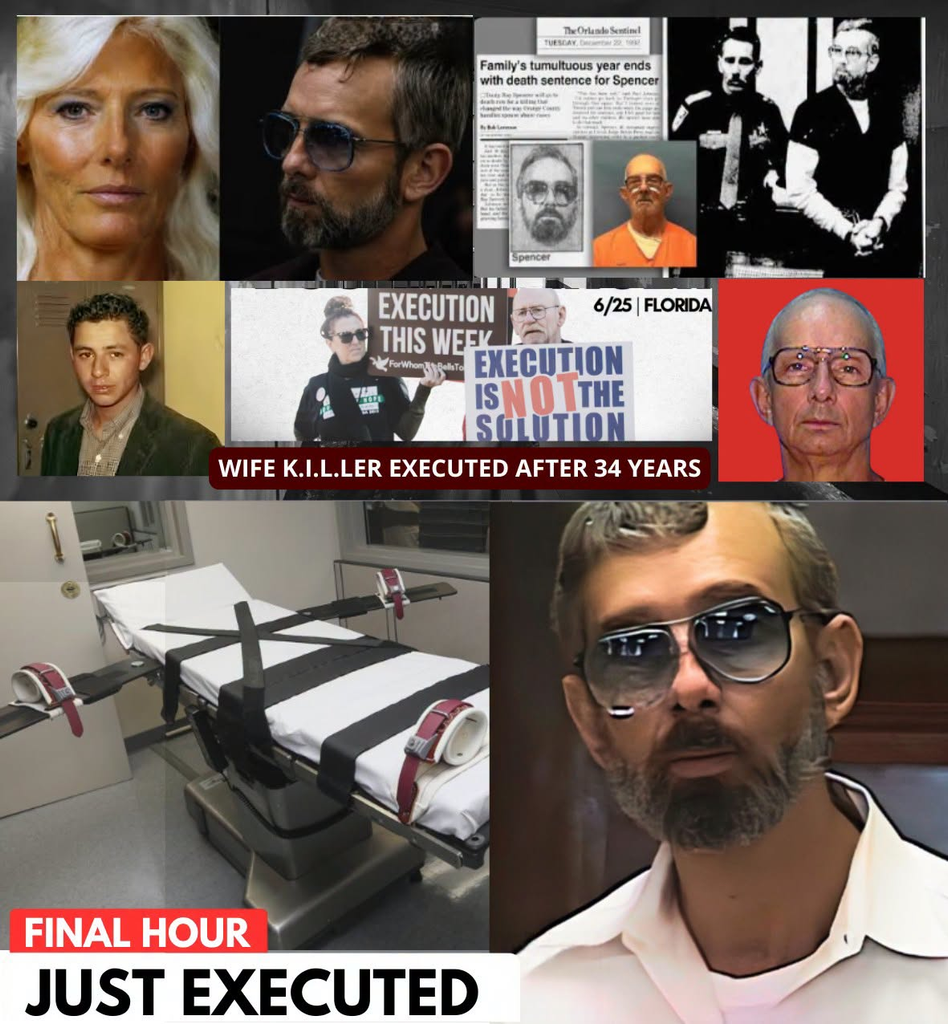
The state of Florida carried out the execution of Dusty Ray Spencer on Thursday evening, ending the life of a 74-year-old man who had spent more than three decades on death row for the 1992 murder of his wife, Karen Spencer. The procedure, which began at exactly 6:00 PM inside the execution chamber at Florida State Prison in Stark, concluded with Spencer being pronounced dead at 6:10 PM, making him the oldest inmate executed in the state’s history since 1924. His final words, delivered through a thick glass wall to the witnesses assembled on the other side, were a mixture of apology and religious resignation, as he stated, “I am sorry.
Sorry for the family. I place my soul in your hands. I am going, Lord.
 I am going. Amen.”
Outside the prison walls, the scene was a familiar one for a state that has become the epicenter of capital punishment in the United States. Protesters and death penalty advocates lined the road, a ritual that has played out with increasing frequency in Florida over the past two years, as the state has executed more individuals than nearly any other state has in a decade. For many observers, the spectacle has become routine, almost mechanical, a recurring story told with a different name each time.
Tonight, that name was Dusty Ray Spencer, a man who entered the prison system in his forties and left it as one of the oldest individuals ever executed in the state, his age at death surpassing any true precedent in Florida’s modern capital punishment system.
The execution, however, was not the beginning of this story, but rather the culmination of a legal and human 𝒹𝓇𝒶𝓂𝒶 that spanned nearly three and a half decades. The narrative begins not in the sterile confines of an execution chamber, but in a modest home in Orange County, Florida, with a woman named Karen Spencer, who was denied the 34 years that Dusty Spencer was granted to reflect, to age, and to change. Her story, and his, are inextricably linked, and understanding the full weight of what occurred requires a deep dive into the lives of both individuals, the systemic failures that preceded the murder, and the long, contentious legal battle that followed.
Born on February 13, 1952, in Pennsylvania, Dusty Ray Spencer’s early life was marked by trauma that would cast a long shadow over his future. According to accounts given by individuals who knew him decades later, Spencer’s childhood home was not a safe haven. He later reported suffering sexual 𝓪𝓫𝓾𝓼𝓮, humiliation, and intimidation at the hands of his father, the one person who was supposed to protect him.
These experiences remained lodged in his memory, and by his teenage years, he had turned to alcohol as a coping mechanism, a detail that seems almost cliché in true crime stories, yet exists because patterns repeat themselves. After graduating from Hopewell High School in 1970, Spencer enlisted in the U. S.
Marine Corps during the Vietnam War, serving for three years in search and rescue operations before his discharge in 1973.
His military service was later treated in courtrooms and clemency petitions as the one clean chapter in a troubled life, with one court even describing it as heroic. However, the structure of military life did not cure the alcoholism that had taken root. After his discharge, Spencer moved to Florida and married his first wife.
 Four years into that marriage, he was arrested for delivering $1,600 worth of marijuana to an undercover narcotics agent. While the case was pending, Spencer attended Valencia Community College, achieving a 3. 5 GPA over nearly two years, evidence of his capacity for discipline when he chose to apply it.
He eventually pleaded guilty to the 𝒹𝓇𝓊𝑔 charge, but his first marriage did not survive the ordeal. By the late 1980s, Dusty Spencer was a man in his late thirties, twice touched by the criminal justice system, burdened by childhood memories he could not escape, and an alcoholic who had never been able to quit.
None of this excuses what happened later. A traumatic childhood and struggles with alcohol are the reality for millions of people who never raise a hand to a loved one. But it describes the raw material Spencer brought to his next relationship, an unresolved history of violence and a coping mechanism that dulled his judgment without addressing the underlying rage.
It is a combination that repeats itself time and again in domestic violence cases, not a stranger who snaps suddenly, but a person who arrives already carrying the capacity for violence, waiting for enough pressure to release it. This is the man Karen Spencer met. Karen grew up more than 500 miles away in Burlington, North Carolina, as the only daughter of her mother, Mary.
In her youth, a friend taught her how to groom poodles, and Karen became skilled enough to work in pet grooming throughout high school and for a time after her first marriage ended. She had three sons from that marriage, and when it dissolved, she found herself raising them largely alone with little financial support, a life described by everyone who knew her as one of intelligence, competence, and self-reliance.
When she met Dusty Spencer, two of her sons had grown and moved out, leaving only her youngest, a teenager, living with her. The meeting was unremarkable, a simple encounter between two adults. Karen needed her ceilings painted, and Spencer worked in that trade, so he gave her a quote and she hired him.
She liked the work well enough to call him back for the doors and trim. Amid the work, room by room, coat by coat, the two began talking, then dating, and then, as Spencer himself recounted, falling in love. It is worth pausing to consider how ordinary that beginning was, because it is a pattern that repeats in so many of these stories.
There was nothing alarming in a paint estimate, no warning sign in a man who showed up on time, did excellent work, and charged a fair price. Karen was not reckless or naive in her choice. She was a smart, independent woman who had already weathered a difficult marriage and built her life on her own terms.
The man she met in 1988 or 1989 was, by all accounts, genuinely charming, hardworking, and present. Whatever violence lurked beneath the surface had not yet emerged, and she had no way of knowing it existed. They married on February 11, 1989, and it became more than a marriage; it was a partnership in every sense.
Together, they founded a painting company called A-Plus Painting, which succeeded for a time. By 1990, the business was grossing more than $200,000 a year, a real amount, a genuine success story of two people who had started from difficult beginnings and rebuilt something with their own hands. They bought a 36-foot fishing boat and named it “Dusty’s Dream,” keeping it at Daytona Beach for weekend getaways, candlelit dinners on the water, and deep-sea fishing trips.
Neighbors and friends who saw them in those early years described a couple who genuinely seemed to enjoy each other’s company, having built something real out of two difficult pasts. For a time, by all external measures, it was.
 But it did not last. The early 1990s brought a national economic downturn that hit small businesses across the country, and A-Plus Painting was no exception. As finances became more difficult, everything else between Dusty and Karen deteriorated.
By late 1990, financial pressures had begun to turn into real conflict, and their arguments escalated. On December 10, 1991, the couple fought over Karen withdrawing money from their joint business account, and the situation quickly spiraled. Spencer choked her and struck her, and in the midst of it, he explicitly threatened to 𝓀𝒾𝓁𝓁 her.
Karen called the police, and Spencer was arrested on a domestic violence charge, a real charge and an official arrest. This was supposed to be the turning point toward safety, but it was not. A judge granted him a $5,000 bond, and he was released.
But before his release, while Spencer was still in his cell, he made a phone call to his wife. According to court records, what he said should have changed everything: he told her that when he got out, he would finish what he started. This threat was reported to authorities.
It was documented, not a secret, not speculation, not something fabricated after the fact. Karen Spencer told someone in a position to act that her husband had promised, from inside his cell, to 𝓀𝒾𝓁𝓁 her. But that did not stop what happened next.
This is the hardest part of the story, because it involves a decision that seems, on its face, almost impossible to understand, yet is deeply human and painful upon closer examination. Karen Spencer asked her husband to come home for the holidays even after he choked her, even after the threat he made from his cell that he would 𝓀𝒾𝓁𝓁 her. She wanted him released to spend Christmas and New Year’s at home.
This was not blind forgiveness. She made it clear to him that once the holidays were over, he had to leave the home for good. In hindsight, it seems like a desperate attempt to hold her life together for one more season before she let it go for good, a bid to give her family one last normal holiday before everything changed.
Advocates for domestic violence victims have spent decades trying to explain decisions like this to people who have never experienced it: the financial entanglement of a joint business, the fear of what an angry man might do when kicked out versus what he might do when managed and soothed and given more time, the stubborn, faint hope that this time will be different. None of these explanations make what happened later any less preventable. They only make it easier to understand why a smart, capable woman made that choice.
On New Year’s Eve 1992, while Spencer was drinking with a friend, he reportedly said he wanted to take Karen out on the boat and throw her overboard. Two days later, the same friend said his wife would not go out on the boat with him. The holidays ended.
It was time for him to leave. Karen had filed a restraining order to keep Spencer off the property. But he came anyway.
On January 4, 1992, Dusty Spencer broke into the home and attacked Karen. Her teenage son, Timothy, woke to his mother’s screams and rushed in to pull his stepfather off her. Spencer attacked the boy with a clothing iron, striking him as he tried to intervene.
Spencer then fled the home. Karen went to the hospital, where she needed 11 stitches to close the wounds on her face. She later stated that police were not actively looking for her husband after that, and that she had to locate him herself before officers would move.
No arrest warrant was issued at that time, and there was no urgency. This detail is significant and worth reflecting on. In the early 1990s, police could treat domestic violence reports, even those involving a documented death threat and a woman with 11 stitches in her face, as a private matter between husband and wife, not an ongoing crime.
This gap between what Karen reported and what was done about it is not incidental to this story; it is, in many ways, the core of it.
Two weeks passed. On January 18, 1992, Dusty Spencer returned home for the last time. He attacked Karen in the backyard, striking her with a piece of brick.
As she begged him to stop, he beat her head against a concrete wall. Timothy, now 18, came home during the assault. He ran inside, grabbed a .
22 caliber rifle from his mother’s bedroom, and rushed back outside, aiming it at his stepfather. But the gun did not fire. Imagine Timothy’s feeling in that moment: an 18-year-old boy pulling the trigger on the man beating his mother to death, hearing only a click.
There was no second chance to shoot. Spencer turned the knife he was carrying toward his stepson, and Timothy had no choice but to flee. He ran to a neighbor’s house and called 911.
 When police arrived, Dusty Spencer was gone, and Karen Spencer was dead. The autopsy later showed she had been stabbed four or five times in the chest, two of which penetrated her heart and lung. There were defensive wounds on her face and arms, the kind one gets while trying to protect oneself from a blade, trying to survive, trying to buy a few more seconds.
She also had severe injuries to the back of her head from the brick or the wall, or both. Each wound told part of the same story: a woman who fought to stay alive until the very end. Karen had a small, sick dog named Pebbles, a dog with only four teeth that she carried everywhere.
When police arrived, Pebbles was found on Karen’s chest, whimpering, refusing to leave her, the last living thing to stay with her.
Spencer, meanwhile, had driven away from the only life he had built. He headed toward Kissimmee, near Walt Disney World, away from Orange County. He did not remain free for long.
Two days after the murder, on January 20, 1992, Polk County deputies tracked him to a friend’s house where he was hiding. He was arrested there and charged with first-degree murder. He was held without bond in the Orange County Jail.
There is something almost mundane about how a manhunt like this ends. It was not a car chase or a standoff. It was a man who had run out of places to hide, out of people willing to shelter him, and deputies who showed up quietly at the door.
Two days of freedom, paid for with everything, and then it was over. On February 6, 1992, a grand jury formally indicted him for the murder of Karen, the attempted murder of her son, and aggravated battery and attempted murder related to the January 4 attack. The indictment was not for a single moment of violence, but for a pattern that had built over weeks and culminated in murder.
The case almost fell apart before it reached a jury. In September 1992, the trial was postponed after prosecutors discovered an administrative error in their paperwork. Karen’s cause of death had been incorrectly recorded as blunt force trauma instead of the fatal stab wounds that actually killed her.
It might seem minor, a clerical mistake, but left uncorrected, it could have been exploited by the defense to cast doubt, arguing the state did not even know how the victim died. Prosecutors caught it in time, and the trial resumed in the fall of that year. Timothy testified.
A news report from November 1992 described him speaking in a soft voice as he told the court how he watched his mother being killed. An 18-year-old boy testifying about the worst night of his life in a room full of strangers, with the perpetrator sitting just a few feet away. The prosecution sought the death penalty, citing the brutality of the final attack and the pattern that preceded it: the choking in December, the beating with the iron on January 4, and the final assault on January 18.
They argued this was not a single moment of rage, but an escalation that was predicted weeks in advance, promised aloud from a jail cell, and carried out in three separate stages despite every opportunity for the courts, the police, or the justice system to intervene. The defense, in contrast, argued that Spencer was suffering from severe psychological distress, and that his judgment and self-control had been impaired by his chronic alcoholism since adolescence. A psychologist from Ohio, Dr.
Katherine Birch, testified that after evaluating him, Spencer suffered from severe paranoia and impaired thinking as a result of years of heavy drinking. Their defense did not deny that Spencer killed Karen; that was beyond dispute. The argument was about what he deserved as punishment, and whether his mental state that night should be considered when determining the ultimate penalty.
On December 9, 1992, the jury returned its recommendation. By a vote of seven to five, they recommended death. It is notable how close that vote was.
Five jurors, after hearing all the evidence from both sides, concluded that life in prison, not execution, was the appropriate outcome. This division would prove significant decades later when Florida changed its laws regarding how death sentences are imposed. On December 21, 1992, Orange County Circuit Judge Belvin Perry formally sentenced Dusty Ray Spencer to death.
In his ruling, Judge Perry noted a detail that remains difficult to comprehend: Karen Spencer was alive and conscious throughout the entire beating that killed her. Spencer was transferred to death row at Union Correctional Institution. For Karen’s family, perhaps they felt the story was over.
But it was not. The legal battle was far from finished. In September 1994, the Florida Supreme Court overturned Spencer’s death sentence.
The majority of justices ruled that the trial court had improperly allowed the jury to consider the murder as cold, calculated, and premeditated, and that more weight should have been given to Spencer’s mental state at the time of the crime. The case was remanded for a new sentencing hearing. Not all members of the court agreed.
Two dissenting justices argued the murder was indeed cold-blooded and that death was still the appropriate sentence. A third justice went the opposite direction, arguing Spencer’s sentence should be commuted to life. The case went back to the trial court.
 On January 18, 1995, exactly three years to the day after he killed Karen, Dusty Ray Spencer was re-sentenced to death.
Over the next three decades, his appeals wound their way through the court system, one after another, all denied. He spent the remainder of the 1990s, the entire 2000s, the 2010s, and into the 2020s behind bars. A man who entered death row in his early forties remained there, continuing to appeal, still alive, until he reached his seventies.
Imagine what those three decades witnessed. Timothy grew from an 18-year-old boy who watched his mother die into a middle-aged man. Karen’s mother, Mary, lived for years, perhaps decades, carrying the memory of a phone call or a knock at the door that no parent should ever receive.
Presidents changed. Technology changed. The entire world outside those walls spun and aged and shifted, while Dusty Spencer sat in a small cell, appealing sentence after sentence, waiting for the court system to decide his fate.
According to death penalty opponents who knew him during those final years, Spencer had become, by their account, a different man. After quitting alcohol for the first time in his life, he found solace in daily religious services and in friendships with other men on death row. When he died, he left his remaining few possessions, including his favorite bags of coffee, to a friend.
But none of that erases what happened in that backyard in January 1992. It does not erase the eleven stitches, the gun that did not fire, the brick, the wall, the knife. But it is part of the truth.
Because an honest telling of this story must include both things at once: the man who committed this crime, and what he became during the 34 years he waited to be held accountable for it.
In May 2026, Florida Governor Ron DeSantis signed Spencer’s death warrant, the tenth that year alone, part of a record-setting pace of executions across the state. Spencer’s lawyers made a final push for clemency, citing his advanced age, failing health, liver cirrhosis, heart problems, and alleged cognitive decline. They argued that executing a 74-year-old man who posed no threat to anyone served no legitimate public safety purpose.
His spiritual advisor at the time described it, bluntly, as an execution in a nursing home. Death penalty opponents also pointed to the original 1992 trial, where the jury voted 7-5 in favor of death. Under current Florida law, that vote would not be enough to impose a death sentence at all.
The state now requires at least eight jurors to agree before recommending it. In most other death penalty states in the country, a jury as divided as Spencer’s would have resulted in a life sentence, not an execution three decades later. In contrast, people like a retired investigator who worked the original case defended Spencer, saying he committed atrocities against his wife and deserves the punishment he has been waiting for, regardless of how much time has passed.
The Florida Attorney General’s office defended the state’s execution pace generally, arguing that death row inmates have committed some of the most heinous crimes imaginable, and that the state owes it to victims to carry out the sentences imposed by the courts. The Florida Supreme Court denied Spencer’s final appeals just one week before the scheduled date. The execution was carried out as planned.
Dusty Ray Spencer was executed by lethal injection at Florida State Prison on June 25, 2026, at the age of 74, making him the oldest person executed in Florida in over a century. His last meal was pizza, french fries, and a milkshake. His final words were an apology to Karen’s family, followed by a short prayer that ended with the phrase, “I am on my way.”
He was pronounced dead at 6:10 PM. It would be easy to end a story like this with the execution, the old man strapped down, the simple last meal, the final apology. These stories are often told to end there, because it feels complete.
A crime, a sentence, a consequence, the end. But Karen Spencer did not get an ending like that. She got a backyard, a brick, a concrete wall, and a knife.
She was 40 years old, with her son watching helplessly as she was killed in the home where they were supposed to build a life together. She grew up in Burlington, North Carolina, the only daughter of a mother who still remembered how she learned to groom poodles as a young girl and turned that skill into a trade. She raised three sons largely on her own after her first marriage ended with little support.
By all accounts, she did a good job. Karen Spencer built a business from nothing with her own two hands, alongside a man she loved. She had a small, sick dog with four teeth that she carried with her everywhere, and the dog stayed on her chest, refusing to leave, until strangers arrived and found them together.
After her death, her body was returned to her hometown of Burlington and buried there under her real name, Spencer, with the name struck from her headstone. It was a simple, deliberate act by her loved ones to reclaim her identity from the man who ended her life in the only way they could at the time.
Karen Spencer’s murder was not just the end of her life; it changed Florida law. In the years that followed, the state sought to close some of the gaps that had allowed documented, repeated threats of violence to occur, imposing restrictions on bail for domestic violence suspects, criminalizing threats of violence outright, requiring court appearances before bail is considered, and urging law enforcement to treat domestic violence reports as ongoing crimes rather than private disputes to be ignored. But these changes came too late for Karen Spencer.
Perhaps these laws came in time for someone else. Somewhere in Florida, right now, there may be a woman facing a choice similar to the one Karen faced in December 1991: whether to let someone back into her home, whether to believe a threat made from behind bars, whether the system designed to protect her will intervene in time. The laws were changed because of what happened to Karen.
Whether they are sufficient is a question every state with similar laws is still trying to answer. In the end, that is the only thing resembling justice in this story.
© 2026 MZ News — Blog powered by WordPress.