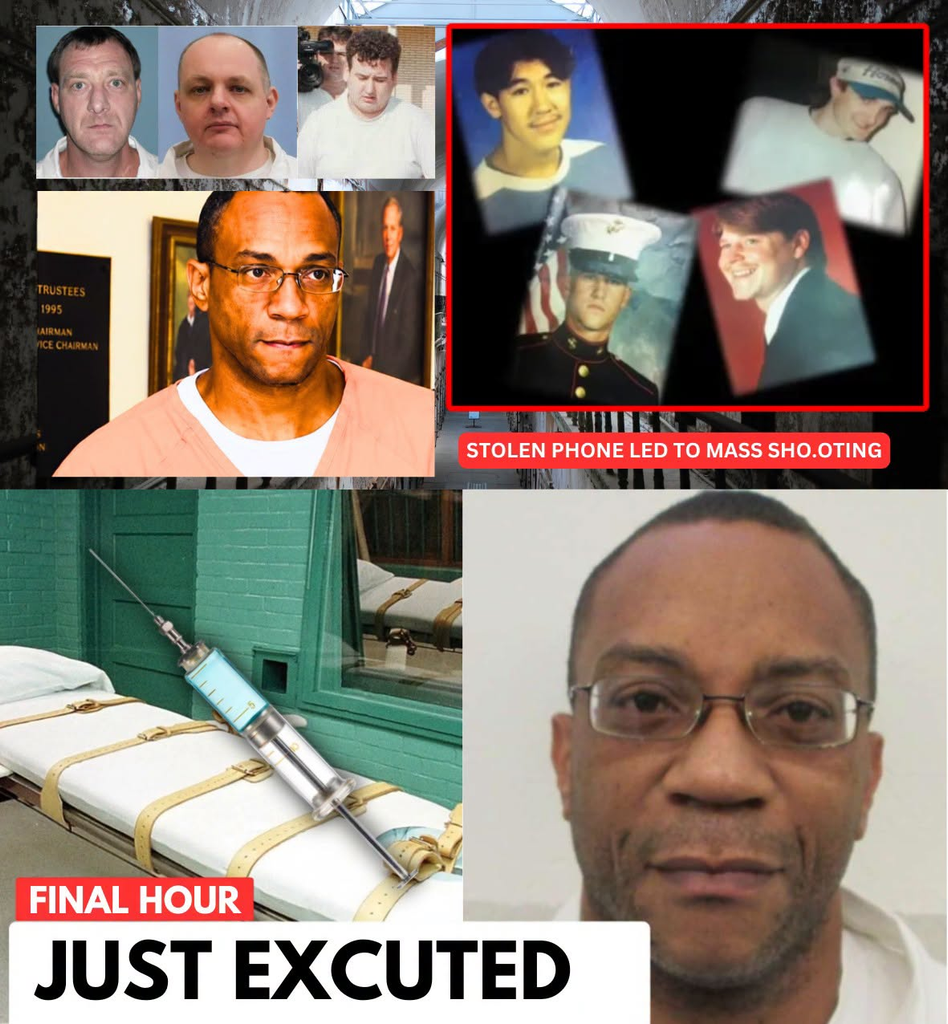
The legal odyssey of Nicholas Bernard Acklin, the Alabama man convicted in the 1996 quadruple homicide known as the “Cell Phone Murders,” has reached a definitive juncture. After 27 years of appeals, the Supreme Court of the United States has declined to hear his final petition, leaving his death sentence intact. However, the case is not a simple narrative of justice served; it is a complex web of legal maneuvering, disputed evidence, and a crime that shocked Huntsville to its core.
The brutal events of September 25, 1996, began with a dispute over a stolen mobile phone and a police report, escalating into a two-hour hostage crisis that ended with four young men dead. Acklin, now 53, was convicted and sentenced to death for his role as the primary shooter, but his journey through the courts has been marked by allegations of ineffective counsel, suppressed evidence, and a family conflict that may have shaped his defense strategy.
 The Supreme Court’s rejection of his latest appeal, filed as Nicholas Bernard Acklin v. John Q. Ham, Case No.
25-5145, on October 6, 2025, effectively closes the federal avenue for relief. The denial does not set an execution date, but it clears the final significant legal hurdle that has kept Acklin alive for nearly three decades. The decision confirms that the lower courts’ rulings, which upheld his conviction and rejected claims of prosecutorial and defense misconduct, will stand.
To understand the gravity of this ruling, one must revisit the night that defined a generation of Huntsville residents. At approximately 10:05 PM, seven people were gathered in a small garage apartment on University Drive, a modest space shared by Ashley Rutherford and his fiancée, Michelle Hayden. The atmosphere was casual, with friends watching television and waiting for Rutherford to return from work.
 This ordinary Wednesday evening was shattered when Acklin, Joey Wilson, and Corey Johnson, all armed, forced their way inside.
The intruders were not there for robbery; they were seeking retribution. Days earlier, Rutherford and Charles Lamar Hemphill had filed a police report regarding a stolen cell phone, a device that had been traced to Wilson. The trio believed a warrant had been issued, a misconception that fueled their rage.
For nearly two hours, the hostages were subjected to a harrowing ordeal of physical and psychological torture, including beatings, threats with firearms, and forced humiliation.
 The violence escalated as the captors demanded answers that the victims could not provide. Acklin, using a . 357 Magnum, forced the barrel into Rutherford’s mouth and held it under Michael Boddie’s chin.
The hostages were forced to strip to their underwear, and Acklin repeatedly took Hayden outside, where he sexually assaulted her. The situation was a powder keg, and at approximately 11:30 PM, the powder ignited. Acklin and Wilson opened fire, unleashing 19 rounds from 9mm pistols into the cramped space.
The gunfire was indiscriminate and lethal. Acklin fired the first shot, striking Rutherford in the back of the head. He then shot Hemphill, Johnny Couch, and Boddie, all in the head.
Wilson targeted Bryan Carter, firing six shots into his neck and chest. Hayden was shot in the face, arm, and abdomen but survived. Mike Skirchak, who had been forced back inside earlier, managed to escape through the back door during the chaos, emerging as the only unharmed survivor.
The scene was one of utter devastation, with four young men dead and two others critically wounded.
 In the aftermath, the investigation moved swiftly. Acklin was arrested at his mobile home within hours, where police found Boddie’s driver’s license in his pocket, a direct link to the hostage-taking. The recovery of multiple firearms, including the .
357 Magnum and two 9mm pistols, further cemented the case against him. The evidence was overwhelming, leading to his conviction in October 1998 on four counts of capital murder and two counts of attempted murder. The jury recommended death, and the judge concurred, describing the killings as a “massacre” and noting Acklin’s apparent lack of remorse.
The legal battles that followed were as intense as the crime itself. Acklin’s defense team argued that his trial was compromised by a conflict of interest. They claimed that his father, who was funding the defense, threatened to stop payments if evidence of childhood 𝓪𝓫𝓾𝓼𝓮 was introduced, fearing it would tarnish the family name.
This allegation became the cornerstone of his post-conviction appeals. In 2013, a hearing was held to examine these claims, with family members testifying about a violent and abusive upbringing, a stark contrast to the loving home depicted during the original sentencing phase.
The state countered that Acklin himself had instructed his attorneys not to present such evidence. The conflicting testimonies created a legal quagmire. The courts, however, ultimately sided with the prosecution, ruling that the new evidence did not meet the high standard required to overturn a death sentence.
 The Alabama Court of Criminal Appeals affirmed the lower court’s denial in 2017, and the state Supreme Court declined to hear the case in 2018. The Supreme Court’s refusal to intervene in 2025 marks the final chapter in this specific legal saga.
The case has also been defined by the disparate outcomes for the three perpetrators. Joey Wilson, the man whose stolen phone sparked the violence, was also sentenced to death. Corey Johnson, who participated in the assault but did not fire the fatal shots, accepted a plea deal and received a 15-year sentence.
He was released in 2011, only to be arrested again in 2016 for the murder of Candice Wilson, Joey Wilson’s sister. Johnson was subsequently sentenced to life in prison for that crime, a tragic coda to a story already steeped in violence.
For the families of the victims, the Supreme Court’s decision brings a mix of relief and exhaustion. The names of the dead—Charles Lamar Hemphill, Bryan Carter, Michael Boddie, and Johnny Couch—are not forgotten, but the decades of legal proceedings have been a prolonged burden. The garage apartment where the murders occurred was demolished in 2017, erasing the physical site of the tragedy, but the emotional scars remain.
District Attorney Rob Broussard and Sheriff Kevin Turner have both referred to the case as the worst mass murder they encountered in their careers, a testament to its lasting impact on the community.
Acklin remains on death row at Holman Correctional Facility, his status unchanged by the Supreme Court’s denial. The ruling does not mandate an immediate execution date; that decision rests with the state, which would need to secure a warrant from the Alabama Supreme Court. Given the lengthy appeals process that has characterized this case, any potential execution date remains speculative.
The legal system has spoken, but the final act of this tragedy has yet to be written.
© 2026 MZ News — Blog powered by WordPress.