After He Murdered His Family Friend’s 6-Year…
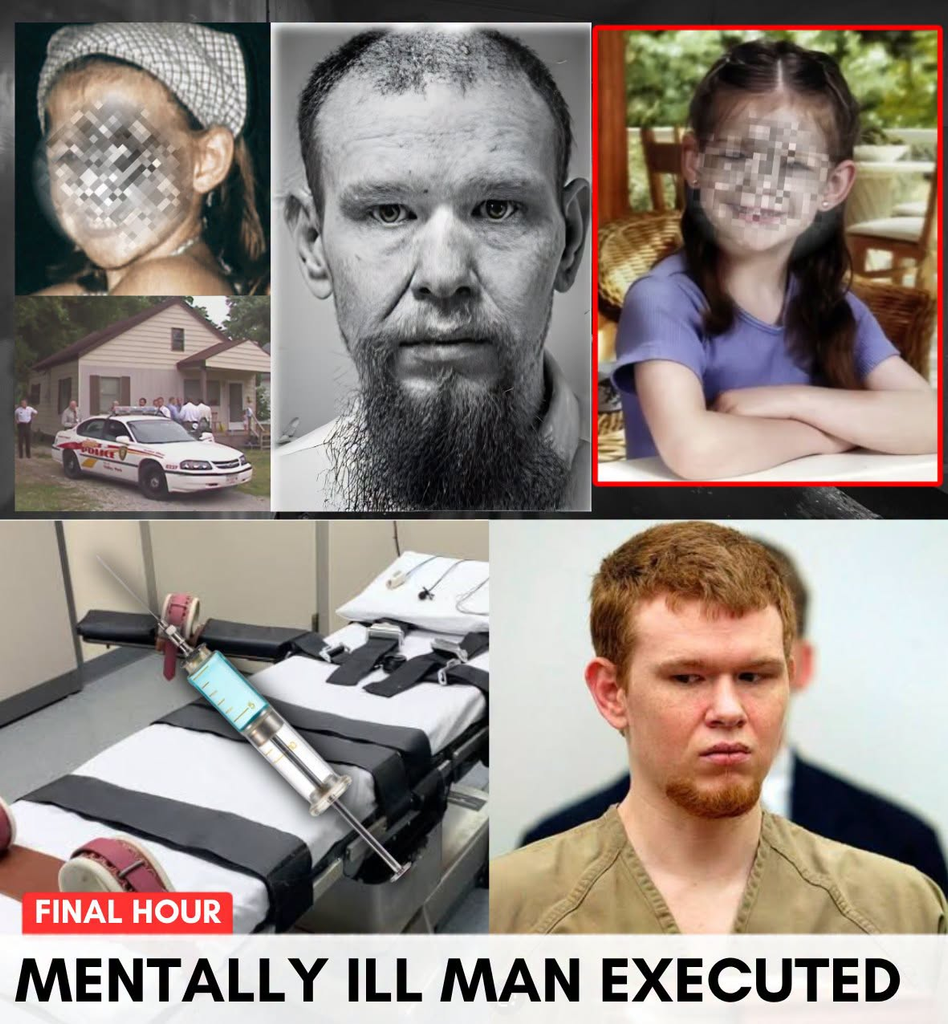
 The state of Missouri executed Johnny Johnson on Tuesday evening, ending a 21-year legal battle over the fate of a man diagnosed with severe mental illness who brutally murdered six-year-old Casey Williamson in 2002. The execution by lethal injection was carried out at 6:33 p. m.
Central Time at the Eastern Reception, Diagnostic and Correctional Center in Bonne Terre, just hours after the U. S. Supreme Court rejected a last-ditch appeal arguing that Johnson was too mentally ill to understand why he was being put to death.
Johnson, 45, was pronounced dead after receiving a single dose of pentobarbital. He had been convicted of first-degree murder for the July 26, 2002, killing of young Casey, the daughter of a family friend who had allowed him to sleep on their couch after a backyard barbecue. The case became a flashpoint in the national debate over capital punishment and mental illness, drawing attention from human rights organizations, religious leaders, and three dissenting Supreme Court justices who warned that the state was about to execute a man whose comprehension of his own fate was fundamentally compromised.
The execution nearly did not happen. In the final hours before Johnson was scheduled to die, his legal team filed an emergency appeal with the nation’s highest court, arguing that decades of untreated schizophrenia had left him incapable of rationally understanding the connection between his crime and his punishment. According to a neuropsychiatrist hired by the defense, Johnson believed that the devil was using the state of Missouri as a tool to bring about the end of the world, and that his execution was part of a cosmic battle rather than a legal consequence of murdering a child.
The Supreme Court’s conservative majority rejected the appeal without comment, but Justices Sonia Sotomayor, Elena Kagan, and Ketanji Brown Jackson filed a blistering dissent. Sotomayor wrote that Johnson had presented substantial evidence of his incompetence, including decades of documented psychiatric history and a detailed evaluation from a medical expert, and that he deserved a hearing before any court allowed the execution to proceed. She warned that the majority’s decision cleared the way for the execution of a man with documented mental illness before any court had seriously investigated whether he understood what was happening to him.
The legal battle over Johnson’s mental state had been building for years. Born with developmental delays and suffering multiple head injuries before age ten, Johnson was first institutionalized at fourteen and had been hospitalized four separate times by the age of eighteen. He was eventually diagnosed with schizoaffective disorder, a condition that combines the hallucinations and delusions of schizophrenia with severe mood disturbances.
In the months before Casey’s murder, Johnson had stopped taking his medication and was exhibiting increasingly erratic behavior that worried his family, though no one anticipated the violence that would follow.
On the night of July 25, 2002, Johnson attended a neighborhood barbecue at the Williamson family home in Valley Park, a small, tightly knit community southwest of St. Louis. The family had known Johnson for years—his older sister had grown up with Casey’s mother, who had even helped care for Johnson when he was a boy.
When the party ended and Johnson had nowhere to go, the family offered him their couch, as they had done many times before. Casey, a bright and energetic six-year-old who was the eldest of her mother’s children, went to sleep in her bedroom, surrounded by people who loved her.
The next morning, Casey’s father, Ernie Williamson, saw his daughter in the kitchen around 7 a. m. , still wearing her nightgown.
It was a mundane moment, a father glimpsing his child at the start of an ordinary day. It would be the last time he saw her alive. When he realized she was gone, panic set in.
Casey was not in her room. She was not in the yard. And Johnny Johnson, the family friend who had spent the night on the couch, was also gone.
Witnesses soon reported seeing a man matching Johnson’s description walking through the area that morning, carrying a small girl on his shoulders. Investigators found Johnson later that day, and he confessed almost immediately, leading them to the abandoned glass factory on the outskirts of town where he had taken Casey. In his confession, Johnson admitted to luring the child away from the home, taking her to the factory, and attempting to sexually assault her.
 When she screamed and fought back, he killed her. He then went to the nearby Meramec River, apparently trying to wash away evidence before he was found.
The confession and the physical evidence left no doubt about what had happened, but the question of Johnson’s mental state would consume the courts for more than two decades. At trial, his defense team did not deny that he had killed Casey. Instead, they argued that his severe and chronic mental illness had impaired his ability to form the intent required for a first-degree murder conviction, and that this should be weighed heavily in determining whether he deserved life or death.
The prosecution, while acknowledging Johnson’s diagnosis, presented expert testimony that he was capable of rational thought and understood what he was doing at the time of the crime.
In March 2005, a jury convicted Johnson of first-degree murder and sentenced him to death. Over the following years, his case wound through the appeals process, with his attorneys challenging the conviction and sentence on multiple grounds, including the adequacy of the state’s expert testimony and the failure to disclose information that could have undermined a prosecution witness. As the years passed, the focus of the appeals shifted to a different and more specific question: whether Johnson, after two decades of untreated or inadequately treated mental illness on death row, still understood why the state intended to execute him.
The legal standard governing this question dates back to the Supreme Court’s 1986 decision in Ford v. Wainwright, which held that executing a person who has lost their sanity violates the Eighth Amendment’s prohibition on cruel and unusual punishment. Two decades later, in Panetti v.
Quarterman, the Court clarified that this standard extends not only to those who are unaware of their crime or punishment, but also to those whose mental illness so distorts their thinking that they lack a rational understanding of the connection between the two. Johnson’s attorneys argued that he met this standard, citing his belief that the devil was using Missouri as an instrument of apocalyptic prophecy.
The state pushed back forcefully. The Missouri Attorney General’s office challenged the credibility of the defense’s psychiatric evaluation, pointing to prison mental health records indicating that Johnson had never exhibited the specific hallucinations or delusional beliefs described in the petition. The head of mental health services at Johnson’s prison testified that his condition, however severe, had never manifested in the way his lawyers now claimed.
The Missouri Supreme Court rejected Johnson’s incompetence claim, ruling that he had not met the legal threshold for a stay of execution on those grounds.
In the days leading up to the execution, the case drew widespread attention. Missouri’s Catholic bishops, along with other religious and civic leaders, sent a letter to Governor Mike Parson requesting clemency, citing Johnson’s documented mental illness and broader concerns about the use of capital punishment. A papal representative also sent a separate letter on behalf of the Vatican.
None of it changed the outcome. On the Monday before the scheduled execution, Governor Parson formally denied Johnson’s clemency request, describing the crime as one of the most horrific he had ever reviewed.
 The execution proceeded as scheduled, with members of Casey Williamson’s family among the witnesses, along with the former prosecutor and one of the original investigators who had worked on the case in 2002. Witnesses described Johnson turning his head as if listening to his spiritual advisor during the preparation for the lethal injection. He was given a single dose of pentobarbital, and at 6:33 p.
m. , he was pronounced dead. He was the fourth person executed in Missouri that year and the sixteenth in the United States in 2023.
Johnson’s final statement, released by the Missouri Department of Corrections in the hours before his death, expressed remorse. “I am sorry for what I did,” he wrote. “I apologize to the people and family of Casey Williamson for the harm I caused them.”
But the family was not unified in their feelings about the execution. Casey’s father, Ernie Williamson, had stated his personal opposition to the death penalty during the clemency proceedings, even in his daughter’s case. Other family members felt differently.
Casey’s great-aunt, Della Steele, wrote a heartfelt letter to the governor urging him to allow the execution to proceed, describing the devastating impact the murder had on the family over two decades and arguing that allowing the execution sent an important message that harming a child has severe and lasting consequences.
Casey’s mother, who had spent years following the case through the courts, told reporters in the days before the execution that she was, in her words, ready to close this chapter of her life. The family’s grief had already taken a profound toll. Casey’s older sister, who was twelve at the time of the murder, struggled for years afterward and died in 2015 of a 𝒹𝓇𝓊𝑔 overdose, a loss the family partially attributed to the unhealed grief over Casey’s death.
Casey’s two younger brothers, who were only two and four years old when she died, grew up with psychological struggles and complicated relationships. Even Casey’s grandfather, according to family accounts, turned to alcohol under the weight of his loss and did not live to see the case resolved.
In the years following Casey’s death, her loved ones worked to keep her memory alive in tangible ways. They established a scholarship in her name and organized an annual community safety fair, which began providing child identification kits to local families as a direct and practical response to the tragedy that had taken Casey’s life. For a small community built on the familiarity that made people feel safe, the betrayal was a double blow: the tragic loss of a six-year-old girl, and the realization that the danger had never come from a stranger.
The Johnson case has become one of the most significant modern tests of a question the American legal system has not fully resolved: what is the state’s obligation to a person whose severe mental illness may prevent them from understanding their punishment? Legal scholars have noted that the case fits within a long-running tension in American capital punishment law. The Supreme Court has drawn a firm line prohibiting the execution of certain categories of people outright, such as juveniles and those with intellectual disabilities, based on its evolving view of what constitutes cruel and unusual punishment.
But severe mental illness has never received the same comprehensive protection. Instead, the law poses a narrower, more fact-specific question: not whether a person is mentally ill, but whether their illness has progressed to the point where they can no longer rationally understand the connection between their crime and their punishment.
 It is a standard that requires courts to make individualized, nuanced judgments, often based on conflicting expert evaluations that can reach vastly different conclusions from the same set of facts. Johnson’s case became one of the most closely watched examples of how difficult these judgments are and what is at stake when they are made. The dissenting justices warned that the country was on the verge of executing a man before anyone had confirmed his understanding of what was happening to him.
The majority disagreed, and the execution went forward.
Outside the courthouse in Bonne Terre, representatives of Casey Williamson’s family gathered on the evening of August 1 to witness the execution. For them, and for the investigators and prosecutors who had spent countless hours over more than two decades building the case, the execution closed a chapter that had occupied a significant portion of their lives. For the community of Valley Park, the abandoned glass factory where Casey’s body was found had been demolished in 2012, a physical erasure of the site associated with that terrible morning.
But the memory of Casey Williamson, and the questions her death raised, remain.
The legal questions raised by Johnson’s case about mental illness and the death penalty are far from settled, and they will almost certainly arise again in future cases, argued by lawyers standing in the same positions where Johnson’s attorneys stood. The grief caused by his crime for a family in Valley Park, Missouri, did not end when the courts finished considering all the appeals, nor did it end at 6:33 p. m.
on August 1, 2023. Grief of that magnitude does not disappear according to a court schedule; it changes shape over the years, from sharp and immediate pain to something families learn to carry slowly and imperfectly.
What this case leaves behind more than anything else is a set of questions with no easy answers. How should a justice system assess the responsibility of a person whose mind was affected by illness before any harm was done? What does accountability look like when the person being held accountable does not fully understand why?
And what do we owe to families like the Williamsons? Not just in the form of a verdict or a sentence, but in the decades of support that most of them never fully received once the cameras and the courtrooms moved on to the next case. These are not questions this story can answer, but they are the questions the case itself leaves open, as so many similar cases do.
What remains in the end is not the legal argument or the execution itself, but a six-year-old girl who loved her family, spent an ordinary summer evening at a backyard barbecue, and was missed by those who loved her for more than two decades. Her family turned that absence into a scholarship, a safety fair, and identification kits aimed at protecting other children in ways Casey never had the chance to be protected. That, more than any court ruling or execution order, is the legacy this case leaves behind.
And it is the part of this story most worth remembering.
© 2026 MZ News — Blog powered by WordPress.