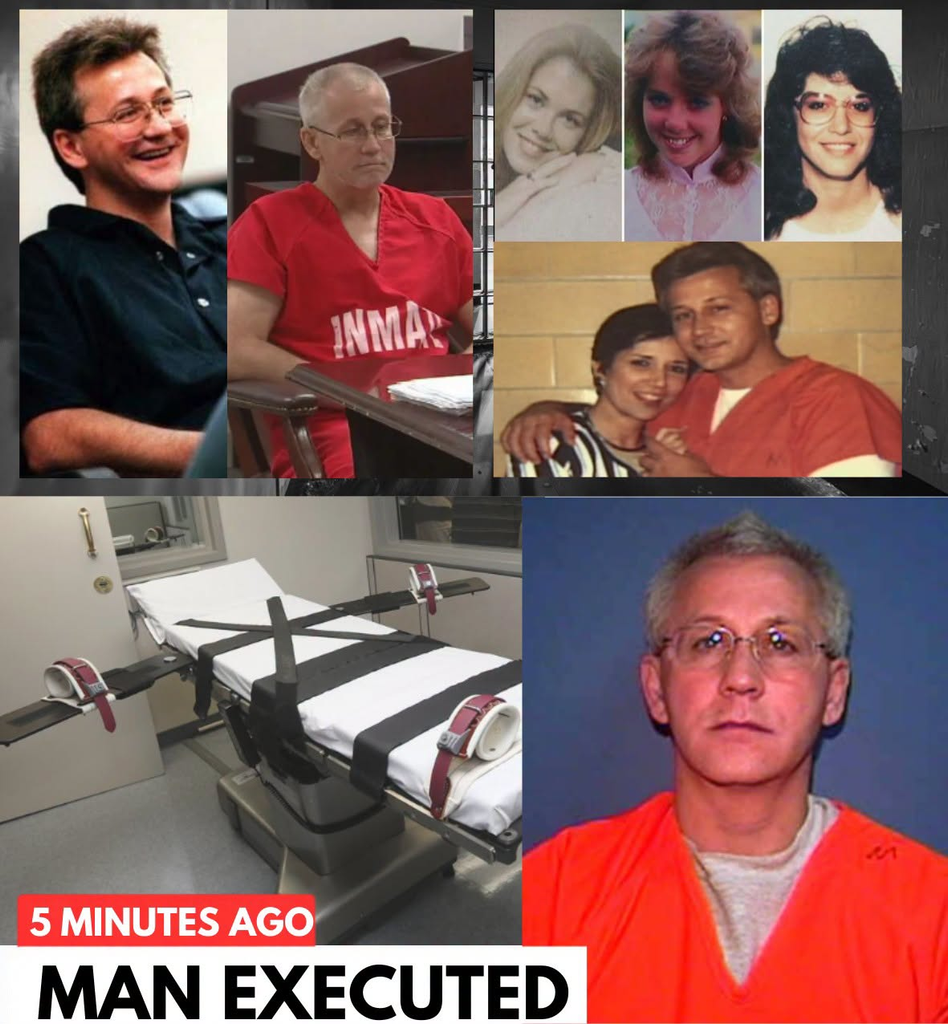
Just IN: Florida EXECUTES Oscar Ray Bolin – Serial Killer of 3 Women | His Last Meal + Final Words..
 STARKE, Fla. — The state of Florida ended the life of Oscar Ray Bolin Jr. with a lethal injection at 10:16 p.
m. on Thursday, closing a 30-year legal saga that spanned ten separate jury trials, three death sentences, and a marriage that turned a prominent attorney’s wife into the convicted killer’s most vocal advocate.
Bolin, 53, was pronounced dead at Florida State Prison after a 12-minute procedure that began at 10:05 p. m. , following a last-minute rejection of his final appeal by the U.
S. Supreme Court without comment. He declined to make a final statement, answering the warden’s inquiry with a simple, “No, sir.”
The execution was carried out for the 1986 murder of Terry Lynn Matthews, a 26-year-old bank worker who was abducted from a Pasco County post office parking lot with her car engine still running and keys in the ignition. But the families of two other victims—Natalie Blanche Holley and Stephanie Collins—were present in the witness room, having waited nearly three decades to see the man convicted of killing all three women face the ultimate penalty.
Kathleen Reeves, Matthews’ 78-year-old mother, had outlived her husband and three of her children while fighting through three separate trials for her daughter’s murder. She told reporters after the execution that she had brought the signed death warrant to her daughter’s grave earlier that year, rolling it up between flower stems as a final offering. “We miss you, Terry.
You were the sunshine in our lives. Rest in peace, my darling daughter,” she said outside the prison gates.
Donna Whitmer, mother of 17-year-old Stephanie Collins, who was abducted after her shift at a Tampa drugstore and found wrapped in sheets off Morris Bridge Road, said she stood in the Florida night and declared, “We all miss Stephanie every day. I can’t have her back, but I’ll have sweet memories.”
Bolin’s execution was the first in the United States in 2016, and it came only after the U. S. Supreme Court rejected his final appeal at approximately 10:00 p.m. , leaving the families and prison officials in a tense, hours-long wait that began at the scheduled 6:00 p. m.
 start time. The delay was the latest in a case defined by procedural twists, overturned convictions, and a defense strategy that repeatedly pushed the legal system to its limits.
The condemned man’s final hours were spent in relative calm, according to prison officials and his spiritual adviser, Brother Dale Recinella, who described Bolin as “in good spirits” during a two-hour visit. His last meal consisted of a ribeye steak cooked medium rare, a baked potato with butter and sour cream, a salad of iceberg lettuce, cucumber, and tomato, baked garlic bread, lemon meringue pie, and a bottle of Coca-Cola. He ate half the steak, half the potato, nibbled at the salad, drank half the Coke, and finished the pie.
The night before his execution, Bolin sat for a recorded interview with Fox 13 Tampa Bay and maintained his innocence with unshakable conviction. “I did not murder these women. My conscience is clear.
After 28 years of this, being in this box for 28 years, it’s a release. They can’t hurt me no more,” he said.
When asked whether his execution would bring peace to the victims’ families, he offered no comfort. “Is it going to change anything for them? When they wake up the day after, is anything going to be different?
Now, I’m not going to be there. Where’s the focus of their anger now? They’re still going to be without their child.
They’re still going to be numb,” he said.
He expressed no remorse, no acknowledgment of the women whose lives he was convicted of taking, and no regret beyond the loss of his own freedom. His wife, Rosalie Bolin, did not attend the execution. She released a written statement through her attorney saying she was “heartbroken” and that the execution would “create a set of invisible victims.”
The case against Bolin began to take shape in 1990, nearly four years after the three murders, when an anonymous tip to an Indiana Crime Stoppers line identified him as the perpetrator. The tip came from the new husband of Cheryl Hefner, Bolin’s ex-wife, who had divorced him in 1989 after their marriage collapsed under the weight of his violent history.
Cheryl Hefner had first gone to authorities in 1982, claiming Bolin had kidnapped her and driven her around the Tampa Bay area for hours without her consent. The charge was dropped, and the two married the following year. She later told investigators that she had been with Bolin on the night Natalie Holley was killed and had helped him dispose of evidence afterward.
Bolin’s teenage half-brother, Philip, also came forward, describing how he had watched his older brother slit Terry Matthews’ throat, beat her head until it was unrecognizable, try to drown her with a garden hose, and strike her with a wooden club in a field near the post office where she had stopped on her way home from work.
 The first convictions came in 1991, but the Florida Supreme Court overturned all three in 1995 on a technicality: Cheryl Hefner’s testimony about Bolin’s confession was deemed inadmissible because she was still legally married to him at the time of the confession, making it protected under spousal privilege. The court ruled that without her testimony, the foundation of the prosecution’s case was legally compromised.
What followed was an extraordinary legal marathon. Bolin was tried and convicted ten times by ten separate juries across three decades. He was tried three times in the Matthews case, three times in the Collins case, and four times in the Holley case.
Every single jury returned a guilty verdict. Every single conviction was upheld on appeal, only to be overturned on procedural grounds and retried.
In the Collins retrial, FBI hair and fiber analyst Michael Malone testified that black wool fibers from Bolin’s truck were found at all three crime scenes, and that hair evidence matched Bolin to the Collins murder. The testimony was presented as rigorous science, and jurors had no reason to doubt the credentials of a senior FBI laboratory analyst.
But in 2014, the Office of the Inspector General of the Justice Department released a report stating that Malone had “repeatedly created scientifically unsupportable laboratory reports” and had provided “false, misleading, and inaccurate testimony” in criminal trials. Bolin’s case was among 52 flagged for review. The evidence that had helped convict him had been produced by a man the federal government formally identified as a fabricator.
Rosalie Bolin, who had been assigned to Bolin’s case as a mitigation specialist for the Hillsborough County Public Defender’s Office in 1994, seized on the revelation. She had already become convinced of his innocence, telling anyone who would listen that she had “looked into the eyes of thousands of criminals” and that Bolin lacked the “darkness” she saw in others.
She left her husband, a prominent Tampa attorney, and her four daughters to marry Bolin over the telephone on October 6, 1996, in a ceremony witnessed by 12 million television viewers. She wore a wedding dress in her apartment while he wore a prison-issue orange jumpsuit on death row. Three days later, he was sentenced to death again for the Matthews murder.
Rosalie trained as a private investigator and spent the next 20 years building a case for his innocence, presenting it to any media outlet that would listen. She told people that the notoriety of their union would afford Bolin “a rich man’s justice.” The victims’ families watched in horror as she became a television fixture, proclaiming the innocence of the man convicted of killing their daughters.
Anita Holley, sister of Natalie Blanche Holley, who was stabbed ten times in the chest and throat and left in an orange grove in January 1986, said of Rosalie, “She actually went on national television proclaiming his innocence. She was enjoying the notoriety and that just, oh my goodness.”
Kathleen Reeves said, “It was taking the attention off what he had done and putting it on the criminal. Like he was some sort of superstar and she was the superstar’s angel.”
Bolin’s attorneys filed for a new trial based on the discredited FBI evidence, also pointing to an Ohio prison inmate named Steven Kasler who had confessed to the murder of Terry Matthews. Prosecutors countered that Kasler had a history of false confessions, having previously claimed responsibility for other crimes he did not commit. Kasler committed suicide in late 2014 before a hearing could be held, and the confession died with him.
The courts denied the motion for a new trial. In the final years of his life, one verdict did change: a new jury in the Holley case found Bolin guilty of second-degree murder rather than first-degree, converting his death sentence for that killing to life in prison. But the death sentences for the Matthews and Collins murders stood.
Governor Rick Scott signed the death warrant in October 2015, specifically for the murder of Terry Lynn Matthews. The execution was scheduled for January 7, 2016, at 6:00 p. m.
The families drove to Florida State Prison in Starke, prepared to witness the end of the man who had taken their daughters.
The morning of the execution, Bolin met with Rosalie from 8:00 a. m. until 11:00 a.
m. The content of that three-hour conversation was not made public. He then met with his spiritual adviser from noon until 2:00 p.
m. before receiving his last meal.
At 6:00 p. m. , the execution did not begin.
 The U. S. Supreme Court had agreed to review his final appeal for a stay.
The families sat and waited. The prison sat and waited. The state sat and waited.
Kathleen Reeves, who had been told to wait for 30 years, said, “I’m always prepared for Rosalie to pull a rabbit out of the hat.”
At approximately 10:00 p. m. , the U.
S. Supreme Court rejected the appeal without comment. No explanation.
No dissent published. Just the rejection issued into the night at the last possible hour.
The lethal injection procedure began at 10:05 p. m. There were 36 witnesses.
The families of all three victims were in the room. They sat and watched in silence as Bolin’s chest heaved for several minutes, taking a series of deep, slow breaths. The procedure lasted approximately 12 minutes.
At 10:16 p. m. , Oscar Ray Bolin Jr.
was pronounced dead. He was the first person executed in the United States in 2016.
Outside the prison, tears rolled down the face of Bolin’s attorney, Bjorn Brunvand, as he spoke to reporters. “I cannot imagine the pain the families have suffered, but this is not the solution. Executing people is barbaric, and I don’t think it’s healthy for us to find joy in a healthy human being being executed,” he said.
Kathleen Reeves had a response to the question of whether justice had been served, even though Bolin was only executed for one of the three murders. “It doesn’t matter. He only dies once,” she said.
The case leaves behind questions that no verdict, no matter how many times it was delivered, ever fully resolved. Ten juries convicted Oscar Ray Bolin. Ten separate groups of citizens heard the evidence and said guilty every single time across 30 years of retrials and appeals.
The half-brother who witnessed the murder of Terry Matthews, the ex-wife who confirmed the confession, the cousin who admitted his role in the Texas killing—these were not discredited witnesses.
But the FBI analyst who handled the hair and fiber evidence in all three cases was formally identified by the federal government as a man who fabricated laboratory reports and lied under oath in criminal trials. His evidence helped send Bolin to death row. That same evidence was found unreliable, and the state executed Bolin anyway.
The Ohio inmate who confessed to the Matthews murder killed himself before a hearing could be held. The confession died with him and was never tested. Rosalie Bolin spent 20 years of her life, left her four daughters, left her marriage, trained as a private investigator, and dedicated everything she had to the claim that the state of Florida was about to execute an innocent man.
She was not a naive person. She was not someone who had read a news story and formed a quick opinion. She was someone who had reviewed every document, every photograph, every measurement, who knew the case better than almost anyone alive.
She pointed to shoe prints at one crime scene that were a size 10, while Bolin wore a size eight.
 Was she right? Ten juries said she was wrong. Was she wrong?
The FBI analyst who handled the evidence was later proven to have lied in dozens of cases, and Bolin was executed before anyone could fully examine what that meant.
Kathleen Reeves visited her daughter’s grave and brought the death warrant inside the flowers. It was the last thing she could do for her. She said it herself: “He only dies once.”
And if she is wrong about who died in that chamber, there is no way to undo it.
The execution of Oscar Ray Bolin Jr. closed a chapter in Florida’s criminal justice history, but it did not close the debate over whether the state got it right. The families of Natalie Holley, Stephanie Collins, and Terry Lynn Matthews have their answer.
The state of Florida has its answer. But the questions raised by this case—about the reliability of forensic evidence, the finality of the death penalty, and the lengths to which a convicted killer will go to avoid accountability—remain open.
Bolin was convicted of murdering three women in 1986, all in the Tampa area, all stabbed to death, all abducted from the routine moments of ordinary lives. A restaurant parking lot at 1:30 in the morning. A drugstore at the end of a shift.
A post office with the engine still running. The state of Florida put a needle in his arm on January 7, 2016, and ended his life.
The women he was convicted of killing did not have the luxury of a final meal, a final statement, or a final appeal. Natalie Holley was 25 years old when she was stabbed ten times and left in an orange grove. Stephanie Collins was 17 years old when she was stabbed to death and her skull crushed, her body wrapped in sheets and towels off the side of Morris Bridge Road.
Terry Lynn Matthews was 26 years old when she was slit across the throat, beaten, and drowned with a garden hose in a field near a post office.
They were all in the process of becoming the people they were going to be. Natalie was the night manager at a Church’s Fried Chicken restaurant. Stephanie was a student at Chamberlain High School balancing school and a part-time job.
Terry was working nights at a bank so she could spend her days taking scuba diving lessons, and she had just bought a mobile home she was fixing up to move out of her parents’ house.
Their families spent 30 years waiting for justice. They sat through ten trials. They watched a convicted killer marry a woman who gave up everything to defend him.
They watched the legal system overturn convictions and order retrials. They watched an FBI analyst’s testimony be discredited. They watched an Ohio inmate confess to one of the murders and then die before his confession could be tested.
And on the night of January 7, 2016, they watched Oscar Ray Bolin Jr. take his last breaths in the execution chamber at Florida State Prison. Kathleen Reeves said goodbye to her daughter.
Donna Whitmer said she would have sweet memories. Anita Holley’s mother had died in 2012, four years before the execution, and did not live to see it.
Rosalie Bolin did not come to the prison. She released a written statement saying she was heartbroken, and that the execution would create a set of invisible victims. Her attorney, Bjorn Brunvand, wept outside the prison and called the execution barbaric.
The state of Florida called it justice. The families of the victims called it closure. Oscar Ray Bolin Jr.
called it a release. “They can’t hurt me no more,” he said the night before he died.
He was wrong about that. The state of Florida hurt him in the most final way possible. But the questions he left behind will outlive him, and they will continue to hurt everyone who has to ask them.
© 2026 MZ News — Blog powered by WordPress.