
ByMichele Debczak|Oct 15, 2024, 2:53 PM EDT
 Add us as a preferred source


Sesame Street has explored some sensitive topics over the years, but few episodes were as controversial as the one PBS aired—and quickly pulled—in 1976. Episode 847 features Margaret Hamilton reprising her role as the Wicked Witch of the West nearly four decades after The Wizard of Oz (1939) premiered. The episode was banned for being “too scary” for kids, and for decades it was difficult to find. Now, as the AV Club reports, this piece of lost media has been made available to view online.
Margaret Hamilton’s Sesame Street appearance was uploaded to YouTube on June 18, and it’s already received close to 275,000 views (and counting). In the segment, the infamous witch loses her broomstick, threatens to turn Big Bird into a feather duster, and charms Oscar the Grouch. Compared to the flying monkeys scene in The Wizard of Oz, the episode feels pretty tame.https://www.youtube.com/embed/nZ2hzAW2O4g?feature=oembed
But many parents thought differently when it premiered in 1976. PBS was bombarded with complaints of the character traumatizing preschool-age viewers. Though the episode was reportedly meant to teach kids about overcoming their fears, the network gave in to the backlash. After airing only once, it was pulled from syndication permanently.
Though it’s categorized as lost media, Episode 847 of Sesame Street hasn’t been impossible to view. It’s archived at the Library of Congress, and grainy recordings have surfaced online in recent years. This newest upload is notable for its high quality. If ’70s kids have been searching for the lost footage since their childhood, this video is as close to the original as they’re likely to get. The clip also proves that the banned episode isn’t quite as horrifying as its reputation suggests.
[h/t AV Club]
Related Tags
Quiz: Which ‘Little House on the Prairie’ Character Are You?
Find out which pioneer best matches your personality with this eight-question quiz!
ByNitya Rao|Jul 18, 2026, 8:00 PM EDT

Before we had the “tradwife” trend, we had Little House on the Prairie, where living off the land was the norm rather than the niche lifestyle it is today. The sweeping plains of Independence, Kansas, from Laura Ingalls Wilder’s original novel to the 2026 Netflix adaptation, remain the same. Yet, somehow, the world was an entirely different place. It was a world where survival required just as much pluck as it did positivity.
In the series premiere, Pa tells Laura that “hope is everything,” a profound sentiment she eventually echoes back to him by the season finale. And while the unpredictability of life on the prairie probably calls for a prayer or two, Ma reminds us that it isn’t always a bad thing. In Episode 4, she insists that “an uncertain life is full of possibilities.”
Maybe you relate to Ma’s realism, or perhaps you’re more like Pa, rose-colored glasses and all. Then there are the Lauras of the world who would rather be traipsing through the tallgrass than thinking about the perplexities of pioneering. Dr. George Tann’s charisma, Mary’s perfectionism, and John Edwards’ mysteriousness fill in the blanks. We may have evolved from bonnets to baseball caps, but each of us has an inner pioneer personality that persists.
Are you ready to find your place within the covered wagon? Take this quiz to discover which Little House on the Prairie character captures your true colors.
Which pioneer mirrors your personality the most? Each and every member of the community is resilient, passionate, and inspiring in their own way. Share this personality quiz with your family and friends to find out if you’re the same Little House on the Prairie character, or if you have the perfect balance of traits to brave the frontier together!
The Evolution of the Little House Legacy
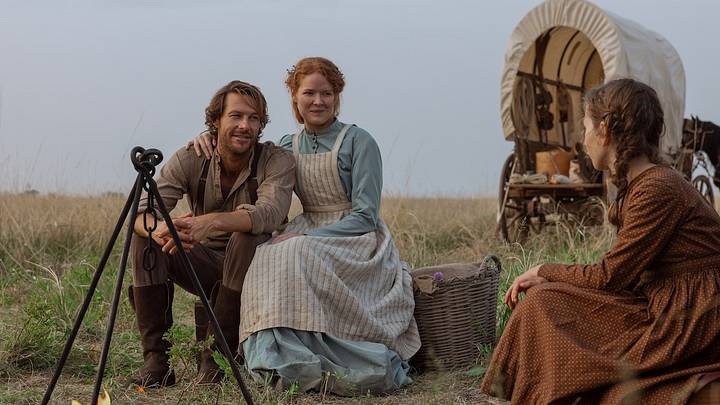
If you were raised on Little House reruns, odds are you have a favorite memory of life on the prairie. But before it became the next big thing to stream, Little House on the Prairie was a product of pen, paper, and fuzzy frontier flashbacks. That was roughly the recipe that Laura Ingalls Wilder used to craft the autobiographical book Little House in the Big Woods in 1932.
It was this coming-of-age tale that gave readers a tiny taste of the family’s cozy yet chaotic world of handcrafted log cabins and homemade maple sugar. Much like the staple pioneer sweet, one bite—and book—simply wasn’t enough. Over nearly a century, that opening chapter spawned eight more original novels, a 1970s TV series, and, most recently, a Netflix series offering a visually richer, realistic take on frontier life.
Along the way, generations of fans hitched their wagons to Laura’s fiery spirit and Mary’s quiet strength, while looking to Ma and Pa as the blueprint for making a house a home. From the page to the screen, this timeline traces the Little House on the Prairie legacy, showing how each installment puts its own spin on the Ingalls saga:
The Original Book Series
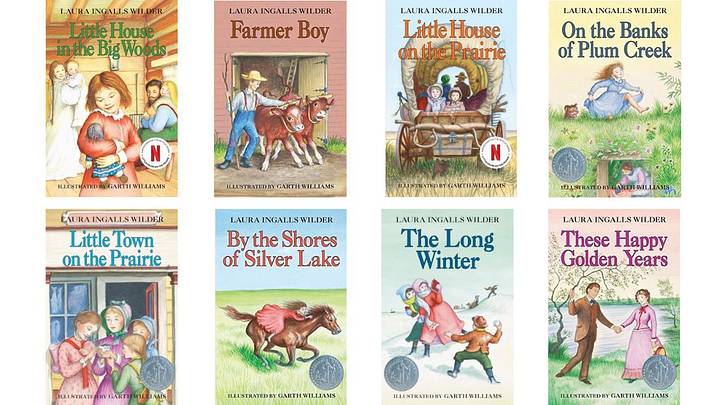
Little House in the Big Woods (1932)
Farmer Boy (1933)
Little House on the Prairie (1935)
On the Banks of Plum Creek (1937)
By the Shores of Silver Lake (1939)
The Long Winter (1940)
Little Town on the Prairie (1941)
These Happy Golden Years (1943)
The First Four Years (1971)
The Screen Adaptations
Little House on the Prairie, NBC Series (1974–1983)
Beyond the Prairie: The True Story of Laura Ingalls Wilder, CBS Movies (2000-2002)
Little House on the Prairie, Disney Miniseries (2005)
Little House on the Prairie, Netflix Series (2026)
We might swap out the actors or change the cinematography, but the heart of the Ingalls family never fails. We keep coming back to them because watchable resilience is rare, whether they’re braving a brutal blizzard or just fighting to keep a roof over their heads. Every reimagining reflects the respective era it was made in, but the overarching theme of holding onto hope through hardship is timeless.
Next: Join Mental Floss’s Geography Quiz Competition
More Personality Quizzes:
•
Quiz: Which ‘Sex and the City’ Character Are You?
•
Quiz: Which Beatles Band Member Are You?
•
Quiz: Which Disney Princess Are You?
•
Quiz: Which Disney Prince Is Your Fairytale Match?
7 Songs You May Not Know Smokey Robinson Wrote
The “King of Motown” was behind major hits by The Supremes, The Temptations, and the Jackson 5.
ByEden Gordon|Jul 28, 2026, 4:00 PM EDT

Smokey Robinson is one of the best-known figures in R&B. Often referred to as the “King of Motown,” Robinson was the founder and frontman of the group The Miracles. He also served as the vice president of Motown Records for years, and went on to launch a legendary solo music career.
Along the way, Robinson has penned a huge number of major hits for other artists. The artist, who once called songwriting his “gift from God,” has written over 4,000 songs, dozens of which have reached the Billboard Top 40. A member of both the Songwriters Hall of Fame and the Rock ‘n’ Roll Hall of Fame, he has a knack for getting to the heart of the human experience with his songcraft.
“What makes a song is a timeless thing,” Robinson once said. “That’s why I very seldom write songs about dances, cars, or political stuff because all that stuff is passé. What’s here today, politically or with cars or dances may be gone tomorrow. I basically write about love and live things because they are always current.”
Here are seven hit songs you may not know Robinson penned.
- “My Girl” // The Temptations
- “Since I Lost My Baby” // The Temptations
- “Ain’t That Peculiar” // Marvin Gaye
- “Who’s Lovin’ You” // The Jackson 5
- “My Guy” // Mary Wells
- “Don’t Mess With Bill” // The Marvelettes
- “Your Heart Belongs to Me” // The Supremes
“My Girl” // The Temptations
This beloved soul classic has soundtracked countless first dances and sweet moments ever since it was released in 1965. It was written by Smokey Robinson and Ronnie White of The Miracles, and helped The Temptations ascend to pop stardom.
For Robinson, the song was a chance to pay tribute to his wife, Claudette. It was also a response of sorts to “My Guy,” the hit song he had written for Mary Wells.
“We were at the Apollo in New York and Smokey came and ran the track down and we rehearsed it,” Temptations member Otis Williams recalled. ‟At the time when he ran the track down, I said, ‘That sounds like it might be something.’ But it really didn’t hit me until we came all the way home [to Detroit], recorded it, and then Smokey put the strings on it. We sat there listening to the playback, and it really sounded like a No. 1. But, you know, it’s very seldom that you can predict a No.1 tune. But at that time, we really felt it would be more of a record that would be a No. 1 than the songs we had recorded before then. And luckily enough, it was.”
The song was The Temptations’ first single with David Ruffin as lead vocalist, and his tender vocals helped give the song some of its signature warmth. Billboard called the song the 10th biggest hit of the year it came out, and the song has remained in regular rotation ever since.
“Since I Lost My Baby” // The Temptations
Another hit that Robinson wrote for The Temptations was “Since I Lost My Baby,” which was a collaboration between Robinson and Miracles member Pete Moore. The song was the third Temptations track to feature Ruffin on lead vocals.
It was also one of Robinson’s personal favorites. “There’s something about that tune that I just set it aside. It wasn’t the biggest commercially, and I can’t put my finger on what I love about it,” Robinson told Loraine Alterman of the Detroit Free Press after the song’s release. Of course, the song did make some waves on the charts, hitting the Top 20 on the Billboard Hot 100 in 1965.
“Ain’t That Peculiar” // Marvin Gaye
In 1965, Marvin Gaye—himself a consummate songwriter—recorded two songs by Robinson: “I’ll Be Doggone” and “Ain’t That Peculiar.” The latter was written with Pete Moore, Bobby Rogers, and Marv Tarplin, and it tells the story of a heartbreaking relationship seemingly built on more lies than truth. It became a huge hit for Gaye, following in the footsteps of the similarly successful “I’ll Be Doggone” and hitting No. 1 on the Billboard Hot R&B Singles chart that year.
“Who’s Lovin’ You” // The Jackson 5
This song was originally recorded by The Miracles in 1960, but it was famously covered by the Jackson 5 in 1969. In a speech at Michael Jackson’s memorial service in 2009, Robinson recalled the first time he heard the cover.
“Berry (Gordy) had this gathering at his house. He said, ‘Come here, I want you to see somebody very special,’” Robinson recalled. “I went over and these five young guys were there, and they sang and danced up a storm. A couple weeks later they recorded my song. I thought to myself: Now they have pulled a fast one on us, because this boy cannot possibly be 10 years old…I quickly went over to him because I wanted to see his birth certificate. I could not believe that someone that young could have that much feeling and soul. He had to know something to sing a song like that. It was wonderful—as a songwriter that’s a dream come true to have someone sing one of your songs like that.”
“My Guy” // Mary Wells
Just weeks after turning 21 in 1964, Mary Wells’ “My Guy” hit No. 1 on the Billboard Hot 100. The Robinson-penned tune became her biggest hit and cemented Wells’ position as one of Motown’s brightest early stars. The song, which was also produced by Robinson, displaced Louis Armstrong’s “Hello, Dolly!” at the top of the charts, and was replaced two weeks after it hit the top by The Beatles’ “Love Me Do.” The Beatles, as it turned out, were major fans of Wells, and she would later go on to tour with them in the UK.
“My Guy” incorporates a calypso rhythm and also drew melodic inspiration from Eddie Heywood’s 1956 instrumental track “Canadian Sunset.” It also became Motown’s first major hit in England. Wells would go on to leave the Motown label, and her career never quite reached the heights of “My Guy” again, but the song remains a shining achievement.
“Don’t Mess With Bill” // The Marvelettes
The Marvelettes were Motown’s first successful female group, thanks to their 1961 single “Please, Mr. Postman.” But by 1965, they needed another hit—and that came in the form of “Don’t Mess With Bill,” which Robinson wrote for the group. The song rose to No. 7 on the Billboard Hot 100, and featured Wanda Young on lead vocals. Robinson also penned and produced several other songs for the group, including “The Hunter Gets Captured By the Game” and “As Long As I Know He’s Mine.”
“Your Heart Belongs to Me” // The Supremes
The Supremes were Motown’s biggest act of all, and Robinson was key to the group’s rise from the very start, helping them land their first audition for Motown Records while they were still a high school singing group.
Robinson also wrote some big hits for the band, including their very first single, “Your Heart Belongs to Me.” The song hit No. 95 on the pop chart and marked the start of the Supremes’ ascension into the stratosphere. Robinson was also behind some of their other triumphs, including 1971’s “Floy Joy” and “I’ll Try Something New,” which was originally recorded by the Miracles and was later recorded by Diana Ross & The Supremes and The Temptations.
Next: Join Mental Floss’s Geography Quiz Competition
Read More:
•
Frank Sinatra’s Least Favorite Frank Sinatra Songs
•
Quiz: How Many Prince Songs Can You Name From a Single Lyric?
•
Whitney Houston’s Favorite Whitney Houston Song
•
Quiz: Can You Name the Song From Its Opening Lyrics? (1950s Edition)