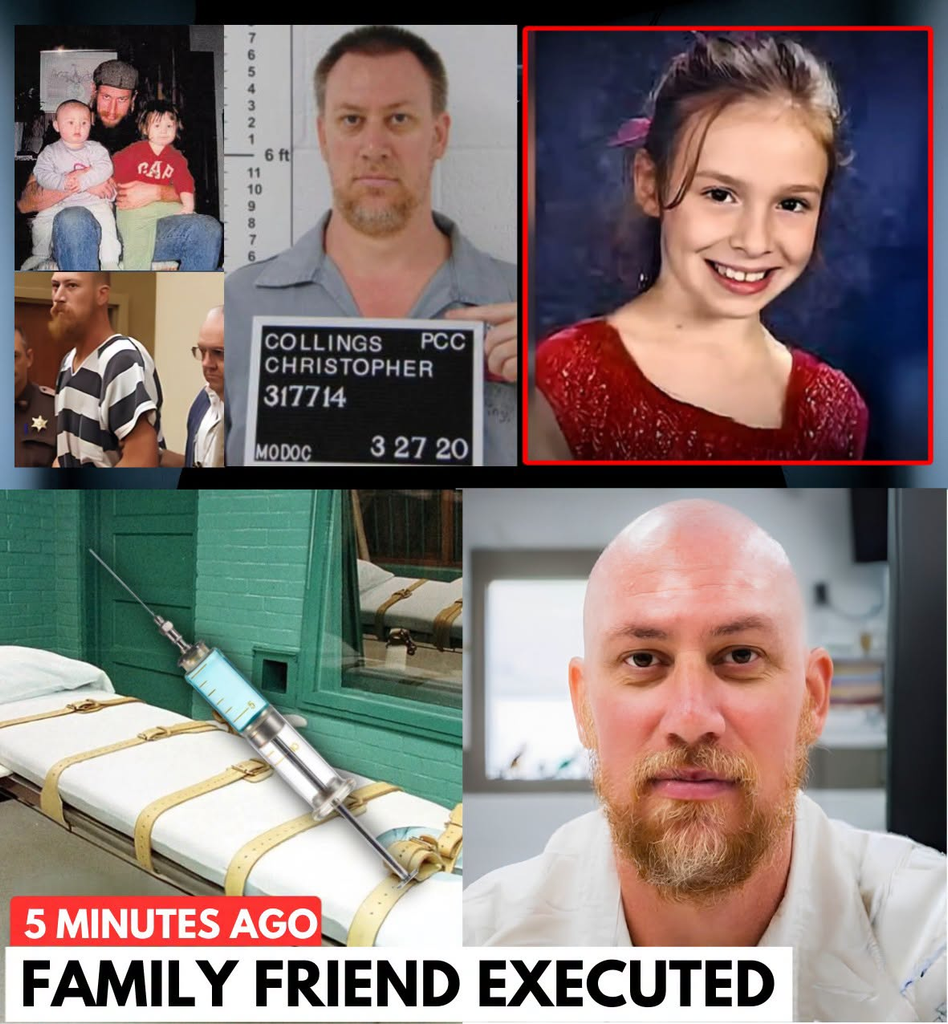
JUST IN : Christopher Collings Executed for Killing 9-Year-Old Rowan Ford | Missouri Death Row Case.
 The sky over Bon Terre, Missouri, had already surrendered to the deep, heavy darkness of a December evening when the state of Missouri carried out the execution of Christopher Leroy Collings. At 6:10 p. m.
on Tuesday, December 3rd, 2024, the 49-year-old man who stood 6 feet 8 inches tall was pronounced dead inside the execution chamber at the Eastern Reception, Diagnostic and Correctional Center. The lethal injection of pentobarbital ended a 17-year legal odyssey that began with the brutal murder of a 9-year-old girl and ended with a final statement of apology read to a silent witness gallery.
The final hours before the execution were a flurry of last-ditch legal maneuvers, all of which failed. Governor Mike Parson denied Collings’ clemency petition on Monday, December 2nd, stating that the conviction and sentence remained for what he called a “horrendous and callous crime.” The United States Supreme Court, in a final emergency appeal filed by Collings’ attorneys, declined to intervene.
With every judicial avenue exhausted and every appeal denied, the state of Missouri prepared to deliver the ultimate punishment for a crime that had haunted the small community of Stella for nearly two decades.
Inside the witness gallery, Colleen Munson, the mother of the victim, Rowan Ford, took her seat. She had waited 17 years for this moment. She was quiet, her gaze fixed on the chamber where the man who confessed to killing her daughter was being prepared for his final moments.
Munson had not looked away when her daughter’s body was found in a remote sinkhole in 2007, and she did not look away now as the state prepared to end the life of the man she held responsible for the death of her little girl.
 The execution of Collings brings to a close a case that has been riddled with controversy, legal questions, and a lingering sense that the full truth of what happened on the night of November 2nd, 2007, may never have been fully told. While the state maintains that justice has been served, the case against Collings was built on a confession that his attorneys argued was obtained improperly, and the prosecution of his co-defendant, David Spears, ended with a plea deal that saw Spears walk free after just seven years in prison, a fact that continues to divide those who followed the case.
To understand the weight of this execution, one must return to the beginning. Stella, Missouri, is a town of a few hundred people, a place where neighbors know each other’s trucks and the concept of locking doors is often an afterthought. It was in this environment that Rowan Damia Ford, a bright fourth-grader at Triway Elementary School, grew up.
Born on April 11th, 1998, in San Diego, California, Rowan was a happy child who loved Barbie dolls, rode a purple bicycle, and was so devoted to her church that she would sometimes walk there alone, without being asked.
Rowan lived in a two-story home with her mother, Colleen Munson, and her stepfather, David Spears. Colleen worked the overnight shift at a Walmart in Jane, Missouri, a schedule that dictated the rhythm of the household. David Spears was a friend of Christopher Collings, a man he had known for nearly a decade.
During the summer and fall of 2007, Collings had even moved into the Spears household, sleeping in the basement while he got back on his feet. To Rowan, Collings was not a stranger; he was “Uncle Chris,” a regular presence who helped her with homework and was a fixture at the dinner table.
In late October 2007, Collings moved out, relocating to his family’s farm in Wheaton, a small community in Barry County, just a short drive from Stella. He set up a travel trailer on the property and continued his friendship with Spears, working odd jobs and drinking together on weekends. The trust that had been built inside the Spears household was about to be shattered in the most violent way imaginable.
Friday, November 2nd, 2007, started like any other day. Rowan went to school, Colleen prepared for her overnight shift, and Spears was around. By the evening, Spears met up with Collings and another friend, Nathan Mahurin, at a farm where they had been working.
The three men stopped at a liquor store, picking up several six-packs of Smirnoff Ice malt liquor, before heading back to the Spears home to drink and play pool. At 8:30 p. m.
, Colleen Munson laced up her shoes and got ready to leave for work. Before she walked out the door, Rowan, who was still awake, ran downstairs to say goodbye, giving her mother a hug and a kiss. It was the last time Colleen would ever see her daughter alive.
The three men continued drinking, making at least three more runs for alcohol over the course of the evening. By the time the night was deep, they had driven to Collings’ trailer in Wheaton, where they smoked marijuana. Collings would later admit to drinking five six-packs of Smirnoff Ice that night, stating he was “really, really effed up.”
Back at the house in Stella, Rowan was alone. She had fallen asleep on the bedroom floor. Three grown men had left her there, unsupervised, in the dark.
Around 10:45 p. m. , the men decided to call it a night.
Mahurin offered to drive Collings home, and they convinced Spears to come along for the ride. On the way, they stopped for one more beer run. Then, heading back toward Stella to drop Spears off, Mahurin, intoxicated and cautious, took the back roads to avoid the risk of being pulled over.
Around 11:30 p. m. , Mahurin and Spears dropped Collings off at his trailer and began the long, slow drive back to Stella.
But Christopher Collings did not go inside his trailer.
According to the confession he would give to law enforcement six days later, Collings got into his own vehicle the moment they left. He drove the direct route, the fast way, back toward Stella. He arrived at the Spears house before Mahurin and Spears got back.
The lights were off. The house was quiet. Colleen was at work, and David Spears was still on the road.
There was no one inside except a little girl sleeping on the floor of her bedroom. Collings went inside, found Rowan on the bedroom floor, and picked her up. He carried her out of the house, put her in his truck, and drove her back to his trailer in Wheaton.
What happened inside that trailer is not something that can be detailed here. The autopsy would later confirm that Rowan was violated and hurt in ways that no child should ever be hurt. Collings would tell investigators he had planned to take her home, that after what he had done, he intended to return her to her bed.
He walked her outside the trailer, keeping the lights off and staying silent, trying to ensure she couldn’t see his face or hear his voice. They were moving toward his truck when a break in the clouds allowed a sudden wash of moonlight to fall across the yard. In that moment, Rowan turned around.
She saw his face. She recognized him. She called him “Uncle Chris.”
By his own account, something in Christopher Collings shattered in that moment. He called it panic. He said he “freaked out.”
 He reached into the bed of an old pickup truck and grabbed a coil of chicken house rope. He looped it around Rowan Ford’s neck. The prosecutor at his trial would later argue that Collings had never intended to let her go, that the story of wanting to bring her home was a lie.
He had gone to a deep, dark place, the prosecutor said, that led him to put that cord around her neck for what he described as “minutes that seemed like an hour.” When it was over, Rowan Ford was gone. She was 26 days away from her 10th birthday.
She weighed 62 pounds and was just under 4 feet tall.
Collings put her body in his truck and drove to a place in McDonald County, a sinkhole locally known as Fox Cave near the town of Powell, about 20 miles from Wheaton. He dropped her body in. He drove back to the trailer, gathered the rope, the clothes he was wearing, and his blood-stained mattress, and made a fire.
He burned all of it, trying to erase every trace of what he had done. Then he waited for morning to come.
At 9:00 a. m. on Saturday, November 3rd, 2007, Colleen Munson came home from her overnight shift.
She walked into the house and called Rowan’s name. Nothing came back. She checked the bedroom, the rest of the house, and then went outside to walk the neighborhood, calling out and looking up and down the street.
She woke David Spears and asked him where Rowan was. Spears told her Rowan was at a friend’s house. Colleen wanted to call the police immediately, but Spears told her not to, insisting Rowan was fine.
Hours passed. Rowan did not come home. By the time the sun was dropping, Colleen had waited as long as she was going to wait.
She called the Newton County Sheriff’s Department and reported her daughter missing.
What followed was one of the largest searches in Newton County’s recent history. Law enforcement, FBI agents, and hundreds of community volunteers fanned out across the area, searching fields, roads, and properties. But David Spears had not reported her missing for 8 to 10 hours after she disappeared.
He had told investigators she was at a friend’s house but could not name the friend. His demeanor from the very first conversation with law enforcement struck everyone who spoke to him as wrong. Newton County Sheriff Chris Jennings would later say this case was the most horrendous he had ever encountered in his entire career.
He still carries Rowan’s picture in his wallet.
On November 4th, detectives spoke with Collings in the parking lot of a local restaurant. He gave them a story that matched what Mahurin had told them about the evening but left out the marijuana entirely. He said he went home and went to sleep after Mahurin and Spears left.
He said he had no idea Rowan was even missing until police told him. Nobody believed him, but believing him and proving it were two different things. On November 5th, the FBI took full control of the investigation.
Agents seized Spears’ pickup truck and a second vehicle, a car his mother confirmed she had loaned her son that night after he called her around 1:30 a. m. asking to borrow it.
David Spears had left the house at 1:30 in the morning, had his mother’s car, and didn’t come home for five and a half hours. Cadaver dogs, working independently of each other, both alerted on Spears’ Suburban, the driver’s side door, the left rear quadrant, the driver’s seat, and the rear cargo area.
Agents also seized the hard drives from Spears’ computers. What they found there was deeply disturbing: two years’ worth of material, some of it violent, some of it involving minors. The investigation was widening, and the picture being built around David Spears was not the picture of a grieving stepfather.
Yet Collings was also in the frame. He was one of the last people seen at the house, he was visibly unsettled, and he kept seeking out Wheaton Police Chief Clinton Clark, a man he had known for 17 years. In the days after Rowan disappeared, Collings couldn’t seem to stay away from Clark, flagging him down on the street, showing up at his office, or calling his cell phone.
Every time he said the same thing: he was helping search for Rowan, he loved her, he wanted her found. Clark told the FBI he believed Collings was at a breaking point and felt Collings knew something and was working up to telling it.
On November 9th, six days after Rowan was reported missing, Fox Cave gave up what the search had been dreading. Rowan Ford’s body was found inside. She was 𝓷𝓾𝓭𝓮 from the waist down, wearing one sock, and covered in leaves and debris.
The autopsy confirmed ligature strangulation and that she had been violated before her death. The same day her body was discovered, Clark met Collings at the Muncie Bridge on the edge of Wheaton. What was said at that meeting, what was recorded, and in what order the Miranda warning was given, would be argued in federal court for over a decade.
But what happened at that bridge was this: Christopher Collings was ready to talk. He told them everything. The drinking, the trip back to Stella, the house, the bedroom, Rowan asleep on the floor, his hands lifting her, his truck, his trailer, what he did there, walking her outside, the moonlight, her face turning, the rope, the sinkhole, the fire.
Law enforcement officers who heard that confession said they were genuinely shocked. Their working assumption had been that David Spears had killed Rowan and Collings simply knew what happened. Instead, Collings pointed entirely at himself and insisted over and over in every statement that David Spears was not involved.
After Collings’ first three statements, Newton County deputies went back to David Spears with fresh questions, and David Spears told them something different. According to the transcript of Spears’ statement to Newton County deputies on November 9th, Spears gave his own account of that night. He said he called his mother around 1:30 a.
 m. , borrowed her car, and drove to Collings’ trailer. He said he was there and that he also had contact with Rowan.
And then he said these words, according to the transcript: “I choke her with it. I realize she’s gone. She’s really gone.”
Not Collings, but Spears telling deputies he was the one who put his hands on that rope. And there was something else: it was Spears who knew where the body was. It was Spears who led investigators to Fox Cave.
Two men, two confessions, completely irreconcilable accounts of who killed Rowan Ford. Both men were arrested on November 9th and charged identically with one count of first-degree murder, one count of forcible rape, and one count of statutory rape. In May 2008, the state announced it intended to seek the death penalty for both.
The trials were never going to be equal, and the sequence in which they happened was going to determine everything. Collings went first. By early 2012, the case had been moved to Phelps County because of extensive publicity.
On March 12th, 2012, the trial began. David Spears, still technically awaiting his own trial, appeared in that courtroom as a witness for the prosecution. The case against Collings rested almost entirely on one thing: the confession, and specifically on the testimony of Clinton Clark, the Wheaton police chief.
Clark was the prosecution’s star witness. What the jury never knew, what was never disclosed to the defense during the trial, during the direct appeal, or during the initial post-conviction proceedings, was that Clinton Clark had a criminal record. Four convictions, all related to going absent without leave during his military service in the Vietnam era.
He had been incarcerated for several months as a result. The prosecution knew and did not tell the defense under Brady versus Maryland, a foundational legal requirement that prosecutors must hand over any evidence that could undermine the credibility of their own witnesses. The jury never got to make that judgment.
They were never given the chance.
The jury also never heard what would later be discovered about Collings’s brain. Years after his conviction, a neurologist reviewed MRI images, EEG results, and other diagnostic materials. The findings were significant: structural abnormalities in the right temporal lobe, affecting the circuits responsible for awareness, judgment, deliberation, emotional regulation, and the ability to inhibit impulsive behavior.
When combined with the extreme level of intoxication documented that night, the neurologist concluded that Collings’s capacity for deliberate, premeditated decision-making would have been severely compromised. The jury never heard any of this. They sentenced him based on what they were given, and what they were given was incomplete.
At the penalty phase, six witnesses testified about the impact of Rowan’s life and death. Colleen Munson took the stand and spoke about her daughter, her love of dolls, her bike, her church, and that last moment before her shift when Rowan ran downstairs for a hug and a kiss. She said she had not much of a life since the night she came home to an empty house.
The jury deliberated and came back with death. On March 20th, 2012, Christopher Leroy Collings was found guilty of first-degree murder and sentenced to death by lethal injection.
Then, six months later, the prosecution turned to David Spears. On September 26th, 2012, the first-degree murder charge against Spears was withdrawn. All the rape charges were withdrawn.
David Spears pleaded guilty to child endangerment and hindering prosecution, significantly reduced felony charges. He was sentenced to 11 years in prison. With credit for time served since his 2007 arrest, he served roughly seven years.
He walked out of prison in March of 2015, the man whose own mouth had said, “I choke her with it.” The man whose vehicle cadaver dogs had hit on twice, independently. The man who led police to the body.
The man whose computer contained two years of disturbing material targeting the vulnerable.
The story of David Spears after his release is its own category of stunning. Shortly after walking out of prison, while still technically on probation, Spears went to work for the Missouri State Public Defender’s office. He was hired by a district defender named Stephen Reynolds based in Clayton, Missouri.
Stephen Reynolds was the husband of Sharon Turlington, the attorney who had represented David Spears at trial. The co-defendant, working for the public defender’s office, hired by his former defense attorney’s husband. Collings’ attorneys flagged this in federal court, arguing it created a conflict of interest so deep that it had affected how Collings was represented.
No court granted relief. As of 2024, David Spears was earning $40,842 a year working for the Howell County Public Defender’s office in West Plains, Missouri. When a reporter reached him at that office on the day of Collings’ execution and asked if he had a comment, Spears said, “Ma’am, you called me at work.
I have no comment. Please don’t call my place of work again.”
Between 2012 and 2024, Christopher Collings filed appeals in every court that would hear them. The Missouri Supreme Court denied in 2014. A Rule 29.
15 post-conviction motion was denied in 2018. The United States District Court for the Eastern District of Missouri denied. The 8th Circuit Court of Appeals denied in 2023.
The United States Supreme Court denied cert twice, the last time in 2024. In June 2024, he filed a writ of habeas corpus back at the Missouri Supreme Court, specifically targeting the withheld Clark criminal record, arguing that Brady versus Maryland had been violated. The Missouri Supreme Court denied the writ.
In August 2024, the Missouri Supreme Court set the execution date for December 3rd, 2024, at 6:00 p. m.
 Collings’ attorneys filed a clemency petition with Governor Mike Parson, laying out the entire record: Clark’s hidden convictions, the brain abnormalities, the brutal childhood, the sentencing disparity with Spears, the conflict of interest in the public defender’s office, and the three jurors who had since stated on the record that they would have voted for life rather than death had they known the full picture. Governor Parson reviewed it all and issued his denial on December 2nd, 2024. His statement read: “Mr.
Collings has received every protection afforded by the Missouri and United States Constitutions, and Mr. Collings’ conviction and sentence remain for his horrendous and callous crime. The state of Missouri will carry out Mr.
Collings’ sentence according to the court’s order and deliver justice.” The US Supreme Court denied a final emergency stay. It was done.
Before the execution, one paragraph about who Christopher Collings was before he became a death row number. He was born to parents who were both behind bars by the time he was six months old. He was separated from his five siblings and placed into foster care, where he was physically abused by the people who were supposed to protect him.
He was violated as a child more than once by people in positions of trust. He began drinking and using drugs as a teenager. He never formed stable attachments to anyone.
He had no prior criminal record before November 3rd, 2007. On death row, he stayed sober. He participated in restorative justice programs.
He trained dogs for the Puppies for Parole program. He had no major violations across 12 years of incarceration. None of that changes what he did to Rowan Ford, but the jury that sentenced him to death was not given the full picture of who he was or how his mind worked.
And that is a fact that three of his own jurors have since confirmed on the record.
December 3rd, 2024, 6:00 p. m. , Bon Terre, Missouri.
Christopher Leroy Collings was brought into the execution chamber at the Eastern Reception Diagnostic and Correctional Center. A spiritual advisor stood at his side. He had already written out his final words.
His final meal had been a bacon cheeseburger, breaded mushrooms, tater tots, and a chef salad. The witnesses were in their places. Colleen Munson was in the gallery.
She was still. She had waited 17 years for this specific hour. The single dose of pentobarbital was administered.
Witnesses would later describe what they saw: the condemned breathed heavily, he swallowed hard, and after a few seconds, all movement stopped. Nine minutes after the injection, at 6:10 p. m.
, Christopher Leroy Collings was pronounced dead.
His final statement was read: “Right or wrong, I accept this situation for what it is. To anyone that I have hurt in this life, I am sorry. I hope that you are able to get closure and move on.
Regardless of which side of this situation that you are on, you are in my prayers and I hope to see you in heaven one day.” His attorneys issued a statement afterward, saying he was taken too early from this Earth and that what happened that night in Bon Terre was an act of vengeance. Governor Parson said he hoped all those who knew and loved Rowan may find peace in knowing that justice has been done.
Former Barry County Sheriff Mick Epperly, the man who first investigated this case back in 2007, attended the execution. He said it was the most unforgettable case of his entire law enforcement career and that the condemned deserved what he received. Newton County Sheriff Chris Jennings was also in that room.
He had said publicly that he had waited for that day, that Rowan’s case was the most horrendous thing he had ever seen in his career, and that he still carries her picture. He was there when it was over.
Rowan Damia Ford was born on April 11th, 1998. She was taken from this world on November 3rd, 2007. She would have been 26 years old today.
She loved Barbie dolls. She rode a purple bicycle through the streets of Stella. She asked for her room to be painted pink.
She loved church so much she sometimes walked there alone. Her last act on this earth was running downstairs to hug her mother before Colleen left for work. Two men confessed to what happened to her in the hours after that hug.
Their stories never matched. One of them died on a gurney in Bon Terre on December 3rd, 2024. The other one is currently working at the public defender’s office in West Plains, Missouri, earning a state salary, and has no comment.
Whether justice was complete in this case, whether every truth that needed to be spoken was spoken in that Phelps County courtroom in 2012, is a question the state of Missouri answered with a needle and a stopped heart. What is not a question is that Rowan Ford deserved to grow up. She deserved to come home that Saturday morning.
She deserved so much more than what was done to her in the dark outside a travel trailer in Wheaton, Missouri, by a man she called Uncle Chris.
© 2026 MZ News — Blog powered by WordPress.