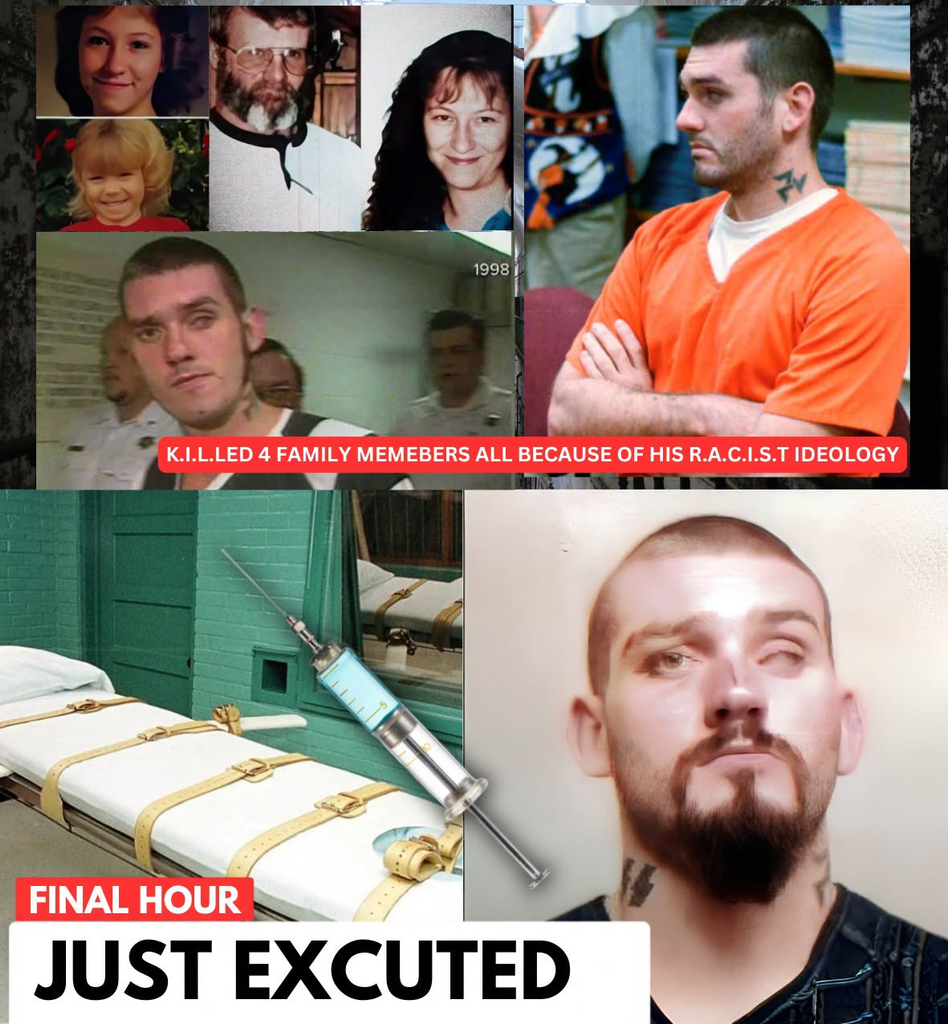
White Supremacist Executed After Brutal Family of 4 Murders | Daniel Lewis Lee’s Last Words…..
 The federal government executed Daniel Lewis Lee early Tuesday morning, ending a 17-year hiatus on federal capital punishment and delivering a verdict that has divided a nation, fractured a grieving family, and reignited a fiery debate over the morality and legality of state-sanctioned death.
At precisely 8:07 a. m. on July 14, 2020, inside the federal execution chamber at the U.S. Penitentiary in Terre Haute, Indiana, Lee, 47, was pronounced dead. He was administered a lethal dose of pentobarbital, the single-𝒹𝓇𝓊𝑔 protocol that had become the subject of a frantic, overnight legal battle that reached the highest court in the land.
His final words, delivered through the glass partition to the witness room, were a steadfast denial of the crime that had placed him on the gurney. “I didn’t do it. I’ve made a lot of mistakes in my life, but I’m not a killer.
You’re killing an innocent man,” he said, his voice reportedly clear and steady before the drugs took effect.
The execution was the culmination of a chaotic and unprecedented night of legal maneuvering, where the fate of a man hung in the balance as judges across the country traded rulings in a desperate race against the clock. It was a scene of high 𝒹𝓇𝒶𝓂𝒶 that saw the Supreme Court issue a 5-4 decision in the dead of night to clear the way for the lethal injection, overturning a lower court’s stay that had been granted just hours earlier. The decision, unsigned and issued at approximately 2:01 a.
m. , effectively silenced the final appeals from Lee’s legal team, who had argued that the execution protocol posed a substantial risk of severe pain and suffering.
Lee was already strapped to the execution gurney for four hours before the Supreme Court’s ruling came down. He lay there, restrained and staring at the ceiling, while his lawyers fought for his life in courtrooms hundreds of miles away. His attorneys were not present with him in the chamber due to COVID-19 restrictions, a fact that his legal team would later decry as shameful.
The family of his victims, who had spent years pleading with the government to spare Lee’s life, were also barred from witnessing the execution, a cruel irony given that the state claimed to be acting in their name. They were forced to follow the harrowing legal proceedings from their homes, watching the state take a life they had fought to preserve.
The execution of Daniel Lewis Lee was not the end of a story, but the culmination of a brutal and tragic narrative that began long before the murky waters of the Illinois River gave up their dead. It is a story rooted in a fractured childhood, a descent into violent extremism, and a cold-blooded triple murder that shocked the conscience of a nation. To understand the man who was executed, one must first understand the boy who was lost.
Born on January 31, 1973, in Yukon, Oklahoma, a flat and unremarkable town on the western edge of Oklahoma City, Lee’s life was marked by turbulence from the very beginning. His mother would later tell authorities that something was wrong from his early childhood. He suffered from seizures and had a neurological impairment that was never fully treated, never fully understood, and ultimately only served as a footnote in a life that would end on a medical gurney.
He was not a child who fell through the cracks; he was a child who was thrown into the abyss.
By the time he was fifteen, in 1988, Lee had already come to the attention of law enforcement in Oklahoma County, not once, but twice. Within a single week, he was charged with larceny and arson. He was fifteen years old.
Four months after those initial arrests, he was charged with three counts of second-degree burglary and witness intimidation. The court looked at his case and released him. The following year, in 1989, Lee was committed to a mental health facility in Miami, Oklahoma.
His stay there was short-lived. Staff documented repeated instances of harassment, intimidation, and physical assault against other patients. They discharged him.
A boy with documented neurological problems and a pattern of escalating violence was kicked out of a psychiatric hospital for being too violent for it. He was then simply released back into the world.
What followed was a period that should have alarmed anyone watching. But it seemed to alarm no one enough to intervene in any meaningful way. In the spring of 1989, Lee escaped from custody, and authorities caught him.
He escaped again in the summer, and authorities caught him again. During his escapes, Lee began to gravitate toward a certain type of community, one that offered him the belonging and order his chaotic life lacked. Lee began making contact with the Ku Klux Klan.
According to those who knew him during that period, Lee described finding a father figure in a senior Klan member named Bobby Norman. A fatherless boy, a purposeless boy, a boy whose brain did not work as it should. And into that void stepped a man in a white robe who told him he belonged.
Although police also suspected Lee of committing a string of armed robberies during his escape periods, he was never charged. In August 1989, he was committed to the Central Oklahoma Juvenile Center in Tecumseh, but he escaped within a week of his arrival. When he was recaptured in October of that year, he told authorities he wanted to get his GED and receive treatment for his 𝒹𝓇𝓊𝑔 addiction.
He seemed, by all accounts, to be a young man who realized he was on a dark path and wanted to find another way. By 1990, he had found work at a fast-food restaurant and was granted a 30-day pass. It is tempting, in retrospect, to imagine a different outcome, a different story.
A troubled boy, yes, but one who briefly seemed to want a better life. That narrative ended on July 24, 1990.
The party was held in Oklahoma City on a July night in 1990. Lee was 17 years old. There was alcohol.
There was LSD. And there was a 22-year-old man named Joseph Waver III, known as “Joey” to his acquaintances, who made the mistake of being in the same place as Daniel Lewis Lee when Lee’s rage exploded. The details of what sparked his fury were almost laughably trivial.
Waver was accused of accidentally urinating on a lawn chair after being threatened by other partygoers. That was all it was. That was the beginning of the chain of events that ended with Joey Waver dead at the bottom of a storm drain, his throat slit.
Lee struck Waver in the face. When Waver fell to the ground, Lee kicked him while he was down. Lee then produced a pair of handcuffs and secured Waver’s wrists.
He was joined by his cousin, 20-year-old John David Patton. The two dragged Waver from the party into the darkness of the night. Partygoers would later recall Patton openly asking people whether they should 𝓀𝒾𝓁𝓁 him.
No one stopped them. Lee and Patton forced Waver to a storm drain in the backyard of a nearby house. Waver was described as slight, weighing around 110 pounds.
The idea was Lee’s, to use the narrow storm drain. Patton was ordered to strip Waver naked. Lee gathered the clothes and put them in a bag to dispose of them.
As Joey Waver stood naked and handcuffed in the dark next to the storm drain, he begged. According to witnesses, his words were literally, “Don’t make me go down there.” Lee handed Patton a rope, a garbage bag, and a knife.
Then Lee left to dispose of Waver’s clothes. While he was gone, Patton slit Joey Waver’s throat. He then stabbed him several times in the chest and the soles of his feet.
Waver’s body was left at the bottom of the drain. Patton returned to the party. He told people there, “It’s okay.
Joey’s fine.” The body was discovered the next morning by the homeowner, Larry Paul Dawson, who had spent the night of the murder in jail, having been arrested for public drunkenness, and found the body when he returned home after his release.
Lee was charged with murder. During the subsequent proceedings, both his lawyer and his mother asked the court to try him as a juvenile. The request was denied.
On December 2, 1990, Lee pleaded guilty to a burglary charge, and the murder charge was dropped. He was sentenced to five years of probation. He was 17 years old.
He had just participated in the abduction and killing of another human being, and he walked out of court with a suspended sentence. John David Patton was sentenced to life in prison without the possibility of parole and died in prison on January 7, 2014. Lee’s position throughout the legal proceedings was that he did not know what Patton intended to do with the knife, that he thought Patton was going to use it to cut Waver’s pants, not to 𝓀𝒾𝓁𝓁 him, and that he was not present when the murder occurred.
 Whether that was true or not, what is indisputable is that Lee handed Patton the knife, helped subdue Waver, helped restrain him, and helped carry him to that drain. Yet, Lee was given a suspended sentence and returned to the world.
The five years between the death of Joey Waver and Daniel Lewis Lee’s entry into the orbit of Chevie Kehoe were not quiet years. They were not the years of a man who had confronted his past and changed his course; they were the years of a man accelerating into criminality. Between 1991 and 1995, Lee accumulated charges in five different states: Oklahoma, Tennessee, Washington, Wyoming, and Florida.
The charges included reckless driving, theft, assault, failure to appear, assault with a deadly weapon, resisting arrest, and trespassing. He was constantly on the move, leaving a trail of wreckage everywhere he landed, then moving on before the consequences could catch up with him. In early 1995, Lee was living in Bowling Green, Kentucky, with his girlfriend, Jennifer Givens, who was pregnant with his daughter.
One day, Givens found a picture of Adolf Hitler among Lee’s belongings and tore it up. Lee beat her. Givens would later state that Lee was physically abusive to her throughout their relationship, including during her pregnancy.
He was arrested for assault. In that same year, on May 3, 1995, Lee was convicted of carrying a concealed weapon in Martin County, Florida, and was sentenced to six months of probation. In that same year, Lee lost his left eye.
The circumstances were in keeping with his character. He was in a bar in Spokane, Washington, where he directed a racial slur at a Native American man. The confrontation escalated, and Lee was hit with a metal ball.
He lost his eye, and in what would become one of his most defining physical features, he refused to wear an eye patch. This earned him a nickname among his fellow neo-Nazi skinhead associates in Spokane, who called him “Cyclops.” He was known as “Cy.”
It was in Spokane in 1995 that Daniel Lewis Lee met the man who would channel his hatred, give his violence a purpose, and ultimately lead his life, and his ideology, to the bottom of a river in Arkansas. His name was Chevie Kehoe, and he was 23 years old when he met Lee. He was the son of Kirby Kehoe, a man federal authorities described as a promoter and practitioner of the anti-government, racist, and every extremist ideology available.
Chevie was raised steeped in Christian Identity theology, a belief system that combines white supremacy with a specific interpretation of biblical scripture, claiming that white Europeans are the true Israelites and that other races are spiritually inferior. From this worldview, Chevie Kehoe founded an organization he called the “Aryan People’s Republic,” or APR. He drew inspiration from a violent white supremacist group known as “The Order,” which had carried out bombings, armored car robberies, and assassinations in the 1980s in pursuit of the same dream: a white ethno-state to be established in the Pacific Northwest.
Kehoe called this vision the “Northwest Territorial Imperative.” To fund this vision, to buy land, and to arm his followers, Kehoe needed money. And he needed men willing to do anything to get it.
Daniel Lewis Lee, a man who had spent his youth affiliated with the Klan, who had already participated in a murder, and who had a documented history of violence dating back to age fifteen, was exactly what Chevie Kehoe was looking for.
Lee joined the APR. He adopted its ideology, or at least the justification it gave him. Lee had once again found what Bobby Norman and the Klan had given him in 1989: a family, a purpose, a group of people who told him his anger had a legitimate direction.
Kehoe had already proven the seriousness of his methods. In February 1995, months before Lee formally joined, Kehoe and his father had broken into the home of an Arkansas gun dealer named William Mueller. Mueller was not home.
The Kehoes wandered through his property and made off with approximately $50,000 in coins, cash, and firearms. Then they left. Mueller filed a report, and Kehoe stored the location in his memory.
In the spring of 1996, Kehoe decided to return.
William Frederick Mueller was 52 years old and had spent most of his adult life surrounded by guns. He was a federally licensed gun dealer, buying, selling, and trading firearms at gun shows across the country. He lived with his wife, 28-year-old Nancy Ann Mueller, née Branch, and her 8-year-old daughter, Sarah Elizabeth Powell, from a previous relationship.
They lived near Tilly in Pope County, Arkansas, about 75 miles northwest of Little Rock. It was quiet, rural country, the kind of place where people minded their own business and trusted their neighbors. Mueller kept a large stock of guns, ammunition, and cash on the property.
He had recorded the serial numbers of many of his firearms, a practice that would prove crucial later. Kehoe knew about the guns because he had already robbed Mueller once. He knew the layout of the place.
He knew roughly what was there, and he knew that Mueller, a gun dealer who dealt mostly in cash, was unlikely to keep his money in a bank.
In January 1996, Chevie Kehoe and Daniel Lewis Lee left Washington state and drove to Arkansas. They brought with them police raid clothing and tactical gear to make them look like law enforcement officers. The plan was simple in its brutality: get in, take everything, and leave no witnesses.
On January 11, 1996, they arrived at the Mueller home. The family was not home, so they waited. When William and Nancy Mueller returned with Sarah, Lee and Kehoe were ready.
They overpowered the couple and subdued them. Then they turned their attention to the child. Eight-year-old Sarah Powell was subjected to electric shocks from a cattle prod while Lee and Kehoe demanded she tell them where the cash, guns, and ammunition were hidden.
An eight-year-old girl was being electrocuted with a cattle prod to give up information they wanted. They found $50,000 in cash and gold, worth more than $100,000 today, plus another $30,000 in firearms and parts. Then, after they had gathered everything they came for, they decided the fate of the three people who could identify them.
All three victims, William, Nancy, and Sarah, were shot with a stun gun. Then plastic bags were placed over their heads, sealed tightly with duct tape, and Lee and Kehoe waited as William Mueller, Nancy Mueller, and eight-year-old Sarah Powell suffocated to death. According to Gloria, Chevie Kehoe’s mother, Lee admitted to his role in killing William and Nancy, but he insisted to her and to others that he refused to 𝓀𝒾𝓁𝓁 Sarah, that when it came time to end the child’s life, he backed away, and that it was Chevie Kehoe who did it himself.
Whether or not that distinction holds any moral weight is a question that would occupy courts, prosecutors, and the victims’ own family for over two decades. What is not in dispute is that Daniel Lewis Lee was present, that he participated in restraining, torturing, and suffocating all three victims, and that he left the scene with the bodies in the car.
They drove 45 miles to the Illinois River. They duct-taped rocks to each of the three bodies, William, Nancy, and 8-year-old Sarah, and threw each one into the water. Daniel Lewis Lee received between $3,000 and $4,000 for his role in the crime, plus a handgun.
Kehoe and his family drove the stolen goods back to Spokane, Washington, stopping on the way in the Christian Identity town of Elohim City, Oklahoma. The Mueller home sat empty. The bodies sank.
No one reported the family missing until January 1996, when the victim’s mother, Earlene Branch Peterson, went to the Pope County Sheriff’s Office. A month later, the family’s car was found 45 minutes from their home, hidden in the Prossian Woods. But there were no answers.
No bodies, no suspects, no leads that went anywhere. And the bodies of William, Nancy, and Sarah remained at the bottom of the water for over five months.
On June 28, 1996, a couple fishing near Lake Dardanelle, 85 miles south of the Mueller home, snagged something on their line. It was part of a body. Law enforcement went into the water and found the rest.
Sarah Powell’s body was recovered first. A plastic bag, still sealed with duct tape, was wrapped around her head. The medical examiner noted a flexible blue paint in the tape.
A database search matched the paint to a blue General Motors vehicle. The investigation was now a triple homicide, and it had just found its first real lead. William Mueller had been careful about one thing.
He had recorded the serial numbers of many of his firearms. Not all gun dealers did this, but Mueller may have had a safeguard against this exact type of theft. That decision, made long before January 11, 1996, is what unraveled everything.
 In July 1996, a convicted criminal named Travis Brick was arrested in South Dakota. He was in possession of a handgun. The serial number traced back to William Mueller.
Brick told authorities he had bought the gun at a gun show from a man he recognized from a picture, Kirby Kehoe, Chevie’s father. This lead directed investigators toward the Kehoe family. And as they began to pull on that thread, the entire web began to collapse.
Another stolen handgun was traced directly to Chevie Kehoe. Federal agents began to form a picture of a criminal organization, the APR, and its activities across multiple states.
In October 1996, an associate of Kehoe’s named Faron Lovelace was found hiding in a cabin in the Idaho wilderness. Near the cabin, a stolen trailer from Arkansas was found. Inside the trailer were guns, ammunition, and camping gear stolen from the Mueller property.
Lovelace began to talk. What he told investigators was not just about the Mueller murders, but about an entire network of violence, theft, and extremist activity that had been going on for years. By December 1996, law enforcement knew enough to actively hunt both Kehoe and Lee.
On December 10, 1996, Lee’s former roommate was arrested in South Dakota with another of Mueller’s rifles. He told investigators he got it from Kehoe, and that he had called Lee to warn him that authorities were closing in. The next day, Lee left Washington for Oklahoma.
Kehoe and his family also fled, moving between several states in an attempt to sell stolen guns at gun shows. On February 15, 1997, Chevie Kehoe and his brother Cheyne were involved in a shootout with law enforcement in Wilmington, Ohio. Both managed to escape.
Later that same day, Kehoe was involved in a second shootout before escaping again. His brother Cheyne later cooperated with federal authorities. His mother, Gloria, became a star witness.
And the family that had built itself on an ideology of violence and white supremacy began to crumble from within.
Chevie Kehoe was arrested on June 17, 1997, in Cedar City, Utah. Federal agencies, including the FBI, the ATF, and the Pope County Sheriff’s Office, had been monitoring Daniel Lewis Lee for weeks before they moved in. On September 24, 1997, a task force arrested Lee at his mother’s home in Yukon, Oklahoma.
He was transported to Pope County, Arkansas. Within days of his arrival, reports were filed of him assaulting other inmates. In February 1998, he was reported for trying to convince another inmate to smuggle a gun into the jail using a hollowed-out radio that was found in his cell.
On February 23, 1998, after a Pulaski County deputy sheriff, Nancy Cummings, denied him access to a phone, Lee allegedly threatened her directly. He told her she would die like the others. He told her he would blow her head off.
This was a man in custody on federal murder charges. Violence was not something he could restrain.
The joint trial of Chevie Kehoe and Daniel Lewis Lee began in November 1998 in the United States District Court for the Eastern District of Arkansas. The murders were tried as federal crimes because they were committed in furtherance of a racketeering enterprise, the Aryan People’s Republic. The prosecution’s case rested on physical evidence, seized weapons, financial records, and a host of witnesses from within Kehoe and Lee’s inner circle, including Gloria Kehoe, Chevie’s mother, who testified against her son.
The stolen guns that were still traceable through Mueller’s serial number records. The duct tape with the distinctive blue paint. The testimony of those to whom the two men had boasted about the crime.
The evidence against the two men was overwhelming. On May 4, 1999, Daniel Lewis Lee was convicted of three counts of murder in aid of racketeering. Ten days later, on May 14, 1999, the jury returned to the question of punishment.
And it is here that the story took a turn that would haunt the case for the next 21 years.
Chevie Kehoe, the founder of the APR, the man who recruited Lee, who planned the Mueller robbery, and who, according to multiple accounts, killed 8-year-old Sarah Powell, was sentenced to three consecutive life sentences without the possibility of parole. The jury, during its deliberations, declined to impose the death penalty on the gang leader. They then sentenced Daniel Lewis Lee to death.
The prosecutors who handled the case were not responsible for this outcome in the way one might assume. In fact, the local U. S.
Attorney, Paula Casey, asked Attorney General Janet Reno to withdraw the death penalty as a sentencing option for Lee, especially after she witnessed Kehoe receive a life sentence. Casey believed the disparity in sentencing was unjust, but her request was denied. Deputy Attorney General Eric Holder ordered prosecutors to continue to seek the death penalty for Lee.
The trial judge who presided over the case shared Casey’s concerns, and he objected to Lee’s death sentence and ordered a new sentencing hearing. However, a federal appeals court overturned his decision and reinstated the death sentence in 2001. The core of the prosecution’s argument for the death penalty was a psychological evaluation that classified Lee as a psychopath, meaning he posed a future danger and would remain a threat to others for the rest of his life, even within the walls of a prison.
The very expert who conducted that evaluation later disavowed it and the checklist it was based on. The methodology is no longer used in federal death penalty cases. Lee, according to his lawyers, was the only federal death row inmate whose sentence was based primarily on that discredited evaluation.
Both the lead prosecutor and the trial judge wrote letters as part of Lee’s 2014 clemency petition to President Obama, urging the Justice Department to commute his sentence. Obama commuted two death sentences before leaving office, and Lee’s was not among them.
The family of Nancy Mueller and Sarah Powell had opposed the death penalty for Lee since the moment Kehoe was given life in prison. Earlene Branch Peterson, the mother of Nancy, went further, becoming one of the most vocal opponents of Lee’s execution, publicly stating that she did not want it carried out in her daughter’s name. She said, “I don’t see how executing Daniel Lee honors my daughter in any way.
In fact, it tarnishes her name, because she wouldn’t want that, and neither do I.” Monica Veillette, the niece and cousin of two of the victims, articulated the family’s stance clearly: “The last part of my aunt’s story is to have someone killed in her name,” she said. We are acting like we are angry, vengeful people, instead of her being a loving human being.
Yet, the government executed Daniel Lewis Lee.
Daniel Lewis Lee arrived on federal death row in 1999. He spent 21 years there, watching administrations come and go, watching the legal system of appeals advance and retreat, watching the country change in ways he could only glimpse through the narrow window of his prison cell. The appeals were numerous, but they ultimately failed.
In 2004, the Eighth Circuit Court of Appeals affirmed his conviction and sentence. In 2013, it affirmed the denial of his habeas petition. In 2015, it affirmed the denial of a subsequent habeas petition.
By April 17, 2017, Lee had exhausted all of his avenues of appeal. Under normal circumstances, that would have meant the end was approaching quickly. But the federal government had been under an effective moratorium on executions for years.
No federal prisoner had been executed since 2003. The proceedings had stalled. His lawyers kept pushing, however, claiming there was DNA evidence in the case that had never been tested, evidence they believed could cast doubt on aspects of Lee’s conviction.
In the days leading up to his execution, U. S. District Judge Lee P.
Rudofsky denied their request to compare the DNA of a hair linked to the crime with other suspects in the case. The evidence remained untested. According to his lawyers, Lee himself had long since disavowed his racist beliefs.
The judicial system had no mechanism to assess the credibility of that claim, or whether a man who had embraced that ideology in his teens and early twenties could truly renounce it. What the judicial system could assess was the record of violence stretching from Oklahoma City in 1988 to Pope County, Arkansas in 1996. And that record was what it was.
 In July 2019, Attorney General William Barr announced that the federal government would resume executions. Daniel Lewis Lee was scheduled to be the first. His execution was initially scheduled for December 9, 2019, then moved, then blocked by a series of legal challenges, then rescheduled.
The legal challenges centered on the execution protocol, specifically the government’s plan to use a single 𝒹𝓇𝓊𝑔, pentobarbital, rather than the three-𝒹𝓇𝓊𝑔 cocktail that had been used in previous federal executions. The inmates and their lawyers argued that the protocol was not fully tested and could cause severe suffering. The courts agreed, then disagreed, then agreed again.
Throughout this period, the victims’ family continued to press. They asked the government to commute Lee’s sentence. They filed a lawsuit to try to stop the execution on the grounds that traveling to attend the execution during the COVID-19 pandemic put their lives at risk.
The Seventh Circuit Court of Appeals ruled that while allowing victims’ families to attend executions is a customary practice, there is no legal right to attend, and it refused to change the date. The family’s emergency appeal reached the Supreme Court. Before the Supreme Court could rule on that matter, a federal judge issued a stay on all federal executions.
Then came the night of July 13, 2020. The execution was scheduled for 4:00 p. m.
that day, but it did not happen. A federal district court in Washington, D. C.
had issued a preliminary injunction earlier that day, ruling that the death row inmates, including Lee, had not exhausted their appeals on the execution protocol, and that they were likely to succeed in their argument that the government’s method of lethal injection was very likely to cause severe pain and needless suffering. The court stayed all four executions. The Bureau of Prisons did not back down.
Instead, federal prosecutors began filing appeals in multiple courts simultaneously. The appeal process moved with a speed that is rare in the legal system, moving through district courts, appellate courts, and up to the Supreme Court of the United States, all within hours rather than months.
At 4:00 a. m. on July 14, the morning after the scheduled execution date, Daniel Lewis Lee was strapped to the execution gurney.
The Bureau of Prisons attempted to begin the process after the Supreme Court vacated the D. C. district court’s order, but defense counsel immediately informed the bureau that a separate stay of execution issued by a federal court in Arkansas in December 2019 was still in effect.
The Bureau of Prisons did not remove Lee from the gurney. Instead, they left him strapped there while federal prosecutors filed new motions with the Eighth Circuit to lift the Arkansas stay. For four hours, Daniel Lewis Lee lay strapped to the execution gurney while lawyers argued over whether he should be taken off of it or executed on it.
His lawyers were not permitted to be with him due to COVID-19 restrictions, as they had not been able to meet with him in person for months. In the three months leading up to the execution, Lee had not had a single confidential conversation with his legal team face-to-face. The victims’ family, who the government claimed to be acting on behalf of, were also not present.
They were barred from attending due to the pandemic. They were at home, following the legal developments minute by minute, while the government executed a man they had spent years trying to save.
At 2:01 a. m. , the Supreme Court of the United States issued an unsigned order, 5-4, lifting the injunction that had stayed the execution.
Justice Stephen Breyer, joined by Justice Ruth Bader Ginsburg, wrote in his concurrence that it was time for the Court to seriously reconsider the constitutionality of the death penalty itself. Justice Sonia Sotomayor, joined by Justices Kagan and Ginsburg, wrote separately, criticizing what she described as the Court’s rush to judgment, noting that the Court had forever deprived the defendants of their ability to constitutionally challenge the executions they were about to carry out. The Eighth Circuit lifted the Arkansas stay at approximately 7:30 a.
m. The Bureau of Prisons informed Lee’s lawyers, not in person, and did not give them any opportunity for a final visit, but via a one-page document, of the new execution time.
In those final minutes, a spiritual advisor was with Lee. The guards were there. The gurney was there.
The IV lines were inserted through the wall. Daniel Lewis Lee was taken to the execution chamber, more than half of his body covered by a light blue blanket. The IV lines extended from his arms through a metal plate.
He was breathing heavily. He looked through the glass at the media witness room and spoke: “I didn’t do it. I’ve made a lot of mistakes in my life, but I’m not a killer.
You’re killing an innocent man.” The pentobarbital was administered. Lee moved his legs and feet.
He breathed heavily, and then the movement stopped. At 8:07 a. m.
on July 14, 2020, a senior prison official announced the time of death. The curtain was drawn.
Attorney General William Barr issued a statement. “Today, Lee finally received the just punishment he deserved. The American people have made a considered decision to allow the death penalty for the worst federal crimes, and justice has been served today with the execution of Lee’s horrific crimes.”
Ruth Friedman, Lee’s lawyer, issued a statement saying, “It is shameful that the government saw fit to carry out this execution during a pandemic. It is shameful that the government saw fit to carry out this execution without Danny Lee’s lawyers present. And while the judges in his case, and even the families of his victims, urged that it not be carried out, it is most shameful that the government ultimately carried out this execution in haste in the middle of the night while the people were asleep.”
Earlene Branch Peterson, the mother of Nancy Mueller, did not witness what the government did in her daughter’s name. She was at home. She had spent years trying to prevent it.
She had told anyone who would listen that her daughter would not have wanted this, that Nancy was a loving human being, and that executing a man in her name made her family look like angry, vengeful people, which they were not. William Mueller, Nancy Mueller, and Sarah Elizabeth Powell were murdered on January 11, 1996. Sarah was 8 years old.
Their bodies remained in the water for 5 months before anyone found them. They were wrapped in duct tape and plastic bags and weighed down with rocks by men who thought they were building a nation. Chevie Kehoe, the man who planned the robbery, founded the organization, and killed the child when his partner refused, is still alive in a federal prison.
He is serving three consecutive life sentences. Daniel Lewis Lee, who drove to Arkansas, waited in a dead family’s home, helped subdue and restrain three people, helped suffocate them, helped throw their bodies in the river, and was paid a handgun and a few thousand dollars for it, is dead.
Daniel Lewis Lee was executed by the federal government at 8:07 a. m. on July 14, 2020, becoming the first federal prisoner to be executed in 17 years.
Whether justice was served that morning depends largely on your definition of the word. The man who masterminded the crime is still alive, and the man who followed him is dead. The victims’ families opposed the execution, as did the judge and prosecutor who handled the case.
The psychological evidence used to sentence him to death rather than life in prison was discredited before the execution was carried out. But what is not in dispute is what happened in Tilly, Arkansas, on January 11, 1996, and what was done to William, Nancy, and Sarah Mueller. The stun gun, the duct tape, the plastic bags, the river, the rocks.
Daniel Lewis Lee was a part of that. He was there. He participated.
And he spent 21 years on a gurney waiting for the state to decide what to do about it. On the morning of July 14, 2020, it decided.
© 2026 MZ News — Blog powered by WordPress.