Death Row (Florida US)
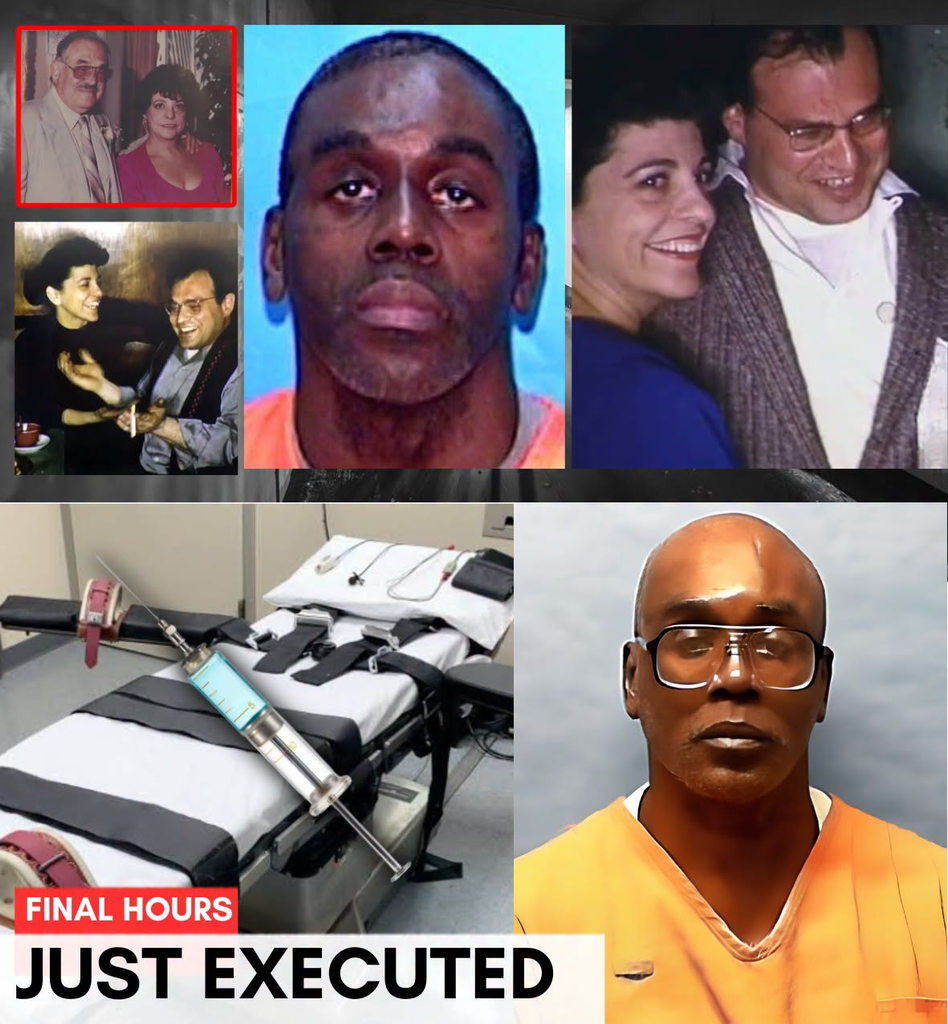
 The final chapter of a 35-year-old nightmare closed Tuesday evening in the stark confines of a Florida execution chamber, as convicted double murderer Victor Tony Jones was pronounced dead at 6:13 p.m. for the brutal 1990 slayings of a Miami couple who had shown him nothing but kindness.
Jones, 64, who had spent more than three decades on death row for the pre-Christmas stabbing deaths of Jacob and Matilda Nester, offered no final statement beyond a polite refusal when asked if he had last words. “No, sir,” were the final syllables uttered by a man who had taken two lives in a savage robbery that prosecutors described as a betrayal of trust so profound it defied comprehension.
The execution at Florida State Prison proceeded without complication, according to prison officials, marking a clinical end to a case that had haunted the Nester family for generations and tested the limits of the state’s capital punishment system. The lethal injection sequence began at 6:00 p. m.
, with witnesses observing as Jones’s chest heaved repeatedly before falling still, a stark contrast to the violent deaths he had inflicted upon his victims decades earlier.
Irene Fiser, the now 76-year-old daughter of the victims, traveled from her home to witness the execution, fulfilling a grim duty she had feared she might never live to see. “I’m 76 years old and I didn’t think I’d be alive to see it,” Fiser admitted in the days leading up to the execution, her voice carrying the weight of a three-decade wait for justice.
The crime that set this long legal odyssey in motion occurred on a quiet December afternoon in 1990, when Jones, a recently hired hand at the Nesters’ medical supply shop in Miami’s Wynwood neighborhood, turned on the elderly couple who had trusted him with odd jobs and treated him with respect. Investigators later determined that Jones had been planning the robbery, waiting for the opportune moment when the shop would have cash on hand but few customers present.
The attack was swift and savage, with Jones plunging a knife into Matilda Nester’s neck and stabbing Jacob Nester in the chest during what prosecutors described as a robbery gone horribly wrong. The violence was extreme and personal, suggesting either panic or rage, or perhaps both, as the elderly couple fought desperately for their lives against a man they had welcomed into their business.
 Jacob Nester, 67, despite suffering a catastrophic stab wound near his heart, refused to die without a fight, staggering to his office and retrieving a .22 caliber pistol. In what would become his final act of courage and defiance, the mortally wounded man fired five shots at his attacker, striking Jones squarely in the forehead and knocking him down, a bullet that would leave a permanent scar but fail to penetrate his skull.
The gunshots alerted nearby shop owners, and police arrived within minutes to find a scene of carnage, with Jacob and Matilda Nester dying in pools of their own blood and Jones wounded but alive. Crucially, investigators discovered the couple’s cash and personal belongings in Jones’s pockets, providing irrefutable evidence of the robbery motive that had precipitated the killings.
Matilda Nester died almost instantly from the catastrophic wound to her neck, while her husband, despite his incredible fight, succumbed to his injuries shortly after arriving at the hospital, the knife having pierced too close to his heart for medical help to arrive in time. Two lives were snuffed out in an instant of greed and violence, just days before the couple would have celebrated Christmas with their daughter and grandchildren.
Jones was arrested at the scene and recovered from his head wound under armed guard, his fingerprints throughout the crime scene, the victims’ blood on his clothes, and their valuables in his possession leaving no room for doubt about his guilt. In 1993, a Florida jury convicted him on two counts of first-degree murder and two counts of armed robbery, deliberating for less than a day before returning guilty verdicts on all charges.
During the penalty phase, jurors heard heart-wrenching testimony from the Nesters’ daughter, Irene, and their grandchildren, who described the devastating impact of losing both beloved family members in such a horrific manner. The jury sentenced Jones to death, determining that the aggravating factors, the brutality, the robbery motive, and the murder of two elderly victims, far outweighed any mitigating circumstances.
The next three decades would see Jones’s legal team mount numerous challenges, at one point claiming intellectual disability and at another citing alleged 𝓪𝓫𝓾𝓼𝓮 in his youth, but courts consistently upheld the death sentence at every level of the state and federal judiciary. Each appeal was reviewed exhaustively, and each time judges came to the same conclusion: the conviction was sound, the sentence was appropriate, and no legal error warranted overturning the jury’s decision.
 By late September 2025, all appeals had been exhausted, and the U. S. Supreme Court declined to intervene with a last-minute stay, clearing the final obstacle for the execution.
Governor Ron DeSantis signed the death warrant, officially scheduling Jones’s execution for September 30th, 2025, after 35 years of legal proceedings that had consumed countless hours and resources.
On the day of his execution, Jones awoke at 4:30 a. m. inside Florida State Prison, beginning the final day of his life in a special holding cell near the execution chamber.
Prison officials noted that he remained calm and compliant throughout the day, with no outbursts, no desperate pleas, and no last-minute confessions, appearing resigned to his fate after so many years of waiting.
He met with his spiritual adviser in the morning, spending quiet moments in prayer and reflection, and unlike some condemned inmates who receive visits from family or friends on their final day, Jones had no other visitors. His family, if he had any remaining connections, chose not to come, leaving him to face his final hours largely alone without the comfort of familiar faces or loving words from relatives.
The prison administration followed established protocols throughout the day, with guards checking on Jones every 15 minutes and a doctor examining him to ensure he was fit for execution, an ironic medical procedure meant to verify that he was healthy enough to be killed. Outside the prison, a small group of death penalty opponents held a candlelight vigil while others stood in support of the execution, holding signs demanding justice for the Nesters.
Jones was offered the customary privilege of a final meal and requested a modest but classic southern feast of fried chicken, collard greens, and sweet tea. He ate his meal quietly in his cell under guard, savoring each bite with the knowledge that it would be his last supper on Earth, and prison officials reported that he consumed most of the food before pushing the tray aside.
Shortly after 6:00 p. m. , Jones was escorted into the brightly lit execution chamber, walking under his own power flanked by correctional officers, his legs shackled but his demeanor composed.
He was placed on a padded gurney with his arms outstretched in a crucifixion position and secured with leather straps, as prison officials inserted IV lines in preparation for the lethal drugs.
The execution chamber was a carefully choreographed space where every detail had been planned and rehearsed, with witnesses seated behind thick glass and a telephone on the wall connected directly to the governor’s office in case of a last-minute reprieve. Medical personnel stood ready behind a one-way mirror, prepared to administer the lethal injection sequence that would end Jones’s life.
 As the first chemical, a powerful sedative, entered his bloodstream, Jones’s chest heaved repeatedly for a minute or two before the movement gradually slowed and ceased altogether. The three-𝒹𝓇𝓊𝑔 cocktail followed its grim sequence: first the sedative to render him unconscious, then a paralytic to stop his breathing, and finally a 𝒹𝓇𝓊𝑔 to stop his heart.
An official stepped forward to check on the inmate, shaking Jones and calling his name to see if there was any response, but there was none. A medical examiner then entered the chamber, listened for a heartbeat or breath with a stethoscope, checked his pupils, and at 6:13 p. m.
declared Victor Jones dead, with officials later reporting that the procedure went without complications.
In the witness gallery that evening sat Irene Fiser, who had waited more than half her life for this moment of justice, traveling to Florida with her two adult daughters and other family members to be present at the execution. The prison provided a front row seat for the Nester family in the viewing room, while no one from Jones’s own family was in attendance on the other side of the glass.
Irene sat with her hands folded in her lap, her face a mask of composure that barely concealed the roiling emotions beneath, later confessing to feeling mixed emotions as she watched the lethal injection unfold. She remarked on the almost gentle nature of Jones’s death compared to what her parents endured, noting the stark contrast between his calm clinical passing and the terrifying violence they suffered.
“After seeing what I saw tonight, I wish my parents had that opportunity to die so gracefully. Close your eyes and just go,” Irene said solemnly, her voice filled with the lingering horror of that night in 1990. “They were violently killed.
My father fought for 20 minutes with a stab wound in his heart. And my mother died instantly on a cold floor.”
In an extraordinary show of grace, Irene even found it in her heart to forgive the man who took her parents’ lives, telling a local reporter afterward, “I do forgive him. I forgive him because it’s important for me to forgive him. I won’t forget it.
I absolutely forgive him. He’s done. I never have to hear his name again.”
With Jones’s death, Irene felt she could at last let go of the shadow he had cast over her family for 35 years, a dark presence that had appeared in legal documents and news stories, a constant reminder of the worst day they had ever experienced. Every appeal, every court hearing, and every postponed execution date had reopened old wounds, but now, finally, it was finished.
 Victor Tony Jones’s execution was the 13th in Florida in 2025, a year that saw the state set a modern record for its use of the death penalty, reflecting a broader push to carry out long-pending death sentences as Florida worked through a backlog of condemned inmates who had exhausted their appeals. The previous high was eight executions in a single year, and no other state had reached the same number in 2025.
The accelerated pace of executions sparked debate throughout Florida and beyond, with death penalty opponents arguing that the increased frequency raised concerns about due process and the risk of executing innocent people. They pointed to cases nationwide where condemned inmates had been exonerated after years on death row, sometimes just days before their scheduled executions.
Supporters of capital punishment countered that justice delayed is justice denied, and that families of victims deserve to see sentences carried out rather than delayed indefinitely by endless appeals. But for the family of Jacob and Matilda Nester, those broader policy debates were secondary to the simple fact that after 35 years, the man who brutally ended two innocent lives had met his fate.
The case of Victor Tony Jones represents both the promise and the tragedy of the criminal justice system, with justice ultimately served and a guilty man held accountable for his terrible crimes, yet that justice took 35 years to arrive, long enough that the victim’s daughter feared she might die before seeing it carried out. The wheels of justice turned slowly, perhaps too slowly, for those who wait for closure.
As witnesses filed out of the prison that September evening, the sun had already set, leaving the facility bathed in harsh floodlights. Irene Fiser walked to her car surrounded by her daughters, ready to return home and begin the process of truly moving forward, while behind them inside the prison, guards were already cleaning the execution chamber, preparing it for the next use.
The story of Victor Tony Jones, Jacob Nester, and Matilda Nester serves as a reminder of the terrible ripple effects of violence, how one brutal act in December 1990 destroyed not just two lives but shattered a family, traumatized a community, and set in motion a 35-year legal odyssey that consumed countless hours and resources. In the end, justice was done, but no one truly won.
The Nesters remained dead, their grandchildren grew up without them, and Jones paid for his crimes with his own life, leaving only the hope that their story might serve as a cautionary tale about the precious fragility of life and the terrible cost of violence. The execution chamber at Florida State Prison now stands empty, awaiting its next occupant, as the state continues its accelerated march toward carrying out the sentences of those who have exhausted their appeals.
For Irene Fiser, the journey that began on that terrible December afternoon in 1990 has finally reached its conclusion, and she can now begin the process of healing that was impossible while Jones’s name remained a constant presence in her life. She expressed relief that the long-delayed sentence was finally carried out and that justice had been served, even as she acknowledged the bittersweet nature of witnessing another human being’s death.
The Nesters’ daughter, now in her 70s, has spent more than half her life waiting for this moment, and her decision to witness the execution reflects both a desire for closure and a commitment to honoring her parents’ memory. Her remarkable capacity for forgiveness, expressed even as she watched her parents’ killer die, stands as a testament to the human spirit’s ability to transcend even the most profound pain and loss.
As the state of Florida continues to carry out executions at an unprecedented pace, the case of Victor Tony Jones will likely be cited in debates about capital punishment for years to come, a stark example of both the finality of the death penalty and the lengthy legal process that precedes it. The 35-year gap between crime and punishment raises questions about the efficiency of the justice system, even as it demonstrates the thoroughness of appellate review.
The medical supply shop in Miami’s Wynwood neighborhood where the Nesters built their modest business and lived out the American dream now stands as a silent memorial to a couple whose generosity was repaid with unspeakable violence. Their story, preserved in court records and news accounts, serves as a reminder of the human cost of crime and the long shadow that violence casts over the families left behind.
Irene Fiser’s words, spoken in the aftermath of the execution, capture the complex emotions of a daughter who has waited decades for justice: relief that it is finally over, forgiveness for the man who caused so much pain, and an enduring love for the parents she lost far too soon. “I’m just glad it’s finally over,” she said, expressing a sentiment that will resonate with anyone who has ever waited for closure that seemed perpetually out of reach.
© 2026 MZ News — Blog powered by WordPress.