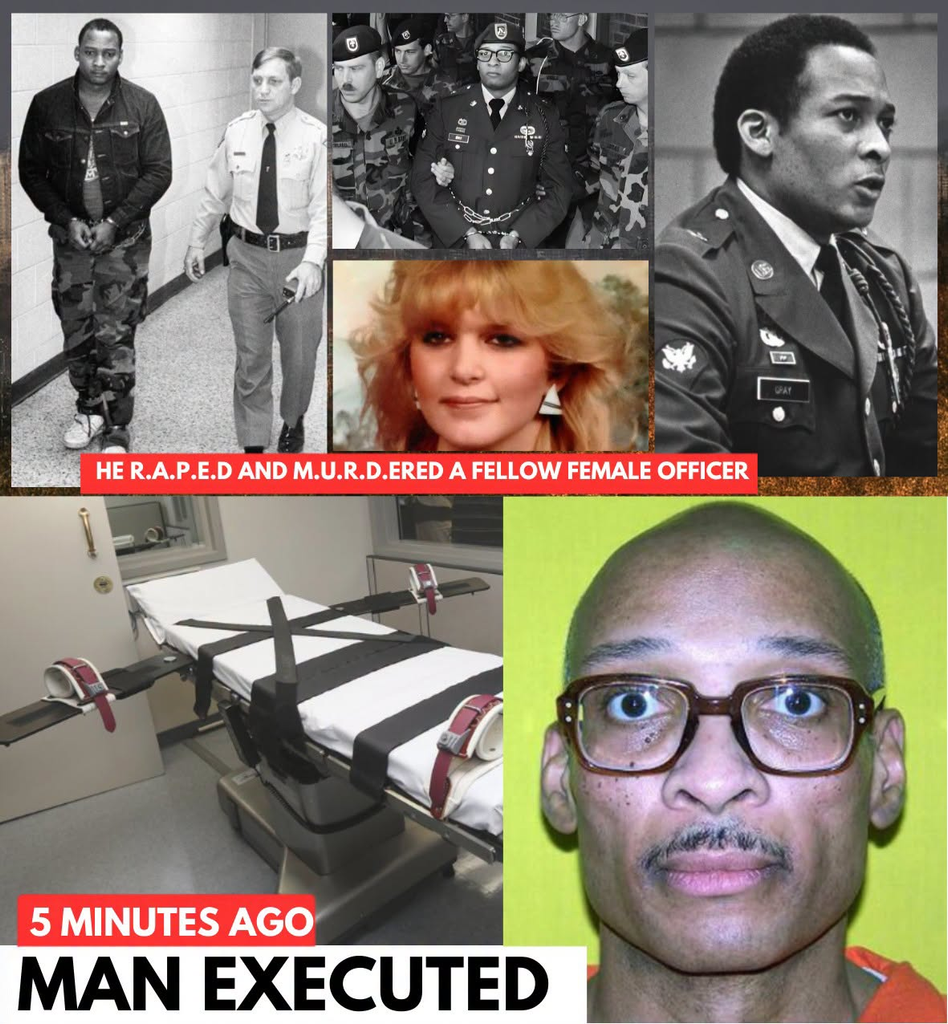
 What if the man trained to protect his country was secretly hunting its citizens? What if the uniform you trusted was hiding a predator? He wasn’t just a soldier.
He was a cook in the 82nd Airborne, stationed at one of the largest military bases in America. But behind barracks walls and quiet suburban streets, he unleashed horrors no battlefield ever saw. This is the chilling true story of Ronald Gray, the US Army specialist turned serial killer, and why, despite a death sentence approved by the president, he’s still alive.
Ronald Adring Gray was born in Cochran, Georgia, but spent most of his childhood in the rough streets of Liberty City, a public housing project in Miami, Florida. At just 18 years old, he enlisted in the US Army in 1984, hoping to find purpose or perhaps a new identity. Gray was initially assigned to the target acquisition battery, First Battalion, 39th Field Artillery, but by the time of his arrest, he had risen to the rank of Specialist 44 and was stationed at Fort Bragg, North Carolina.
He served as a cook with the third battalion, 504th parachute infantry regiment, part of the elite 82nd Airborne Division.
To his superiors and fellow soldiers, Gray was just another disciplined serviceman. He showed up for duty, followed orders, and kept his head down. But behind that uniform was a man living a monstrous double life.
One filled with darkness, violence, and secrets that would soon erupt into national headlines. The same hands that prepared meals for paratroopers would later be linked to some of the most brutal crimes in the region’s history.
Between April 1986 and January 1987, Gray committed a series of increasingly violent crimes targeting women near and within the Fort Bragg area. The attacks escalated in brutality, moving from assault to rape to murder with a chilling progression that suggested a man growing bolder with every crime. On April 1986, the first known attack, Gray broke into the home of a woman near Fort Bragg.
He raped her at knife point, but allowed her to live. She reported the attack, but he wasn’t immediately linked to it. The investigation stalled, and Gray remained free to strike again.
On April 27th, 1986, Gray murdered civilian Linda Jean Coats, aged 23, a student at nearby Campbell University. Her death marked a turning point. The crimes were no longer just violent assaults.
They had become homicides. And Gray, emboldened by his ability to evade detection, continued his reign of terror through the winter months.
On December 11th, 1986, Gray abducted, raped, and murdered a second civilian, Tammy Kofer Wilson, age 18. Just four days later, on December 15th, 1986, Gray abducted, raped, sodomized, and murdered Private Laura Lee Vicky Clay, age 18. She disappeared from Fort Bragg.
Two witnesses saw her at a local Kmart with a man later identified as Gray. Vicory Clay’s car was found the next morning a block from her home. It appeared to have been driven through the woods.
The driver’s seat was set farther back than necessary for Vicory Clay to drive. Three of Gray’s fingerprints were found on the hood of the car.
On January 17th, 1987, a soldier discovered Vicory Clay’s half-naked and decomposed body in the woods near Fort Bragg. She had been raped, sodomized, and shot in the neck, forehead, chest, and back. She had also suffered blunt force trauma to various parts of her body.
 The murder weapon, a 22 caliber pistol that Gray had stolen in November 1986, was found 60 ft from the victim’s body. The discovery of the weapon tied the murder directly to Gray, but the investigation was still in its early stages.
On January 3rd, 1987, he raped and attempted to murder Private Marannne Lang Nameoth, age 19. Gray entered her barracks room under the pretense of notification of a party that he did not want to leave on the barracks notification board. Once inside, Gray grabbed Nameoth, held a knife to her throat, and asked for her military field gear.
Gray tied Nameoth’s hands behind her, removed her underclo, and raped her. Gray then stabbed her repeatedly in the neck and on the side of her body, threatening to return and 𝓀𝒾𝓁𝓁 her if she screamed. Nameoth suffered a lacerated trachea and a collapsed lung, but she survived.
When Gray’s photograph appeared in the news following his arrest for another crime, Nameoth identified him as her assailant.
Three days later, on January 6th, Kimberly and Rugles, a 23-year-old local cab driver, was dispatched to Gay’s address to pick up a passenger named Ron on the evening of January 6th. In the early morning of January 7th, military police officers on routine patrol discovered Ruggles empty cab parked at the edge of the woods. Her 𝓷𝓾𝓭𝓮 body was discovered a short distance away.
She was found raped, beaten, and stabbed 37 times to death. Ruggle’s mouth had been gagged with a cloth belt that matched a pair of black karate pants other police officers had found in Gray’s possession hours earlier. Gray’s fingerprints were on the interior door handle of Ruggle’s taxi.
And Rugle’s fingerprints were found on money in Gray’s possession. Gray’s footprints were also found at the scene of the crime.
On the morning of January 3rd, 1987, a young civilian woman, the surviving victim, was alone in her apartment near Fort Bragg when Ronald Gray broke in through her door. He wasn’t there to rob her. He came armed, focused, and he was prepared to 𝓀𝒾𝓁𝓁.
 He raped her at knife point, methodical and merciless. Then he bound her tightly, determined to leave no witnesses behind. But Gray made one critical mistake.
In a brief moment of distraction, seconds really, she broke free. She ran bleeding barefoot, terrified, but alive. And that decision would change everything.
Because her escape was the beginning of the end for Ronald Gray.
She gave a detailed description of her attacker and his vehicle to police. Within just 3 days, the Fagville Police Department sprang into action. They ran the survivor’s description through military personnel records, cross-checked it against a backlog of unsolved rapes and assaults, and the pattern became disturbingly clear.
All signs pointed to one man, Ronald Gray, a 24-year-old Army specialist stationed at Fort Bragg. He had prior reports of suspicious behavior, and his vehicle matched witness descriptions. The pieces of the puzzle were finally coming together, and the picture they formed was horrifying.
Police located and arrested Gray on January 6th, 1987. Inside his possession, the keys to Kimberly and Rugle’s cab, blood stained clothing, and other forensic evidence, a knife later matched to the wounds found on Ruggle’s body. The arrest was swift, but the evidence was overwhelming.
While in custody, Ronald Gray partially confessed to several attacks, providing information that only the perpetrator could know. Detectives later used DNA evidence, survivor testimony, his own admissions to tie him to multiple unsolved rapes, and murders. The case against him was building into one of the most comprehensive prosecutions in the region’s history.
And so the first trial began in North Carolina State Court, where Ronald Gray was charged with murder, rape, kidnapping, and assault. In 1987, the jury returned its verdict. Guilty on all counts.
The punishment, three consecutive life sentences. No chance of parole. No way out.
Justice had spoken. But the story was far from over. You see, Ronald Gray hadn’t only targeted civilians.
He had also committed crimes on US military property and against fellow soldiers. One of his victims was Private Laura Lee Vicker Clay, a 19-year-old servicewoman who was found raped, shot, and dumped near Fort Bragg.
The military couldn’t ignore what he’d done on their watch. And because some crimes happened on base, and others involved military personnel, Ronald Gray fell under the jurisdiction of both civilian and military justice systems. So even after his life sentences in state court, the US Army charged him again.
This time under the uniform code of military justice and this time they wanted death. The dual jurisdiction meant that Gray would face a second trial, one that carried a far more severe potential outcome.
In April 1988, Ronald Gray was brought before a general court marshal at Fort Bragg. The courtroom was lined with decorated officers and the charges read like a litany of evil. Two counts of premeditated murder, three counts of rape, robbery, attempted murder, burglary, sodomy.
Prosecutors laid out the horror. He used his uniform to lure victims into false safety. He stalked women on and off base.
He tortured them. He killed without hesitation. They played the surviving victim’s testimonies, the forensics, his confession.
The military court heard every detail of the crimes, and the weight of the evidence was undeniable.
And in July 1988, Ronald Gray became the first US soldier in over 25 years to receive a military death sentence. The commanding general approved it. Military appellet courts upheld it.
Then in 2008, President George W. Bush signed the execution order, the first by a US president in decades. But that wasn’t the end.
 You might think a presidential execution order seals a man’s fate, but not in Ronald Gay’s case. For over 60 years now, the US military has sentenced men to die, but never followed through. And no one really talks about it.
To understand why, you need to understand how military justice works. It’s governed by the Uniform Code of Military Justice or UCMJ. Unlike civilian death penalty cases, military executions require a court marshal conviction, a review by military appellet courts, approval from a commanding general, and final authorization from the president of the United States.
No presidential approval, no execution. Period. That means even if a soldier is found guilty and sentenced to death, the military can’t carry it out until the president signs off.
The legal appeals are endless.
Military death sentences go through years of mandatory legal review. Appeals can stall a case for 30 to 40 years or more. In this case, federal courts stepped in with appeals citing mental health concerns, constitutional challenges, and potential procedural errors during his trial.
Every year that passes brings new legal challenges. Many inmates raise claims of mental competency, intellectual disability, PTSD, procedural misconduct. The system is designed to be thorough, but that thoroughness has created a de facto moratorium on military executions.
There is no active execution facility. The military does not maintain a ready execution chamber. Fort Leavenworth hasn’t executed anyone in over 60 years and would need to rebuild lethal injection protocols from scratch.
Changing public and global opinion also plays a role. Support for the death penalty has steadily declined in the US, and executing soldiers, especially for crimes committed during or near combat, carries international and diplomatic risks. All these factors make executions harder to justify and easier to block.
So, here’s the truth. The military still hands down death sentences. The courts still uphold them.
Presidents still have the final say, but no one pulls the trigger. Ronald Gray wore the uniform. He swore to serve, and he slaughtered without remorse.
Convicted, sentenced, even marked for death by the president himself. But over three decades later, he’s still breathing. A soldier turned predator protected not by mercy but by a system too paralyzed to finish what it started.
So ask yourself, is justice delayed still justice at all? The victims’ families have waited over 35 years for closure. They have watched as appeal after appeal delayed the ultimate punishment.
They have seen the man who destroyed their lives continue to exist, housed and fed, while their loved ones remain in graves. The system that was supposed to deliver justice has instead delivered endless procedural delays. And Ronald Gray, the man who terrorized an entire community, remains alive.
The case of Ronald Gray raises uncomfortable questions about the American justice system. How many more years must pass before a sentence is carried out? How many more presidents must sign execution orders that are never fulfilled?
How many more families must wait for a resolution that may never come? The military justice system was designed to be rigorous, but in Gray’s case, that rigor has become a barrier to justice. Every legal challenge, every appeal, every procedural review has pushed the execution further into the future.
Some legal experts argue that the military’s failure to execute anyone in over 60 years effectively makes the death penalty a hollow threat for service members. Others argue that the lengthy appeals process is a necessary safeguard against wrongful executions. But for the families of Gray’s victims, these arguments ring hollow.
They see a man who confessed to his crimes, who was convicted by two separate courts, who was sentenced to death by a military jury and approved by the president, still breathing decades later.
Ronald Gray’s case has been cited in legal journals and military law reviews as an example of the dysfunction in the military justice system. The Uniform Code of Military Justice was updated in 2016 to address some of these issues, but the changes came too late for Gray’s case. His appeals have been exhausted at every level.
The courts have upheld his sentence. The president has signed the execution order. And yet, no date has been set for his execution.
 The military has cited practical concerns. The execution chamber at Fort Leavenworth would need to be renovated. The lethal injection protocol would need to be developed and tested.
The medical personnel would need to be trained. These are not insurmountable obstacles, but they are obstacles nonetheless. And in the absence of political will to overcome them, they have become permanent barriers.
As the years pass, the memory of Gray’s crimes fades from public consciousness. New stories capture the headlines. New cases demand attention.
But for the families of Linda Jean Coats, Tammy Kofer Wilson, Private Laura Lee Vicky Clay, and Kimberly and Rugles, the pain never fades. They live with the knowledge that the man who murdered their loved ones is still alive, still breathing, still being housed at the expense of the taxpayers whose citizens he terrorized.
The case also highlights a broader issue with the American death penalty. Even in civilian cases, executions are becoming increasingly rare. The number of executions has declined dramatically over the past two decades.
Public support for the death penalty has fallen to historic lows. Several states have abolished it entirely. And the federal government, despite resuming executions in 2020, has not carried out a military execution since 1961.
Ronald Gray’s case sits at the intersection of all these trends. He is a military prisoner, subject to a system that has not executed anyone in over 60 years. He is a death row inmate, whose sentence has been upheld at every level.
He is a convicted serial killer, whose crimes were among the most brutal in North Carolina history. And yet, he remains alive, a testament to the paralysis that has gripped the American justice system.
The question that lingers is simple. If the military is not willing to carry out executions, why does it continue to impose them? If the president is not willing to set an execution date, why sign the order?
If the courts are not willing to allow the sentence to be carried out, why uphold it? These contradictions have created a system where the death penalty is a theoretical possibility but a practical impossibility.
For Ronald Gray, the practical effect is that he will likely die of natural causes. He is now in his sixties, and his health has declined during his decades in custody. He has spent more than half his life behind bars.
He has outlived several of his victims’ parents. He has watched as the legal system that condemned him has failed to follow through on its promise.
The story of Ronald Gray is a story of justice delayed and possibly denied. It is a story of a system that promises punishment but delivers only process. It is a story of families who have waited decades for closure that may never come.
And it is a story that raises fundamental questions about the nature of justice in America.
Is justice delayed still justice at all? For the families of Gray’s victims, the answer is increasingly no. They have waited too long.
They have suffered too much. They have watched as the man who destroyed their lives has been allowed to continue his own. And they have learned a bitter lesson about the limits of the American justice system.
The military has no answer for them. The courts have no answer for them. The president has no answer for them.
All they have is the knowledge that Ronald Gray was convicted, sentenced, and approved for execution. And all they have is the painful reality that he is still alive.
© 2026 MZ News — Blog powered by WordPress.