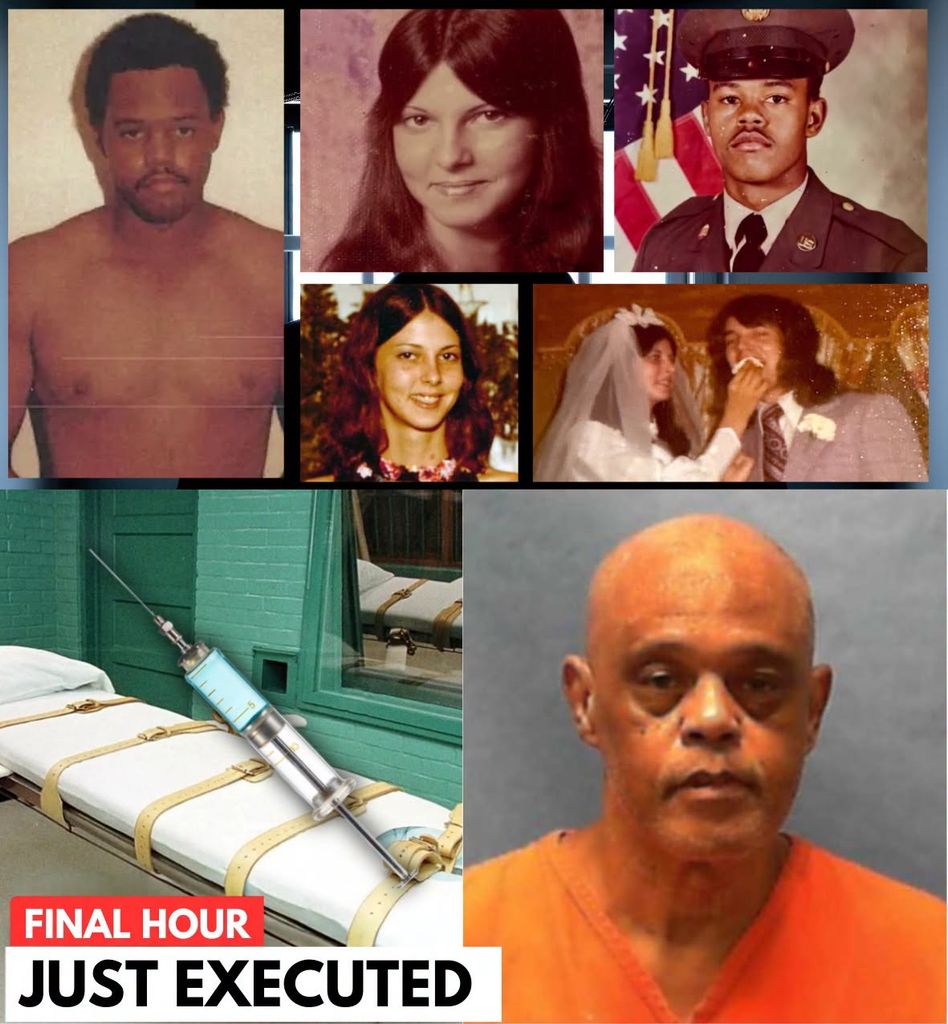
The final act of a 43-year legal saga unfolded in a sterile execution chamber at Florida State Prison on Tuesday evening, as Kayle Barrington Bates, a man who had become one of the longest-serving inmates on the state’s death row, was pronounced dead at 6:17 p. m. The 78-year-old, who spent over four decades appealing his conviction for the brutal 1982 murder of Janet White, offered no apology, no final statement of innocence, and no last-minute plea for mercy.
His only response to the warden’s standard inquiry was a single, quiet word: “No.”
 The execution, which was Florida’s tenth of the calendar year, marked a grim milestone for the state, setting a new record for executions carried out in a single year since the death penalty was reinstated in the 1970s. The swift administration of the three-𝒹𝓇𝓊𝑔 lethal injection protocol took just over fifteen minutes to complete, bringing a definitive close to a case that had haunted the Florida panhandle community for generations. Outside the prison walls in Raiford, the atmosphere was charged with a mixture of solemn vindication and vocal protest, reflecting the deep divisions that continue to surround capital punishment in America.
The origins of this case trace back to a warm summer morning on June 14, 1982, when Janet White, a 24-year-old insurance worker, arrived at her office in the Florida panhandle expecting an ordinary Tuesday. Her life was brutally cut short when Bates, then a young man, entered the building and abducted her at gunpoint. He forced her into the nearby woods, where he attempted a sexual assault before stabbing her to death in a frenzied attack.
As she lay dying, he callously ripped a diamond ring from her finger and fled the scene, leaving behind a community in shock and a widower, Randy White, who would spend the next four decades seeking justice.
The investigation quickly led to Bates, and his trial in 1983 was swift and decisive. The evidence presented against him was overwhelming, painting a picture of a calculated and violent predator. The jury, which was all-white, deliberated for a mere 50 minutes before returning a guilty verdict on charges of first-degree murder, kidnapping, armed robbery, and attempted sexual battery.
The subsequent sentencing phase resulted in a death sentence, a punishment that would become the subject of a legal battle that would outlast nearly every other aspect of the case, spanning more than four decades and countless courtrooms.
What followed was a labyrinthine journey through the American appellate system, a process that would transform Bates from a convicted murderer into a symbol of the death penalty’s complexities. His initial conviction was upheld, but procedural issues at his trial led to a new sentencing hearing in 1995, where a jury again recommended death, this time by a vote of 9 to 3. During his decades in prison, Bates underwent a significant personal transformation, converting to Islam and adopting the name Ma’Dib al-Shariff Chuan, though official prison records continued to list him under his birth name.
His legal team, however, never relented in their efforts to overturn his sentence. They argued that Bates, a military veteran, may have suffered from brain damage that was not properly considered during his trial. They filed repeated motions for DNA testing on evidence they believed could potentially exonerate him, but these requests were consistently denied by the courts.
They even joined a broader lawsuit alleging racial bias in the selection of inmates for execution, pointing to a pattern where cases involving white victims were prioritized over those with Black victims, a claim that added a layer of racial controversy to an already fraught case.
 By 2025, Bates had exhausted every legal avenue available to him. The Florida Supreme Court rejected his final appeals, and the United States Supreme Court declined to intervene. With his options depleted, Florida Governor Ron DeSantis signed the death warrant, setting the stage for the execution that would take place on August 19th.
The state was in the midst of an unprecedented push to carry out sentences, and Bates was set to become the tenth person executed that year, a statistic that drew intense national and international scrutiny to Florida’s capital punishment system.
In the days leading up to the execution, a coalition of anti-death penalty activists, faith-based groups, and civil rights organizations mounted a desperate campaign to stop the lethal injection. Thousands of appeals for clemency were sent to the governor’s office, with advocates emphasizing Bates’s status as a veteran and the decades he had already spent incarcerated. They argued that executing a man who had been a productive member of the prison community for so long was an act of state vengeance rather than justice, but their pleas were ultimately ignored, and the governor declined to intervene.
The final day in the life of Kayle Barrington Bates began early, with prison officials waking him at 5:15 a. m. He was allowed a final visit with family, and three people came to see him one last time: his daughter, his sister, and his brother-in-law.
The content of those conversations remains private, but one can only imagine the emotional weight of saying goodbye to a loved one knowing they will be executed in a matter of hours. Notably, Bates declined to meet with a spiritual adviser, forgoing the comfort of a minister or imam despite his years of religious conversion.
One of the most enduring traditions surrounding executions is the offering of a final meal, a small courtesy that allows the condemned to request a last taste of freedom. Some inmates request lavish feasts, while others ask for simple childhood comforts. Bates, however, chose to decline the offer entirely.
He asked for nothing special, either eating the standard prison fare or nothing at all. Prison officials noted his refusal in their records, leaving observers to speculate on his reasoning, whether it was an act of defiance, a sign of resignation, or simply a loss of appetite in the face of his impending death.
 As the afternoon wore on, the final preparations for the execution were completed. At 6:00 p. m.
, Bates was led into the execution chamber and strapped to a gurney, with IV lines inserted into his arms. On the other side of a thick glass window, a group of witnesses gathered to observe the proceedings. Among them was Randy White, the widower of his victim, who had waited 43 years to see this moment.
Media representatives were also present, documenting the final chapter of a story that had captivated the state for decades.
The warden gave the signal, and the curtain separating the witnesses from the chamber was raised. Following protocol, the warden turned to Bates and asked if he had any final words. It was his last opportunity to speak, to offer an apology to the family of his victim, to proclaim his innocence, or to say a final goodbye to his own family.
The room fell silent, and Bates, with his final breath of free will, simply said “No.” It was a single, monosyllabic response that offered no closure, no explanation, and no remorse, leaving witnesses to interpret its meaning for themselves.
With his final words spoken, the execution proceeded without delay. The three-𝒹𝓇𝓊𝑔 protocol began at 6:01 p. m.
, with a powerful sedative flowing into his veins to render him unconscious. This was followed by a paralytic agent to stop his breathing and a final chemical to stop his heart. Witnesses observed Bates’s breathing become rapid as the sedative took effect, before it slowed and eventually stopped altogether.
 By 6:05 p. m. , he was completely still, and after a formal examination by a physician, Kayle Barrington Bates was pronounced dead at 6:17 p.
m.
The reaction to the execution was immediate and deeply polarized. Randy White, who had witnessed the death of his wife’s killer, made no immediate public statement, but his presence in the witness room was a powerful symbol of a long-awaited justice. For him and others who knew Janet White, the execution was a delayed but necessary consequence of a heinous crime.
They saw it as the ultimate accountability for a man who had shown no remorse, even in his final moments, and the closure of a painful chapter that had defined their lives for over four decades.
Conversely, anti-death penalty advocates were outraged, condemning the state for carrying out what they viewed as a racially tainted execution. They pointed to the all-white jury that convicted Bates in the 1980s, his status as a Black man in a deeply segregated legal system, and the state’s refusal to grant DNA testing that could have potentially altered the outcome. They highlighted his service as a military veteran and the thousands of pleas for clemency that were ignored, framing his death not as justice, but as a failure of the system to live up to its own standards of fairness and mercy.
The execution of Kayle Barrington Bates was more than just the conclusion of a single case; it was a stark illustration of the deep moral and legal divides that define the American death penalty debate. For proponents, it was a demonstration that the state will ultimately carry out its most severe punishment, even if it takes decades. For opponents, it was a tragic example of a broken system, where a man’s life was extinguished after 40 years of legal limbo, with questions about his guilt and the fairness of his trial left unresolved.
The legacy of this case will undoubtedly continue to fuel arguments on both sides for years to come.
For Randy White, the closure is now absolute. He can finally move forward without the specter of his wife’s killer looming over his life. For the state of Florida, the execution serves as a benchmark for its aggressive pursuit of the death penalty, a policy that has made it the most active execution state in the nation.
And for Kayle Barrington Bates, a man who converted to Islam, refused a last meal, and whose final word to the world was a simple “No,” the story ends in that execution chamber in Raiford, a stark and final punctuation mark on a life that began with promise and ended in infamy.
© 2026 MZ News — Blog powered by WordPress.