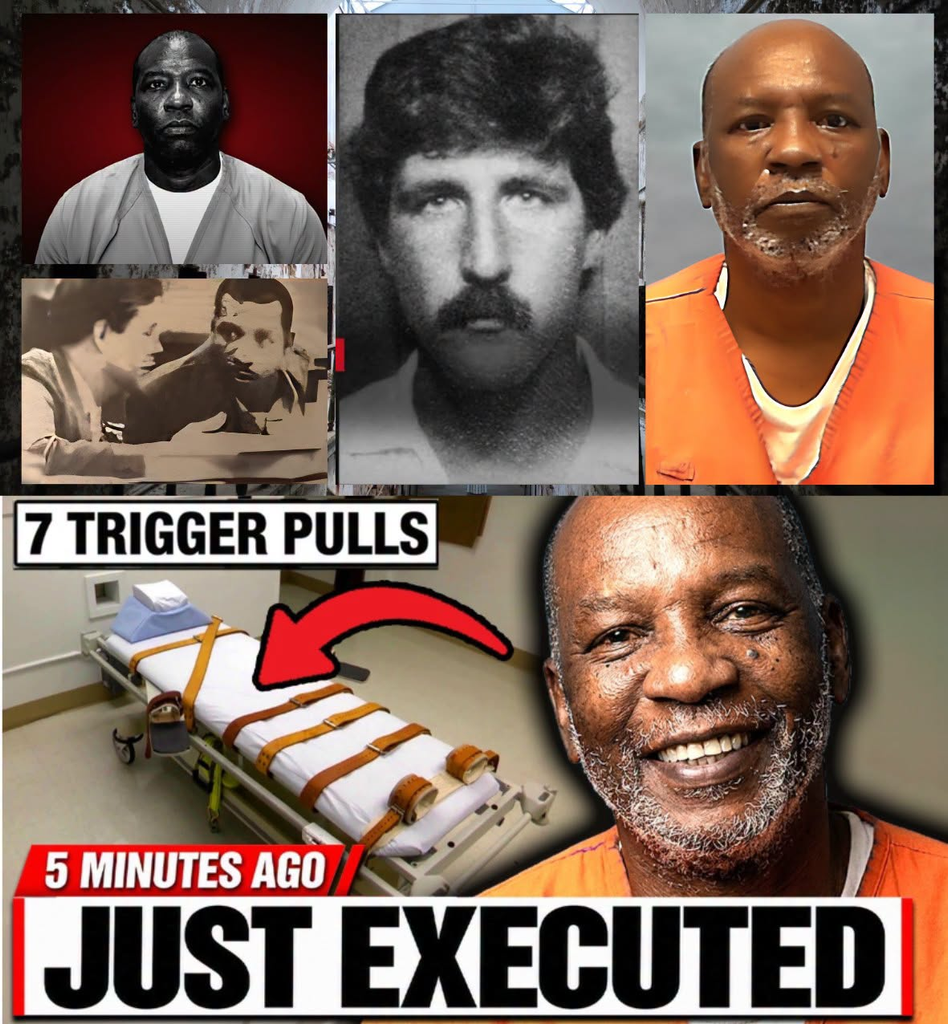
The last sound Corporal Richard Ratchkowski ever heard was the voice of the man he was trying to help, telling him that one of them had to die. On October 20th, 2026, after nearly four decades of legal maneuvering and appeals, the State of Florida finally executed William Reeves Jr. , the convicted killer who gunned down the 29-year-old deputy in cold blood to avoid a three-year prison sentence.
The execution, carried out by lethal injection at Florida State Prison, brought a bitter and long-delayed conclusion to a case that haunted the Indian River County Sheriff’s Office for forty years.
 The chain of events that led to this moment began in the pre-dawn hours of September 23rd, 1986, at a payphone outside a Zippy Mart near Vero Beach. A 911 call came in that hung up without a word, a call placed by Reeves, who was stranded and out of change after trying to summon a taxi. Corporal Ratchkowski, a four-year veteran of the force known affectionately as “Raz,” responded to the routine hang-up call, a task that was supposed to be the most mundane part of his shift.
He pulled into the parking lot, radioed his arrival, and struck up a conversation with the man at the phone, who simply needed a ride home.
Ratchkowski, displaying the compassion that defined his character, went above and beyond the call of duty. He contacted dispatch, confirmed a cab was on its way, and even ran Reeves’ name for outstanding warrants, finding none. He jotted down Reeves’ information on a piece of paper, a note that would later become a critical piece of evidence.
As the two men waited for the taxi, a loaded . 38 caliber pistol slipped from the waistband of Reeves’ shorts and clattered to the ground. In that single, horrifying second, the situation transformed from a simple act of kindness into a life-or-death struggle.
When Ratchkowski moved to secure the weapon, Reeves reacted with lethal violence, shoving the deputy, grabbing him by the throat, and retrieving the gun. Pointing the firearm directly at the officer’s face, Reeves warned him not to reach for his own weapon. Witnesses later testified that Ratchkowski begged for his life, pleading, “Don’t shoot me.
Don’t 𝓀𝒾𝓁𝓁 me.” Reeves’ chilling response, which he later recounted to a friend, was a cold-blooded calculation: “One of us got to go. Me or you?”
As the unarmed deputy turned to flee, Reeves opened fire, emptying all seven rounds from the pistol, striking Ratchkowski four times in the back.
 Even as he lay bleeding on the pavement, the fallen deputy fought back, drawing his service weapon and firing three rounds at his attacker, but missing. Reeves fled into the thick woods behind the store, walking seven miles to evade a massive manhunt that included dozens of officers, K-9 units, and a helicopter. He later showed up at the home of a friend, Eugene Hinton, covered in sweat and carrying the still-wrapped gun, confessing, “I done messed up.
I just shot a cop.” The motive for the murder was as senseless as it was tragic: Reeves, a convicted felon fresh out of prison, was terrified of returning to jail for a mandatory three-year sentence for being a felon in possession of a firearm.
Reeves was apprehended two days later in Albany, Georgia, after attempting to sell cocaine to an undercover agent. He was carrying a newspaper with the headline about the deputy’s murder. In a taped confession, he admitted to the shooting, repeatedly stating he was “coked up” and panicked, but the core reason remained clear: he couldn’t let the officer take his gun.
The first trial in 1987 resulted in a swift conviction and a unanimous jury recommendation for the death penalty. However, in a stunning turn of events in 1991, the Florida Supreme Court overturned the conviction due to a conflict of interest, as one of the prosecutors had once served as Reeves’ own public defender years earlier.
The retrial in 1992 proved to be a grueling ordeal for the victim’s family, forcing them to relive the horrific details of the murder. The defense attempted to introduce a “Vietnam syndrome” argument, claiming Reeves suffered from PTSD related to his military service, but the judge barred the testimony during the guilt phase. The prosecution hammered home the chilling premeditation of the act, pointing to the note in the patrol car and Reeves’ own admission.
The jury again found him guilty of first-degree murder and recommended death by a vote of 10-2, leading to a sentence in Florida’s electric chair. Yet, this was only the beginning of a legal war that would span three more decades.
 For the next 34 years, a revolving door of appeals and habeas corpus petitions kept Reeves alive, outliving his victim by a factor of more than ten. His legal team brought in a parade of new experts who offered theories of brain damage, cocaine-induced psychosis, and severe PTSD, even securing a 100% disability rating from the VA. They attempted to discredit the confession and introduce new affidavits from witnesses who had changed their stories.
Twice, a federal judge ruled in Reeves’ favor, and twice, the 11th Circuit Court of Appeals reversed those rulings, upholding the conviction and death sentence. Throughout it all, the family of Richard Ratchkowski waited, their grief compounded by the endless legal process.
The emotional toll on the Ratchkowski family was immeasurable. Richard’s parents both passed away before seeing justice served, and his mother stopped decorating for the holidays entirely after his death. His younger brother, Mark, who was 22 at the time of the murder, became the family’s spokesperson, enduring decades of frustration as he watched the man who killed his brother continue to appeal.
The pain was compounded by the fact that Richard was killed while performing an act of pure kindness, calling a cab for a man he had no reason to suspect. Richard’s son, born after his death, never had the chance to meet his father, a man described as a fisherman, a scuba diver, and a jokester.
The case finally gained new momentum in 2024 when Indian River County Sheriff Eric Flowers took up the cause, publicly urging Governor Ron DeSantis to sign a death warrant. Flowers argued that Reeves was costing taxpayers millions of dollars while sitting on death row, and he vowed to be present at the execution, wanting the last thing Reeves saw to be the uniform of an Indian River County deputy. In September 2026, nearly forty years to the day after the murder, Governor DeSantis signed the death warrant.
The final appeals were exhausted, and the date was set for October 20th, 2026, marking a final, definitive end to a saga that had tested the limits of the justice system.
 On the day of his execution, Reeves, aged 77, woke at 5:00 a. m. and reportedly remained calm and compliant throughout the day.
He spent his final hours with his sister, brother, nephew, and a friend, as well as a spiritual adviser. His last meal consisted of crackers and juice, a stark contrast to the violence of his crime. At 6:00 p.
m. , the curtain was raised in the execution chamber at Florida State Prison, revealing Reeves strapped to a gurney. When asked if he had any last words, he offered none, no apology, no explanation, no final statement to the family of the man he had murdered.
The silence was a final, bitter insult to the memory of the deputy who had begged for his life four decades prior.
The lethal injection began immediately after his refusal to speak. Within thirty seconds, witnesses observed him take several large breaths before becoming still. A medic confirmed no heartbeat, and at 6:18 p.
m. , William Reeves was pronounced dead, marking Florida’s 18th execution of the year. For Mark Ratchkowski, the answer to the question he had been asked for forty years finally changed, but the closure he received was bittersweet.
He acknowledged that while justice had been served, the pain of losing his brother would never truly go away. The execution of William Reeves closed a chapter of legal history, but it could never erase the memory of a kind-hearted deputy who died trying to help a stranger get home.
© 2026 MZ News — Blog powered by WordPress.