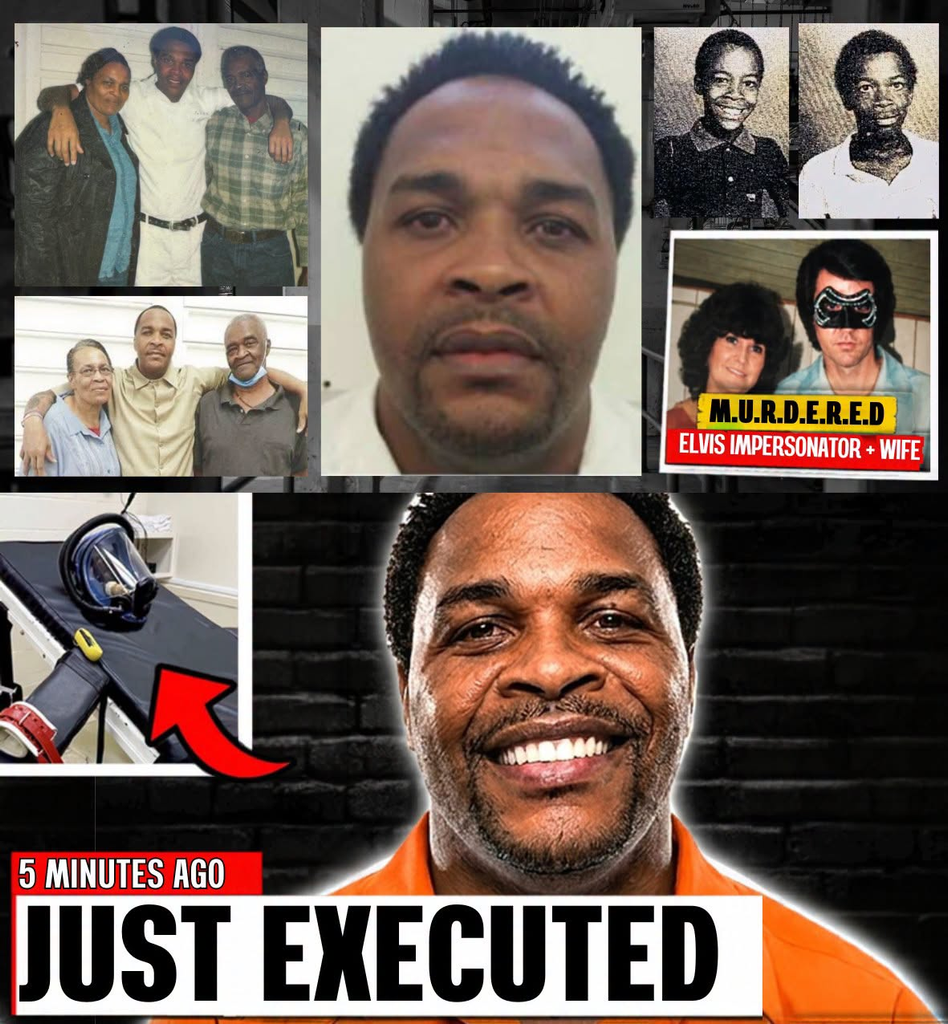
The final appeal had been exhausted, the last phone call made, and the clock had run out on a quarter-century of legal maneuvering. At 6:32 PM Central Time on September 17th, 2026, Jeffrey Lee was pronounced dead at the William C. Holman Correctional Facility in Atmore, Alabama, marking the end of a case that had become a national flashpoint over the morality, methodology, and finality of capital punishment in the United States.
Lee, 49, was executed by lethal injection for the December 1998 shotgun murders of two people inside a rural Alabama pawn shop. His death came just three months after a federal judge halted his scheduled nitrogen gas execution, a ruling that threw the state’s execution protocol into chaos and set off a frantic legal scramble that ultimately ended with Lee dying by the very method he had originally sought to avoid.
 The execution was carried out without incident, according to Alabama Department of Corrections Commissioner John Hamm, who stated that the procedure was completed in accordance with state law. Lee’s spiritual advisor was present in the execution chamber, and his final statement, which was not released to the media, was delivered to witnesses before the lethal dose of pentobarbital was administered. The state’s official death certificate lists the time of death as 6:32 PM.
This was not the death Lee had anticipated. In March 2026, Governor Kay Ivey had signed a death warrant scheduling Lee for execution by nitrogen hypoxia, a method Alabama had pioneered and used in several controversial executions since 2024. That method, which involves forcing the inmate to breathe pure nitrogen gas through a sealed mask, had been the subject of intense litigation due to witness accounts describing violent convulsions, gasping, and involuntary muscle spasms lasting several minutes before unconsciousness.
Lee’s legal team, led by attorney Leslie Smith, argued that this constituted cruel and unusual punishment, a violation of the Eighth Amendment. In a landmark ruling on June 10th, 2026, U. S.
District Judge R. Austin Huffaker agreed, issuing a stay of execution just hours before Lee was scheduled to die. The judge wrote that the state had failed to demonstrate that the nitrogen hypoxia protocol did not pose a substantial risk of severe pain and suffering, citing the documented struggles of previous inmates.
The state of Alabama immediately appealed, but the 11th Circuit Court of Appeals upheld the lower court’s ruling, effectively banning the use of nitrogen gas for executions in the state pending further review. Faced with a valid death warrant and a blocked method, the state did what many legal observers predicted: it pivoted. Within 48 hours, the Alabama Attorney General’s office filed a new motion with the court, requesting a new execution date using the state’s backup method, lethal injection.
It was a bitter irony that was not lost on Lee or his supporters. In 2018, when Alabama offered death row inmates a choice between nitrogen gas and lethal injection, Lee had selected nitrogen. He had cited the well-documented failures of lethal injection in other states, where botched procedures had led to inmates experiencing excruciating pain from improperly administered drugs or failed IV lines.
He had argued that nitrogen, while novel, offered a more reliable path to unconsciousness.
Now, with nitrogen off the table, the state sought to execute him with the very method he had rejected. Lee’s attorneys filed an emergency motion to block the lethal injection, arguing that the state was engaging in a form of procedural whiplash, forcing Lee to die by a method he had explicitly refused. They argued that forcing him to choose between two potentially cruel methods, only to have the first one taken away, was itself a form of psychological torture.
The courts disagreed. A federal judge ruled that the state had a legitimate interest in carrying out the lawfully imposed sentence and that lethal injection, while not perfect, had been deemed constitutional by the Supreme Court in previous rulings. The judge noted that Lee had been given ample opportunity to challenge the protocol and that the state had a right to proceed with a method that was not currently under a judicial stay.
The Supreme Court declined to hear the emergency appeal on September 16th, clearing the final legal hurdle.
The execution proceeded, but the case has left a deep scar on the national conversation about the death penalty. For Lee’s supporters, including Sister Helen Prejean, the activist and author of Dead Man Walking, the execution was a travesty of justice. “We are killing a man who has been completely transformed,” Prejean said in a statement released after the execution.
“The state had to fight tooth and nail to find a way to 𝓀𝒾𝓁𝓁 him that wouldn’t be deemed too cruel, and in the end, they settled on a method he had begged them not to use. This is not justice. This is vengeance.”
Prejean’s words echoed the central argument of Lee’s defense for the past decade: that the man who walked into Jimmy’s Pawn and Package store on December 12th, 1998, was not the man who was executed on September 17th, 2026. The crime itself was brutal and senseless. Lee, then 21, had spent the night drinking, smoking marijuana, and ingesting cocaine.
He had a two-month-old son at home. He drove to the store with his brother and cousin, ostensibly to look at a wedding ring for his girlfriend.
He spoke with an employee, Helen King, who showed him the rings. He said he didn’t have the money and would return. He left, bought a pint of liquor, drank it, and smoked more drugs.
 Then he returned, carrying a sawed-off shotgun. The store’s surveillance camera captured the entire sequence. Lee walked in, saw himself on the live feed, yelled an obscenity, and opened fire.
He shot the owner, Jimmy Ellis, in the chest. He then shot Ellis’s ex-wife, Elaine Thompson, in the face. He then shot Helen King, the woman who had shown him the rings.
Ellis and Thompson died at the scene. King, shot but alive, played dead on the floor while Lee tried to pry the cash register from the counter. He failed, left the shotgun on the counter, and walked out, leaving $900 in Ellis’s pocket and all the jewelry untouched.
He returned moments later, but King had locked the door. He fled to Georgia, where he was arrested hours later after his brother and cousin turned themselves in and gave statements to police.
The case was a prosecutor’s dream. The evidence was overwhelming: surveillance video, a signed confession, and a surviving witness. The trial lasted less than two days.
The jury convicted Lee of two counts of capital murder and one count of attempted murder. During the sentencing phase, the jury voted 7 to 5 in favor of a life sentence without parole. However, under Alabama law at the time, the jury’s decision was merely a recommendation.
The presiding judge, in a move that would later become a defining issue in the case, overrode the jury’s recommendation and sentenced Lee to death.
This judicial override was a legal mechanism that Alabama used for decades, allowing judges to impose harsher sentences than juries recommended. It was a practice that came under intense scrutiny for its racial disparities. A 2011 study by the Equal Justice Initiative found that Alabama judges overrode jury recommendations to impose death sentences at a rate that was disproportionately high in cases involving Black defendants and white victims.
In Lee’s case, the prosecutor had used all 21 of his peremptory strikes to remove Black potential jurors, leaving an all-white jury that recommended life, only to be overruled by a white judge.
Alabama abolished judicial override in 2017, making it one of the last states to do so. The law, however, was not retroactive. Lee remained on death row, his sentence upheld despite the fact that the very mechanism used to impose it had been deemed so flawed that the state legislature outlawed it.
His attorneys argued that this was a fundamental violation of due process. “Alabama fixed the law,” said attorney Leslie Smith. “Jeffrey Lee is still paying the price for when it was broken.”
Over the next 26 years, Lee’s case wound its way through the appeals process. His attorneys argued that his trial counsel was ineffective, failing to present evidence of Lee’s severe childhood trauma and brain injury. They argued that Lee, who grew up in extreme poverty without electricity or indoor plumbing, who began huffing gasoline at age eight and drinking alcohol by age eleven, who suffered a traumatic brain injury in a car accident in his late teens, was not the same person who committed the crime.
They presented evidence of his complete transformation on death row.
Prison records showed zero violent infractions in over 25 years. Lee became a ministry leader, a chaplain’s assistant, and a mentor to other inmates. He worked to raise his son from behind bars, sending letters and making phone calls.
 He expressed deep remorse for his actions, stating that he didn’t even know the names of his victims until he was arraigned, and that he prayed for them daily. “Jeffrey Lee today is not who he was 28 years ago,” he said in a statement. “I’m more caring, more honest, more open, and I live in a way that honors life.
Now, I see life as being sacred.”
The state, however, argued that the brutality of the crime outweighed any mitigation. They pointed to the cold-blooded nature of the shooting, the fact that Lee shot an unarmed woman in the face, and the fact that he attempted to rob the store. They argued that Lee’s transformation, while commendable, did not erase the fact that he had taken two lives in a fit of 𝒹𝓇𝓊𝑔-fueled rage.
The courts, time and again, agreed with the state, denying appeals and upholding the death sentence.
The final act of the 𝒹𝓇𝒶𝓂𝒶 began in March 2026, when Governor Ivey signed the death warrant. The initial execution date was set for June 11th, 2026, using nitrogen gas. Lee’s attorneys immediately filed suit, arguing that the method was cruel and unusual.
They presented evidence from previous nitrogen executions in Alabama, where witnesses described inmates shaking violently, clenching their fists, and gasping for air for up to three minutes before losing consciousness. They argued that this was not a peaceful death, but a prolonged struggle.
Judge Huffaker’s ruling on June 10th was a bombshell. He agreed with the defense, stating that the state’s protocol failed to ensure a swift and painless death. The ruling effectively put a moratorium on nitrogen executions in Alabama, a method that the state had championed as a more humane alternative to lethal injection.
The state’s immediate pivot to lethal injection was seen by many as a desperate measure to ensure the execution occurred before the governor’s term ended.
Lee’s final days were spent in a small cell on death row, awaiting the outcome of his legal battles. He was allowed visits from his legal team and his spiritual advisor. He was offered a final meal, which he reportedly ate little of.
On September 17th, he was moved to the execution chamber at Holman Correctional Facility. The witnesses on the other side of the glass included representatives of the media, Lee’s attorneys, and family members of the victims.
The execution team took over an hour to set the IV lines, a process that has been a source of controversy in other executions due to the difficulty of finding suitable veins. Once the lines were secured, the warden read the death warrant. Lee was given the opportunity to make a final statement.
According to witnesses, he appeared calm and spoke briefly, thanking his supporters and apologizing to the victims’ families. He then nodded to the warden, signaling that he was ready.
The lethal injection protocol in Alabama uses a single 𝒹𝓇𝓊𝑔, pentobarbital, a barbiturate that is intended to induce unconsciousness and then stop the heart. The 𝒹𝓇𝓊𝑔 was pushed through the IV line by a team in an adjacent room. According to official reports, Lee’s breathing slowed and then stopped within minutes.
He was pronounced dead at 6:32 PM. The entire procedure, from the first 𝒹𝓇𝓊𝑔 to the pronouncement of death, took approximately 11 minutes.
 Outside the prison, a small group of anti-death penalty protesters gathered, holding candles and signs. They sang hymns and prayed. Among them was a man who identified himself as Lee’s son, now 28 years old.
He declined to speak to reporters, but his presence was a stark reminder of the generational impact of the crime and the punishment. “This is a tragedy on every level,” said one protester. “Two people were murdered, and now the state has murdered another person.
There is no justice in this.”
The victims’ families, who had waited 27 years for this moment, expressed a sense of closure. In a statement read by a family spokesperson, they said, “Jimmy and Elaine were taken from us in a violent, senseless act. We have waited a long time for this day.
We hope that this brings some peace to our family and allows us to move forward.” They declined to comment on the controversy surrounding the execution method, stating only that they trusted the legal process.
The execution of Jeffrey Lee has reignited the debate over capital punishment in the United States. It has highlighted the ongoing struggles states face in finding a constitutionally permissible method of execution. The botched lethal injections in Oklahoma, the controversial nitrogen hypoxia executions in Alabama, and the difficulty in obtaining execution drugs have all led to a de facto moratorium on executions in many states.
However, Alabama has remained steadfast in its commitment to carrying out death sentences, even as its methods have been challenged and changed.
Legal experts are already analyzing the implications of the Lee case. The ruling that struck down nitrogen hypoxia is likely to be appealed by the state, potentially leading to a Supreme Court review. The case also raises questions about the fairness of the judicial override system, which was used to sentence Lee to death.
While the practice is now illegal in Alabama, Lee’s case serves as a stark example of its application.
“The system failed Jeffrey Lee,” said attorney Smith. “It failed him when the judge overrode the jury. It failed him when the state tried to 𝓀𝒾𝓁𝓁 him with a method that was clearly cruel.
And it failed him when they forced him to die by a method he had rejected. This is not a victory for the rule of law. This is a stain on it.”
As the sun set on Atmore, Alabama, the prison lights dimmed, and the reality of what had transpired settled in. Jeffrey Lee was gone. He had spent more than half his life on death row, a man who had committed a horrific crime but who had, by all accounts, transformed himself into a force for good within the prison walls.
His execution, however, was not about who he had become. It was about what he had done. And in the end, the state of Alabama, after a 27-year legal odyssey, ensured that the sentence was carried out, regardless of the method, regardless of the controversy, and regardless of the man he had become.
© 2026 MZ News — Blog powered by WordPress.