The new documentary I Am Raquel Welch offers an intimate and revealing portrait of one of Hollywood’s most iconic stars, delving far beyond her celebrated beauty to explore the complicated family dynamics that shaped her life.
At the heart of the film is Welch’s childhood relationship with two profoundly different parents: a gentle, nurturing mother and a strict, authoritarian father whose influence left deep emotional scars.
For decades, Raquel Welch was widely admired as one of the most stunning women in cinema history. Her image became synonymous with glamour, strength, and undeniable screen presence.
Yet, as the documentary makes clear, her legacy extends far beyond her physical appearance. Welch, who passed away in 2023 at the age of 82, was also a groundbreaking figure in Hollywood—widely regarded as the first true female action star.
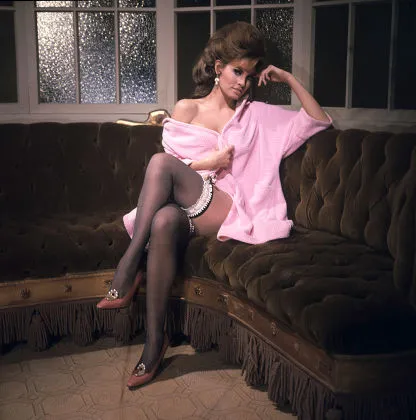
Through rare footage, archival interviews, and candid reflections from those who knew her best, I Am Raquel Welch paints a complex portrait of a woman whose resilience was forged long before fame found her.
Films such as Bandolero! (1968), 100 Rifles (1969), and Hannie Caulder (1971) demanded an extraordinary level of athleticism and toughness at a time when most actresses were rarely expected to perform physically demanding roles. Welch embraced these challenges, redefining what female stars could do on screen.
But that strength did not appear overnight.
Born Raquel Jo Tejada, Welch was the daughter of Bolivian aerospace engineer Carlos Armando Tejada and his wife, Josephine. From an early age, she grew up in a household where discipline and expectations were rigidly enforced.
The documentary reveals that her upbringing required her to develop both emotional endurance and physical resilience—traits that would later become hallmarks of her career.

In interviews featured throughout the film, Welch describes her parents as polar opposites. Her mother, she recalls, was “almost angelic”—a kind, gentle presence who offered warmth and emotional safety.
In stark contrast stood her father, whom Welch described as extremely strict and authoritarian. “My father was very severe,” she once said in an interview clip. “Somewhat authoritarian… sorry, Dad.”
That apology, delivered years later, hints at the complexity of their relationship. Despite his harshness, Welch loved her father deeply and longed for his approval. Yet his parenting style left her constantly striving for perfection, believing love had to be earned through flawless performance.
One particularly painful aspect of her childhood involved her cultural identity. Carlos Armando Tejada refused to speak Spanish in the household, determined that his children would not grow up with accents.
While his intentions may have been rooted in a desire for assimilation and opportunity, the effect on Welch was lasting. In a recorded audio clip featured in the documentary, she reflects on this loss with quiet sorrow.

“There’s a part of me that’s missing,” she says. “And that missing part is the part my father chose to remove from our lives.”
Cultural historian Brian Eugenio of Princeton University offers insight into this contradiction. “It’s a paradox,” he explains. “She adored her father and wanted desperately to please him. But he was also a harsh man—demanding, controlling, and emotionally distant.”
Welch herself describes the love she received as conditional. “I had to do something,” she says in another narration. “I had to get perfect grades. I had to do everything perfectly.”
The documentary does not shy away from the darker moments of her upbringing. One of the most harrowing stories involves a violent confrontation that occurred when Welch was just 16 years old.
Author Luis I. Reyes recounts the incident in detail. During a family argument at the dinner table, Welch’s father became enraged and threw a glass of milk in her mother’s face.

For Welch, this moment was unbearable.
She could not accept seeing her gentle mother humiliated in such a way. According to Reyes, Welch stood up, grabbed a metal fireplace poker, and threatened her father with it. In a rare audio clip, Welch confirms the story herself.
“I threatened his life,” she says plainly. “And he backed off. He ran away.”
The incident marked a turning point—not only in her relationship with her father, but in her sense of self. For the first time, she confronted the fear that had shaped much of her childhood.
Her former husband, Richie Palmer, who appears throughout the documentary, speaks emotionally about the impact of this violence. Choosing his words carefully, he describes Welch’s father as a man she loved, admired, and respected—but also deeply feared.
“It was clearly domestic violence,” Palmer says through tears. “And no one should ever have to live with that. It left scars.”
Yet those scars also forged remarkable strength.
Because Welch stood up to her father, Reyes notes, the violence stopped. “He never did it again,” he says. “That moment changed everything for her.”

As I Am Raquel Welch reveals, the courage Welch later displayed on screen was not merely performance—it was an extension of survival.
The same determination that allowed her to confront fear in her own home empowered her to challenge Hollywood norms, take on physically demanding roles, and refuse to be reduced to a single image.
The documentary ultimately reframes Raquel Welch’s legacy. She was not simply a symbol of beauty, nor just a pioneering action star. She was a woman shaped by conflict, resilience, cultural loss, and defiance—someone who turned adversity into strength and transformed pain into power.
Now streaming on the CW website, I Am Raquel Welch stands as both a tribute and a revelation, offering audiences a deeper understanding of the woman behind the icon—and the childhood experiences that made her unforgettable.