
Are you trying to seduce me, punk?
ByStacy Conradt,Ellen Gutoskey|Dec 5, 2023, 10:29 AM EST
 Add us as a preferred source

It might seem counterintuitive that many of the most famous movie quotes are also the most misquoted ones—but the more people say something, the more chances there are for it to get bungled. And sometimes, the bungled version ends up supplanting the actual quote practically everywhere except in the original source.
Read on to find out which iconic lines we’ve been getting wrong for decades, from Casablanca’s “Play it again, Sam” to The Silence of the Lambs’s “Hello, Clarice.”
1. “It was beauty that killed the beast.” // King Kong (1933)
Actual quote: “It was beauty killed the beast.”
It’s probably our modern grammar sensibilities that cause us to add a that to this King Kong quote, but Carl Denham (Robert Armstrong) didn’t. When a police lieutenant tells him that “the airplanes got” King Kong, Denham corrects him: “Oh, no, it wasn’t the airplanes. It was beauty killed the beast.”
2. “Mirror, mirror, on the wall, who’s the fairest of them all?” // Snow White and the Seven Dwarfs (1937)
Actual quote: “Magic mirror on the wall, who is the fairest one of all?”
The jealous queen’s queries to her magic mirror are a regular occurrence throughout Snow White and Seven Dwarfs, yet many viewers managed to miss what she actually asks that piece of glass. To be fair, our collective memory of the movie might have gotten muddled by the different versions of the rhyme in various translations of the Grimm brothers’ story.
It’s been rendered as “Looking-glass upon the wall, who is fairest of us all?”, for example, and “Mirror, mirror, on the wall, who in this land is fairest of all?” Disney itself even used “Mirror, mirror” in a 1980s hardcover book.
3. “Frankly, Scarlett, I don’t give a damn.” // Gone with the Wind (1939)
Actual quote: “Frankly, my dear, I don’t give a damn.”
Rhett Butler (Clark Gable) says this to Scarlett O’Hara (Vivien Leigh) in response to her panicked questions—“Where shall I go? What shall I do?”—as he’s leaving her. He doesn’t call her by name here in the film or in the book.
4. “Play it again, Sam.” // Casablanca (1942)
Actual quote: “Play it, Sam. Play ‘As Time Goes By.’”
Ingrid Bergman’s Ilsa Lund never asks Sam, the pianist played by Dooley Wilson, to “play it again.” She says, “Play it once, Sam, for old time’s sake.” Then, after he feigns confusion, she clarifies: “Play it, Sam. Play ‘As Time Goes By.’”
The misquote is so prevalent that Woody Allen even borrowed it verbatim for the title of his 1969 stage play, which he adapted for the big screen a few years later.
5. “Badges? We don’t need no stinkin’ badges!” // The Treasure of the Sierra Madre (1948)
Actual quote: “Badges? We ain’t got no badges! We don’t need no badges! I don’t have to show you any stinkin’ badges!”
When Gold Hat (Alfonso Bedoya) claims that he and his cohort are mounted police, Dobbs (Humphrey Bogart) asks where their badges are. Gold Hat’s response is a little longer than what most people remember, but that’s not for no reason: The abridged version was immortalized in 1974’s Blazing Saddles and in a 1967 episode of The Monkees.
6. “I’m ready for my close-up, Mr. DeMille.” // Sunset Boulevard (1950)
Actual quote: “All right, Mr. DeMille. I’m ready for my close-up.”
People don’t bungle Norma Desmond’s (Gloria Swanson) most iconic line too badly, but the call-out to director Cecil B. DeMille (who plays himself in the film) technically comes before the rest of the quote. (In the stage musical, the line is “And now, Mr. DeMille, I’m ready for my close-up.)
7. “Fasten your seat belts. It’s going to be a bumpy ride.” // All About Eve (1950)
Actual quote: “Fasten your seat belts. It’s going to be a bumpy night.”
It would’ve made sense for Bette Davis’s Margo Channing to follow up her seat belt directive with a warning about a bumpy ride. But she doesn’t do that—she says “night,” instead. (For what it’s worth, she’s talking about a party, not a trip.) The line “It’s going to be a bumpy ride” has been uttered elsewhere, including in 2004’s Harry Potter and the Prisoner of Azkaban.
8. “A man’s gotta do what a man’s gotta do.” // Hondo (1953)
Actual quote: “A man ought to do what he thinks is best.”
The axiom A man’s gotta do what a man’s gotta do has appeared in plenty of places, none of them a John Wayne movie. What his eponymous character says in Hondo is admittedly a little less catchy, but still iconic when you know the context: Hondo has just refused to tell his dog to move out of another man’s way, to which the man says, “I’ll be hanged if I go out of my way for any cur dog.” Hondo, rifle in hand, ends the discussion with “A man ought to do what he thinks is best.”
Another misconception is that the quote is from the Alan Ladd–starring Shane (1953). Viewers may have conflated two lines from the film: Joe Starrett’s (Van Heflin) “I couldn’t do what I gotta do if I hadn’t always knowed that I could trust ya” and Shane’s “A man has to be what he is.”
9. “Mrs. Robinson, are you trying to seduce me?” // The Graduate (1967)
Actual quote: “Mrs. Robinson, you’re trying to seduce me. Aren’t you?”
The delivery of this line in The Graduate has more nuance than the misquote affords it. Dustin Hoffman’s Benjamin Braddock avers, with a good-natured shake of his head, that Mrs. Robinson (Anne Bancroft) is trying to seduce him—but when she starts laughing, he immediately loses all confidence and follows it up with an uneasy “Aren’t you?”
10. “Please, sir, can I have some more?” // Oliver! (1968)
Actual quote: “Please, sir, I want some more.”
Not only does poor, starving Oliver not ask the workhouse master if he may have more gruel—he doesn’t ask at all. “Please sir, I want some more,” he says in Charles Dickens’s original novel and every major film adaptation of it: 1933’s, 1948’s, 2005’s, and 1968’s musical version, Oliver!
11. “Do you feel lucky, punk?” // Dirty Harry (1971)
Actual quote: “You’ve got to ask yourself one question: ‘Do I feel lucky?’ Well, do ya, punk?”
Clint Eastwood’s Harry Callahan isn’t too concerned with brevity when he delivers this speech to a robber he’s holding at gunpoint. But we’ve all subconsciously edited it down for the sake of a good catchphrase. (Except for Jim Carrey’s The Mask character, who repeats the original quote in full, though he slightly botches the beginning).
12. “We’re gonna need a bigger boat.” // Jaws (1975)
Actual quote: “You’re gonna need a bigger boat.”
Even the most rabid Jaws fan might be guilty of mishearing this line, in part because Brody (Roy Scheider) has a cigarette hanging out of his mouth when he says it.
13. “I’m mad as hell, and I’m not gonna take it anymore!” // Network (1976)
Actual quote: “I’m as mad as hell and I’m not going to take this anymore!”
It’s no mystery why we often don’t get the wording of Howard Beale’s (Peter Finch) impassioned on-air outburst exactly right: When other people shout it from their windows in the film, not all of them get the wording exactly right.
14. “I’m out of order? You’re out of order! This whole court’s out of order!” // … And Justice for All (1979)
Actual quote: “You’re out of order! You’re out of order! The whole trial is out of order! They’re out of order!”
Speaking of movie outbursts, there isn’t a YouTube compilation titled “Al Pacino losing his shit” for nothing. Pacino’s reaction to the judge’s “Mr. Kirkland, you are out of order” in … And Justice for All ranks among the most memorable, but it’s a little less smoothly worded than you might think.
It’s also not the only time Pacino has played a lawyer who reacts to being told he’s out of order in a courtroom. In Scent of a Woman, he replies with “Outta order? I’ll show you outta order! You don’t know what outta order is, Mr. Trask.”
15. “Luke, I am your father.” // The Empire Strikes Back (1980)
Actual quote: “No, I am your father.”
The Empire Strikes Back’s most famous line is so widely misremembered that it’s become a popular example of the Mandela effect: a shared false memory. “Luke, I am your father” works great as a standalone quote, but “No, I am your father” makes more sense in context. “Obi-Wan never told you what happened to your father,” Darth Vader says, and after Luke answers, “He told me enough—he told me you killed him,” Vader sets the record straight.
16. “Beam me up, Scotty.” // Star Trek IV: The Voyage Home (1986)
Actual quote: “Scotty, beam me up.”
Shockingly, the exact phrasing “Beam me up, Scotty” has never appeared in the Star Trek canon, though countless variations—including “Beam us up, Mr. Scott,” “Scotty, beam us up fast,” and simply “Beam me up”—have. The closest we’ve gotten is when William Shatner’s James T. Kirk says “Scotty, beam me up” in the 1986 film Star Trek IV: The Voyage Home.
17. “If you build it, they will come.” // Field of Dreams (1989)
Actual quote: “If you build it, he will come.”
Though Kevin Costner’s Field of Dreams brings all sorts of legendary ballplayers to his yard, the voice that tells him to build the field only promises a single person—same as it is in W.P. Kinsella’s Shoeless Joe, the novel that inspired the film. (James Earl Jones’s character does say “People will come” several times in his famous baseball monologue, which might contribute to the confusion.)
18. “Hello, Clarice.” // The Silence of the Lambs (1991)
Actual quote: “Good morning.”
Hannibal Lecter (Anthony Hopkins) does greet Clarice (Jodie Foster) in The Silence of the Lambs, but not with a hello. The first time they meet, he just says “Good morning.” Though Lecter does frequently address her by name during their conversations, there’s a more compelling reason so many people think he utters “Hello, Clarice” in as many words—because he does so in the 2001 sequel, Hannibal.
“Is this Clarice?” Lecter says over the phone, and then, after a beat of silence, “Well, hello, Clarice.” The clip appeared in the trailer, so even people who didn’t watch Hannibal in full might’ve heard the quote before another movie.
19. “Life is like a box of chocolates. You never know what you’re gonna get.” // Forrest Gump (1994)
Actual quote: “My momma always said life was like a box of chocolates. You never know what you’re gonna get.”
The simile doesn’t get lost in the misquote, but some of the context does. Forrest Gump (Tom Hanks) is reiterating something his mother used to say, and he uses was—not is—to keep it in the past. We also get to hear Mrs. Gump (Sally Field) utter the adage herself in the movie, but she adds a direct address in the middle of it: “Life is like a box of chocolates, Forrest. You never know what you’re gonna get.”
20. “I’m king of the world!” // Titanic (1997)
Actual quote: “I’m the king of the world!”
A true Titanic super fan would never forget the first the in Jack’s (Leonardo DiCaprio) gleeful cry from the bow of the ship. Neither did director James Cameron when he memorably repeated the line in his speech after winning the Best Director Oscar in 1998.
A version of this story was published in 2018; it has been updated for 2023.
Related Tags
6 Foods Families Really Ate During the Gilded Age
That lavish spread you saw in ‘The Gilded Age’? From towering aspics to sea turtle soup, high society’s favorite dishes weren’t a Hollywood creation, but actual history.
ByNitya Rao|Nov 7, 2026, 8:00 PM EST
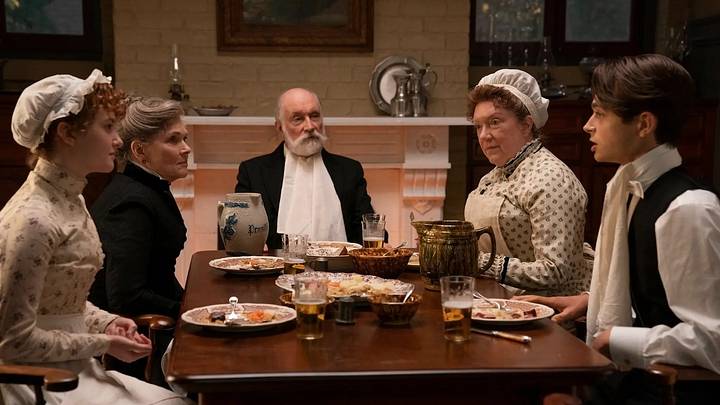
If “you are what you eat,” then you might want to rethink “eating the rich.” From our history books to the HBO series The Gilded Age, records and recreations show that the wealthiest Americans often ate foods that would make a poor man’s plate look a lot more appealing.
The Gilded Age shows that not everything that glitters is gold. This flashy period between the 1870s and 1900 was fueled by new money at the hands of tycoons like Vanderbilt and Carnegie—fortunes that embossed New York’s Fifth Avenue and Newport, Rhode Island, in glitz and gold leaf. The era was a snapshot of America’s elite that included clifftop “cottages,” lavish balls, and… tureens of turtle soup?
That’s just one of the delicacies that graced Gilded Age tables. While the servants and working class—like the show’s Mrs. Bauer and Jack Trotter—ate far simpler fare and leftovers, the upper crust’s menu was a lot more eclectic.
From oysters on the half shell to meat jelly, here are five foods families really ate during the Gilded Age that you may or may not see on season 4 of HBO’s namesake show.
Celery
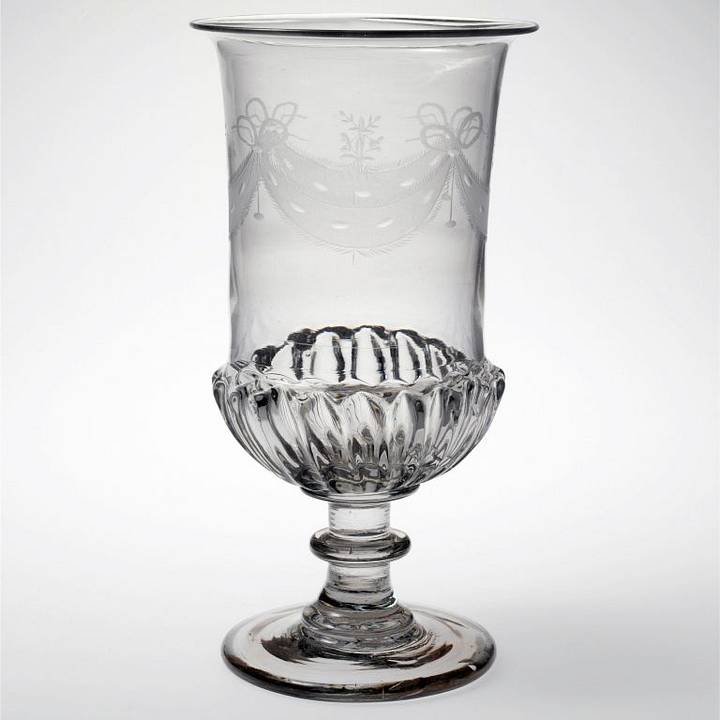
Today, we see celery as nothing more than the free side given with chicken wings. But back in the Gilded Age, this crunchy, watery vegetable was the centerpiece of the meal—literally. 19th-century aristocrats even had decorative glass “celery vases” made to hold the hard-to-grow stalks, displaying the unlikely status symbols upright for all to see. As celery production increased and its price decreased, Gilded Age chefs began experimenting with the vegetable in the kitchen—braising it, dressing it in mayo, and more.
Oysters

No trip to Newport is complete without stopping by Midtown Oyster Bar for a dozen on the half shell, and back in the Gilded Age, high society was just as obsessed. Much like lobster, oysters had a humble beginning as a working-class staple across 19th-century coastal cities. They were shucked and slurped down by maritimers on the streets of New York long before becoming an elegant appetizer on Gilded Age menus. From raw oysters on sparkling beds of crushed ice to decadent baked preparations like Oysters Rockefeller, the modest mollusk underwent one of the greatest glow-ups in culinary history.
Turtle Soup
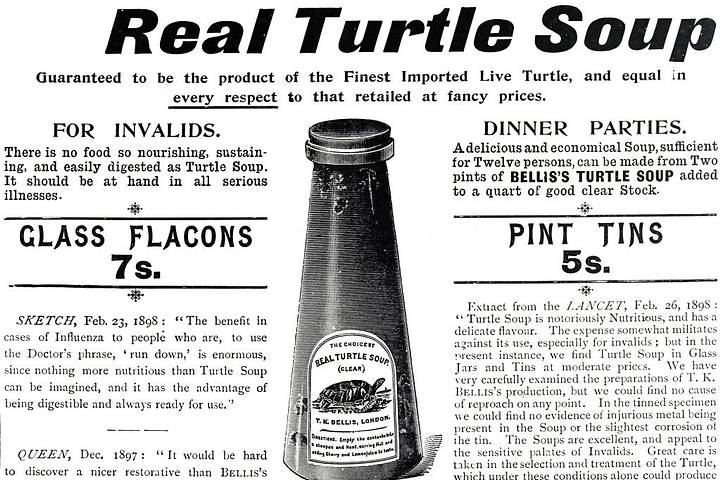
On The Gilded Age, most meals start with the clink of silver spoons against porcelain bowls. Menus from Gilded Age establishments like Delmonico’s and period etiquette magazines back up this soup starter standard. An excerpt from Godey’s Lady’s Book on how to throw a proper dinner party goes as follows: “Commence dinner with raw oysters, then a choice of one or two soups.”
The soup du jour wasn’t always lobster bisque or cream of celery, though. A luxury at the time—and a dish rarely seen today due to strict conservation protections—turtle soup was all the rage in the Gilded Age. Chefs favored the diamondback terrapin, a turtle found from Cape Cod down the Gulf Coast. Whether eating out at a fine dining establishment in the city or hosting an intimate dinner party, these turtles were boiled, chopped, and finished with a swish of sherry before landing on high-society tables in the 1880s and ’90s. That is, until overhunting almost wiped the creature out by the 1910s, sending prices soaring and pushing the dish off most menus.
Aspic
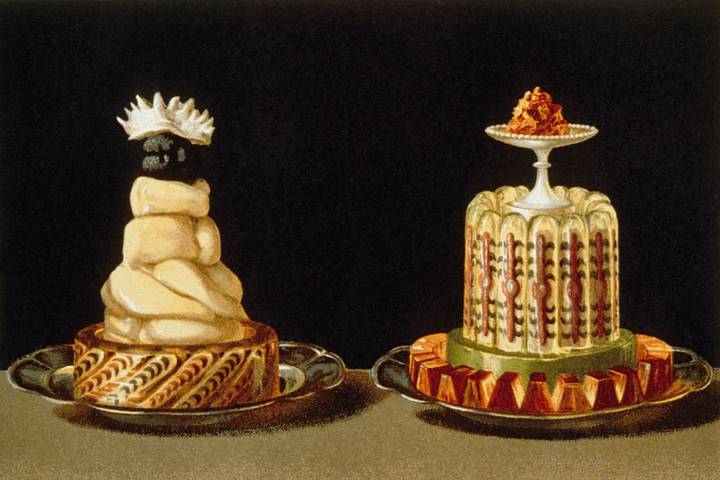
Before 1950s housewives discovered Jell-O molds, Gilded Age kitchens were constructing towering aspics that served as equal parts savory centerpiece and sign of a master chef. These edible gelatinous sculptures—which migrated from Europe and were made from boiled animal bones before powdered gelatin was popularized in the late 1800s—contained meat, fish, produce, and eggs suspended in translucent broth like an edible display case. Served midway through formal multi-course banquets, colorful aspic creations were more of an art form than the cold course they were presented as.
Charlotte Russe

You might recognize the name from the popular 2000s women’s clothing store, but unlike the store, this sweet, berry-topped cake wasn’t always made for the masses. Concocted by French chefs in the late 18th century and said to be named in honor of Queen Charlotte, Charlotte Russe cake—a tower of ladyfingers surrounding cold Bavarian cream or custard and berries—was the creme de la creme of Gilded Age dessert spreads.
While the nouveau riche enjoyed decadent riffs, sometimes even decked out with a decorative ribbon, the treat eventually evolved past wedding breakfasts and banquets of the elite. Decades later in the 20th century, the spongy sweet shifted from the white tablecloths of Delmonico’s to the streets of Brooklyn, where pushcart vendors served simplified versions out of cardboard cups to working-class New Yorkers.
Read More:
•
6 Foods Families Really Ate During the Middle Ages
•
6 Foods Families Really Ate in the Times of ‘Little House on the Prairie’
•
What Did People Eat for Breakfast in Colonial Williamsburg?
•