
ByJennifer M Wood|Jan 31, 2020, 10:00 AM EST
 Add us as a preferred source

Here are some things you might not have known about the award-winning—and much-beloved—1960s-set coming-of-age tale, which made its debut on January 31, 1988.
1. The basic concept for The Wonder Years began as a film script.
“We played around with writing a screenplay that used narration as a device,” series co-creator Carol Black told New York magazine in 1989. “We just started to think that there was a lot of potential fun in that ‘cause you can really play with the contrast between the narrator’s point of view and what the characters are doing. And you can go inside their head and expose what they’re really thinking when they’re saying something different … And then we just sort of jumped from there to thinking that effect is accentuated when you have an adult narrator looking back on childhood.” Black created the series with her husband, Neal Marlens; the couple had previously worked on Growing Pains.
2. The Wonder Years was inspired by A Christmas Story.
From the coming-of-age theme to the use of narration, A Christmas Story inspired the spirit of The Wonder Years. Peter “Ralphie” Billingsley even appeared in the series’s final two episodes as one of Kevin’s roommates.
3. The Wonder Years’s lack of laugh track and single camera setup were revolutionary.
The Wonder Years set itself apart from other shows of its time, production-wise, with its single camera setup, use of a narrator, and complete lack of laugh track. “The Wonder Years [showed the television industry] that it’s OK to create a show like that—to take out the laugh track, to try different camera styles—to take a risk,” Josh Saviano, who played Paul Pfeiffer, told Salon in 2013.
4. Fred Savage was the obvious choice to play The Wonder Years’s Kevin Arnold.

Casting kids is never an easy task. To help them in finding their lead actor, Marlens and Black interviewed five casting directors for recommendations. All five of them suggested Fred Savage, who at that point was best known for his role in The Princess Bride.
“By the time we actually settled on a casting director, we had already resolved that we should see Fred,” Marlens told The Philadelphia Inquirer in 1988. “Knowing nothing about him, we arranged to screen some unedited footage of a film he was making at the time, Vice Versa … [We saw] a marvelous actor with a natural quality, which essentially means he has no quality at all except being a kid. It sounds funny, but it’s a rare thing to find in a child actor. It’s the same thing we looked for and discovered in Josh Saviano and Danica McKellar.”
5. The Wonder Years is set in Anytown, USA.
Though no specific location is ever given for Kevin Arnold’s hometown, that’s not the doing of the series’s creators. Neal Marlens wanted to set The Wonder Years in Huntington, Long Island—his hometown—and additional elements were also pulled from Black’s hometown of Silver Spring, Maryland. But it was at ABC’s insistence that no city or state was ever mentioned. Still, many eagle-eyed watchers have combed through the series for clues—like Jack Arnold’s license plate and Wayne’s driver’s license—that place the show in California, where it was filmed.
6. The Wonder Years premiered after the Super Bowl.
After more than 80 million viewers tuned in to see the Washington Redskins crush the Denver Broncos (final score: 42 to 10) on January 31, 1988, they were treated to the series’s premiere—which Marlens called “a bit of Americana after the quintessential example of Americana.”
7. The Wonder Years won its first Emmy after just six episodes.
Though it wasn’t an immediate ratings bonanza, The Wonder Years was a critical smash from the get-go. On August 28—with only six episodes screened—Marlens and Black took home the 1988 Emmy for Outstanding Comedy Series.
8. Fred Savage became the youngest Lead Actor Emmy nominee.

In 1989, at the age of 13, Savage became the youngest actor to be nominated for an Emmy in the Outstanding Lead Actor in a Comedy Series category. He was nominated again in 1990.
9. Danica McKellar’s toughest competition for Winnie Cooper was her sister.
When it came down to casting the role of dream girl Winnie Cooper, there were two final contenders: Danica McKellar and her sister, Crystal. “It was practically a tossup,” casting director Mary Buck told the Los Angeles Times in 1990. After choosing Danica for the role, Crystal was hired for the recurring role of Becky Slater, Winnie’s one-time rival for Kevin’s affections.
10. Kevin and Winnie’s first kiss was the real thing.
In the series’s premiere episode, Kevin and Winnie share an awkward first kiss, a coming-of-age ritual neither of the young actors had yet to engage in in real life. “The one good thing about getting your first kiss on camera is that you know for sure it’s going to happen,” McKellar said in 2014. For his part, Savage called it terrifying. “We were both really scared and nervous and—and—didn’t know what was going to happen or … if we were going to do it right.”
11. A mutual crush between Fred Savage and Danica McKellar was inevitable.
Though they swear the relationship eventually morphed into a brother-sister sort of bond, both Savage and McKellar admitted to having mutual crushes in People. “I was in love with her for the same reasons every other boy fell in love with her,” Savage said. “You won’t meet a sweeter, nicer girl—and she’s gorgeous.”
“In the beginning we had a mutual crush,” added McKellar. “Then things went into the teasing stuff and then into a more comfortable, brother-sister thing.”
12. It was Dan Lauria’s suggestion that The Wonder Years’s Jack Arnold be a veteran.

“I really didn’t contribute that much, but the one thing I did contribute to the character is that when we were shooting the pilot I said to Neal, ‘Look, I’m a vet. I’m a Vietnam veteran and a Marine, and I think if the story is that I’m a vet, that’d fit the character,’” Dan Lauria recalled to Paste. “Before we even finish the pilot, he said, ‘Well, if we go, Dan, we’re going to make you a Korean War vet to fit the frame.’ And so they did, and it paid off. There were a number of episodes where it was mentioned that I was a veteran and when my daughter left for college I gave her my old duffle bag from the service. We always had the Vietnam War in the background on the TV at the dinner table. So there were actual news clips.”
13. Some of Kevin and Winnie’s dialogue in The Wonder Years was lifted from real life.
“Kevin and Winnie’s relationship was, in some ways, defined by my friendship with Fred and some of the things that we would say,” McKellar told Collider. “The writers would actually take lines from things that we were saying to each other, off camera, and put it into the script. There was this whole episode dedicated to, ‘Do you like him, or do you like him, like him?’ That was an expression that he and I used when we were talking about some guy that I had a crush on, in real life. And then, it showed up in a script, a few weeks later. There were a lot of blurred lines.”
14. A growth spurt caused Winnie and Kevin’s breakup on The Wonder Years.
Kevin and Winnie’s on-again, off-again romance was one of the series’s key storylines. But on at least one occasion—between the show’s third and fourth seasons—the breakup was more of a practical decision when a growth spurt saw McKellar standing much taller than her sub-five-foot onscreen beau. The couple was kept apart just long enough for Savage to catch up to his co-star’s height.
15. Jason Hervey’s brother was the real Wayne Arnold.

“There were so many things that I borrowed from our real life experiences,” Hervey told Uproxx of his brother, Scott. “I’ll give you an example: Juliette Lewis was my girlfriend on the show at the time, and it was the driver’s license episode. We took Fred—I mean, Kevin—to the mall because my mom made us, and I dropped him off at the absolute, absolute furthest end of the mall parking lot and I said to him, ‘Well, technically, this is the mall.’ And when I picked him up, of course, he was already flirting with this girl, and sure enough Wayne pulls up and I tell him to get in the car, and then every time he went to reach for the door, I kept jerking it forward. And obviously, the first day of 7th grade, my brother did that to me in real life, and just embarrassed the hell out of me.”
16. Growing up was part of The Wonder Years’s demise.
The Wonder Years was a show about growing up, which is partially what led to its wrapping production after six seasons. “There has always been a question of just how long the wonder years last,” executive producer Bob Brush told the Los Angeles Times in 1993, following the series’s finale. “As the kids were developing and getting older, there were of course new stories to tell, but the tension and constraints of the deadline of the concept of the wonder years were beginning to press on us … When [Fred Savage] became 16 and 17, there were really things he needed to get to that we couldn’t do at 8 p.m., especially with the kind of venerable cachet that the show had obtained with its audience. We would get notes from the network saying, ‘You could do this on any show besides The Wonder Years.’”
17. The Wonder Years enlisted The Sopranos creator David Chase’s help.
In an effort to breathe a more mature life into the series, producer Ken Topolsky commissioned Sopranos creator David Chase to write a script. “When it’s a suburban kid who has a pretty good life and he’s complaining about mom not letting him do something, you just want to smack him,” Topolowsky told The Wall Street Journal. “That’s when we felt that Kevin’s wonder years were over.” Though he calls Chase’s script “phenomenal” and “one of the best,” its storyline—which included hard drug use—would have been too big a leap for the family-friendly series.
18. Daniel Stern wasn’t The Wonder Years’s original narrator.
Though Daniel Stern’s voice is the adult Kevin Arnold we all know and love, it was Arye Gross who narrated the original pilot. Eventually, the series premiere was re-recorded with Stern.
19. Marilyn Manson was not Paul Pfeiffer.
It’s one of those Internet rumors that never seems to die. But somehow, somewhere, someone decided that Josh Saviano, the actor who played Kevin’s BFF Paul Pfeiffer, was in fact Marilyn Manson. Which is simply not true. Though that hasn’t stopped the shock rocker from getting in on the fun. “I met [Marilyn Manson] once,” Savage told ABC News. “He came up to me, and he goes, ‘You know, we worked together.’ I was like, ‘I do. I do know that.’”
20. Paul Pfeiffer really did become a lawyer.
In the series finale, Kevin shares that Paul attended Harvard and became a lawyer. Which isn’t too far off base. In reality, Josh Saviano attended Yale and became a lawyer.
21. The Wonder Years fans were disappointed that Kevin and Winnie didn’t end up together.

Executive producer Bob Brush knew that fans of the series wouldn’t be happy that it didn’t end with Kevin and Winnie’s happily ever after. “Some viewers will be surprised that nothing works out the way your fondest wish would be,” Brush told the Los Angeles Times. “The message I wanted in there is that that’s part of the beauty of life. It’s fine to say, ‘I’d like everything to be just the way it was when I was 15 and I was happy,’ but it seemed more nurturing to me to say that we leave these things behind and we go on to forge new lives for ourselves.”
22. The little boy’s voice in The Wonder Years’s finale is Daniel Stern’s son.
As the series concludes, the voice of Kevin’s little boy is heard asking his dad to come outside and play catch. The voice is Stern’s son.
23. The Wonder Years gave a boost to many young actors’ careers.
Juliette Lewis, Jim Caviezel, Alicia Silverstone, Giovanni Ribisi, Mark-Paul Gosselaar, David Schwimmer, Carla Gugino, and John Corbett (then known as Jack) are just a few of the actors who found some of their earliest roles on The Wonder Years. Even Robin Thicke got in on the action, as a young man doing his teenaged best to pick up a girl.
24. Jack Arnold dated Maggie Seaver.
Before The Wonder Years, Marlens and Black had created Growing Pains. Which is how Dan Lauria heard about the role of Jack Arnold. “I had done a part on Growing Pains, and I was going out with Joanna Kerns [who played mom Maggie Seaver on the show] at the time, so I heard about it through her,” Lauria told Paste. “My agent couldn’t get me in, and Joanna said, ‘Well, why don’t you call Neal? He likes you, you guys got along.’ ‘Cause we both grew up on Long Island, so we would tease each other [about] which school was better at sports. And I said, ‘No, I don’t want to do that, it’s so unprofessional,’ and Joanna went in and actually called Neal, and she came out and said, ‘Neal said be there tomorrow at 10 o’clock. He thinks you’re perfect.’”
25. Fred Savage will always be Kevin Arnold.

Though he has made the transition from actor to producer and director of shows like It’s Always Sunny in Philadelphia and Party Down, Savage told GQ that “The persona of The Wonder Years is something that’s going to be with me forever. And I’m happy for that. It’s nothing that I’d ever shy away from, and it makes me feel so good that it’s something people still remember and talk about it and think of it so fondly. I think now I’ve established myself as a director, but starting out, I’d be foolish to think that every opportunity that came after The Wonder Years didn’t stem from The Wonder Years. So I owe so much of everything to that show.”
The Defining Macy’s Thanksgiving Day Parade Balloon of Every Decade
Watch 100 years of pop culture drift down Manhattan. From Felix the Cat to Bart Simpson, these are the iconic character balloons that colored Thanksgiving morning in every era.
ByNitya Rao|Nov 12, 2026, 6:00 PM EST
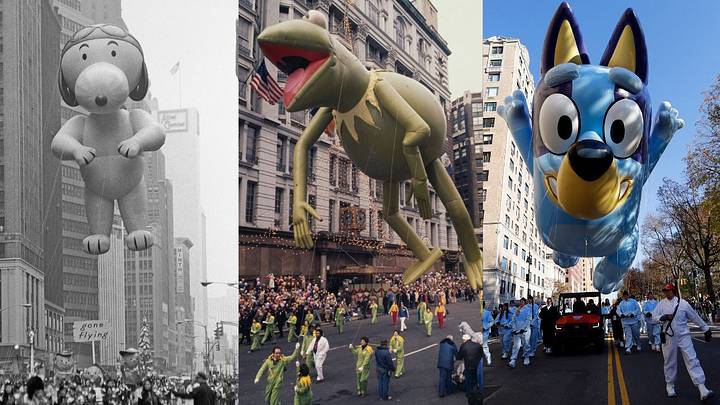
Everyone knows the best part of Thanksgiving is the sides—and the sideshow. For a few hours every November, the main meal makes room for the annual Macy’s Thanksgiving Day Parade, a feast for the eyes featuring colorful character balloons, festive floats, and a whole lot of helium.
Since 1924, the parade has been a revolving door for America’s favorite pop culture icons, from classic Mickey Mouse to Gen Alpha’s beloved Bluey. As silly as the giant Snoopy and Spider-Man shadows over Manhattan’s West Side may seem, it’s this very spectacle that keeps millions glued to their screens every Thanksgiving morning. Here’s a look back at the cartoon characters and blockbuster balloons that shaped the Macy’s Thanksgiving Day Parade over the last century.
1920s: Christmas Parade Premiere
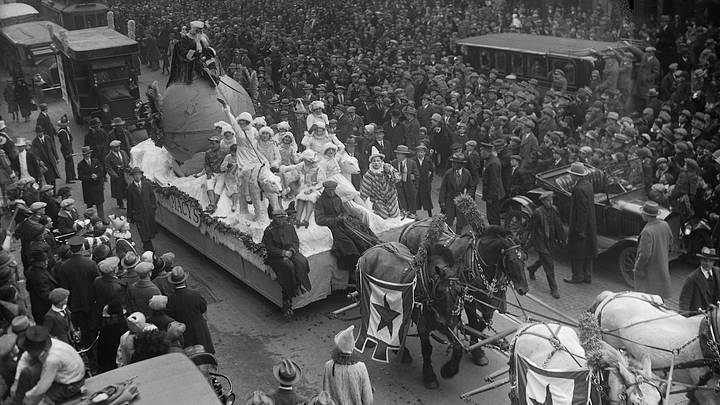
Before we had colossal character inflatables and live television coverage, Manhattan’s biggest holiday celebration was known as the Macy’s Christmas Parade. Launched on November 24, 1924, for a crowd of just 10,000 spectators, the event featured horse-drawn floats like this 1925 Santa Claus carriage and even live animals from the Central Park Zoo to usher in the holiday shopping season.
1930s: Mickey Mouse Takes Manhattan
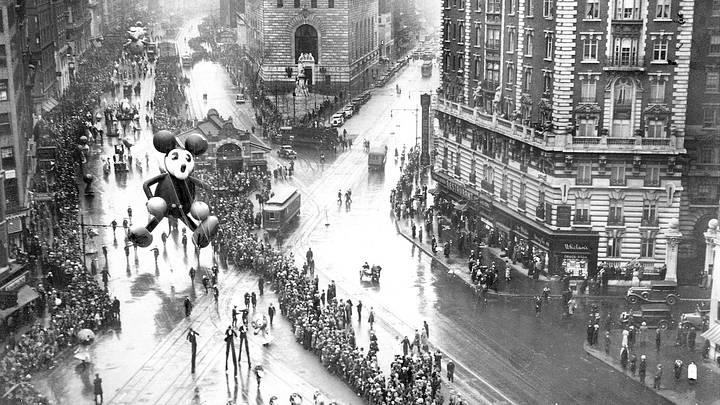
From Disney’s animation studio to the streets of Manhattan, the balloon adaptation of this beloved Disney character was introduced to the parade in 1934. Walt Disney designed the original Mickey Mouse balloon, which saw four more tweaks over the years.
1940s: Post-War Rebirth
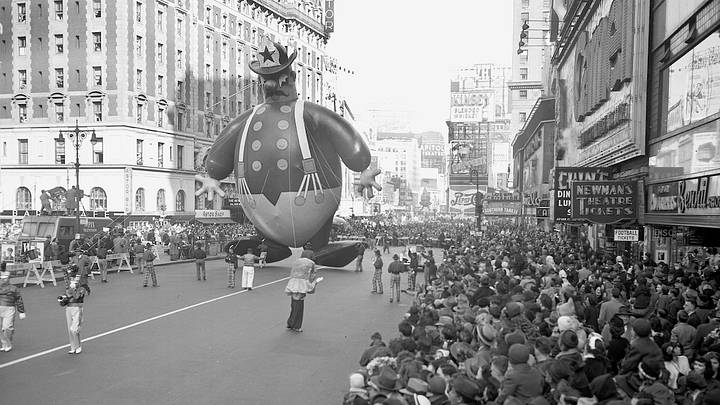
While Macy’s halted the parade from 1942 to 1944 during World War II, all was right by the late 1940s, when oversized helium friends passed by Central Park once again. Quirky figures like Harold the Fireman—a play on Herald Square, where the route famously ran through—became big names thanks to broadcast networks increasingly covering the parade, with CBS putting it on screens nationwide for the first time in 1948.
1950s: The Rise and Fall of Mighty Mouse
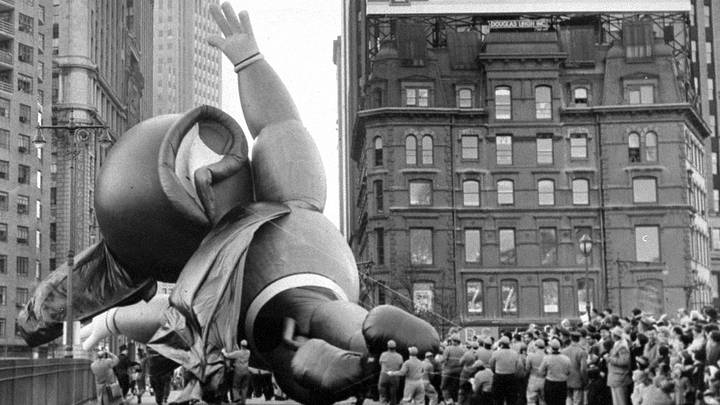
As television turned the parade into a pre-pie living room tradition, live broadcasting brought unscripted drama. During the 1956 parade, the Mighty Mouse balloon tragically collided with a street sign, collapsing and slowly deflating at Columbus Circle in front of millions of viewers at home.
1960s: Snoopy Takes Flight
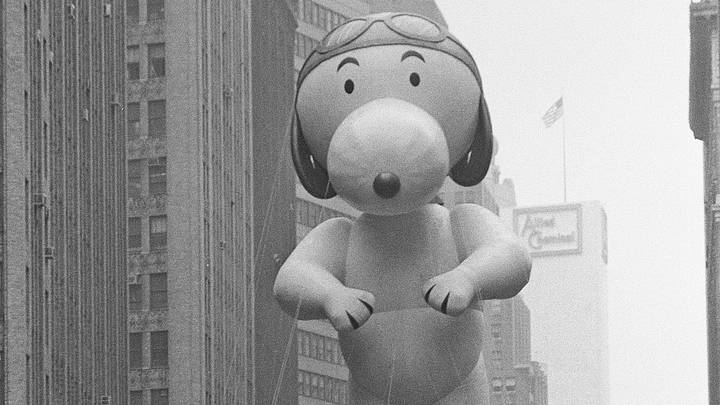
Snoopy first joined the festivities in 1968 as an aviator. Most of the 1970s saw the Peanuts pup as an astronaut, while the ’80s featured an ice-skating Snoopy. Broadcast on NBC, the debut started a half-century run that would eventually make Snoopy the most frequently featured character in parade history.
1970s: Muppetmania Meets Macy’s
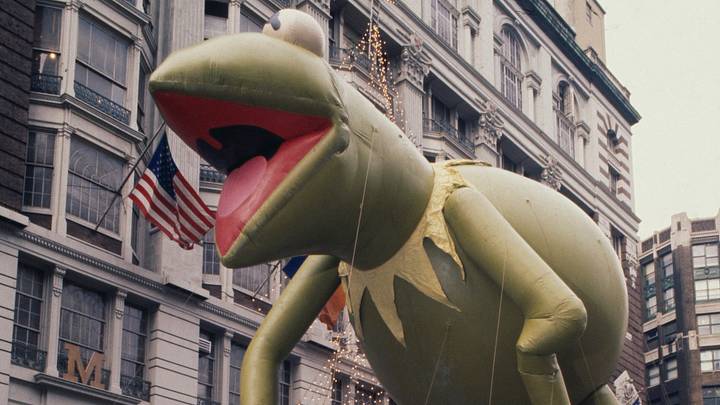
The success of Sesame Street and The Muppet Show led to Muppetmania amidst the Macy’s Thanksgiving Day Parade in the late ’70s. Kermit the Frog debuted in 1977 as the parade’s first major puppet-based balloon, marking the start of an era where Saturday morning TV staples ruled the route.
1980s: Superman on Sixth
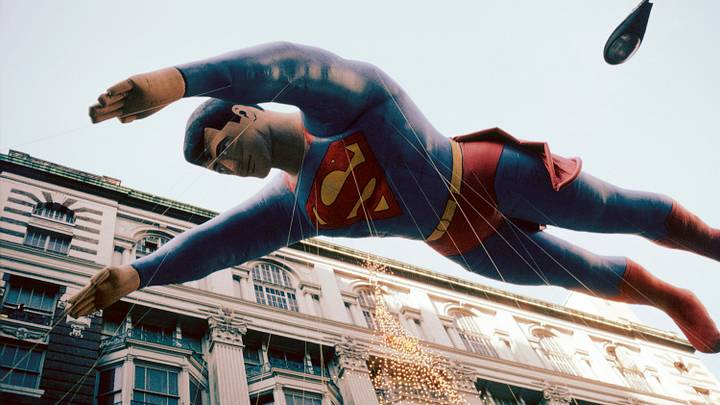
America’s favorite comic books came to life in more ways than one in the ’80s, thanks to the success of Christopher Reeve’s hit films and the return of the new and improved Superman balloon. Measuring 104 feet long and 35 feet wide, the massive character balloon made its mark on the Macy’s Parade as the largest in history at the time. With its detailed, humanoid design, the 1980 “Man of Steel” also served as the final balloon manufactured by Goodyear, before DC’s rival Marvel eventually took over the superhero slot with Spider-Man by 1989.
1990s: A Primetime Parade
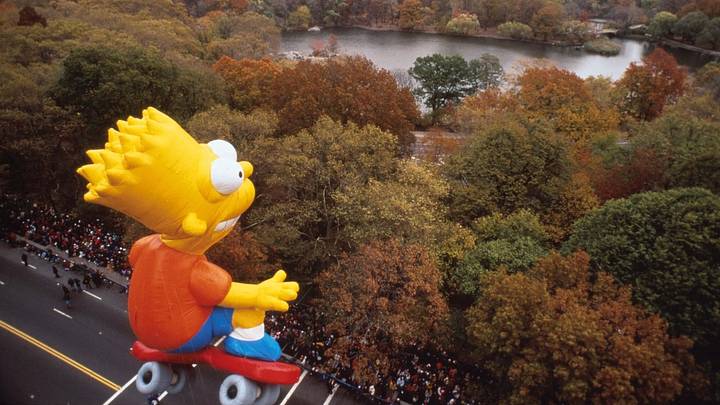
Soaring superheroes made way for skateboarding sitcom stars as quirky cartoons characterized cable TV in the ’90s. The Bart Simpson balloon cruised through the decade for the most part—save for a split seam in 1993. The Cat in the Hat, on the other hand, faced a different fate in 1997, when heavy winds caused the inflatable to strike a lamppost and permanently change how the parade handles safety.
2000s: New Millennium, New Balloons
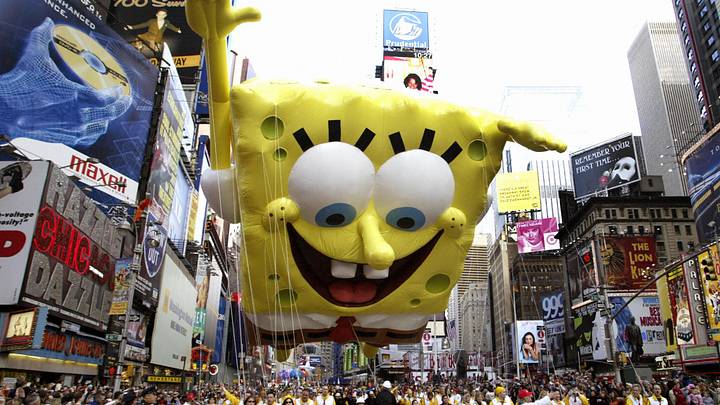
One bright yellow cartoon character led to the next as the new millennium commenced, with the SpongeBob SquarePants balloon floating through Times Square for the first time in 2004. From Pokémon’s Pikachu to the M&M crew, the parade’s Y2K era was a manifestation of modern animation come to life. While far from the first quirky character to fly over Central Park, the SpongeBob balloon was the first square balloon in the history of the Turkey Day spectacle.
2010s: Thanksgiving Goes Global
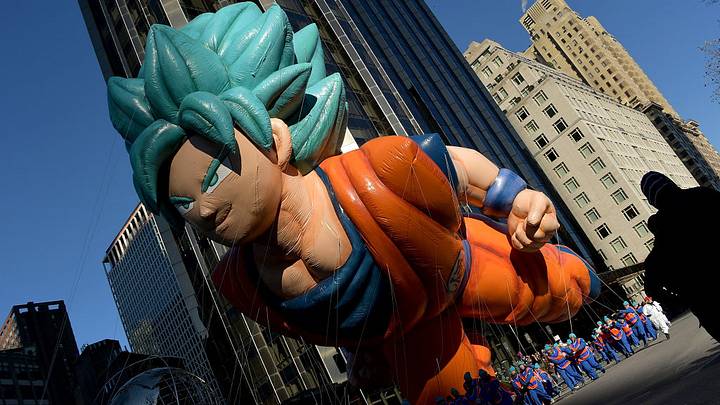
Thanksgiving might have started stateside, but the parade’s pop-culture reach blew up beyond borders by the tail end of the 2010s. In 2018, Goku from Dragon Ball made history as the first Japanese manga character to join the festivities. Casting jagged shadows over the city with his spiky cyan hair, the Saiyan warrior helped introduce Macy’s to a more worldly audience. For the franchise’s 40th anniversary in 2024, the balloon got a makeover complete with Goku’s classic black hair—plus back-up from fellow manga character Monkey D. Luffy’s balloon.
2020s: Streaming Superstars
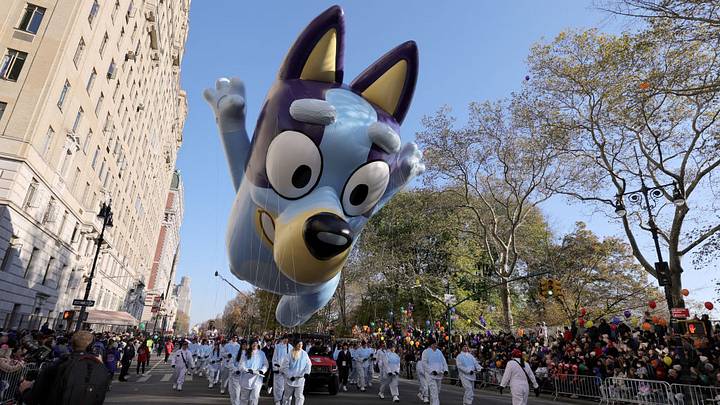
Even a global pandemic couldn’t stop the Macy’s Thanksgiving Day Parade from livening up the streets of Manhattan, with a scaled-down return in 2021 followed by an influx of fresh pop-culture characters in the years following. Featuring blown-up fan favorites like Bluey—the animated Australian pup—and Stuart the Minion, the late-November skies above New York basically doubled for a Roku screen.
Read More:
•
Quiz: Can You Name the ’80s Sitcom From Its Thanksgiving Episode?
•
The Most Popular Holidays in the U.S., Ranked
•
The Defining Macy’s Thanksgiving Day Parade Balloon of Every Decade
•
2026’s Most Popular Thanksgiving Sides By State, Mapped
•
75 Holiday Jokes That Are So Funny, You’ll Want to Share Them With Everyone