
ByKenneth Partridge|Apr 14, 2023, 10:00 AM EDT
 Add us as a preferred source
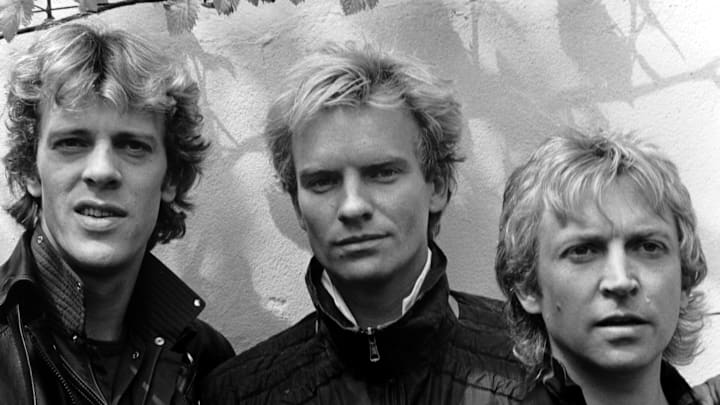
Coming into their fifth and final album, 1983’s Synchronicity, The Police were on the verge of something big. Their previous LP, 1981’s Ghost In the Machine, had peaked at No. 2 on the Billboard 200 and yielded the Top 5 smash “Every Little Thing She Does Is Magic.” Now the reggae-inspired, formerly punk-adjacent English trio led by Sting was poised for a level of stardom that few groups can even dream about.
Synchronicity—released 40 years ago this June—definitely delivered on its promise. On the strength of three Top 10 singles, one of them being the decade-defining, chart-topping, frequently misunderstood “Every Breath You Take,” Synchronicity reached No. 1 on the Billboard 200 and held that slot for 17 non-consecutive weeks. (It also reached No. 1 in the UK.) More importantly, it showcased a musically and intellectually curious band that was able to create great music despite some serious interpersonal conflicts.
Here are 10 facts about The Police’s blockbuster swan song.
1. The band members were not on good terms.
Sessions for 1981’s Ghost In the Machine went pretty smoothly. Sting came in with the song ideas; then guitarist Andy Summers and drummer Stewart Copeland added their distinctive parts. But that changed with Synchronicity: The three of them were “sick of each other,” as producer Hugh Padgham told Sound on Sound.
“Sting and Stewart hated each other, and although Andy didn’t show as much venom, he could be quite grumpy—and there were both verbal and physical fights in the studio,” Padgham said. Eventually, Police manager Miles Copeland presided over a poolside meeting that saved the sessions from disintegrating.
2. Sting, Andy Summers, and Stewart Copeland actually worked in separate rooms.

The Police recorded Synchronicity at Beatles producer George Martin’s AIR facility on the Caribbean island of Montserrat. Sting played bass in the control room, Summers strummed in the studio’s live room, and Copeland whacked his drums in a dining room upstairs. According to Hugh Padgham, this arrangement “worked both sonically and for social reasons.” It kept the warring musicians apart, and it ensured that there was no bleed between the guitar and bass during recording. Plus, Copeland’s drums sounded best in the dining area, even if he could only see his bandmates via live video feed.
3. The album’s title was inspired by Swiss psychiatrist Carl Jung.
Sting has a reputation for being one of rock’s leading intellectuals, and he proved it once again with Synchronicity. The title nods to famed Swiss psychiatrist Carl Jung’s 1960 book Synchronicity: An Acausal Connecting Principle, which deals with the “meaningful coincidence of two or more events where something other than the probability of chance is involved.” In Jung’s view, some coincidences aren’t coincidences—they’re something more—and as Sting told the radio show In the Studio, he wanted the entire album to focus on this idea.
“The concept interested me in that it was about accidents and some of the greatest things that happen in music with a band are accidental, or apparently accidental,” he said. Sting can even be seen reading Jung’s book on the Synchronicity album cover.
4. Synchronicity was the beginning of the end for The Police.
Although it was based on the writings of Jung—the man behind the theory of the “collective unconscious”—Synchronicity was an intensely personal album for the newly divorced Sting. “‘Every Breath You Take,’ ‘Wrapped Around Your Finger’ were all about my life,” Sting told In the Studio. “And so that was the end of The Police because I realized that I couldn’t involve this kind of personal work in a democratic process, at least not about the issues. So it was very clear to me during the making of this record this was the end of The Police.”
5. Sting wrote many of the songs in a very famous house.

Sting may have been in a fragile mental state when he wrote his songs for Synchronicity, but at least his body was in a peaceful place: James Bond creator Ian Fleming’s Goldeneye estate on the northern Jamaican coast. “Britain had gone to war with Argentina over the Falklands,” Sting wrote in his book Lyrics. “Young men were dying in the freezing waters of the South Atlantic, while I was gazing at sunspots on a clifftop overlooking the Caribbean.”
6. Summers worked through some mommy issues on “Mother.”
Synchronicity includes the super-catchy hit singles “I’ll Be Watching You,” “Wrapped Around Your Finger,” and “King of Pain.” It also features “Mother,” an abrasive, spoken-word track by Summers. Over the course of three unsettling minutes, Summers rants about his mom phoning him all the time and generally threatening to “devour” him—a fear that may stem from this lyric: “Every girl I go out with becomes my mother in the end.”
Summers told Songfacts that “Mother” was inspired by his actual mother. “We all have our family situations, and I had a pretty intense mother who was very focused on me,” he said. “I was sort of ‘the golden child,’ and there I was, sort of fulfilling all of her dreams by being this pop star in The Police. I got a certain amount of pressure from her. It’s not heavy—it was written kind of ironic, to be kind of funny, but crazy. It’s inspired a little bit by Captain Beefheart. It’s something that’s really off-the-wall.” The weirdest part: Sting apparently loved it.
7. “Wrapped Around Your Finger” references Greek mythology.
In the opening lines of “Wrapped Around Your Finger,” Sting sings about being “caught between the Scylla and Charybdis.” The line basically means “stuck between a rock and a hard place,” and it name-checks two figures from Greek mythology. Scylla was a deadly sea creature said to have 12 feet and six heads—each with a set of sharp teeth. Living right across from Scylla in the Straits of Messina was Charybdis, another sea monster, this one in the form of a whirlpool. Scylla and Charybdis appear in numerous ancient stories, most notably Homer’s Odyssey, where the former claims six members of Odysseus’s crew.
8. “O My God” calls back to two earlier Police (or Police-related) songs.
A highlight of side one of Synchronicity, the sax-streaked “O My God” contains snippets of lyrics from two earlier songs. The first verse and chorus are lifted from “3 O’Clock Shot,” an unreleased song from Sting, Summers, and Copeland’s pre-Police band Strontium 90. Later on, around the 2:58 mark of “O My God,” Sting quotes some lines from “Every Little Thing She Does Is Magic,” off Ghost in the Machine.
9. Musically speaking, the album is an exercise in minimalism. (Sort of.)
After the overstuffed sound of Ghost in the Machine, which brought synths and horns into the mix, The Police decided to strip things back on their follow-up. “I think we’d become so refined as a group of musicians that we realized that the three instruments just playing solo and ensemble was perhaps the best way of doing it—and it just seemed to happen,” Sting told Rolling Stone. “The songs worked with three instruments. There were lots of overdubs, but the overall feel was spartan.”
10. There are many versions of the album cover.
The Synchronicity cover design features three rows of black and white photographs, each overlaid with a streak of bright red, yellow, or blue. This basic concept gave way to many variations. According to the Goldmine Record Album Price Guide, there are 93, though a seemingly authoritative YouTube video puts the total number of U.S. vinyl variations around 40, depending on how you count. To further complicate matters, some rare variations swap the usual colors for black and white or gold, silver, and bronze.
Related Tags
The Defining Macy’s Thanksgiving Day Parade Balloon of Every Decade
Watch 100 years of pop culture drift down Manhattan. From Felix the Cat to Bart Simpson, these are the iconic character balloons that colored Thanksgiving morning in every era.
ByNitya Rao|Nov 12, 2026, 6:00 PM EST
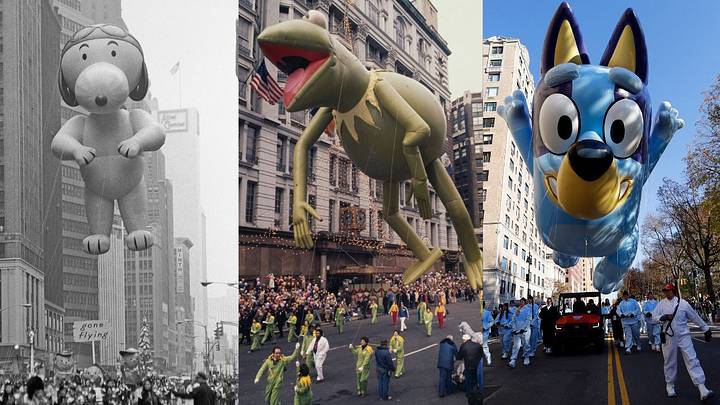
Everyone knows the best part of Thanksgiving is the sides—and the sideshow. For a few hours every November, the main meal makes room for the annual Macy’s Thanksgiving Day Parade, a feast for the eyes featuring colorful character balloons, festive floats, and a whole lot of helium.
Since 1924, the parade has been a revolving door for America’s favorite pop culture icons, from classic Mickey Mouse to Gen Alpha’s beloved Bluey. As silly as the giant Snoopy and Spider-Man shadows over Manhattan’s West Side may seem, it’s this very spectacle that keeps millions glued to their screens every Thanksgiving morning. Here’s a look back at the cartoon characters and blockbuster balloons that shaped the Macy’s Thanksgiving Day Parade over the last century.
1920s: Christmas Parade Premiere
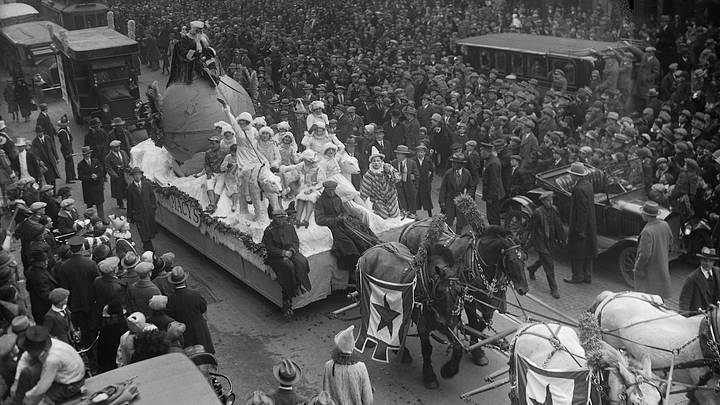
Before we had colossal character inflatables and live television coverage, Manhattan’s biggest holiday celebration was known as the Macy’s Christmas Parade. Launched on November 24, 1924, for a crowd of just 10,000 spectators, the event featured horse-drawn floats like this 1925 Santa Claus carriage and even live animals from the Central Park Zoo to usher in the holiday shopping season.
1930s: Mickey Mouse Takes Manhattan
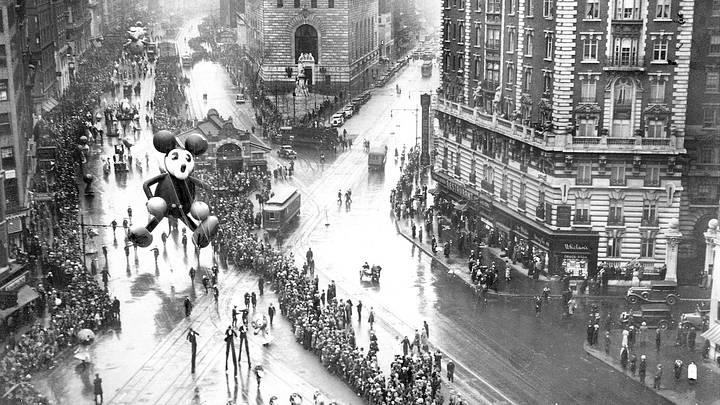
From Disney’s animation studio to the streets of Manhattan, the balloon adaptation of this beloved Disney character was introduced to the parade in 1934. Walt Disney designed the original Mickey Mouse balloon, which saw four more tweaks over the years.
1940s: Post-War Rebirth
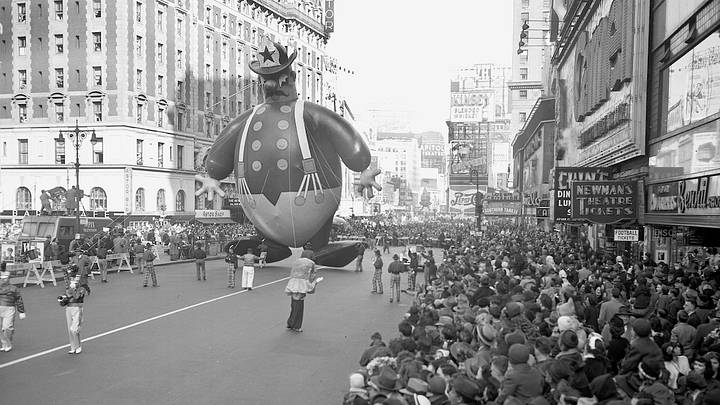
While Macy’s halted the parade from 1942 to 1944 during World War II, all was right by the late 1940s, when oversized helium friends passed by Central Park once again. Quirky figures like Harold the Fireman—a play on Herald Square, where the route famously ran through—became big names thanks to broadcast networks increasingly covering the parade, with CBS putting it on screens nationwide for the first time in 1948.
1950s: The Rise and Fall of Mighty Mouse
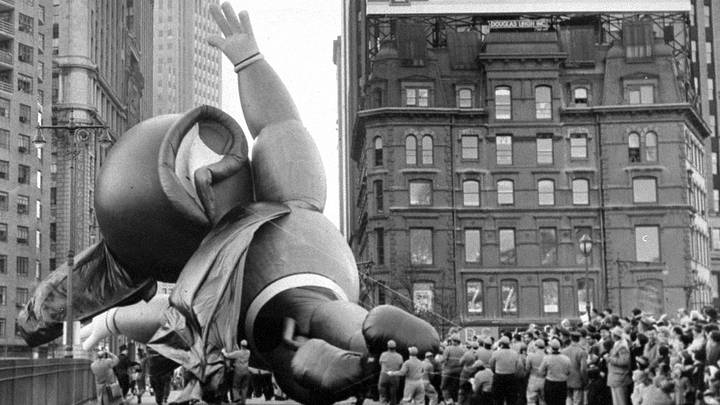
As television turned the parade into a pre-pie living room tradition, live broadcasting brought unscripted drama. During the 1956 parade, the Mighty Mouse balloon tragically collided with a street sign, collapsing and slowly deflating at Columbus Circle in front of millions of viewers at home.
1960s: Snoopy Takes Flight
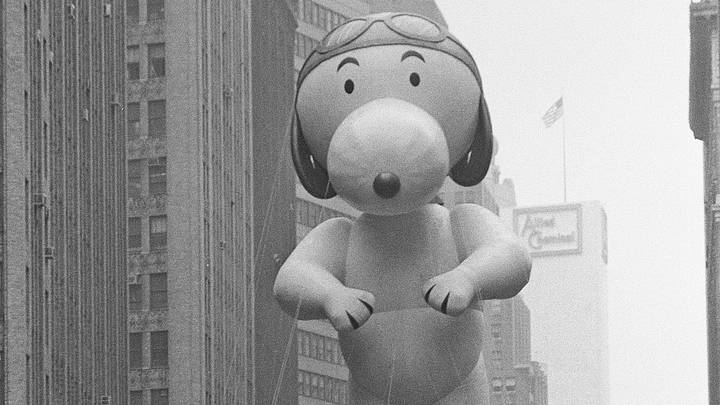
Snoopy first joined the festivities in 1968 as an aviator. Most of the 1970s saw the Peanuts pup as an astronaut, while the ’80s featured an ice-skating Snoopy. Broadcast on NBC, the debut started a half-century run that would eventually make Snoopy the most frequently featured character in parade history.
1970s: Muppetmania Meets Macy’s
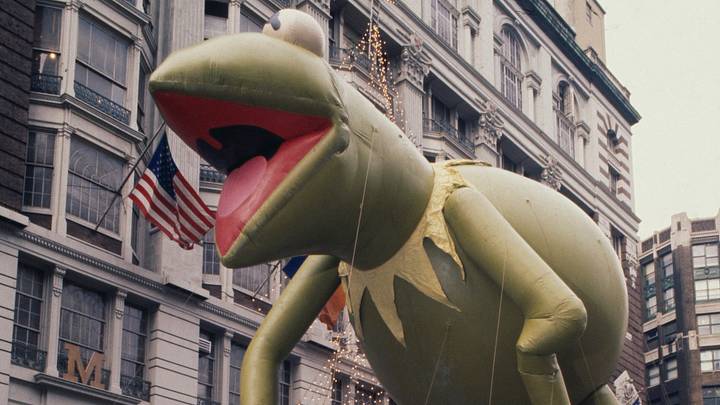
The success of Sesame Street and The Muppet Show led to Muppetmania amidst the Macy’s Thanksgiving Day Parade in the late ’70s. Kermit the Frog debuted in 1977 as the parade’s first major puppet-based balloon, marking the start of an era where Saturday morning TV staples ruled the route.
1980s: Superman on Sixth
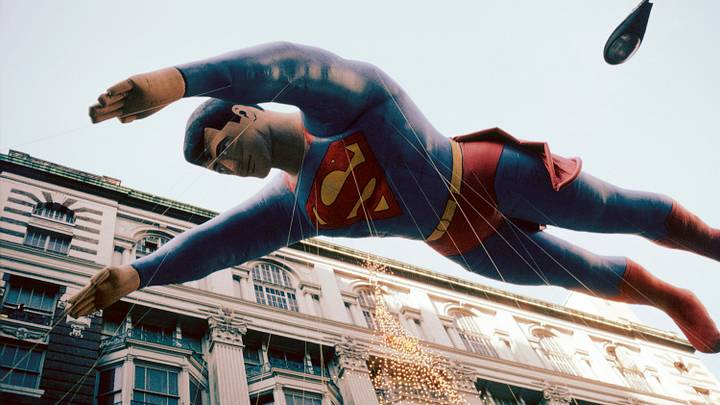
America’s favorite comic books came to life in more ways than one in the ’80s, thanks to the success of Christopher Reeve’s hit films and the return of the new and improved Superman balloon. Measuring 104 feet long and 35 feet wide, the massive character balloon made its mark on the Macy’s Parade as the largest in history at the time. With its detailed, humanoid design, the 1980 “Man of Steel” also served as the final balloon manufactured by Goodyear, before DC’s rival Marvel eventually took over the superhero slot with Spider-Man by 1989.
1990s: A Primetime Parade
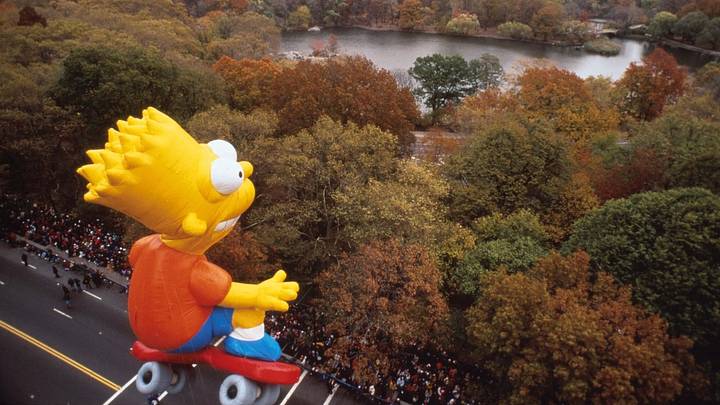
Soaring superheroes made way for skateboarding sitcom stars as quirky cartoons characterized cable TV in the ’90s. The Bart Simpson balloon cruised through the decade for the most part—save for a split seam in 1993. The Cat in the Hat, on the other hand, faced a different fate in 1997, when heavy winds caused the inflatable to strike a lamppost and permanently change how the parade handles safety.
2000s: New Millennium, New Balloons
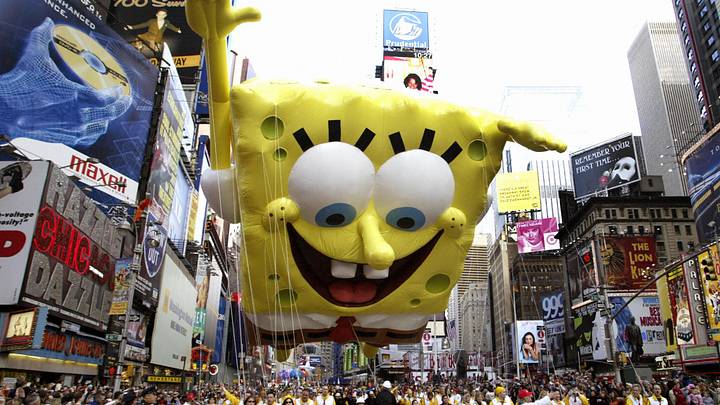
One bright yellow cartoon character led to the next as the new millennium commenced, with the SpongeBob SquarePants balloon floating through Times Square for the first time in 2004. From Pokémon’s Pikachu to the M&M crew, the parade’s Y2K era was a manifestation of modern animation come to life. While far from the first quirky character to fly over Central Park, the SpongeBob balloon was the first square balloon in the history of the Turkey Day spectacle.
2010s: Thanksgiving Goes Global
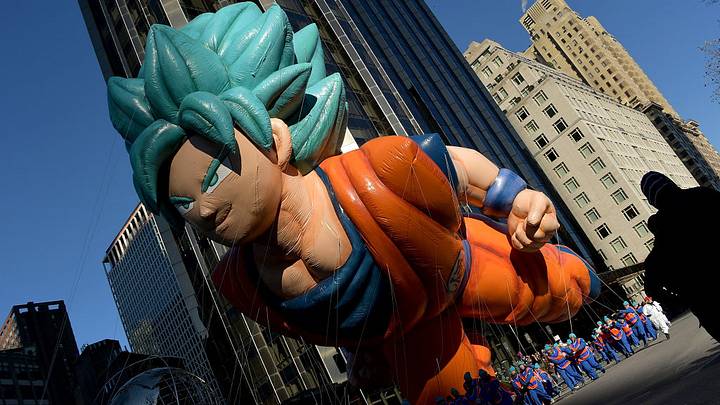
Thanksgiving might have started stateside, but the parade’s pop-culture reach blew up beyond borders by the tail end of the 2010s. In 2018, Goku from Dragon Ball made history as the first Japanese manga character to join the festivities. Casting jagged shadows over the city with his spiky cyan hair, the Saiyan warrior helped introduce Macy’s to a more worldly audience. For the franchise’s 40th anniversary in 2024, the balloon got a makeover complete with Goku’s classic black hair—plus back-up from fellow manga character Monkey D. Luffy’s balloon.
2020s: Streaming Superstars
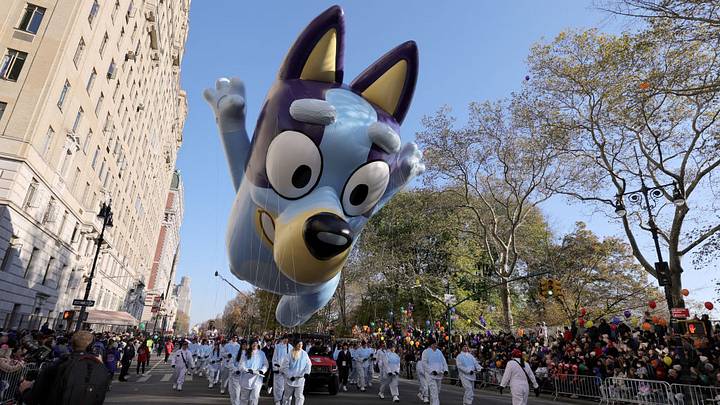
Even a global pandemic couldn’t stop the Macy’s Thanksgiving Day Parade from livening up the streets of Manhattan, with a scaled-down return in 2021 followed by an influx of fresh pop-culture characters in the years following. Featuring blown-up fan favorites like Bluey—the animated Australian pup—and Stuart the Minion, the late-November skies above New York basically doubled for a Roku screen.