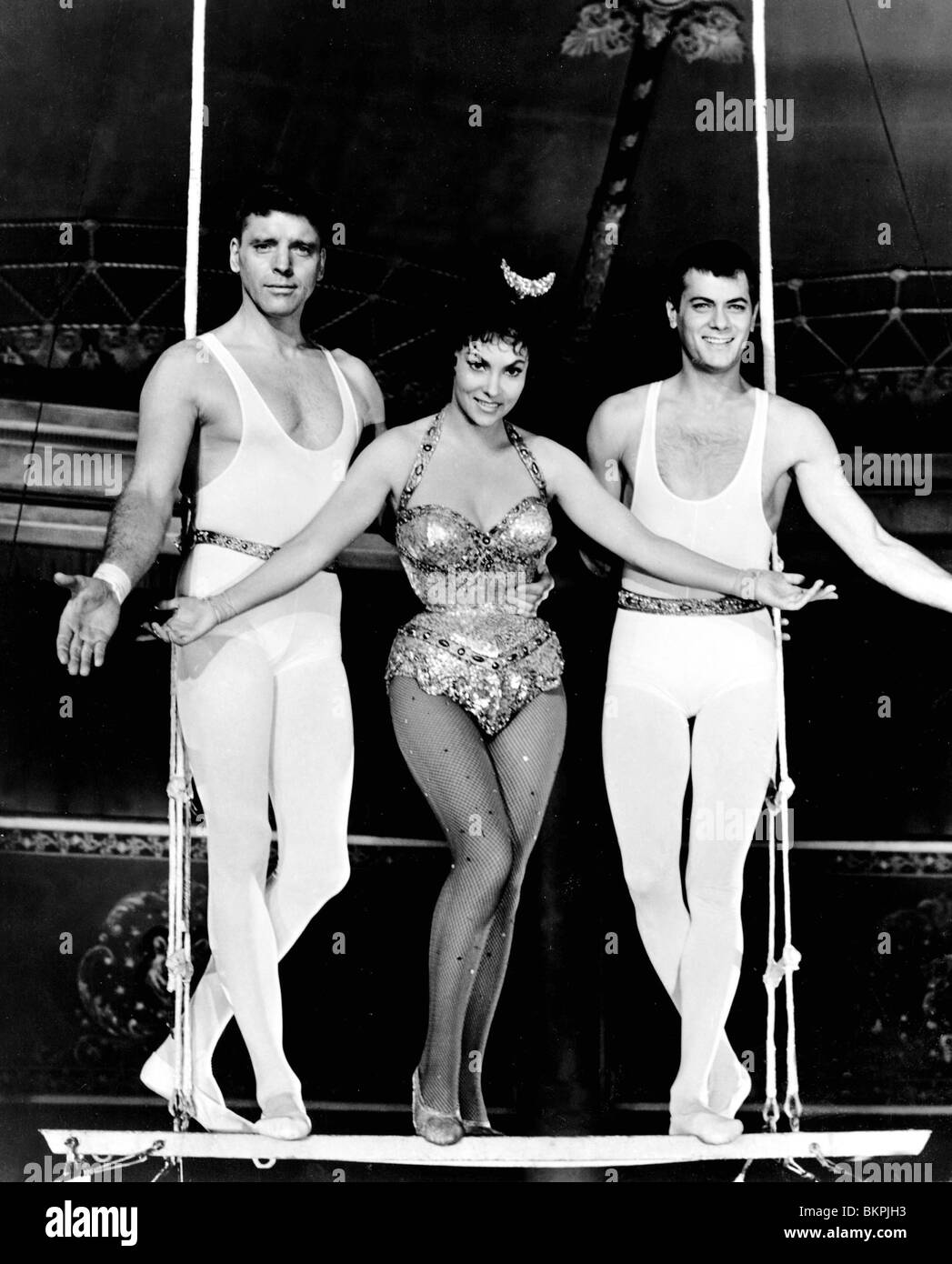
Under the grand dome of the Cirque d’Hiver in Paris, the audience held its breath. The orchestra’s brass section blazed to life, lights shimmered against sequined costumes, and a woman stepped onto a narrow wooden bar suspended high above the earth.
Her balance was perfect, her gaze unwavering. The danger didn’t scare her—it thrilled her. The woman was Gina Lollobrigida, and in 1956, she wasn’t merely playing a part. She was redefining what it meant to be a star.

The film was Trapeze, directed by the Oscar-winning Carol Reed, and while it was billed as a dazzling circus drama, it became something far deeper. It told a story of ambition, rivalry, and love—but behind the scenes, it also captured a real shift happening in cinema itself.
Gone were the days when actresses were expected only to look beautiful and say their lines. In Lollobrigida, audiences saw something different: a woman who radiated strength, intelligence, and self-possession, all wrapped in the irresistible glamour of 1950s stardom.
When Trapeze was announced, Hollywood wasn’t sure what to make of its Italian leading lady.
Lollobrigida had already gained attention in Europe for her sultry screen presence in Bread, Love and Dreams and Beat the Devil, but American producers were wary.
Could a foreign actress, still perfecting her English, carry a major studio film alongside icons like Burt Lancaster and Tony Curtis? Could she handle the grueling physical demands of a story set in the dangerous, vertiginous world of circus acrobatics?
Lollobrigida didn’t just meet those expectations—she shattered them.

Determined to prove herself, she trained for weeks on the trapeze under Lancaster’s guidance.
A former circus acrobat himself, Lancaster demanded realism. He didn’t want doubles, he wanted authenticity—every drop of sweat, every gasp of risk. And Gina, who had grown up in the rugged hills of Italy and was no stranger to hard work, refused to back down.
“They expected glamour,” she would later say, “but I gave them strength.”
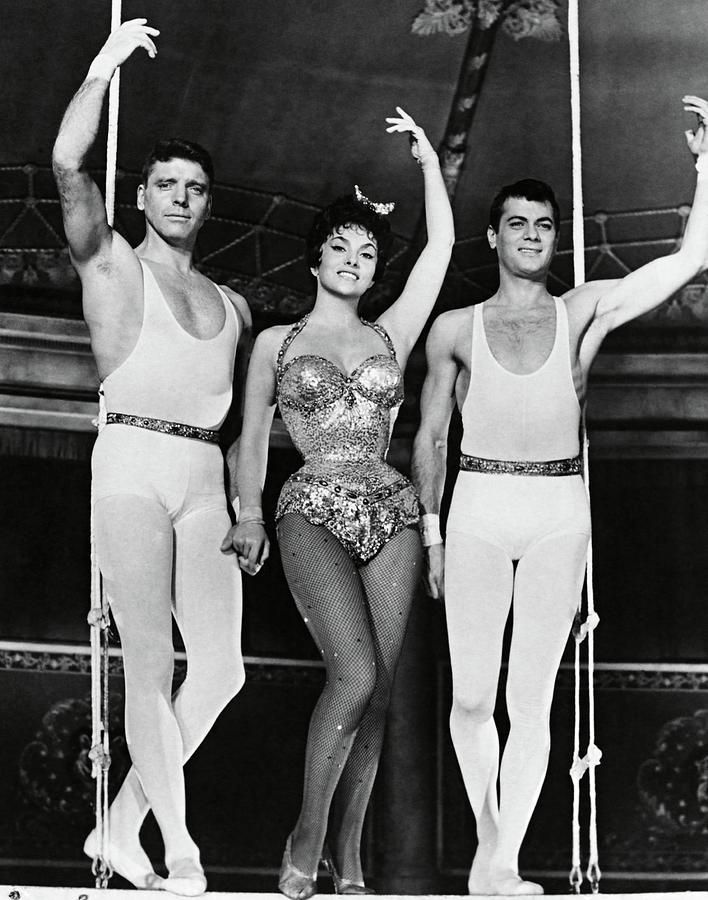
That strength burned through every frame. As Lola, the fiercely ambitious performer who enters the lives of two men—one a veteran trapeze artist recovering from a near-fatal fall, the other his daring young protégé—Lollobrigida brought fire and complexity to a role that could easily have been reduced to a cliché.
Her Lola wasn’t just the romantic interest. She was the equal, the catalyst, the storm around which the others revolved.
Off-camera, the dynamic between Lollobrigida and her co-stars was equally charged. Lancaster, intense and commanding, was known for his perfectionism. Curtis, the young Hollywood heartthrob, was eager to prove his own worth in a film that demanded real physical skill.
And in the middle stood Lollobrigida, who refused to be intimidated by either.
“There were moments,” she later recalled, “when the air between us felt electric—not romantic, but competitive. We were all fighting to stay on top, to give our best, to not fall—on the trapeze or otherwise.”
The tension was real, and it translated beautifully to the screen. Every glare, every smile, every movement carried the friction of pride and attraction. Critics would later say that the chemistry between the three wasn’t acting—it was instinct.
Filmed inside the historic Cirque d’Hiver, the production embraced authenticity to the point of recklessness. The performers dangled more than forty feet above the floor, often without safety nets.
Lollobrigida, despite being terrified of heights, insisted on doing many of her own scenes. “You can’t fake courage,” she said. “You either have it, or you don’t.”

When Trapeze premiered, it became one of the biggest hits of 1956. Audiences around the world were captivated—not only by the heart-stopping stunts but by the emotional depth at its core.
Here was a film about risk, not just physical but personal: the risk of ambition, of desire, of daring to want more than the world allows you.
And at the heart of it all was Gina Lollobrigida, shimmering under the lights yet grounded in something more powerful than beauty. She had crossed oceans and languages to claim her place among Hollywood’s elite, and she did it on her own terms.
For many women watching, she became a symbol of independence. While others were content to play the ingénue or the accessory, Lollobrigida portrayed a woman who was neither submissive nor cold—she was human, hungry, and real. “Trapeze,” said one critic, “belongs to Gina Lollobrigida the way the sky belongs to the bird.”
But the success of Trapeze was also a beginning. In the years that followed, Lollobrigida would continue to push boundaries. She moved fluidly between Hollywood and Europe, starring in Solomon and Sheba, Come September, and Woman of Straw, alongside leading men like Frank Sinatra, Rock Hudson, and Sean Connery.
Yet acting was only one chapter of her life.
By the 1970s, she reinvented herself yet again—this time behind the camera.
She became a celebrated photographer and journalist, photographing luminaries such as Paul Newman, Audrey Hepburn, and Salvador Dalí. In one of her boldest moments, she even interviewed Fidel Castro, capturing not only his likeness but his humanity.
Later, she turned to sculpture, her art exhibited in major galleries across Europe.
“Beauty fades,” she once said, “but daring—daring lasts forever.”
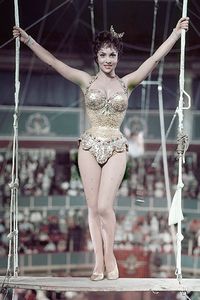
Her words could easily describe her performance in Trapeze. Even today, still images from the film retain their hypnotic power: Lollobrigida suspended midair, her sequined costume sparkling like a constellation, her expression one of serene control.
It is both a literal and symbolic flight—a woman who refused to stay on the ground, who claimed the space that had always been hers.
The magic of Trapeze wasn’t just in the spectacle of acrobatics. It was in what it represented: a moment in film history when artistry, courage, and sensuality collided. When a European actress dared to outshine her male counterparts not by playing their game, but by creating her own.
Decades later, Gina Lollobrigida’s name still evokes that same combination of glamour and grit. She was more than an actress. She was an artist, a dreamer, a force of will who rose—quite literally—above expectation.
Under the circus lights of 1956, she did more than perform. She soared. And long after the applause faded, the image of her suspended high in the air, caught between strength and grace, continues to remind us that the greatest act of all is to believe you can fly—then to prove it.