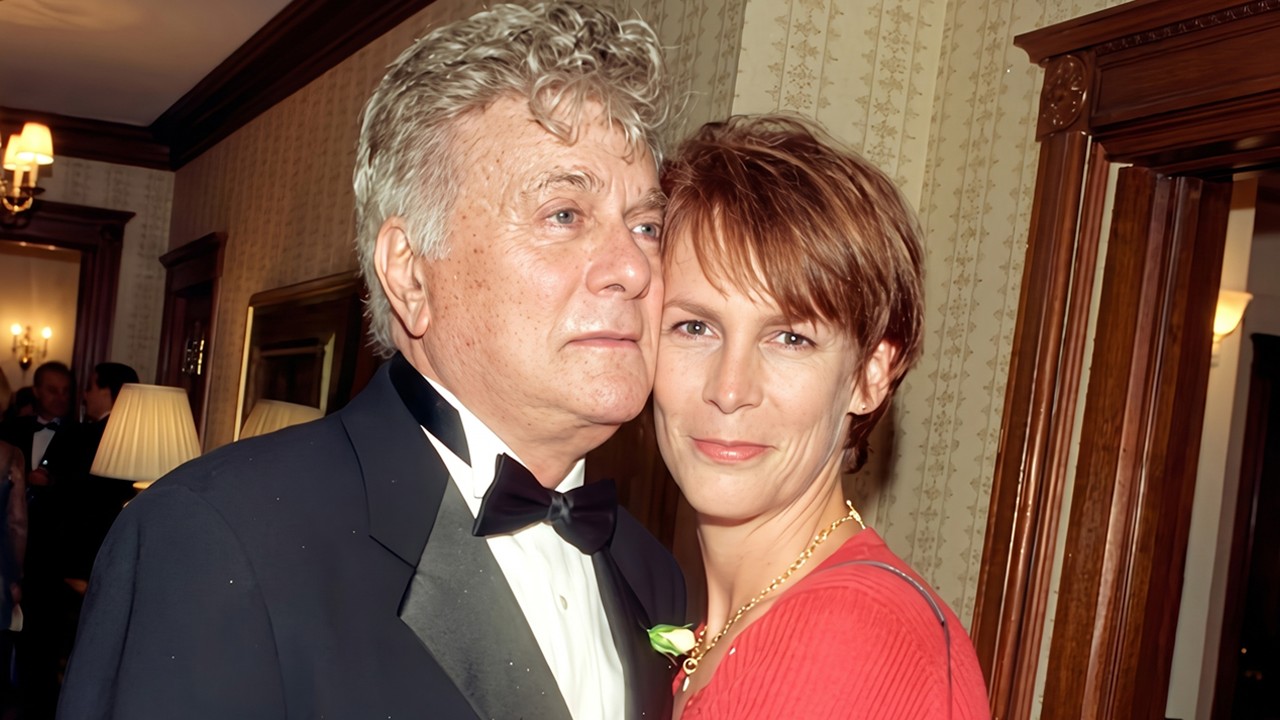
The final act of Tony Curtis was not a curtain call but a cold, calculated strike from beyond the grave, a devastating legal document that severed the already fragile threads binding him to his daughter, Jamie Lee Curtis. The will, unsealed in a Nevada court shortly after his death in 2010, contained a single, brutal sentence that echoed through Hollywood with the force of a bombshell: “I intentionally make no provision for any inheritance for my children.” This was not an oversight or a moment of senile confusion; it was a deliberate, final rejection of the woman who had become a global superstar, a decision rooted in a decades-long cauldron of professional jealousy, personal insecurity, and a profound inability to love.
The public was stunned. Here was a man who had shared the screen with Marilyn Monroe and defined an era of cinematic charm, leaving his five biological children, including the Oscar-winning Jamie Lee, with nothing but the sting of his explicit dismissal. The language of the will was precise, naming each child individually before declaring them unworthy of a single cent of his estimated tens of millions of dollars in assets, which included real estate, artwork, and royalties from his classic films.
The entire estate was bequeathed to his sixth wife, Jill Vandenberg Curtis, a woman 45 years his junior, who had become the sole gatekeeper to the aging star in his final years.
To understand this 𝓈𝒽𝓸𝒸𝓀𝒾𝓃𝑔 act of paternal cruelty, one must rewind to the fractured beginning of the Curtis family saga. In the 1950s, Tony Curtis and Janet Leigh were the golden couple of Hollywood, their glamour and success splashed across every magazine cover. Their union seemed blessed, producing two daughters, Kelly and Jamie Lee, born in 1958.
But the fairy tale shattered in 1962 when Tony, then in his forties, unilaterally filed for divorce while Janet was on set, having fallen for a 17-year-old German actress, Christine Kaufmann. The betrayal was public and humiliating, leaving Janet to raise their young daughters with a stepfather while Tony embarked on a new life of lavish parties and subsequent marriages.
For young Jamie Lee, the departure of her father was a wound that never fully closed. He was a stranger who sent child support checks but offered no warmth, no guidance, and no presence. She grew up in the shadow of his fame, acutely aware that she was an afterthought in his dazzling life, an unwanted remnant of a discarded marriage.
This abandonment forged in her a fierce independence and a desperate need to prove her own worth, separate from the towering legacy of her famous parents. She would later speak candidly about this void, acknowledging that her father had no real interest in being a parent, viewing his financial obligations as the entirety of his paternal duty.
The first major rupture in their already strained relationship came with Jamie Lee’s meteoric rise to fame. In 1978, she was cast as Laurie Strode in John Carpenter’s low-budget horror film “Halloween.” Hollywood saw it as a curiosity, the daughter of a legend slumming in a genre film.
But the movie became a cultural phenomenon, launching Jamie Lee into a stratosphere of stardom that her father, whose own career was beginning to wane, could not tolerate. She had achieved success without his help, without his name, and that success became a mirror reflecting Tony’s own fading relevance, a source of bitter professional jealousy rather than paternal pride.
Tony Curtis, a man afflicted with the narcissism of old Hollywood, viewed fame as his lifeblood. As his own iconic roles receded into the past, replaced by lesser projects and the ravages of age, he watched his daughter’s star ascend with a toxic mix of resentment and envy. He saw her not as a proud extension of his legacy, but as a rival who was stealing the spotlight that he believed was rightfully his.
Instead of celebrating her achievements, he belittled them, suggesting her success was due to her family name or dismissing the genre of her films as inferior to the “high art” of his era. Every accolade she received was a painful reminder that his time in the sun was over.
This professional jealousy poisoned any possibility of a genuine reconciliation. Jamie Lee, caught in a painful bind, desperately wanted her father’s approval, but the brighter she shone, the more she seemed to push him away. Her acclaimed performances in films like “Trading Places,” “A Fish Called Wanda,” and “True Lies” were not sources of pride for Tony but further nails in the coffin of their relationship.
 The rift became a quiet war, played out in the press, with Jamie Lee recognizing the brutal truth that the charming man on screen was, in reality, a small-minded individual incapable of sharing the spotlight even with his own flesh and blood.
The family tragedy deepened in 1994 with the death of Nicholas Curtis, Tony’s 23-year-old son with Christine Kaufmann, who died of a heroin overdose. The loss was devastating, but instead of bringing the family together, it 𝓮𝔁𝓹𝓸𝓼𝓮𝓭 Tony’s profound emotional bankruptcy. While Jamie Lee was tormented by the loss of her half-brother, Tony’s reaction was one of cold denial.
He saw his son’s death as a stain on his carefully constructed public image, a personal embarrassment rather than a tragedy to be mourned. He offered no support to his grieving children, retreating into his own private world of self-pity, a reaction that ignited a fire of resentment in Jamie Lee that would never be extinguished.
Nicholas’s death was not an isolated incident but a symptom of a generational curse of addiction that haunted the Curtis family. Tony himself had been a heavy abuser of alcohol and cocaine, a reckless lifestyle that contributed to the instability of his children’s lives. Jamie Lee, too, struggled with an addiction to opioid painkillers for a decade, a battle she fought in the shadows of her own fame.
The difference between father and daughter lay in their response to this adversity. Jamie Lee bravely confronted her addiction and found recovery, while Tony sank deeper into the bitterness and self-pity of old age, his arrogance and harsh personality crushing any last attempts at reconciliation.
As Tony’s health deteriorated in the early 2000s, he became increasingly isolated at his ranch in Henderson, Nevada. The only person he trusted was Jill Vandenberg, his sixth wife, who managed every aspect of his life and became a formidable wall between him and his children. Jamie Lee and her siblings made numerous attempts to reconnect, but every effort was met with coldness and invisible barriers.
Inside that luxurious estate, a narrative was being constructed that painted his children as vultures, only interested in his money and fame. This psychological erosion, fueled by his wife’s influence, pushed the family distance to a point of no return.
The will, amended just months before his death, was the culmination of this toxic dynamic. It was not merely a financial disinheritance but a public execution of his paternal bond. By naming his children and then deliberately excluding them, Tony Curtis was making a final, cruel statement.
He was punishing them for the perceived slights of a lifetime, for daring to have their own lives and successes. The act was a desperate attempt to wield power from beyond the grave, to have the last word in a decades-long conflict that he himself had created through his selfishness and jealousy.
 Jamie Lee’s sister, Kelly, challenged the will in court, alleging that Tony had been psychologically manipulated and coerced while his mental clarity was declining. However, the legal battle quickly hit a dead end against the precisely crafted provisions of the document. Jill Vandenberg later auctioned off hundreds of Tony’s personal belongings, from awards to memorabilia, reaping millions of dollars without sharing a single keepsake with his children.
The public was outraged, but Jamie Lee chose silence. That silence was not agreement; it was the profound speechlessness of a daughter who had been dealt the deepest, most bitter wound of her life by the man who gave her life.
The word “despised” was used by the media to describe Tony’s feelings, but the reality was more complex and brutal. It was not simple hatred but a tangled web of jealousy, a fear of being forgotten, and a profound inability to love. Tony Curtis, born Bernard Schwartz into a poor immigrant family, had endured a childhood marked by 𝓪𝓫𝓾𝓼𝓮 and tragedy.
These unhealed wounds drove him to seek validation through Hollywood fame, transforming him into a classic narcissist who could only love himself. When Jamie Lee rose to global stardom, her very existence triggered his deepest fear: being surpassed and erased from the public’s memory. His contempt was a defense mechanism of a fragile ego.
In the final years of his life, the influence of his sixth wife cannot be overstated. Jill Vandenberg created a perfect environment of isolation, fueling Tony’s existing suspicions and constructing a narrative where his children were only after his money. The decision to disinherit them was not entirely his own independent thought but the result of a prolonged process of psychological manipulation.
He died believing the world, including his own children, wanted to take advantage of him. This was the greatest tragedy of a man who spent his life living in a false glow of fame, ultimately dying alone and surrounded by doubt.
Faced with this final rejection, Jamie Lee Curtis chose a path of remarkable grace and resilience. She did not drown in hatred or seek revenge. She understood that demanding love from someone incapable of giving it was futile.
In later interviews, she spoke of her father with a calm, forgiving, yet clear-eyed attitude, acknowledging his shortcomings as a father while respecting him as an artist. She stated, “I don’t hate him. I understand who he was.
He was a product of his time, of the personal wounds he never managed to overcome. He gave me life, gave me a part of the artistic genes, and the rest I had to learn on my own how to become a decent human being.”
 By accepting the bitter truth about her father, Jamie Lee freed herself from the chains of the past. She consciously broke the cycle of family tragedy, focusing on her own family and building a life completely independent of the toxic legacy Tony left behind. She did not need his inheritance to prove her standing.
Through sheer resilience, she built a remarkable career empire with her own hands, moving beyond the label of “star’s daughter” to become an independent cinematic icon in her own right.
The pinnacle of her relentless effort came at the 2023 Academy Awards when Jamie Lee Curtis was announced as the winner of Best Supporting Actress for her role in “Everything Everywhere All at Once.” As she stood on stage to receive the highest honor in cinema, a prize Tony Curtis had longed for but never attained, she tearfully honored both her parents. But that victory was understood by the world to be the sweet reward of her own sweat, tears, and resilience.
It was a complete and deeply human victory over the shadow of her legendary father’s rejection.
Tony Curtis may have taken away a portion of Jamie Lee’s material inheritance and left a deep wound in her soul, but he could never take away her talent, strength, and loving heart. A person’s true legacy when they leave this world is not found in the money in a bank account or the cold words written in a will. Legacy lies in the way we live, the way we heal our wounds, and the way we rise from our own brokenness.
Jamie Lee Curtis transformed the tragedy of rejection into the strength to live a life of kindness, talent, and pride, a testament to the indomitable human spirit that no act of paternal cruelty could ever extinguish.
The story of Tony and Jamie Lee Curtis is more than a media 𝒔𝒄𝒂𝓃𝒹𝒶𝓁 about a will that excluded his children. It is a costly lesson about the destructive power of selfish ego in the world of entertainment. Tony Curtis lived a dazzling life under the stage lights, celebrated as an icon of beauty and talent.
But behind the velvet curtain, he entered the final stretch of his life in emotional isolation, nurturing jealousy toward his own daughter. His decision to disinherit his children did not allow him to live forever; it only deepened the stain on his personal legacy. Hollywood can give you all the applause in the world, but it cannot give you a heart capable of love.
If you choose to nurture your ego instead of your family, you may end up with everything, yet have nothing at all.