
ByStacy Conradt|Jan 22, 2020, 10:00 AM EST
 Add us as a preferred source
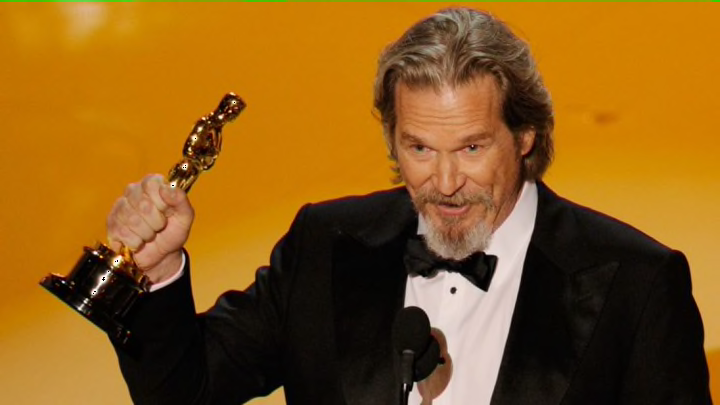
Winning an Oscar is, for most people, a once-in-a-lifetime achievement. Unless you’re Walt Disney, who won 22. Nevertheless, owning a little gold guy is such a rarity that you’d think their owners would be a little more careful with them. Now, not all of these losses are the winners’ fault—but some of them certainly are (we’re looking at you, Colin Firth).
1. Angelina Jolie

At the 2000 Academy Awards ceremony, after Angelina Jolie planted a kiss on her brother and made the world collectively squirm, she went onstage and collected a Best Supporting Actress Oscar for her role as Lisa in Girl, Interrupted. She later presented the trophy to her mother, Marcheline Bertrand. The statuette may have been boxed up and put into storage when Marcheline died in 2007, but it hasn’t yet surfaced. “I didn’t actually lose it,” Jolie said, “but nobody knows where it is at the moment.”
2. Whoopi Goldberg

In 2002, Whoopi Goldberg sent her Ghost Best Supporting Actress Oscar back to the Academy to have it cleaned and detailed, because apparently you can do that. The Academy then sent the Oscar on to R.S. Owens Co. of Chicago, the company that manufactures the trophies. When it arrived in the Windy City, however, the package was empty. It appeared that someone had opened the UPS package, removed the Oscar, then neatly sealed it all back up and sent it on its way. It was later found in a trash can at an airport in Ontario, California. The Oscar was returned to the Academy, who returned it to Whoopi without cleaning it. “Oscar will never leave my house again,” Goldberg said.
3. Olympia Dukakis

When Olympia Dukakis’s Moonstruck Oscar was stolen from her home in 1989, she called the Academy to see if it could be replaced. “For $78,” they said, and she agreed that it seemed like a fair price. It was the only thing taken from the house.
4. Marlon Brando

“I don’t know what happened to the Oscar they gave me for On the Waterfront,” Marlon Brando wrote in his autobiography. “Somewhere in the passage of time it disappeared.” He also didn’t know what happened to the Oscar that he had Sacheen Littlefeather accept for him in 1973. “The Motion Picture Academy may have sent it to me, but if it did, I don’t know where it is now.”
5. Jeff Bridges
In 2010, Hollywood legend Jeff Bridges won his first-ever Oscar for his portrayal of alcoholic country singer Bad Blake in Crazy Heart, but it was already missing by the time next year’s ceremony rolled around, when he was nominated yet again for his role in the Coen brothers’s True Grit.
When asked about his year-old statuette, Bridges admitted that “It’s been in a few places since last year but I haven’t seen it for a while now.” Finding the MIA Oscar seemed even more urgent when Bridges lost the 2011 Best Actor Oscar to Colin Firth for The King’s Speech. “I’m hoping it will turn up, especially now that I haven’t won a spare,” Bridges said. “But Colin deserves it. I just hope he looks after it better.”
6. Colin Firth

Perhaps Jeff Bridges secretly cursed Colin Firth as he said those aforementioned words, because Firth nearly left his new trophy on a toilet tank the very night he received it. After a night of cocktails at the Oscar after-parties in 2011, Firth allegedly had to be chased down by a bathroom attendant, who had found the eight-pound statuette in the bathroom stall. Notice we said allegedly: Shortly after those reports surfaced, Firth’s rep issued a statement saying the “story is completely untrue. Though it did give us a good laugh.”
7. Matt Damon

When newbie writers Matt Damon and Ben Affleck took home Oscars for writing Good Will Hunting in 1998, it was one of those amazing Academy Award moments. Now, though, Damon isn’t sure where his award went. “I know it ended up at my apartment in New York, but unfortunately, we had a flood when one of the sprinklers went off when my wife and I were out of town and that was the last I saw of it,” Damon said in 2007.
8. Margaret O’Brien

In 1945, 7-year-old Margaret O’Brien was presented with a Juvenile Academy Award for being the outstanding child actress of the year. About 10 years later, the O’Briens’ maid took the award home to polish it, as she had done before, but never returned. The missing Oscar was forgotten about when O’Brien’s mother died shortly thereafter, and when Margaret finally remembered to call the maid, the number had been disconnected. She ended up receiving a replacement from the Academy.
There’s a happy ending to this story, though. In 1995, a couple of guys were picking their way through a flea market when they happened upon the Oscar. They put it up for auction, which is when word got back to the Academy that the missing trophy had resurfaced. The guys who found the Oscar pulled it from auction and presented it, in person, to Margaret O’Brien. “I’ll never give it to anyone to polish again,” she said.
9. Bing Crosby

For years, Bing Crosby‘s Oscar for 1944’s Going My Way had been on display at his alma mater, Gonzaga University. In 1972, students walked into the school’s library to find that the 13-inch statuette had been replaced with a 3-inch Mickey Mouse figurine instead. A week later, the award was found, unharmed, in the university chapel. “I wanted to make people laugh,” the anonymous thief later told the school newspaper.
10. Hattie McDaniel

Hattie McDaniel, famous for her Supporting Actress win as Mammy in Gone with the Wind, donated her Best Actress Oscar to Howard University. It was displayed in the fine arts complex for a time, but went missing sometime in the 1960s. No one seems to know exactly when or how, but there are rumors that the Oscar was unceremoniously dumped into the Potomac by students angered by racial stereotypes such as the one she portrayed in the film.
The Real-Life Serial Killer That Might’ve Inspired ‘Dexter’s Dark Passenger
Brazil’s most notorious killer of killers has been called the real Dexter for years, but ‘Dexter’s’ creator tells a different origin story.
ByMatt Hoffman|Oct 30, 2026, 9:00 PM EDT

Back in July 2004, Jeff Lindsay introduced readers to Dexter Morgan, a Miami police blood-spatter analyst who kills only people who deserve it, egged on by a voice in his head he calls the “Dark Passenger.” Two years later, Showtime turned Darkly Dreaming Dexter into a hit series with Michael C. Hall.
Somewhere along the way, the internet decided Dexter had a real-life model: Pedro Rodrigues Filho, a Brazilian who claimed to have killed more than 100 people, most of them criminals. Entertainment sites now call him “the Brazilian Dexter,” and ScreenRant describes the show as loosely based on his crimes. No quote from Lindsay or the show’s producers backs that up, but the similarities are hard to miss.
The Boy Who Settled Scores
Filho was born in 1954 on a farm in Santa Rita do Sapucaí, in the Brazilian state of Minas Gerais, with an injured skull: his father, he said, had kicked his pregnant mother during a fight. He told the magazine Época in 2003 that he first wanted to kill at 13, when he shoved an older cousin into a sugarcane press. A year later, after his father lost his job as a school guard over accusations that he was stealing school lunches, Filho shot the official who had fired him, then shot the guard he believed was the real thief. (Accounts disagree on who that first victim was: some Brazilian outlets say the mayor of his hometown, others the deputy mayor of Alfenas, also in Minas Gerais.)
He fled to Mogi das Cruzes, outside São Paulo, where he robbed drug dens, killed traffickers, and took over a dead drug boss’s business. When his pregnant girlfriend was shot dead, he went looking for the man who ordered it and, with four friends, hit a wedding party, leaving seven dead and 16 wounded, according to Época. He was arrested shortly after turning 18 and entered prison on May 24, 1973; in the van on the way there, he killed a fellow prisoner he said was a rapist.
Where the Comparison Holds
Like Dexter, Filho had a code, or said he did. He told Época he killed only people who were no good, and that he never killed children, women, or family men. He also had a father story to rival Harry Morgan’s, though a much darker one: Filho claimed he killed his own father in prison, in revenge for his mother’s stabbing, and chewed a piece of his heart. (Época noted that he gave a psychiatrist a completely different account of how his father died.)
The resemblance mostly ends there. Dexter’s code, as Mental Floss has laid out before, includes “don’t get caught,” and Filho spent roughly four decades behind bars, much of it bragging. He had “Mato por prazer” (“I kill for pleasure”) tattooed on his left arm. He claimed 47 victims inside prison alone, though Época found just 18 charges against him on file in 2003; by his death, Brazilian outlets counted 71 homicides on his record.
What Dexter’s Creator Actually Said
Lindsay has told his origin story many times, and it starts nowhere near Brazil: at a Kiwanis Club lunch where he sat at the head table waiting to speak and, as he told BookPage in 2005, “the idea just popped into my head that sometimes serial murder isn’t a bad thing.” He then built the character out of research: he collected books on sociopaths and murderers, interviewed psychologists and crime scene investigators, and got cop friends to turn him loose in their dead-files room. He also rejects the very label that made Filho famous: “Dexter’s not a vigilante,” he told Middlebury Magazine in 2011. “Vigilantes are trying to perform an act of justice. Dexter just likes to kill people.”
The Ending Dexter Survived
Filho walked out of prison in 2007, went back in 2011 for crimes committed during his sentence, and was released for good in 2018. Within months, he had reinvented himself as a YouTube personality who commented on crimes in the news and lectured about his past. On the morning of March 5, 2023, he was on a sidewalk in Mogi das Cruzes holding a small child when men in a black car opened fire, according to the news site G1. The child was unhurt, but according to the police report, one of the attackers stabbed Filho in the throat as he lay on the ground. He was 68.