

The late ‘60s were a turning point for sci-fi cinema. Though the occasional triumph like 1956’s Forbidden Planet would slip through the cracks, the genre was mostly a dumping ground for low-budget schlock fests throughout the ‘50s and early ‘60s. That started to change with the release of 1968’s Planet of the Apes. The movie, starring Charlton Heston and directed by Franklin J. Schaffner, proved that science fiction was something that could be thought-provoking, transcendent, and (most importantly) massively profitable.
Along with 1968’s 2001: A Space Odyssey, Planet of the Apes changed the perception of what sci-fi was capable of and opened the door for everything from Star Wars (1977) to Blade Runner (1982) in the decades since. As a new segment in the Planet of the Apes saga, Matt Reeves’s War for the Planet of the Apes, prepares to hit theaters in July, here are some fascinating facts about the movie that started it all.
1. MOST STUDIOS, AND THE BOOK’S AUTHOR, THOUGHT IT WOULD MAKE A TERRIBLE MOVIE.
Apes, especially talking ones, were the stuff of B-movies back in the 1960s, so nobody took them seriously. That’s exactly the mantra producer Arthur P. Jacobs ran into when he was shopping Planet of the Apes around Hollywood. Jacobs’s pitch was soundly rejected everywhere he went; even Pierre Boulle—author of the source material, La Planète des Singes—agreed. In the documentary Behind the Planet of the Apes, it’s revealed that Boulle considered the book one of his lesser works and never imagined that it would ever make it into theaters.
2. A MAKEUP TEST HELPED CONVINCE 20TH CENTURY FOX TO PRODUCE THE MOVIE.
Jacobs’s Planet of the Apes pitch did manage to catch the attention of one executive: former vice president of 20th Century Fox Richard Zanuck. But Zanuck had one reservation: What if people laughed at the makeup? Up until that point, onscreen apes had either been real monkeys or people in flimsy costumes—and if the makeup didn’t hit the mark, the movie wouldn’t work.
To convince Zanuck, Jacobs shot a makeup test, complete with star Charlton Heston as George Taylor and Edward G. Robinson (who later dropped out of the film) as Dr. Zaius in full ape getup. A young James Brolin and Linda Harrison (who would be cast in the full movie as Nova) played the two chimps—Cornelius and Zira. Though it cost a mere $5000 to shoot, the test impressed Zanuck enough to quell fears over the ape makeup, and he agreed to give Jacobs and director Frank Schaffner $5 million to get Planet of the Apes off the ground.
3. THE MAN BEHIND THE APE MAKEUP ALSO HELPED DESIGN SPOCK’S EARS.
The man hired to design the increasingly vital ape makeup for the movie was John Chambers, who had made a name for himself by this time as one of the premier creature effects artists in Hollywood. He had experience working on sci-fi and fantasy shows like The Munsters, The Outer Limits, and Lost in Space. But his biggest contribution to the genre was his makeup design for Spock’s pointy ears on the original Star Trek TV series.
Chambers’s background was unique in Hollywood at the time: In his younger days, he worked at a veterans’ hospital after World War II, where he helped design prosthetics and facial restorations for soldiers wounded in combat.
4. ROD SERLING WROTE AN INITIAL DRAFT THAT FEATURED A CONTEMPORARY CITY.
The first writer to take a shot at adapting Planet of the Apes was Rod Serling, the man who brought twists, turns, and terror to TV sets across the country with The Twilight Zone. Serling wrote feverishly, producing upwards of 30 drafts of the script in a year [PDF], but one problem kept his vision from reaching screens: money. Serling’s scripts featured ape society as technologically advanced—with apes driving cars, piloting helicopters, and conducting ape-y business in skyscrapers.
Though this was closer to the society depicted in Boulle’s novel, it didn’t fit in with the studio’s $5 million budget. Subsequent drafts placed the apes in a more primitive society where they rode on horseback and lived in cities that could be constructed as less expensive sets.
5. WRITER MICHAEL WILSON BROUGHT MORE HUMOR AND POLITICAL OVERTONES TO THE SCRIPT.
After much of Serling’s script was deemed unusable, writer Michael Wilson was brought onboard to create a filmable version of the movie. Wilson was a victim of Hollywood’s blacklisting in the ‘50s, being forced to go uncredited on some of his most notable works, including the script to 1958’s The Bridge on the River Kwai, which was also adapted from a Boulle novel.
Wilson’s Apes work included punching up the dialogue to be more humorous and introducing the idea of the sham of a trial that Heston’s Taylor has to endure (no doubt a callback to Wilson’s own experience on the blacklist). These new drafts overhauled much of the existing script, which led Serling to say [PDF], “[It’s] really Mike Wilson’s screenplay, much more than mine.”
6. THE MAKEUP PROCESS REQUIRED A SMALL ARMY OF ARTISTS.
At its height, the movie’s production required around 100 makeup artists, wardrobe workers, and hairstylists to be on set to get all of the apes in costume and ready for shooting. For some of the larger scenes, there were around 200 actors and actresses to get in full ape garb, all of which required hours of work. The whole makeup process was run like a well-oiled machine by Chambers, who taught each of the artists how to mold and apply all of the ape makeup—sometimes having artists working at all times throughout the day and night to craft the individual ape pieces.
In the Behind the Planet of the Apes documentary, it’s noted that the production’s use of so many makeup personnel actually delayed work on other films throughout Hollywood due to a shortage of artists.
7. THE MAKEUP PROCESS IMPROVED AS PRODUCTION MOVED ALONG.

When the production started, it took upwards of six hours to put an actor into full ape makeup including the hair, brows, ears, mouth, and hands. This process eventually became more and more streamlined as the work progressed, with Chambers and his team eventually whittling it down to just a bit over three hours. Chambers himself referred to the whole process as an assembly line.
8. LUNCHTIME LED TO SOME UNINTENDED SEGREGATION.
One of the more peculiar side effects of having a cast of humans in ape garb occurred at lunch time on set. Subconsciously, the cast ate divided down species lines: The human actors, chimpanzees, orangutans, and gorillas all fell in line with a sort of self-segregation and ate with their own kind. This wasn’t some brand of method acting, either, as the actors and producers were just as confused by it as anyone, leading Charlton Heston to simply say, “I have no explanation for it whatsoever.”
In Behind the Planet of the Apes, Kim Hunter, who plays Zira in the movie, recalled how she barely spoke to Maurice Evans (Dr. Zaius) on set. Despite being friendly with Evans from previous work, Hunter referred to him as one of those “others” because he was an orangutan and she was a chimp.
9. A CHIMP HANDED MAKEUP ARTIST JOHN CHAMBERS HIS HONORARY OSCAR.
In 1969, there wasn’t an Oscar category for achievement in makeup, but John Chambers’s work on Planet of the Apes was so far beyond the industry standard that it had to be recognized in some way. The Academy decided on an honorary Oscar for Outstanding Makeup Achievement and presented it during the 41st Academy Awards. Chambers was introduced to the crowd by Walter Matthau, but the real star was the chimpanzee decked out in a tux that handed Chambers his award.
10. A TRIP TO A DELI INSPIRED THE ENDING.
Early on in the process, producer Arthur P. Jacobs and director Blake Edwards—who was originally attached to direct Planet of the Apes—were having trouble cracking the film’s ending. In Boulle’s original novel, the action does take place on a completely different planet. For the movie, though, they wanted something less predictable. While eating at a deli near the Warner Bros. lot, Jacobs brought up the idea of having Taylor stranded on Earth the whole time without the characters or the audience knowing it.
The stage was set, but they needed a hook. As the two men left the deli, they looked at a painting of the Statue of Liberty near the cash register. According to Jacobs [PDF], the men had just found their “Rosebud.” A call soon went out to Serling, who integrated their ideas into the script in what the writer calls a “collaboration” with Jacobs [PDF].
11. THE STATUE OF LIBERTY AT THE END WAS A COMBINATION OF A SCALE MODEL AND MATTE PAINTING.
With budget constraints already bearing down on them, there was no logical way to create an entire full-scale model of the destroyed Statue of Liberty for the film’s twist ending. Instead, the production combined a matte painting by Emil Kosa Jr., the man behind the original 20th Century Fox logo, with a practical model for the statue’s reveal.
The model wasn’t created for the whole statue, though. Instead a half-scale recreation of Lady Liberty’s head and torch were constructed to be shot from a scaffold for the statue’s slow reveal.
12. AN EARLIER DRAFT HAD A MUCH MORE OPTIMISTIC ENDING.
Compared to today’s blockbusters, Planet of the Apes ends on a bit of a downer. We learn that humanity is lost as Earth has been destroyed, with only the crumbling image of the Statue of Liberty left to remind us of our once grand civilization. However, writer Michael Wilson’s earlier draft [PDF] would have left the movie with a single sliver of hope about humanity’s future.
In this draft, it’s learned toward the end of the film that Nova is pregnant with Taylor’s child. Though Taylor is struck down by an ape assassin shortly after laying eyes on the crumbling Lady Liberty, Nova escapes into the Forbidden Zone with her unborn child, setting up a potential sequel and showing that perhaps humanity could live on in some way.
Fox executives nixed the idea, fearing that Nova wouldn’t be perceived as purely human by audiences (Wilson referred to her as “humanoid” in an interview with Cinefantastique), leaving an awkward question about whether there was an interspecies romance between her and Taylor.
Home/ENTERTAINMENT
Quiz: Can You Name the Jeff Goldblum Movie From His Character?
We’re celebrating Goldblum’s 74th birthday with some trivia.
ByAlexandria Ingham|Oct 22, 2026, 8:00 AM EDT
 Add us as a preferred source
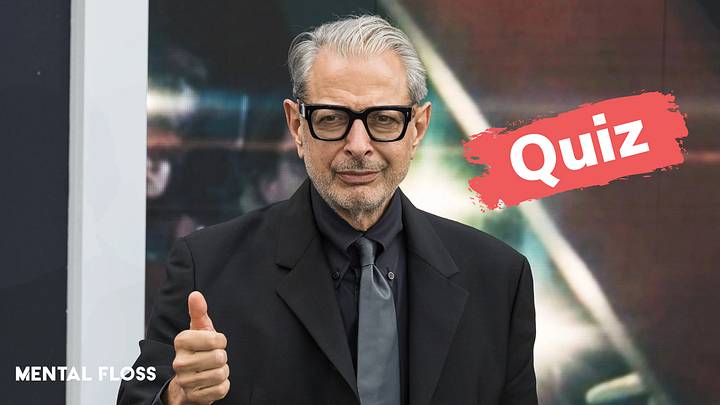
Jeff Goldblum is one of the world’s most beloved actors, and he’s taken on a variety of roles—both good and evil. How well can you remember the names of each one? Can you match the characters to their movies? We’ve got a quiz that will give you a chance to try!
So, did you get 8/8? You’re a true Goldblum fan if you did, and if you didn’t, don’t panic! This is the perfect excuse to rewatch the movies and remember your love for them. Get the popcorn and gather your friends for a Jeff Goldblum marathon.
More Movie & TV Quizzes:
•
Quiz: Can You Name the Jeff Goldblum Movie From His Character?
•
Quiz: How Fast Can You Name the Horror Movie From the Love Interest?
•
Quiz: Only True Horror Fans Can Match These Creepy Locations to Their Movies
•
Quiz: Can You Name the ‘I Love Lucy’ Episode From One Famous Moment?
•
Quiz: Who Said It? ‘Gilmore Girls’ Edition
Most Memorable Jeff Goldblum Characters
Few actors possess a persona as recognizable and eccentric as Jeff Goldblum. It’s hard to believe he’s had a career that spans five decades, making it clear that he is one to watch, as he brings some of the most unforgettable performances to our screens. There are a few characters that stand out more than others, and they’re likely your gateway into his suave charisma and wild ways.
Millennials grew up with Jurassic Park, and it’s Dr. Ian Malcolm who stands out. Goldblum even returned for some of the sequels, bringing sharp intelligence to the movie. He transformed what could have been a chaos-theory-loving nerd into an unforgettable and charismatic mathematician. Although there are some situations he should probably stay away from!
Of course, we also have to mention The Fly. While many view his ‘90s roles as some of his best and his earliest, he showcased his dramatic depth in the 1986 sci-fi horror by playing Seth Brundle.
Like Dr. Malcolm, he was a bit of a nerd in this flick, but he didn’t have as much charisma. Seth was a socially awkward scientist who created havoc with a teleportation experiment that went horribly wrong. Goldblum brought a heartbreaking performance, as he transformed into a human-insect hybrid that terrified everyone.https://www.youtube.com/embed/7VIzpeVgcDI?feature=oembed
If you’re a Will Smith fan, you’ll remember Goldblum in Independence Day. In this 1996 movie, he played the brilliant satellite technician, David Levinson, who offered the down-to-earth brains to counter Smith’s action-hero antics. If you don’t remember the name, you likely remember his own heroic efforts by developing a computer virus that could be planted into the alien mothership to save humanity.
Does it feel like Goldblum always plays scientists? Some of his most memorable roles have certainly involved his brains, but there is one that stands out for being completely different. In 2017, he appeared in the MCU in Thor: Ragnarok as The Grandmaster, bringing multiple elements of himself to the eccentric and charming character. It was also fun to see him play a villain rather than the sidekick saving the Earth.
Don’t forget to check in with the Mental Floss quiz page on a regular basis to continue testing your movie knowledge.
Next: Join Our Halloween Trivia Giveaway
Home/Movie and TV Quizzes
The 5 Best Indian Restaurants in the U.S., According to Guy Fieri
Chicken vindaloo in Alaska and lamb curry in New Mexico? These are the unexpected Indian restaurant picks that made Guy Fieri’s list.
ByNitya Rao|May 12, 2026, 8:34 PM EDT
Add us as a preferred source

Guy Fieri has spent decades behind the wheel of his red Camaro, proving that you don’t need a plane ticket to Delhi to find world-class curry. From the high-desert heat of Santa Fe to a hidden gem inside a Utah gas station, the Mayor of Flavortown has uncovered a “real deal” map of Indian cuisine right here in the U.S.
We aren’t just talking about your standard, lukewarm lunch buffets or the neon-red chicken you find at the mall. We’re shouting out five standout restaurants where the spices are toasted fresh, the tandoors are roaring, and the flavors are, in Fieri’s words, “off the hook.”
If you’re ready to trade the burgers for biryani and see how the spice trade meets the American Main Street, explore this mouthwatering list of Fieri’s top five Indian restaurants in the U.S.
- Paper Dosa – Santa Fe, NM
- Tandoori Oven – Logan, UT
- Gandhi Mahal – Minneapolis, MN
- Hari Om Cuisine of India – Fairbanks, AK
- Al Noor – Baton Rouge, LA
Paper Dosa – Santa Fe, NM
Lamb Curry
Santa Fe is world-renowned for its green chile, but Paper Dosa is successfully putting South Indian comfort food on the New Mexican map. This isn’t your typical rich, cream-based fare; instead, Chef Paulraj Karuppasamy offers an aromatic, authentic approach to the subcontinent’s lesser-known culinary region.
While their namesake paper-thin fermented rice crepes are a work of art, Fieri was specifically floored by the lamb curry. The dish features a lighter profile than most Northern Indian stews, relying on fresh curry leaves and toasted mustard seeds rather than heavy dairy. The result is a vibrant, aromatic dish with layers of flavor—”spice,” “smoke,” and “acid,” to be specific—that allow the tenderness of the lamb to shine through. After sampling the spread, from the potato-stuffed masala dosa to the fragrant lamb curry, Fieri noted that a visit here “isn’t just a meal; it’s an experience.”
Tandoori Oven – Logan, UT
Chicken Tikka Masala
In the world of Diners, Drive-Ins and Dives, some of the best culinary treasures are found in the most unassuming places. Case in point: Tandoori Oven, which is famously tucked inside a Utah gas station. While travelers might stop for a tank of unleaded, locals know to head inside for a “smorgasbord of flavors” that the Arora brothers have been perfecting for years.
When giving Fieri the lowdown on the restaurant’s offerings, Chef Sham Arora clarified that Northern Indian food is typically richer than its Southern counterparts, and the signature chicken tikka masala he later whipped up is a prime example. The secret to this creamy, spicy “Indian stew,” as Fieri describes it, lies in a rigorous two-day marination process that breaks down the proteins until the meat is so tender that your teeth simply sink into it.
After a trip into a traditional clay tandoor oven, the chicken is smothered in a vibrant, orange-red tomato-onion gravy and served with rice, naan, or—if you’re doing it right—both. Between the “perfect blend of spice” and the high-heat char from the clay tandoor, Fieri found himself struggling with the etiquette of eating something so delicious. He joked that his only real anxiety was figuring out how to “shovel it in fast enough” without looking like a dog who had never seen food before.
Gandhi Mahal – Minneapolis, MN
Dal with Naan
Gandhi Mahal is a Minneapolis legend that proves you can be “green” while serving up red-hot curry. Before its original building was lost in 2020, the restaurant was a marvel of urban sustainability, featuring a full aquaponics system in the basement. This high-tech setup allowed the kitchen to grow its own fresh produce and raise fish right on-site. Today, that commitment to fresh ingredients continues through their “Curry in a Hurry” concept.
When Fieri visited, he was immediately floored by the “outstanding” chicken tikka masala, noting it had “such a depth” of flavor. He specifically praised the “richness” of the ground almonds in the sauce and the juiciness of the chicken, which he likened to butter.
But the “next level” experience didn’t stop there. Fieri also got a taste of the plant-based side of the menu, continuing his Indian feast with a helping of earthy dal and blistered naan. The lentils are simmered for hours before being finished with a tarka—a traditional technique where whole spices are tempered in hot ghee to create an explosion of flavor.
Fieri was so impressed by the bite of smooth dal and pillowy naan that he declared the combination “multi-layered perfection.” For Fieri, the soulfulness of the cooking made it the perfect entry point for any skeptic: “If you don’t think you like Indian food, let this be your visa.”
Hari Om Cuisine of India – Fairbanks, AK
Chicken Vindaloo
If you think you have to be in a major metro area—or even the mainland—for authentic spice, Hari Om in Fairbanks is here to prove you wrong. Located just a few hours south of the Arctic Circle, this eatery provides a fiery contrast to the Alaskan chill thanks to the expertise of Chef Amit Paul.
With nearly three decades of experience, Paul has mastered the Dum Pukht tradition—a specialized slow-cooking method where the pot is sealed, allowing the food to steam in its own juices. This technique is likely why Fieri was so impressed with the texture of the chicken vindaloo, noting that the chicken was so tender it “just fell apart.”
The dish features a thick sauce built from a potent paste of red chiles and vinegar, a combination that hits all the right notes for the Mayor of Flavortown. “I love the spice, and I love the acidity,” Fieri remarked, adding that the dish has a “really nice mix of spices” and a distinct “zip.” While the vindaloo brought the heat, Fieri also sampled the lamb korma, a rich, nut-based curry that showed off the kitchen’s range.
Ultimately, Fieri concluded that the meal is “everything you want it to be, especially on a cold day in Fairbanks.”
Al Noor – Baton Rouge, LA
Lamb Kebabs
Baton Rouge might be the land of gumbo and crawfish, but Fieri found a culinary powerhouse tucked away in a suburban strip mall at Al-Noor. Chef Khalad Al-Noor famously walked away from a career in corporate engineering to return to his roots, and the result is what Fieri calls “Indian Soul Food.”
The lamb sheekh kebabs are a masterclass in tandoori cooking. The process starts with fresh ground lamb mixed with a total of 16 flavorful ingredients, including fresh ginger, garlic, and a custom blend of toasted spices. Next, the supple meat is hand-molded onto long metal skewers and lowered into a roaring clay tandoor. The intense heat renders the fat perfectly, creating a kebab that is incredibly juicy with a signature charred exterior.
While Fieri called the restaurant’s unique espresso-rubbed venison “off the hook,” it was the lamb that he deemed truly “outrageous,” noting that the spices aren’t just on the meat—they’re in it.
More Like This:
•
5 Best Restaurants in the U.S., According to Guy Fieri
•
The 5 Best Mexican Restaurants in the U.S., According to Guy Fieri
•
Flavortown Across America: An Interactive Map of Guy Fieri’s Restaurant Empire
•
5 Best Donut Shops in North America, According to Guy Fieri
•
6 Best Pizza Places in America, According to Guy Fieri
Home/FOOD