
ByRebecca Pahle|Mar 4, 2022, 5:00 AM EST
 Add us as a preferred source

Actress Anna May Wong (January 3, 1905–February 3, 1961) had a career that spanned 40 years, and in that time, she accomplished plenty of firsts, most notably being the first Chinese-American movie star. But there’s a lot more to Wong than that one label, so read on for 12 facts about this iconic actress’s life.
1. Anna May Wong was a third-generation Chinese-American.
Though contemporary press often identified Anna May Wong as Chinese—in 1938, Look magazine even named her “The World’s Most Beautiful Chinese Girl”—she was actually a third-generation Chinese-American and was born in Los Angeles under the name “Wong Liu Tsong.” A fan of the movies and an aspiring actress from a very young age, she came up with the stage name “Anna May Wong” when she was only 11.
2. Her love of movies earned her a “curious” nickname.
Growing up in Los Angeles, Wong wanted to take in as much of the burgeoning film industry as she could. She would routinely skip school to sneak into film shoots and watch everything the crew was doing, earning her a nickname along the way: C.C.C., or “Curious Chinese Child.”
“I would play hooky from school to watch the crews at work, though I knew I would get a whipping from my teacher, and later from my father, for it,” Wong said. “I would worm my way through the crowd and get as close to the cameras as I dared. I’d stare and stare at these glamorous individuals, directors, cameramen, assistants, and actors in greasepaint, who had come down into our section of town to make movies.”
3. Wong starred in the first (with an asterisk) Technicolor feature.

When most people think of Technicolor movies, they likely think about 1939’s The Wizard of Oz—but the first Technicolor feature actually hit theaters 17 years earlier. It was called The Toll of the Sea and starred a 17-year-old Wong in her first lead role. The asterisk comes from the fact that The Toll of the Sea was the first generally available Technicolor film—a movie called The Gulf Between came out earlier but required specialized projectors to screen, and thus was never generally available.
4. She was also the first Asian to star in a Hollywood film.
In addition to being her first major role, Wong made history with The Toll of the Sea as the first Asian to get top billing in a Hollywood production. The film is a somewhat loose adaptation of the Madame Butterfly story, wherein an American man has a romance with a demure and ultimately tragic Chinese heroine, a trope Wong found herself returning to many times over her career. Madame Butterfly had been adapted for the screen before, but it starred sound-era superstar Mary Pickford in yellowface.
5. She wanted to be on the other side of the camera.
In March 1924, at the age of 19, Wong created Anna May Wong Productions, with the goal of making films based on Chinese legends. Alas, the project never materialized, thanks to the shady dealings of a business partner and a pair of lawsuits that ground the whole thing to a halt.
6. Wong was one half of the first Asian-American couple in a sound movie.
In 1937’s Daughter of Shanghai, Wong and Korean-American actor Philip Ahn became “the first self-representing Asian American romantic couple in sound-era Hollywood cinema,” according to Hye Seung Chung in Hollywood Asian: Philip Ahn and the Politics of Cross-ethnic Performance. There was much media speculation as to a romantic relationship between Wong and Ahn, who were long-time friends stemming back to childhood. Wong shrugged off the rumors, saying that marrying Ahn “would be like marrying my brother.”
7. She never got married, but that didn’t stop papers from spreading rumors.
Wong was romantically linked to several men through her life—including Dracula and Freaks director Todd Browning and English entertainer Eric Maschwitz, who (it is rumored) wrote the song “These Foolish Things (Remind Me Of You)” about her—but none of those relationships have been definitively proven. Wong never married, though there was some confusion about that when, in a 1936 stop-over in Tokyo, she told a reporter that she was married “to my art.” Later, local papers reported that she had married a Cantonese businessman named “Art.”
8. Wong was outspoken about the racism she experienced in Hollywood.

Throughout her life, Wong was vocal about the restrictions racism put on her career, calling out the industry for largely casting her in one of two stereotypical roles: the demure Asian woman or the villainous “Dragon Lady.”
“I was so tired of the parts I had to play,” she said in a 1933 interview. “Why is it that the screen Chinese is nearly always the villain of the piece, and so cruel a villain—murderous, treacherous, a snake in the grass. We are not like that.”
In particular, Wong commented on how few times her characters were allowed to live until the closing credits; she once said: “When I die, my epitaph should be: I died a thousand deaths. That was the story of my film career. Most of the time I played in mystery and intrigue stories. They didn’t know what to do with me at the end, so they killed me off.”
9. She campaigned for a role that won a white actress (in yellowface) an Oscar.
The great disappointment in Wong’s career came with MGM’s adaptation of Pearl S. Buck’s The Good Earth. Wong advocated hard for the role of O-Lan, the wife of a Chinese farmer, and Buck herself told an MGM executive that she’d prefer the lead roles be played by Chinese actors. Instead, the core couple was played by Luise Rainier and Paul Muni in yellowface; Rainer won her second Oscar for the film. Wong had been offered, instead, the role of the deceitful Lotus.
Of that offer, Wong said this to MGM producer Irving Thalberg: “You’re asking me—with Chinese blood—to do the only unsympathetic role in the picture, featuring an all-American cast portraying Chinese characters.” She didn’t take the part.
Though Wong ultimately was not in The Good Earth—either as O-Lan or Lotus—her sister, Mary Liu Heung Wong, appeared in the film as the “Little Bride.” It was her only credit; she died by suicide three years later.
10. Wong was the first Asian-American lead on a TV series.
Frustrated with the roles she was being offered, Wong grew restless, moving back and forth between Hollywood, Europe, and China, acting on screen and in theater, radio plays, cabaret, vaudeville, and TV. The Gallery of Madame Liu-Tsong, in which Wong starred as an art dealer/detective, was the first-ever U.S. television show starring a Chinese-American person of any gender. The show ran for one season in 1951; no footage or scripts have been uncovered.
11. She was planning a return to film when she died.
Flower Drum Song (1961)—based on the Rodgers and Hammerstein musical (which was in turn based on C.Y. Lee’s novel)—was the first Hollywood movie to feature a majority Asian-American cast. Wong was set to play Madame Liang (eventually played by Juanita Hall) in the film, but poor health kept her from taking the role. She passed away on February 3, 1961, at the age of 56. Up until her death, Wong had only been in one movie since 1949, with her final film appearance coming in 1960’s Portrait in Black.
12. She’s the first Asian-American woman to be on U.S. currency.

In 2021, Anna May Wong was among five trailblazers chosen to appear on coins as part of the “American Women Quarters Program,” which launched in early 2022. You can sign up on the U.S. Mint’s website to receive the quarters, which also feature Maya Angelou, Sally Ride, Wilma Mankiller, and Nina Otero-Warren.
Additional Sources: The Tool of the Sea: The Life and Times of Anna May Wong by Jennifer Warner; Hollywood Asian: Philip Ahn and the Politics of Cross-ethnic Performance by Hye Seung Chung; Screen Style: Fashion and Feminity in 1930s Hollywood by Sarah Berry; Anna May Wong: From Laundryman’s Daughter to Hollywood Legend by Graham Russell Hodges.
Related Tags
The Defining Macy’s Thanksgiving Day Parade Balloon of Every Decade
Watch 100 years of pop culture drift down Manhattan. From Felix the Cat to Bart Simpson, these are the iconic character balloons that colored Thanksgiving morning in every era.
ByNitya Rao|Nov 12, 2026, 6:00 PM EST
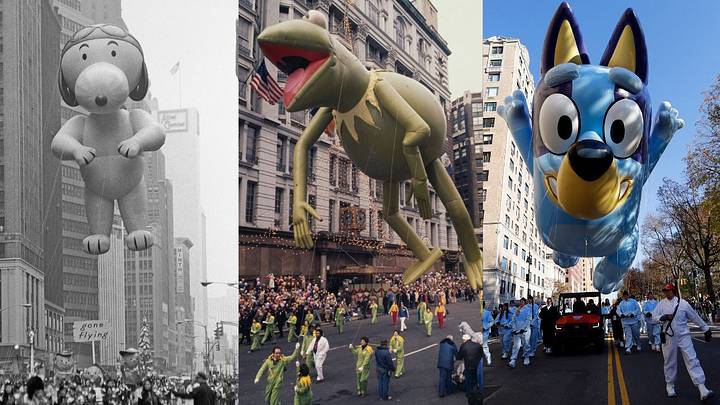
Everyone knows the best part of Thanksgiving is the sides—and the sideshow. For a few hours every November, the main meal makes room for the annual Macy’s Thanksgiving Day Parade, a feast for the eyes featuring colorful character balloons, festive floats, and a whole lot of helium.
Since 1924, the parade has been a revolving door for America’s favorite pop culture icons, from classic Mickey Mouse to Gen Alpha’s beloved Bluey. As silly as the giant Snoopy and Spider-Man shadows over Manhattan’s West Side may seem, it’s this very spectacle that keeps millions glued to their screens every Thanksgiving morning. Here’s a look back at the cartoon characters and blockbuster balloons that shaped the Macy’s Thanksgiving Day Parade over the last century.
1920s: Christmas Parade Premiere
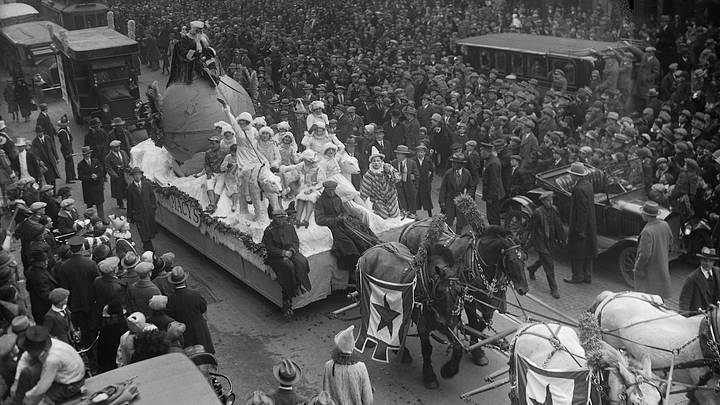
Before we had colossal character inflatables and live television coverage, Manhattan’s biggest holiday celebration was known as the Macy’s Christmas Parade. Launched on November 24, 1924, for a crowd of just 10,000 spectators, the event featured horse-drawn floats like this 1925 Santa Claus carriage and even live animals from the Central Park Zoo to usher in the holiday shopping season.
1930s: Mickey Mouse Takes Manhattan
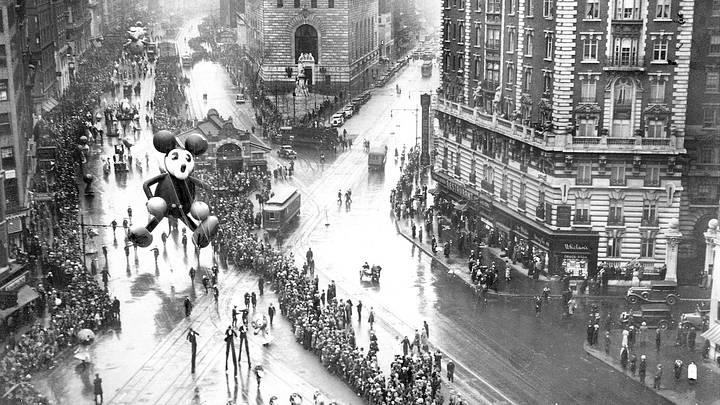
From Disney’s animation studio to the streets of Manhattan, the balloon adaptation of this beloved Disney character was introduced to the parade in 1934. Walt Disney designed the original Mickey Mouse balloon, which saw four more tweaks over the years.
1940s: Post-War Rebirth
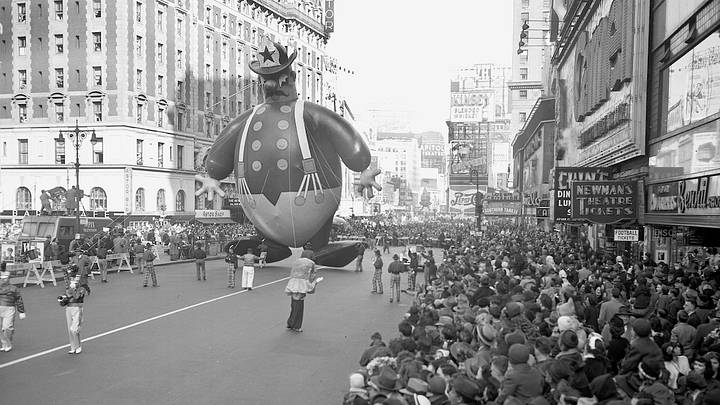
While Macy’s halted the parade from 1942 to 1944 during World War II, all was right by the late 1940s, when oversized helium friends passed by Central Park once again. Quirky figures like Harold the Fireman—a play on Herald Square, where the route famously ran through—became big names thanks to broadcast networks increasingly covering the parade, with CBS putting it on screens nationwide for the first time in 1948.
1950s: The Rise and Fall of Mighty Mouse
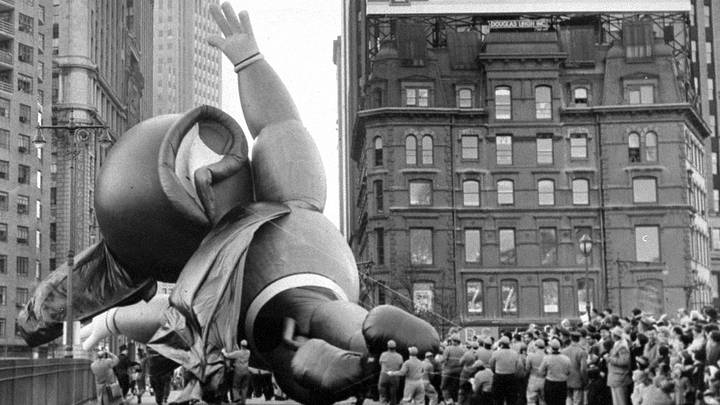
As television turned the parade into a pre-pie living room tradition, live broadcasting brought unscripted drama. During the 1956 parade, the Mighty Mouse balloon tragically collided with a street sign, collapsing and slowly deflating at Columbus Circle in front of millions of viewers at home.
1960s: Snoopy Takes Flight
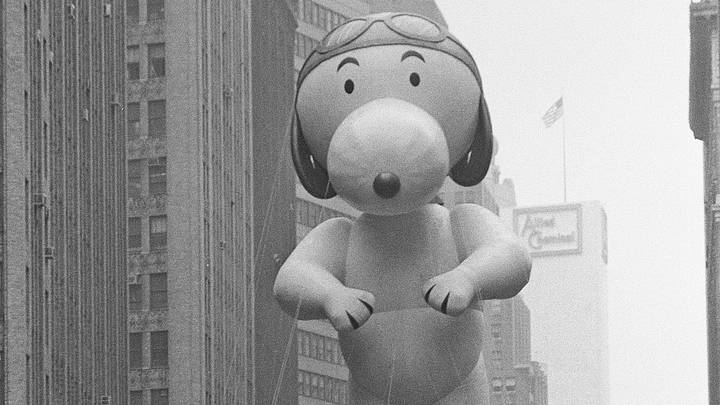
Snoopy first joined the festivities in 1968 as an aviator. Most of the 1970s saw the Peanuts pup as an astronaut, while the ’80s featured an ice-skating Snoopy. Broadcast on NBC, the debut started a half-century run that would eventually make Snoopy the most frequently featured character in parade history.
1970s: Muppetmania Meets Macy’s
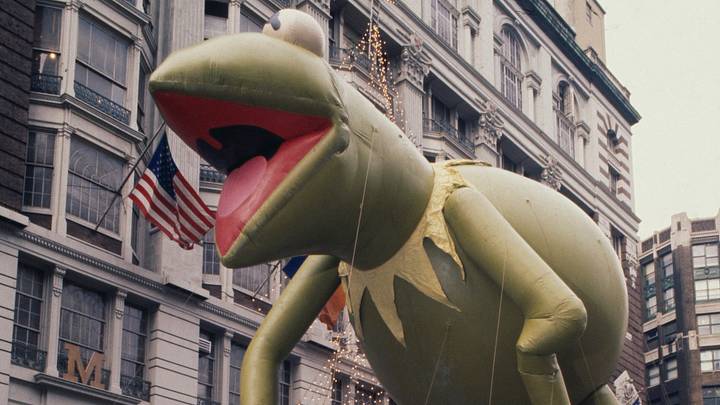
The success of Sesame Street and The Muppet Show led to Muppetmania amidst the Macy’s Thanksgiving Day Parade in the late ’70s. Kermit the Frog debuted in 1977 as the parade’s first major puppet-based balloon, marking the start of an era where Saturday morning TV staples ruled the route.
1980s: Superman on Sixth
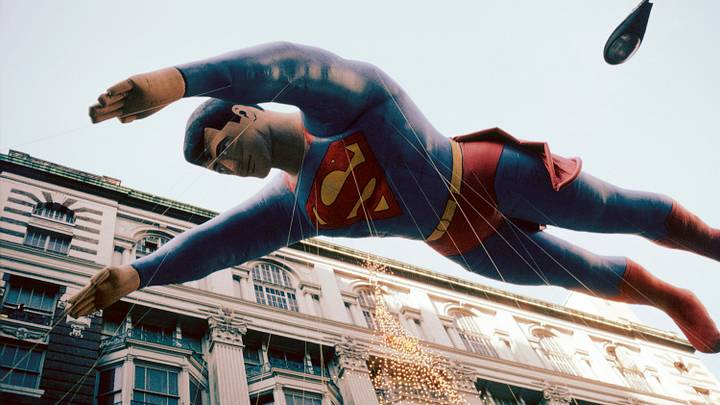
America’s favorite comic books came to life in more ways than one in the ’80s, thanks to the success of Christopher Reeve’s hit films and the return of the new and improved Superman balloon. Measuring 104 feet long and 35 feet wide, the massive character balloon made its mark on the Macy’s Parade as the largest in history at the time. With its detailed, humanoid design, the 1980 “Man of Steel” also served as the final balloon manufactured by Goodyear, before DC’s rival Marvel eventually took over the superhero slot with Spider-Man by 1989.
1990s: A Primetime Parade
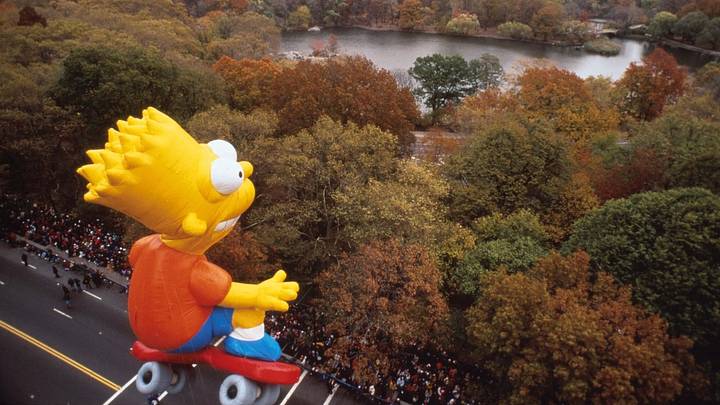
Soaring superheroes made way for skateboarding sitcom stars as quirky cartoons characterized cable TV in the ’90s. The Bart Simpson balloon cruised through the decade for the most part—save for a split seam in 1993. The Cat in the Hat, on the other hand, faced a different fate in 1997, when heavy winds caused the inflatable to strike a lamppost and permanently change how the parade handles safety.
2000s: New Millennium, New Balloons
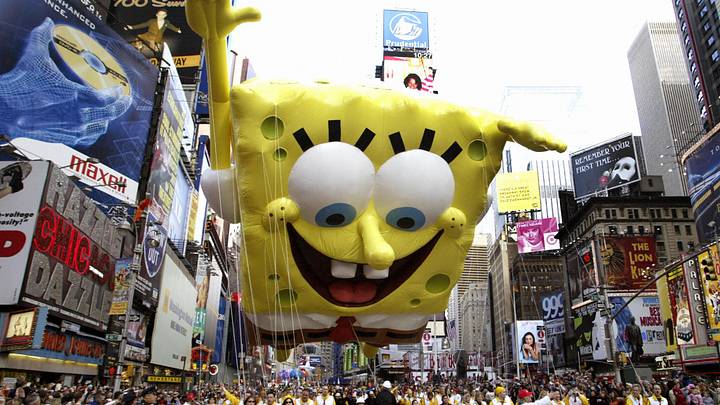
One bright yellow cartoon character led to the next as the new millennium commenced, with the SpongeBob SquarePants balloon floating through Times Square for the first time in 2004. From Pokémon’s Pikachu to the M&M crew, the parade’s Y2K era was a manifestation of modern animation come to life. While far from the first quirky character to fly over Central Park, the SpongeBob balloon was the first square balloon in the history of the Turkey Day spectacle.
2010s: Thanksgiving Goes Global
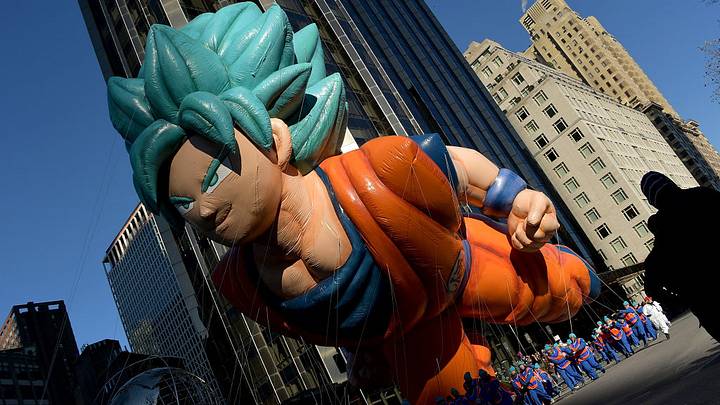
Thanksgiving might have started stateside, but the parade’s pop-culture reach blew up beyond borders by the tail end of the 2010s. In 2018, Goku from Dragon Ball made history as the first Japanese manga character to join the festivities. Casting jagged shadows over the city with his spiky cyan hair, the Saiyan warrior helped introduce Macy’s to a more worldly audience. For the franchise’s 40th anniversary in 2024, the balloon got a makeover complete with Goku’s classic black hair—plus back-up from fellow manga character Monkey D. Luffy’s balloon.
2020s: Streaming Superstars
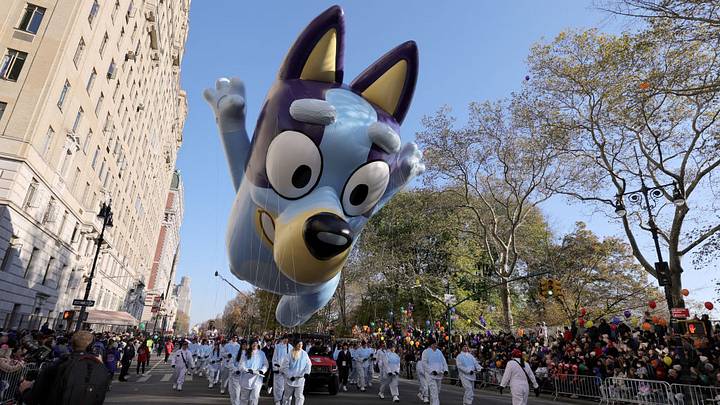
Even a global pandemic couldn’t stop the Macy’s Thanksgiving Day Parade from livening up the streets of Manhattan, with a scaled-down return in 2021 followed by an influx of fresh pop-culture characters in the years following. Featuring blown-up fan favorites like Bluey—the animated Australian pup—and Stuart the Minion, the late-November skies above New York basically doubled for a Roku screen.