
The John Landis-directed comedy classic helped turn stars Eddie Murphy and Dan Aykroyd into household names.
ByRoger Cormier|Jul 27, 2023, 5:30 PM EDT
 Add us as a preferred source

In Trading Places, millionaires Randolph (Ralph Bellamy) and Mortimer (Don Ameche) Duke can’t agree on the whole nature versus nurture theory. So they decide to bet $1 on it and determine the winner by installing homeless con artist Billy Ray Valentine (Eddie Murphy) in the old job at their firm held by Louis Winthorpe III (Dan Aykroyd), who was set up to lose everything by the Duke brothers.
When the two find out about the bet, they seek revenge. In honor of its 40th anniversary, check out these fun facts about the 1983 comedy classic that helped turn its two lead stars into household names.
1. The idea was inspired by a tennis game.
“There were these two brothers who were both doctors who I would play tennis with on a fairly regular basis, and they were incredibly irritating to play with because they had a major sibling rivalry going, all the time about everything,” screenwriter Timothy Harris told Insider in 2013. He presented the idea of brothers arguing the nature versus nurture debate to his writing partner, Herschel Weingrod, and the two went to work.
2. The screenwriters hung out with drunk traders for research.
“The traders I met and hung out with here in L.A., because it was three hours behind New York, had their happy-hours very early in the day,” Weingrod told NPR in 2013. “You can imagine what they were like by, maybe, 2 p.m.”
3. It was originally a vehicle for Richard Pryor and Gene Wilder, titled Black and White.

Comedian Richard Pryor was originally attached to the project alongside Gene Wilder, but as director John Landis put it, he then “unfortunately set himself on fire.”
4. Landis didn’t know who Eddie Murphy was.

Murphy was still an up-and-coming star when the casting was underway. “48 Hrs. (1982) hadn’t come out yet, but they’d previewed it, and Eddie Murphy had previewed very well, and they thought, ‘Ah, this kid’s going to be a star,’” Landis recalled of his discussions with Paramount Pictures. “So they said, ‘What do you think about Eddie Murphy playing the Billy Ray Valentine part?’ And I of course said, ‘Who’s Eddie Murphy?’”
Bellamy, who played Randolph Duke, remembered a moment on set between himself, Ameche (who played his brother, Mortimer), and Murphy in the makeup trailer on the first morning of shooting. “I said, ‘Why, this is my 72nd movie.’ And Don answers, ‘Why, this is my 56th.’ And Eddie Murphy looks embarrassed and said, ‘Boys, this is my first. Ever.’ It broke everybody up, and the movie became my biggest hit.”
5. Landis also thought Ameche was dead.
Ray Milland (Dial M for Murder) was originally cast as Mortimer, but he didn’t pass the insurance physical. When Landis asked for Don Ameche, he was informed that he had not made a movie in 13 years and he couldn’t be found. “The horrible question was asked, ‘Did he die?’” Landis recalled. Ameche was later found, and held off on agreeing to return to movies until he was paid what Milland had been promised. Two years after Trading Places, Ameche starred in Cocoon (1985) and won an Oscar for his efforts.
6. The co-stars weren’t familiar with each others’ work.

Bellamy and Ameche “cheerfully admitted” they were unfamiliar with Murphy and Aykroyd’s work. The two also said that Murphy and Aykroyd acknowledged that they were unfamiliar with Bellamy and Ameche.
7. Jamie Lee Curtis was a hard sell to the studio.

When it came to casting, Landis ran into some issues, especially for the role of Ophelia. It ultimately went to Jamie Lee Curtis, who was best known for her roles in slasher films like Halloween (1978), The Fog (1980), Prom Night (1980), and Terror Train (1980).
“What really got me in trouble was Jamie Lee Curtis, because up to that point she had only done horror pictures,” Landis said. “But Jamie did a terrific job. She somehow made her part, the hooker with a heart of gold, almost believable!”
8. G. Gordon Liddy almost agreed to play Clarence Beeks.
The role eventually went to Paul Gleason (The Breakfast Club) instead, after G. Gordon Liddy allegedly considered playing Clarence until reading the final scene involving his character getting sexually assaulted by a gorilla. In the movie, Beeks reads Liddy’s autobiography Will on the train.
9. It was shot in Philadelphia, New York City, and the U.S. Virgin Islands.
The crew spent 15 days doing exterior shooting in Philadelphia. The city was chosen by Harris because it “has a connection with the founding of the country, the constitution, everybody being entitled to the pursuit of happiness, all the idealism that’s built into America.”
But the interiors of the Duke & Duke office and other Philadelphia locations were shot in New York City. On the last day of production, March 1, 1983, filming concluded on a beach in the U.S. Virgin Islands.
10. Curtis stayed in Marlene Dietrich’s Park Avenue apartment during the shoot.
At the time, Curtis was engaged to Marlene Dietrich’s grandson, production designer J. Michael Riva. The apartment was located at 993 Park Avenue.
11. Breaking Bad’s Gus Frind was one of Murphy’s cellmates in the flick.

Giancarlo Esposito of Breaking Bad fame portrayed the blink-and-you-missed-it role of Cellmate #2 in the comedy hit.
“I was in awe of Eddie Murphy,” Esposito told The AV Club in 2013. “At that time, I was probably a little jealous of Eddie Murphy. Because you work all your early career to be a dramatic actor, and then this guy, a comedian with an affable personality who’s incredibly talented, just shoots right by you to stardom. But that day, we became friends.”
12. There were other interesting cameos.
Bo Diddley played a pawnbroker, Jim Belushi was in the gorilla costume, Al Franken and Tom Davis played baggage handlers, Frank Oz played a police officer, and Kelly Curtis, Jamie Lee’s sister, played “Muffy.”
13. Al Franken still gets paid for his cameo.

In releasing his financial records for 2012, Al Franken revealed he still gets royalties for his appearance as the baggage handler.
14. Aykroyd and Murphy caused billions of dollars in trading to grind to a halt.
Initially, in a shoot where real stock traders performed with some extras at the World Trade Center’s commodity exchange, Comex, Aykroyd and Murphy were supposed to perform on a weekday during actual trading.
According to the studio production notes, the two stars distracted business activities and $6 billion of trading was halted. They then rescheduled to film over the weekend.
15. The Commodity Futures Trading Commission instituted an “Eddie Murphy Rule” in 2010, based on the film’s ending.

In 2010, using misappropriated government information for commodity markets trading was still not technically illegal. The “Eddie Murphy Rule” banning the practice went into effect as part of the Wall Street Transparency and Accountability Act of the Dodd-Frank Wall Street Reform and Consumer Protection Act.
In Trading Places, the Duke brothers used insider info from a not-yet-released USDA report that said orange crops were lowering in value and to focus on buying frozen concentrate orange juice futures. The problem for them was that Aykroyd and Murphy wrote the fake report.
A version of this article was originally published in 2016 and has been updated for 2023.
Related Tags
The Defining Macy’s Thanksgiving Day Parade Balloon of Every Decade
Watch 100 years of pop culture drift down Manhattan. From Felix the Cat to Bart Simpson, these are the iconic character balloons that colored Thanksgiving morning in every era.
ByNitya Rao|Nov 12, 2026, 6:00 PM EST
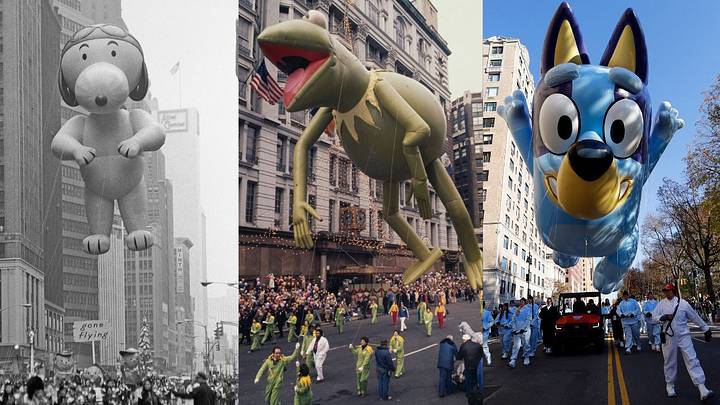
Everyone knows the best part of Thanksgiving is the sides—and the sideshow. For a few hours every November, the main meal makes room for the annual Macy’s Thanksgiving Day Parade, a feast for the eyes featuring colorful character balloons, festive floats, and a whole lot of helium.
Since 1924, the parade has been a revolving door for America’s favorite pop culture icons, from classic Mickey Mouse to Gen Alpha’s beloved Bluey. As silly as the giant Snoopy and Spider-Man shadows over Manhattan’s West Side may seem, it’s this very spectacle that keeps millions glued to their screens every Thanksgiving morning. Here’s a look back at the cartoon characters and blockbuster balloons that shaped the Macy’s Thanksgiving Day Parade over the last century.
1920s: Christmas Parade Premiere
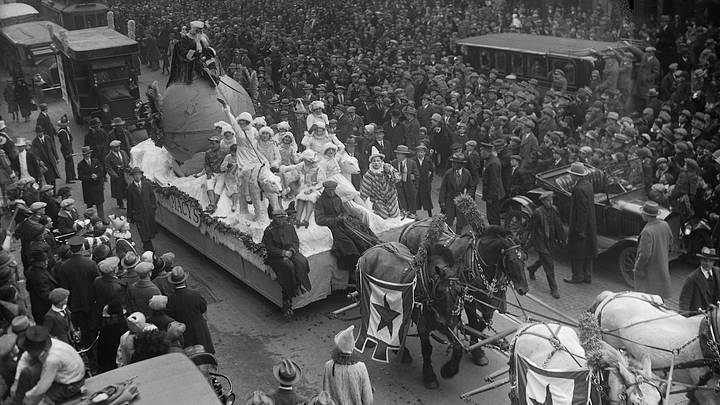
Before we had colossal character inflatables and live television coverage, Manhattan’s biggest holiday celebration was known as the Macy’s Christmas Parade. Launched on November 24, 1924, for a crowd of just 10,000 spectators, the event featured horse-drawn floats like this 1925 Santa Claus carriage and even live animals from the Central Park Zoo to usher in the holiday shopping season.
1930s: Mickey Mouse Takes Manhattan
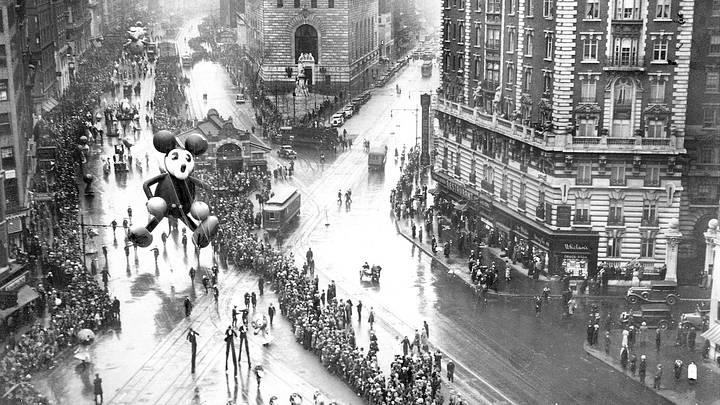
From Disney’s animation studio to the streets of Manhattan, the balloon adaptation of this beloved Disney character was introduced to the parade in 1934. Walt Disney designed the original Mickey Mouse balloon, which saw four more tweaks over the years.
1940s: Post-War Rebirth
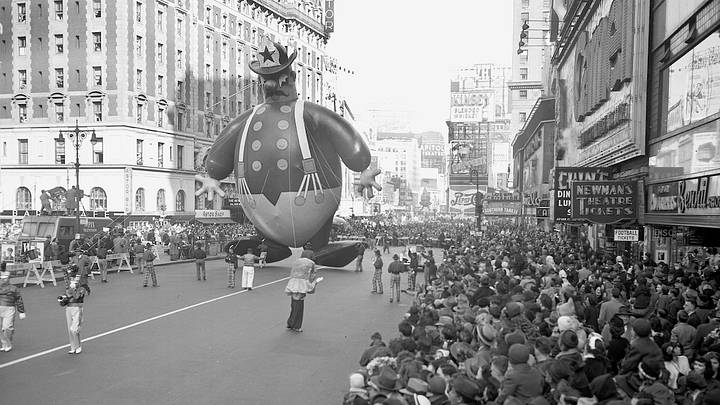
While Macy’s halted the parade from 1942 to 1944 during World War II, all was right by the late 1940s, when oversized helium friends passed by Central Park once again. Quirky figures like Harold the Fireman—a play on Herald Square, where the route famously ran through—became big names thanks to broadcast networks increasingly covering the parade, with CBS putting it on screens nationwide for the first time in 1948.
1950s: The Rise and Fall of Mighty Mouse
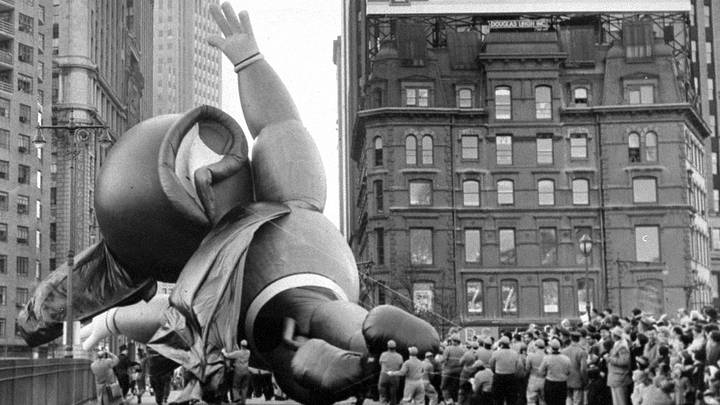
As television turned the parade into a pre-pie living room tradition, live broadcasting brought unscripted drama. During the 1956 parade, the Mighty Mouse balloon tragically collided with a street sign, collapsing and slowly deflating at Columbus Circle in front of millions of viewers at home.
1960s: Snoopy Takes Flight
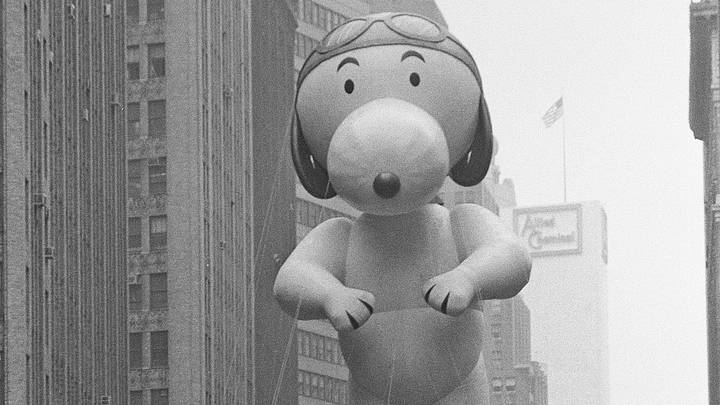
Snoopy first joined the festivities in 1968 as an aviator. Most of the 1970s saw the Peanuts pup as an astronaut, while the ’80s featured an ice-skating Snoopy. Broadcast on NBC, the debut started a half-century run that would eventually make Snoopy the most frequently featured character in parade history.
1970s: Muppetmania Meets Macy’s
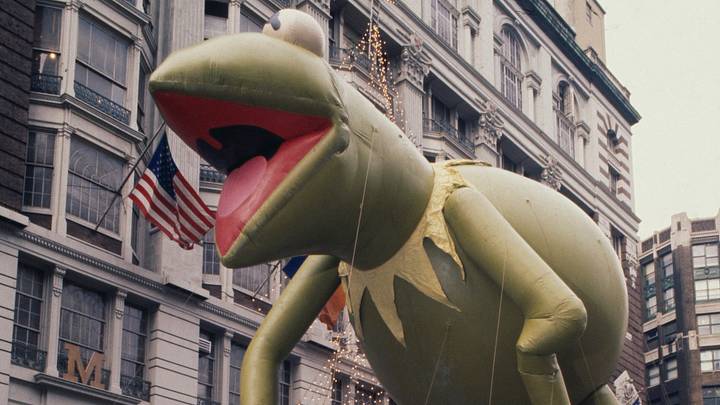
The success of Sesame Street and The Muppet Show led to Muppetmania amidst the Macy’s Thanksgiving Day Parade in the late ’70s. Kermit the Frog debuted in 1977 as the parade’s first major puppet-based balloon, marking the start of an era where Saturday morning TV staples ruled the route.
1980s: Superman on Sixth
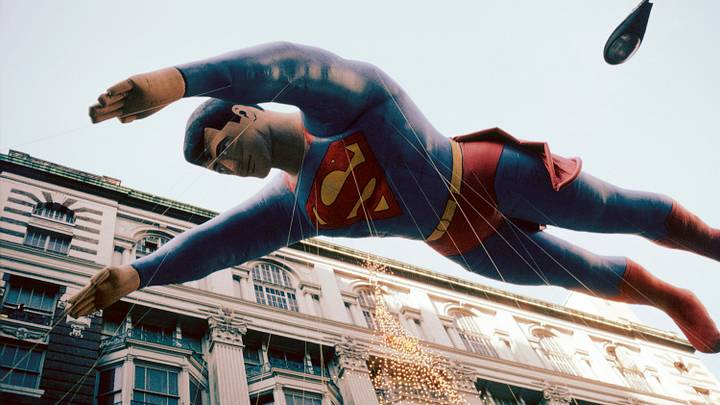
America’s favorite comic books came to life in more ways than one in the ’80s, thanks to the success of Christopher Reeve’s hit films and the return of the new and improved Superman balloon. Measuring 104 feet long and 35 feet wide, the massive character balloon made its mark on the Macy’s Parade as the largest in history at the time. With its detailed, humanoid design, the 1980 “Man of Steel” also served as the final balloon manufactured by Goodyear, before DC’s rival Marvel eventually took over the superhero slot with Spider-Man by 1989.
1990s: A Primetime Parade
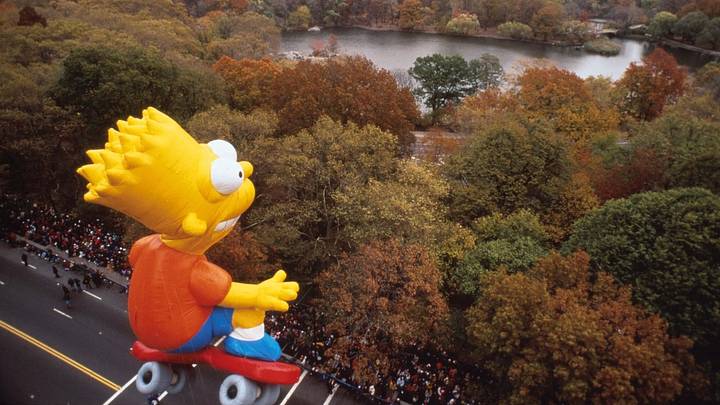
Soaring superheroes made way for skateboarding sitcom stars as quirky cartoons characterized cable TV in the ’90s. The Bart Simpson balloon cruised through the decade for the most part—save for a split seam in 1993. The Cat in the Hat, on the other hand, faced a different fate in 1997, when heavy winds caused the inflatable to strike a lamppost and permanently change how the parade handles safety.
2000s: New Millennium, New Balloons
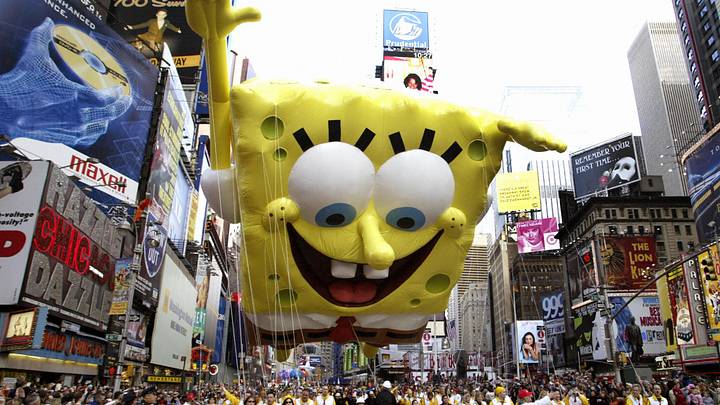
One bright yellow cartoon character led to the next as the new millennium commenced, with the SpongeBob SquarePants balloon floating through Times Square for the first time in 2004. From Pokémon’s Pikachu to the M&M crew, the parade’s Y2K era was a manifestation of modern animation come to life. While far from the first quirky character to fly over Central Park, the SpongeBob balloon was the first square balloon in the history of the Turkey Day spectacle.
2010s: Thanksgiving Goes Global
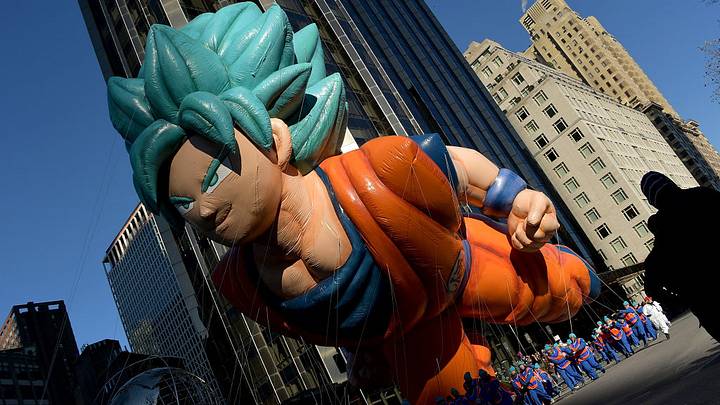
Thanksgiving might have started stateside, but the parade’s pop-culture reach blew up beyond borders by the tail end of the 2010s. In 2018, Goku from Dragon Ball made history as the first Japanese manga character to join the festivities. Casting jagged shadows over the city with his spiky cyan hair, the Saiyan warrior helped introduce Macy’s to a more worldly audience. For the franchise’s 40th anniversary in 2024, the balloon got a makeover complete with Goku’s classic black hair—plus back-up from fellow manga character Monkey D. Luffy’s balloon.
2020s: Streaming Superstars
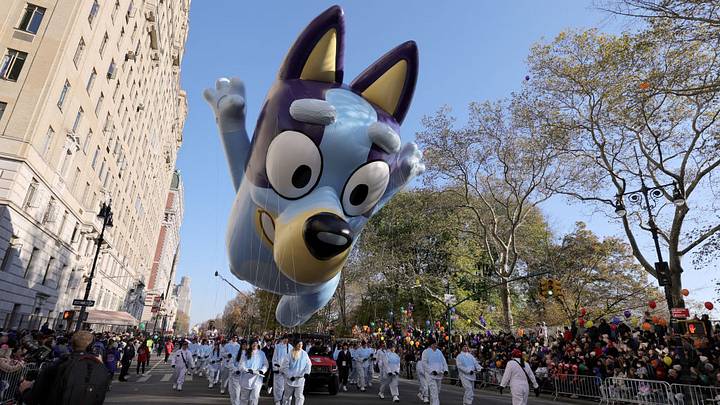
Even a global pandemic couldn’t stop the Macy’s Thanksgiving Day Parade from livening up the streets of Manhattan, with a scaled-down return in 2021 followed by an influx of fresh pop-culture characters in the years following. Featuring blown-up fan favorites like Bluey—the animated Australian pup—and Stuart the Minion, the late-November skies above New York basically doubled for a Roku screen.
Read More:
•
Quiz: Can You Name the ’80s Sitcom From Its Thanksgiving Episode?
•
The Most Popular Holidays in the U.S., Ranked
•
The Defining Macy’s Thanksgiving Day Parade Balloon of Every Decade
•
2026’s Most Popular Thanksgiving Sides By State, Mapped
•
75 Holiday Jokes That Are So Funny, You’ll Want to Share Them With Everyone