
ByMichele Debczak|Jan 15, 2018, 7:00 AM EST
 Add us as a preferred source
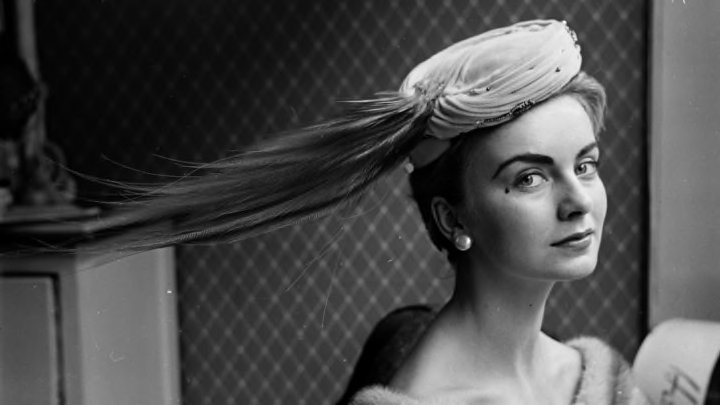
One thing that illustrated and photographic archives have taught us is that people have always known how to rock a stylish piece of headwear. From squat caps to towering toppers, history has produced a hat for every occasion. Here are 20 old styles that, with a healthy dose of fashion and confidence, could still look just as fabulous today.
1. THE CLOCHE

The sleek, head-hugging cloche was the perfect companion to the bobbed hairstyle worn by flappers in the 1920s. The hats were typically left plain to emphasize their bell-shaped silhouette, though they also offered a blank canvas for embellishment. The cloche was most popular during the Jazz Age but it’s occasionally incorporated into retro fashion styles today.
2. THE OTTOMAN HEADDRESS

In Ottoman ceremonial costumes, hats played a starring role. The headgear often featured bright colors, feathery ornamentations, and elaborate designs that signified status. The wearer’s class, religion, gender, and clan could all be gleaned from the way the fabric in their headdress was layered.
3. THE BOWLER HAT

The top hat was popular in the 19th century but it wasn’t always the most practical choice for outdoor activities. When looking for a way to protect the heads of horseback riders from branches, brothers Thomas and William Bowler came up with their namesake cap. The bowler hat was sturdy, compact, and appropriate for most any occasion. Though the bowler hat largely fizzled out by the 1980s, the item’s original London manufacturers Lock & Co. still sell thousands each year.
4. THE PILLBOX HAT

Unlike some hats from history, this one was prized for its simplicity. It could be easily identified by its brimless, round shape evoking that of a pillbox. It began gaining steam in the 1930s before reaching peak popularity with First Lady Jackie Kennedy in the 1960s.
5. THE FASCINATOR

Depending on the look you’re going for, a fascinator can be worn as a subtle accent item or a show-stealing statement piece. The hat is defined as an ornamental headpiece that’s secured to the crown using a headband or comb. Once they fit that criteria, fascinators can take the form of flowers, feathers, fabric, or whatever else the wearer can engineer to stay on their head. And though they’re still popular in the U.K., Americans don’t tend to utilize fascinators outside of Derby Day attire.
6. THE TRI-CORNER HAT

In 17th century Europe and America, tri-cornered hats, or tricornes, gave men the opportunity to show off their lustrous wigs poking out from beneath the upturned brim. It’s no surprise then that the hat style died out with the powdered wig fad, but that doesn’t mean it isn’t fit for a comeback. Even if wearers don’t have wigs to flaunt, they could take a page from our forefathers’ book and upgrade the hat itself with feathers, brocades, and fabrics—or maybe just sports insignias.
7. THE DEERSTALKER HAT

If you’ve seen this hat anywhere, it was most likely on the head of someone portraying Sherlock Holmes. The headpiece has been tied to the character since the books were published in the 19th century (it was the illustrations—not the story—that did it, as Sir Arthur Conan Doyle never mentions the cap in the text). It’s peculiar that an urban detective would be wearing a deerstalker hat in the first place, considering they were designed for hunting game and not tracking clues, but the smartly styled hat’s comeback should be … elementary.
8. THE HENNIN

These striking hats were a clear sign of royalty in the medieval era. Reinforced with wire or padding and draped in fine fabric, the cone-shaped hennin is still synonymous with the stereotypical princess today. English hennins were fairly modest in height, but the French version reached up to to three feet and the hat’s Mongolian predecessor towered five to seven feet high.
9. THE NEWSBOY CAP

This hat goes by many names (the big apple, the eight panel, the Gatsby), but its strongest association is with newsboys at the turn of the 20th century. The floppy, brimmed cap wasn’t just popular with the younger working class. It was worn by men across the social ladder and was a common sight on the golf course.
10. THE PEACH BASKET HAT

The origin of this hat name isn’t too hard to figure out: It resembles a bulky, over-turned fruit basket. The peach basket hat first appeared at the start of the 20th century, but it was shunned by many for being an “unpatriotic” display of vanity during the first world war. It was revived in the 1930s and experienced a popularity streak until the 1950s.
11. THE PORK PIE HAT

This hat is known for having a domed crown inside a pinched rim, creating a shape similar to that of a certain savory pastry. The style was originally worn by women in the 19th century and was later embraced by men’s fashion in the early 1900s (thanks in part to Buster Keaton). It’s not as popular as it was in the 1920s but it recently enjoyed a brief return to the spotlight by way of the Heisenberg character on Breaking Bad.
12. THE CARTWHEEL HAT

Out of context, a cartwheel hat could be mistaken for an hors d’oeuvres platter or a tiny landing pad. The hat was worn slightly askew for an eye-catching look and was often crafted from luxurious materials. But after catching on in the 1930s, the broad hats have since fallen out of fashion.
13. THE CHAPEAU BRAS

With the chapeau bras, gentlemen in the 18th century proved you don’t need to compromise style for convenience. The bicorne shape of the hat was designed to both sit comfortably on a head and fold flat when tucked beneath an arm. The French name roughly translates to “hat arm.” It was a popular hat style among military men in the 1800s, including U.S. admiral George Dewey.
14. THE BOUDOIR CAP

For a brief period at the turn of the 19th century, hair nets were fashionable. Women used boudoir caps to protect their hair while getting dressed in the morning or at night, though more stylish designs also worked as statement-making loungewear. Typically made from silk, muslin, or other lingerie fabric, the cap was the perfect companion to the kimono negligee, which was just beginning to gain popularity in the West at the time.
15. THE EUGÉNIE HAT

The Eugénie hat is named after Empress Eugénie de Montijo, one half of France’s last reigning royal couple. It’s traditionally made from felt or velvet and worn tilted forward slightly to cover the wearer’s eye. The hat saw an initial popularity spike in the mid-19th century, then a second after Greta Garbo wore a version of it in the 1930 film Romance.
16. THE GAINSBOROUGH HAT

Gainsborough hats, or picture hats, were popularized by 18th-century artist Thomas Gainsborough, who often depicted the society women in his portraits beneath massive headwear. The hats are known for their wide brims and over-the-top embellishments. It wasn’t uncommon to see women walking around with stuffed birds perched on their hats during the style’s peak.
17. THE PAMELA BONNET

Named for the protagonist of Samuel Richardson’s 1740 novel, the Pamela bonnet was an elegant hat option for women in the 19th century. It’s crafted from straw and tied with a ribbon in such a way that folds the wide brims against the wearer’s cheeks. The sides of the hat slope down and away from the head, allowing the woman’s fashionable ringlets to peek out.
18. THE HALF HAT

The sleek, close hat trend reached its peak in the 1950s with the half hat. Part-hat, part-hair accessory, the half hat cups the back of the skull and curves across the crown, stopping just short of the ears. Milliner Lilly Daché received an American Designer award for the hat in 1941.
19. THE WHOOPEE CAP

The whoopee cap is best known as the crown hat Jughead wears in the Archie comics. Instead of buying a professionally-made version from a hat shop, wearers fashioned caps of their own by tattering the brims of old fedoras and turning them inside-out. The style appeared recently on Riverdale, the gritty Archie reboot, so a comeback may be on the way.
20. THE HOMBURG

The Homburg isn’t a household name like the top hat or the fedora, but the men’s hat is still a classic. The style is distinguished by a curled brim and a dent depressing the center of the crown. The future King Edward VII launched the trend in the late 19th century. When he brought a hat back with him following a visit to Bad Homburg, Germany, the rest of the world noticed his new look and started wearing Homburg hats of their own.
A shorter version of this story originally ran in 2017.
The Defining Macy’s Thanksgiving Day Parade Balloon of Every Decade
Watch 100 years of pop culture drift down Manhattan. From Felix the Cat to Bart Simpson, these are the iconic character balloons that colored Thanksgiving morning in every era.
ByNitya Rao|Nov 12, 2026, 6:00 PM EST
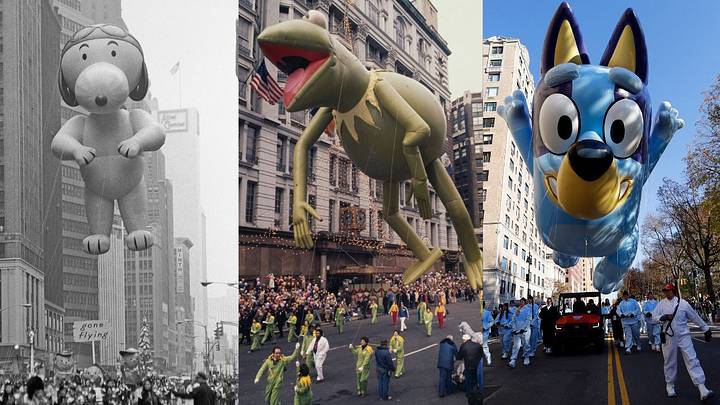
Everyone knows the best part of Thanksgiving is the sides—and the sideshow. For a few hours every November, the main meal makes room for the annual Macy’s Thanksgiving Day Parade, a feast for the eyes featuring colorful character balloons, festive floats, and a whole lot of helium.
Since 1924, the parade has been a revolving door for America’s favorite pop culture icons, from classic Mickey Mouse to Gen Alpha’s beloved Bluey. As silly as the giant Snoopy and Spider-Man shadows over Manhattan’s West Side may seem, it’s this very spectacle that keeps millions glued to their screens every Thanksgiving morning. Here’s a look back at the cartoon characters and blockbuster balloons that shaped the Macy’s Thanksgiving Day Parade over the last century.
1920s: Christmas Parade Premiere
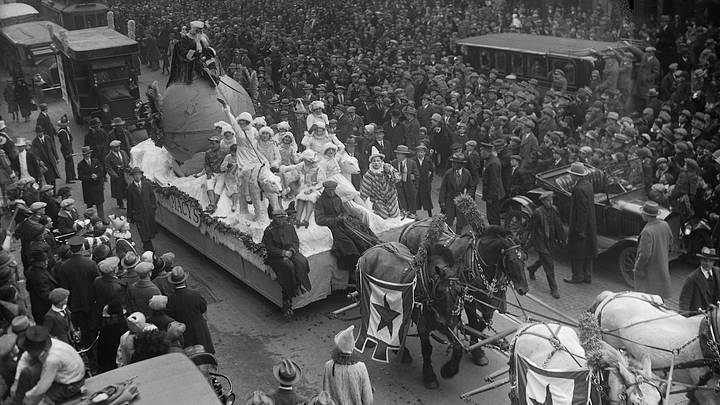
Before we had colossal character inflatables and live television coverage, Manhattan’s biggest holiday celebration was known as the Macy’s Christmas Parade. Launched on November 24, 1924, for a crowd of just 10,000 spectators, the event featured horse-drawn floats like this 1925 Santa Claus carriage and even live animals from the Central Park Zoo to usher in the holiday shopping season.
1930s: Mickey Mouse Takes Manhattan
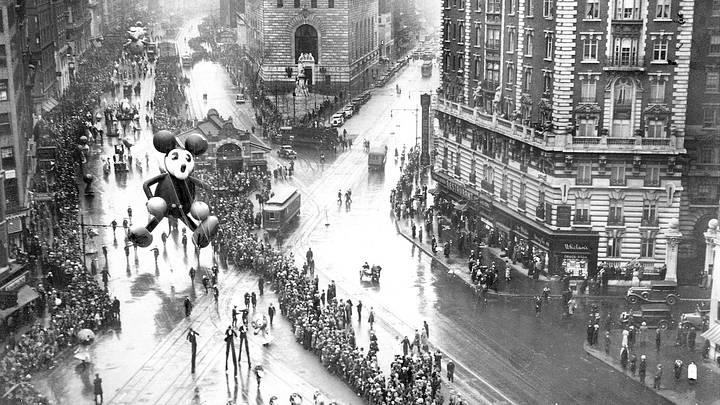
From Disney’s animation studio to the streets of Manhattan, the balloon adaptation of this beloved Disney character was introduced to the parade in 1934. Walt Disney designed the original Mickey Mouse balloon, which saw four more tweaks over the years.
1940s: Post-War Rebirth
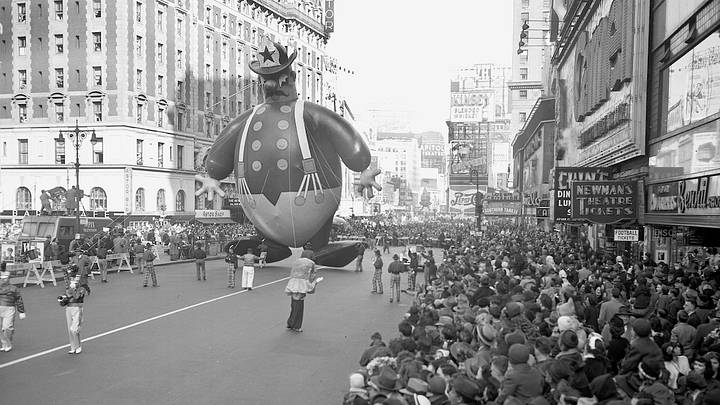
While Macy’s halted the parade from 1942 to 1944 during World War II, all was right by the late 1940s, when oversized helium friends passed by Central Park once again. Quirky figures like Harold the Fireman—a play on Herald Square, where the route famously ran through—became big names thanks to broadcast networks increasingly covering the parade, with CBS putting it on screens nationwide for the first time in 1948.
1950s: The Rise and Fall of Mighty Mouse
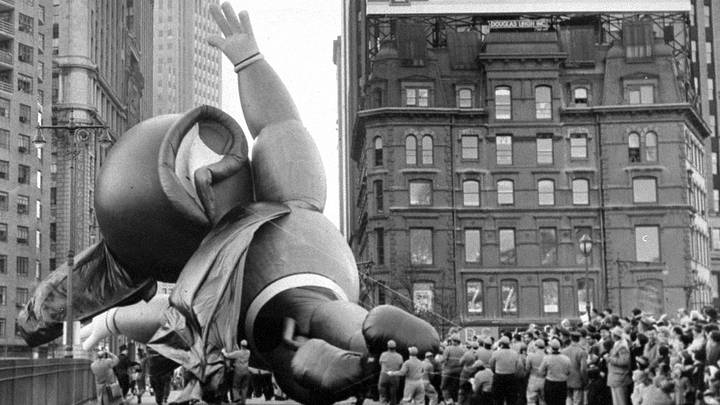
As television turned the parade into a pre-pie living room tradition, live broadcasting brought unscripted drama. During the 1956 parade, the Mighty Mouse balloon tragically collided with a street sign, collapsing and slowly deflating at Columbus Circle in front of millions of viewers at home.
1960s: Snoopy Takes Flight
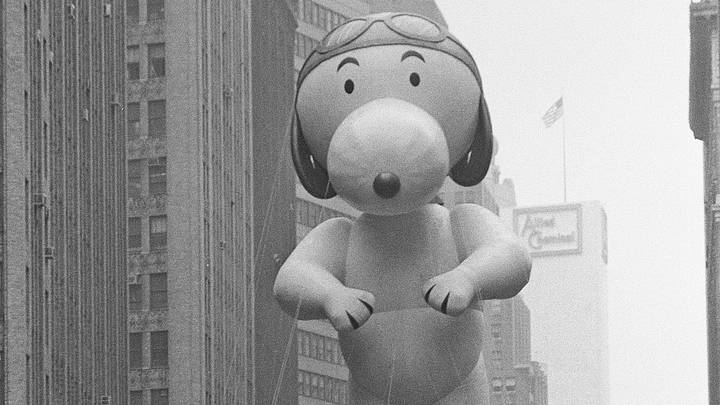
Snoopy first joined the festivities in 1968 as an aviator. Most of the 1970s saw the Peanuts pup as an astronaut, while the ’80s featured an ice-skating Snoopy. Broadcast on NBC, the debut started a half-century run that would eventually make Snoopy the most frequently featured character in parade history.
1970s: Muppetmania Meets Macy’s
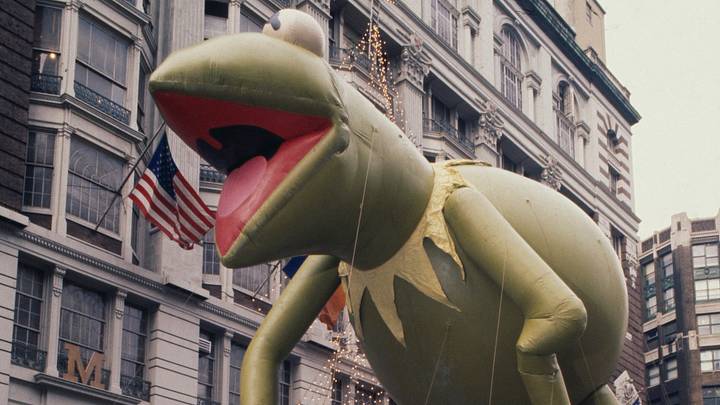
The success of Sesame Street and The Muppet Show led to Muppetmania amidst the Macy’s Thanksgiving Day Parade in the late ’70s. Kermit the Frog debuted in 1977 as the parade’s first major puppet-based balloon, marking the start of an era where Saturday morning TV staples ruled the route.
1980s: Superman on Sixth
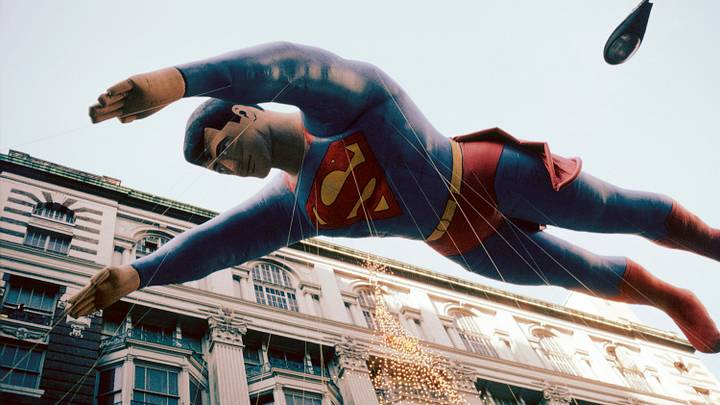
America’s favorite comic books came to life in more ways than one in the ’80s, thanks to the success of Christopher Reeve’s hit films and the return of the new and improved Superman balloon. Measuring 104 feet long and 35 feet wide, the massive character balloon made its mark on the Macy’s Parade as the largest in history at the time. With its detailed, humanoid design, the 1980 “Man of Steel” also served as the final balloon manufactured by Goodyear, before DC’s rival Marvel eventually took over the superhero slot with Spider-Man by 1989.
1990s: A Primetime Parade
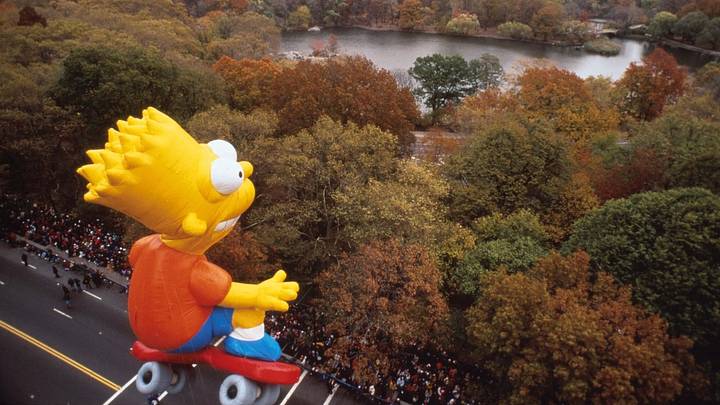
Soaring superheroes made way for skateboarding sitcom stars as quirky cartoons characterized cable TV in the ’90s. The Bart Simpson balloon cruised through the decade for the most part—save for a split seam in 1993. The Cat in the Hat, on the other hand, faced a different fate in 1997, when heavy winds caused the inflatable to strike a lamppost and permanently change how the parade handles safety.
2000s: New Millennium, New Balloons
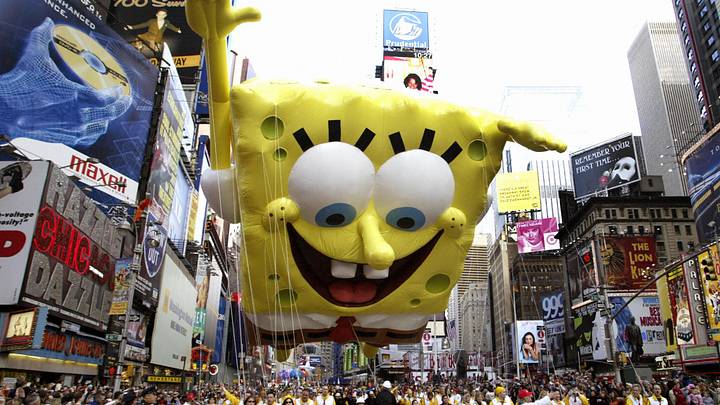
One bright yellow cartoon character led to the next as the new millennium commenced, with the SpongeBob SquarePants balloon floating through Times Square for the first time in 2004. From Pokémon’s Pikachu to the M&M crew, the parade’s Y2K era was a manifestation of modern animation come to life. While far from the first quirky character to fly over Central Park, the SpongeBob balloon was the first square balloon in the history of the Turkey Day spectacle.
2010s: Thanksgiving Goes Global
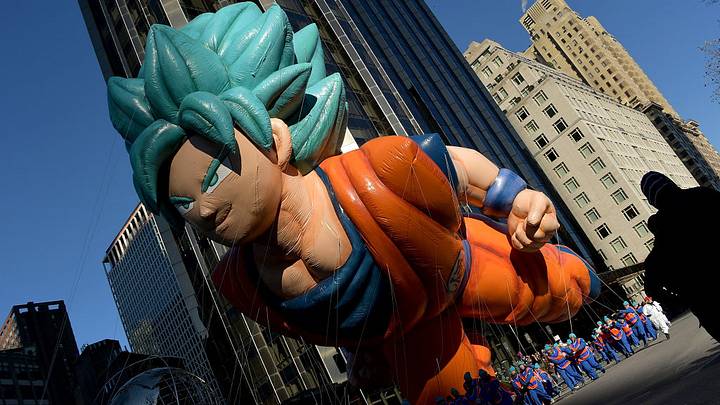
Thanksgiving might have started stateside, but the parade’s pop-culture reach blew up beyond borders by the tail end of the 2010s. In 2018, Goku from Dragon Ball made history as the first Japanese manga character to join the festivities. Casting jagged shadows over the city with his spiky cyan hair, the Saiyan warrior helped introduce Macy’s to a more worldly audience. For the franchise’s 40th anniversary in 2024, the balloon got a makeover complete with Goku’s classic black hair—plus back-up from fellow manga character Monkey D. Luffy’s balloon.
2020s: Streaming Superstars
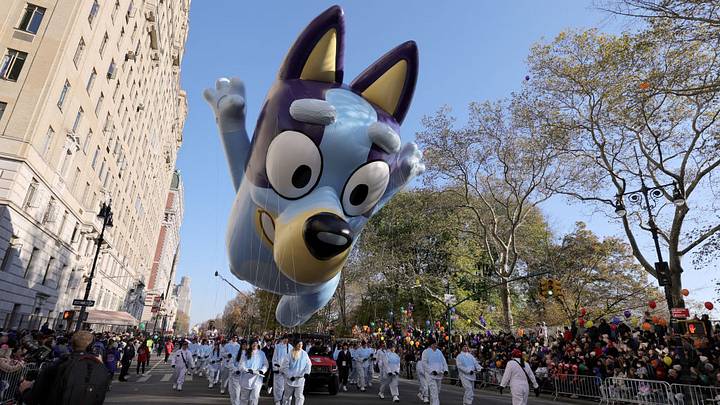
Even a global pandemic couldn’t stop the Macy’s Thanksgiving Day Parade from livening up the streets of Manhattan, with a scaled-down return in 2021 followed by an influx of fresh pop-culture characters in the years following. Featuring blown-up fan favorites like Bluey—the animated Australian pup—and Stuart the Minion, the late-November skies above New York basically doubled for a Roku screen.
Read More:
•
Quiz: Can You Name the ’80s Sitcom From Its Thanksgiving Episode?
•
The Most Popular Holidays in the U.S., Ranked
•
The Defining Macy’s Thanksgiving Day Parade Balloon of Every Decade
•
2026’s Most Popular Thanksgiving Sides By State, Mapped
•
75 Holiday Jokes That Are So Funny, You’ll Want to Share Them With Everyone