ByJake Rossen|Jul 5, 2022, 4:12 PM EDT
 Add us as a preferred source

For as long as Hollywood has existed, studio executives have had to worry about star scandals. From murder to drugs to everything in between, fans have relished gossip about actors and actresses. Often, they were salacious, as in the case of The Maltese Falcon star Mary Astor’s infamous “purple diaries,” which detailed her many adulterous affairs. Or Lana Turner, who found herself embroiled in the death of boyfriend (and gangster) Johnny Stompanato. (Turner’s 14-year-old daughter, Cheryl, had stabbed him following an argument.)
While these lurid tales would be attention-grabbing in any era, not all vintage Hollywood scandals were so shocking. Check out seven controversies that would seem pretty tame today.
1. Maureen O’Hara is caught necking!

The star of Miracle on 34th Street and The Quiet Man had her name dragged through the mud when gossip magazine Confidential ran a story claiming the actress had been seen necking with a man in the audience of Grauman’s Chinese Theatre back in November 1953. The manager purportedly had to throw them out because their heavy petting was too unsavory to allow.
O’Hara was having none of it. Embarrassed by the story, which was contrary to the conservative characters she often portrayed, she decided to take action. She joined forces with the State of California, which had been pursuing Confidential for its often-libelous stories at the behest of other annoyed stars like Liberace, and testified in a lawsuit against the magazine in 1957 and even brought in her sister (a nun) to attest to her character. O’Hara also demonstrated she wasn’t even in the country when the alleged incident was said to have occurred by presenting a passport covering the month in question. A jury declared itself deadlocked and a mistrial was recorded, leaving the ultimate validity of the story an open question. Confidential, however, was effectively neutered. Once it stopped publishing gossip, circulation plummeted.
2. Robert Mitchum does time for the devil’s lettuce!

Thanks to the Reefer Madness propaganda of the early 20th century, marijuana use was perceived to be on par with being a serious drug addict. That stigma led to big trouble for actor Robert Mitchum, best known for hits like Cape Fear and Night of the Hunter. In 1948, Mitchum was working on a joint in a friend’s private home when police arrived and arrested him, home owner Lila Leeds, and several others for drug possession. Cops had apparently been watching both Mitchum and the home, described as a “reefer resort,” for months before springing into action in the hopes of nailing a high-profile narcotics arrest.
This was no light charge. Mitchum received a one-year jail sentence for the infraction, which was knocked down to two months with probation. He served it on a prison farm, making cement blocks and milking cows. Meanwhile, talking heads tried to surmise the latest vice craze to grip Hollywood.
“It peps them up when they’re working under a strain, and it acts as a powerful romantic stimulant,” explained police psychiatrist J. Paul de River. “Now it’s a well-known fact Hollywood people are jaded. They’ve tried everything. The only way they can get any stimulation is to indulge in ‘reefers.’ It’s the only way they have left to get any thrill out of romance.”
Though Mitchum feared the scandal would be the end of his career, audiences seemed to largely forget about it. The actor continued to work up until his death in 1997.
3. Ingrid Bergman dares to have an affair!

Casablanca star Ingrid Bergman caused a tremendous stir in the media in 1950, when she deigned to leave her husband and carry on with Italian director Roberto Rossellini.
The vitriol Bergman received as a result of her choice was intense. Movie theaters refused to screen her films; talk shows avoided booking her. Unbelievably, Bergman was even condemned on the floor of the U.S. Senate, which was considering mandating federal licenses for actors and directors. The histrionic Senator Edwin Jackson (Colorado) hissed that “[Bergman] is one of the most powerful women on earth—I regret to say a powerful influence for evil … Out of the ashes of Ingrid Bergman will grow a better Hollywood.”
Bergman was also sent a tsunami of telegrams and other correspondence from (former) fans, some of whom labeled her a “dirty prostitute.” Others threatened her life.
Bergman was finally able to return to Hollywood in 1959, when much of the controversy had cooled. Twenty-two years later, she was offered a formal Congressional apology. Her marriage to Rossellini lasted from 1950 to 1957. One of her children with Rossellini is actress Isabella Rossellini.
4. Veronica Lake’s hairstyle might cost us the war!

Few actresses did more to influence mid-century fashion than Veronica Lake, the sultry star who favored a hairstyle that fell over one eye. It started as an accident—the hair had simply fallen into her face during a screen test—but became a trademark for the actress.
Because so many women admired Lake, they adopted the same style. That became a problem when women entered the workforce in increasing numbers during World War II. The look, which resulted in partially obscured vision, was thought to be hazardous in factory jobs, where heavy machinery could cause real physical injury. Reports circulated of airplane factory workers getting “scalped” as a result of their ‘dos.
This led to the dreaded interoffice memo, this one penned by Mary Brewster White of the War Manpower Commission. “The working gal’s indifference to the dangers of long flowing hairdos has driven personnel directors to the last stages of profanity,” she wrote. “Veronica Lake has had a tremendous influence because of her unfettered mane upon too large a percentage of ladies engaged in turning out the ammunition.”
The government went to Paramount Pictures in the hopes Lake might be receptive to changing her hairstyle. She did, and even appeared in a short film promoting a new look.
Lake always had a good reason for persisting with the natural veil, however. She once noted that when she wore her hair up or back, she became far less recognizable while out in public.
5. Lee Tracy urinates on the Mexican army!

While shooting a 1934 film about Pancho Villa titled Viva Villa! in Mexico, Gone With the Wind producer David O. Selznick and MGM had to contend with a rogue actor named Lee Tracy. Tracy, the second lead in the film, apparently had a bit too much to drink one night. Driven awake by a military parade just outside of his hotel room, an inebriated Tracy stumbled to the window and began yelling—and by some accounts, urinating—toward the assembled cadets below.
The resulting international incident had a radical impact on both Tracy and Viva Villa! The Mexican government sought him out for arrest, but Tracy managed to return to America. MGM issued a formal apology, and swore that all the footage Tracy had shot would be scrubbed from the movie. (He was replaced by actor Stuart Erwin.) The studio also cancelled his five-year deal, of which three years remained.
6. Tyrone Power was a drunken Santa!

According to actor David Niven, matinee idol Tyrone Power once caused a small but distressing scandal when he agreed to dress and perform as Santa Claus for a holiday party at Niven’s house. Nervous about performing for a group of tiny tots, Niven showed up drunk and got progressively drunker even as kids—including a young Candice Bergen—sat on his lap. Niven also said at least one child complained about Santa’s pungent breath.
7. Mae West goes to prison for a Broadway sex show!

Mae West is one of the silver screen’s most iconic figures, dominating headlines and marquees in the 1930s. But the genesis of her career was submerged in scandal. West first gained notoriety in 1927, when she wrote and starred in a play titled Sex on Broadway.
In the play, West portrayed Margy LaMont, a sex worker looking to find a new line of work. The problem is that most people in LaMont’s orbit can only see her for her sexual appeal. Progressive for its time, Sex was considered indecent—despite the fact that it featured no nudity or sex. At the conclusion of one performance, West went backstage and was met by the New York Police Department’s Vice Squad.
West was hit with a 10-day jail sentence for obscenity, though she was let out after eight days thanks to good behavior. She later said the publicity helped jump-start her Hollywood career, one in which she was, for a time, the highest-paid star in the world. Her movie career also turned out to be area in which she was able to exert a level of creative control similar to what she had experienced on the stage: Of the 13 films she starred in, West wrote nine of them.
Related Tags
Quiz: Can You Name the ’90s Horror Movie From Its Final Girl?
Put that ‘90s movie knowledge to the test this Halloween.
ByAlexandria Ingham|Oct 27, 2026, 7:00 PM EDT
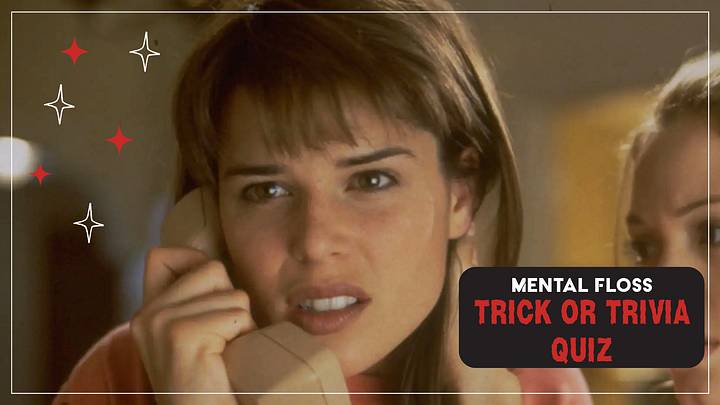
You know the villains, but can you remember the last survivors? The Final Girl is one of the most iconic tropes from horror movies, and the ‘90s had some of the best. Let’s see if you can match the Final Girl to the horror movie.
How did you do? If you got all eight right, we’re impressed, and you’re definitely a horror movie buff. If you didn’t, well, it’s the perfect excuse to have a horror movie binge-watch for Halloween!
More Halloween Quizzes:
•
Quiz: Can You Name the ’90s Horror Movie From Its Final Girl?
•
Quiz: Can You Match the Monster Movie to the Famous Quote?
•
Quiz: Can You Match These TV Witches to Their Shows Without Getting Hexed?
•
Quiz: How Many Classic Horror Movies Can You Identify From Their Monsters?
•
Quiz: Can You Finish These Spine-Chilling Literary Titles?
Most Iconic Final Girls of the ‘90s
The 1990s was a transformative decade when it came to horror. After decades of watching the women scream and make silly choices, the women of the ‘90s became more self-aware. In fact, they were able to poke fun at their earlier counterparts, even when they were forced into making the same mistakes. The evolution of the Final Girl delivered fierce and proactive heroines we could root for.
Sidney Prescott is one of the most memorable. Neve Campbell brought this teenager to life in Scream, kicking off a new style of slasher movies. It wasn’t afraid to poke fun at its own genre, while bringing a leading woman who was layered with trauma and heartache. Even when Sidney was forced to run up the stairs instead of out the front door, she continued to make quick decisions and made it clear she deserved to survive.
While Gale Weathers was technically a co-Final Girl, it was Sidney we rooted for the most.
Just a year later, Jennifer Love Hewitt became the Final Girl, Julie James, in I Know What You Did Last Summer. Her character had one of the most iconic pop-culture moments, as she looked at the sky and screamed, “What are you waiting for?” and she didn’t let us down when she returned for the sequels. It would have been great to see her survive with Helen Shivers, but unlike Scream, there can usually only be one Final Girl.https://www.youtube.com/embed/IE1ZeXC4vtg?feature=oembed
Before the teens, there was one Final Girl of the ‘90s who will always stand out as the queen. It’s all about Jodie Foster’s Clarice Starling in The Silence of the Lambs. The FBI trainee proved that women could remain grounded and quick-thinking, even when faced with the horror of a killer coming after her. It’s rare that a horror movie lands any Academy Award nominations, let alone wins, but Foster proved it’s possible.
If you love to test your movie knowledge, check out the Mental Floss quiz page daily for more trivia challenges.
The countdown to Halloween is on, and we’re challenging our readers here at Mental Floss with our Trick or Trivia quiz giveaway. For 13 nights between October 19-31, we’re putting your knowledge of all things spooky to the test. Think you know Halloween? Take at least one quiz and enter to be in the running to win a $200 Barnes & Noble gift card.