
ByAngela Tung|Feb 4, 2022, 12:00 PM EST
 Add us as a preferred source
While it’s easy to understand how the characters in The Breakfast Club felt—isolated, pressured, “demented and sad, but social“—sometimes it wasn’t so easy to understand what they were saying. So here are eight slang terms from the film, explained.
1. Breakfast Club
There is no breakfast and the detention lasts all day. So why is the movie called The Breakfast Club? According to AMC Story Notes, writer and director John Hughes “got the title from a friend’s son, who called morning detention at his school ‘The Breakfast Club.’” Hughes promptly changed the name of the film from a less-appealing Detention. He could have also been influenced by Don McNeill’s Breakfast Club, a radio show that originated in Illinois and ran from 1933 to 1968. Hughes and his family moved to Northbrook, Illinois, in 1962, when Hughes was 12.
2. Burner
“Only burners like you get high,” Claire tells Bender, mere hours before she gets high herself.
A burner is a drug user and might be short for burnout, which is from the early 1970s. Other drug slang terms include druggie from the late 1960s; pusher from mid-1930s prison slang; and primo, as in primo or excellent drugs, from the 1990s. Nowadays the word burner might be more commonly used to refer to a throwaway cell phone.
3. “So, Ahab … kybo mein doobage”
This famous line said by Bender to Brian has certainly confounded many a movie viewer. While doobage is clearly a variant of doobie, slang for marijuana, and mein is German for “my,” Ahab and kybo are less clear. Ahab could refer to Captain Ahab from Moby-Dick, or the song “Ahab the Arab,” although neither seems to have any connection to Brian or Bender. As for kybo, it could refer to the Boy Scout term for an outhouse, in which case it stands for keep your bowels in order or keep your bowels open. Perhaps Bender is playing off this and telling Brian to keep his bowels off the marijuana since the drugs are down Brian’s pants.
4. Eat My Shorts
While this euphemism for “eat my s***” may seem quintessential Bart Simpson, it’s uttered by Bender in The Breakfast Club two years before The Simpsons makes its premiere on The Tracey Ullman Show. Even earlier is a 1984 song called “Eat My Shorts” by comedian and radio personality Rick Dees.
5. Neo-Maxi-Zoom-Dweebie
Essentially, a really big dweeb. “Face it,” Bender says to Brian. “You’re a neo-maxi-zoom-dweebie.” The term was apparently ad-libbed by Judd Nelson.
It’s unclear how old the word dweeb is. Some sources say it’s from the late 1960s, while the Oxford English Dictionary cites 1982 as the earliest mention. But it’s agreed that the word might be influenced by dwarf and feeb, someone who’s feeble.
Neo-maxi might be a play on neo-Nazi, at least in terms of sound, with maxi implying something huge. As for zoom, your guess is as good as ours.
6. Nothing To Do When You’re Locked in a Vacancy
Vacancy here could mean the empty space of the library, the seemingly endless span of time of all-day detention, or Bender’s own mind as he tears out pages from a book of Molière. It’s most likely Bender’s head since Andrew replies, “Speak for yourself.” The line is also the name of an early 2000s song by punk band None More Black.
7. Riding the Hobby Horse
Bender accuses Brian of claiming he and Claire are riding the hobby horse, or having sex. Hobby horse also refers to the Irish hobby, an extinct horse breed; a toy consisting of a horse head on a stick; a favorite pastime (now shortened to hobby); a favorite topic; as well as a lustful person or loose woman.
8. Wastoid
Another term for someone who uses drugs, wastoid seems to have been coined in The Breakfast Club, or at least makes its earliest appearance there. The word is a combination of wasted, meaning drunk or intoxicated, and -oid, “like, like that of.” This suffix can be found in words like android and humanoid, which are automatons that have human-like qualities but are not actually human, or factoid—something that’s presented as a fact but isn’t, which is often mistaken to mean a small fact or piece of trivia.
A version of this story ran in 2014; it has been updated for 2022.
8 Old West Slang Words That Deserve a Cowboy Comeback
These frontier expressions are fixin’ to ride their way back into your vocabulary!
ByLogan DeLoye|Oct 30, 2026, 4:00 PM EDT
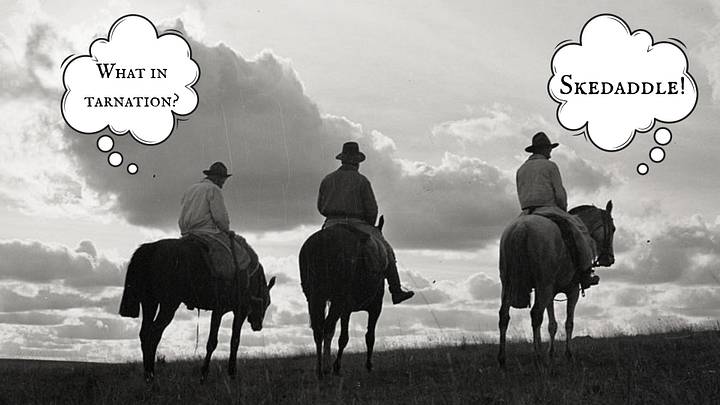
The American frontier, specifically the cattle drive era, inspired a slew of cowboy slang that captured the rugged, untamed, and unpredictable nature of life in the Old West.
Putting on boots and a hat didn’t make you a cowboy in the mid-to-late 1800s. During the heyday of the open range, real cowboys were ranch hands: herding cattle, tending horses, and fixing whatever needed repairing. According to History Hit, many lived in frontier towns and spent their free time at rowdy saloons, contributing to the nightly ruckus.
During the Civil War, cattle “bred excessively” across Texas. When the soldiers returned, someone had to drive the booming herds north, and so the western legend of the cowboy was born (and forever glamorized in pop culture).
In 2026, it’s fashionable to slip on Tecovas and a Stetson without considering their original purpose. But in the late 1800s, every bit of cowboy gear served a purpose. Boots were pointed-toed so cowboys could “easily slip in and out of stirrups” because getting stuck could mean being dragged to death. Wide-brimmed hats protected their eyes from the bright sun, and a folded crown could be a pillow in a pinch. Bandanas tied over their faces kept dust away during tiresome days on the trail.
Along with gear, the era brought a cowboy collection of slang words, some still used today, mostly on ranches and in the South and West regions. Though these words live on, they’re not nearly as common as they used to be.
So, saddle up and get ready to reintroduce eight Old West slang words into your vocabulary for a proper cowboy comeback, according to C Lazy U Ranch’s cowboy slang guide.
OLD WEST SLANG WORDS THAT DESERVE A COMEBACK AND A ‘YEE-HAW!’
TARNATION
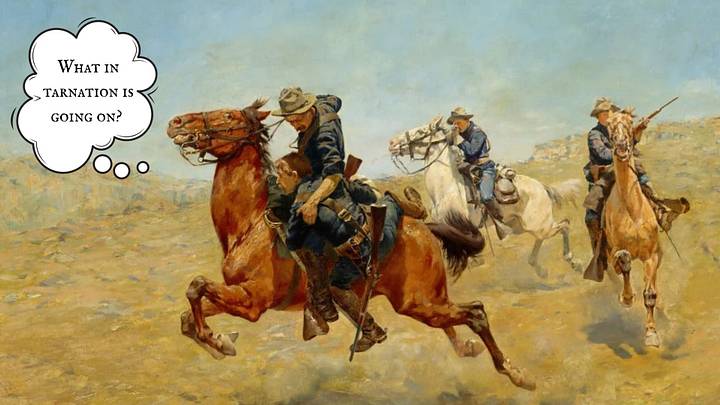
What it means: An expression of “surprise or frustration.” Similar to “what the heck?”
In a sentence: What in tarnation is going on here?
ACE-HIGH
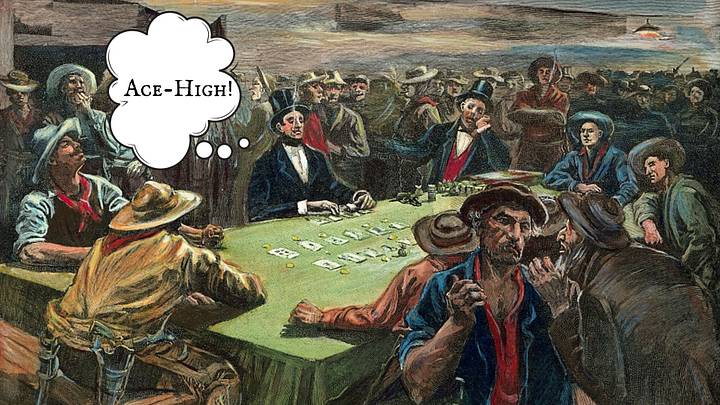
What it means: Something “luxurious or respectable.” Similar to the poker terminology for a valuable “ace-high hand.”
In a sentence: This hotel is ace-high with its espresso machine, giant flat-screen TV, and balcony views.
SKEDADDLE
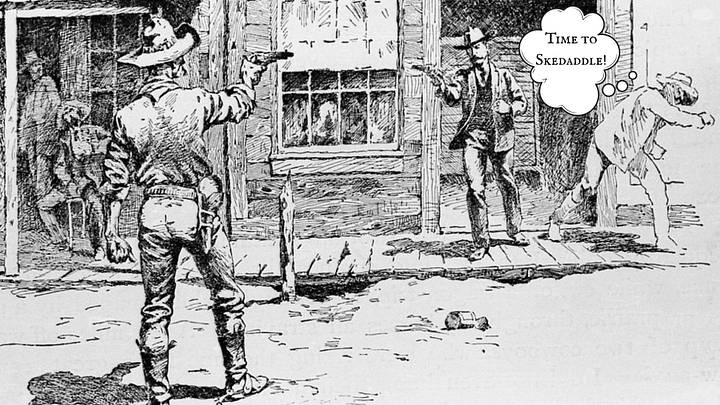
What it means: To exit hastily “or run away.”
In a sentence: Let’s skedaddle before this storm gets worse!
SIDEWINDER
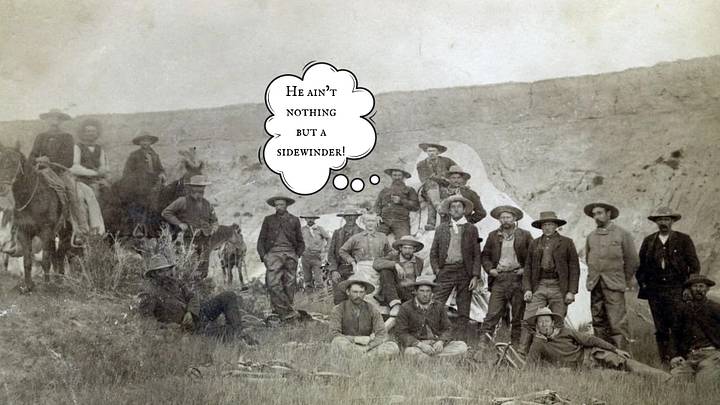
What it means: A sly “untrustworthy person.” Similar to the Sidewinder snake and its “deceptive movement pattern.”
In a sentence: He’s a sidewinder; I wouldn’t trust him.
BELLYACHING
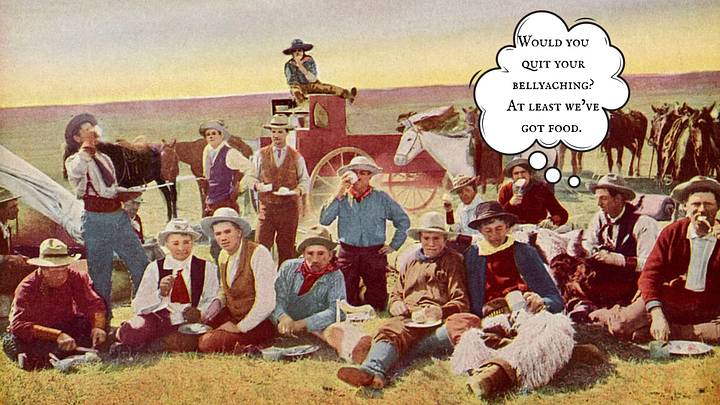
What it means: Continuous complaining or “whining about something.”
In a sentence: Stop bellyaching; we’ve still got 20 miles to go!
HOWDY
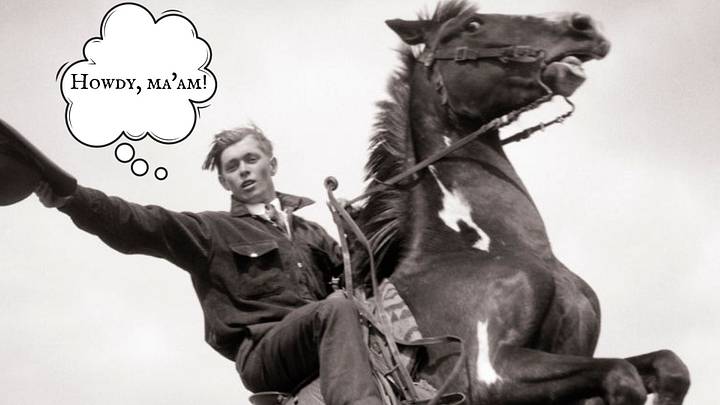
What it means: Cowboy shorthand for “How do you do?” “Hi, how are you?” It can also replace “Good morning!” depending on the time of day.
In a sentence: Howdy, partner!
YEE-HAW
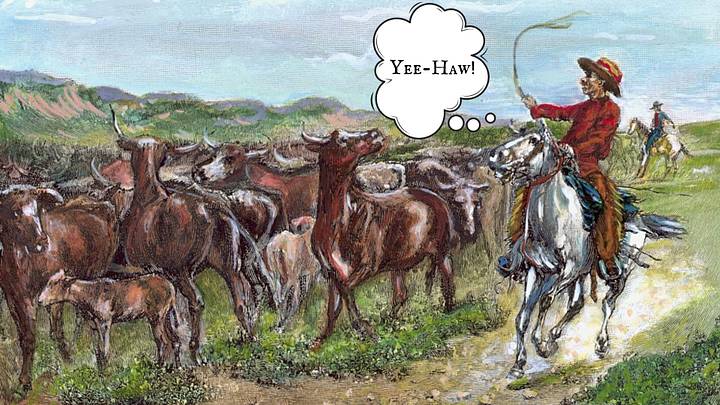
What it means: An expression of excitement and “the ultimate expression of Western enthusiasm.”
In a sentence: She jumped on the horse, put her feet in the stirrups, and yelled “yee-haw” as she rode into the sunset.
ABOVE BOARD
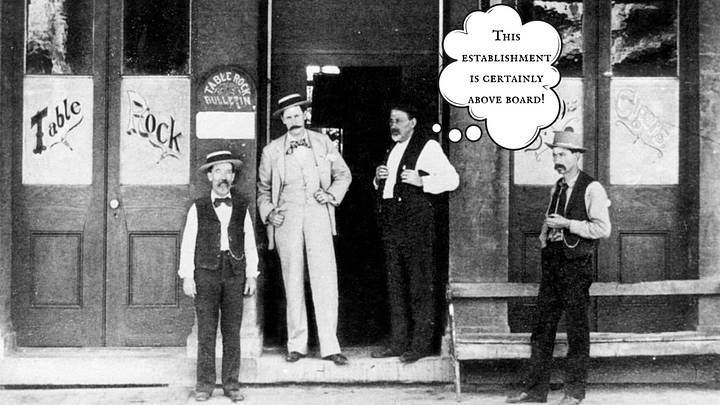
What it means: Someone or something you can trust. “Something honest, legitimate.” Another phrase that comes from a card game. Keeping your cards on the table (above the board) meant you were not cheating.
In a sentence: The hiring process was entirely above board, and when the employees were hired, they already felt like part of the team.
Read More:
•
5 Cowboy Towns in America That Still Feel Like the Wild West
•
41 Cowboy Slang Terms for Things You Eat and Drink
•
7 Strange Tales From the Wild West
Where Did the Phrase “See You Later, Alligator” Come From?
Bill Haley made the phrase famous in 1956, but its true roots trace back much further.
ByPaul Anthony Jones|Oct 31, 2026, 12:00 PM EDT
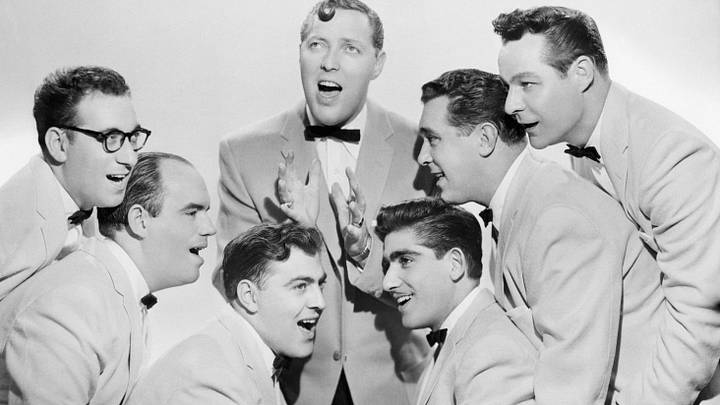
In 1955, rock and roll legends Bill Haley and His Comets recorded a 12-bar blues standard, written and first recorded earlier that year by Louisiana singer-songwriter Bobby Charles, called See You Later, Alligator.
Haley’s track was released early the following year, and although it didn’t hit the top of the charts, See You Later, Alligator nonetheless proved successful enough to become his third and final million-selling record in the U.S. Its popularity was later cemented by Haley performing the song in his 1956 big-screen musical Rock Around the Clock (filmed to cash in on the success of his earlier 1954 hit) that likewise became a global phenomenon—not least thanks to reports of unruly teenagers dancing in cinema aisles and causing riots wherever it was shown.
Before the Beat Dropped
Given both the song and the tie-in movie’s success, it might be tempting to presume that it is responsible for “see you later, alligator” becoming a snappy, slangy way of saying goodbye to someone—and some etymological sources might even claim precisely that. But in fact, the opposite is true: Haley’s song merely helped to circulate and further popularize a phrase that had already long been in use by the time his record was released.
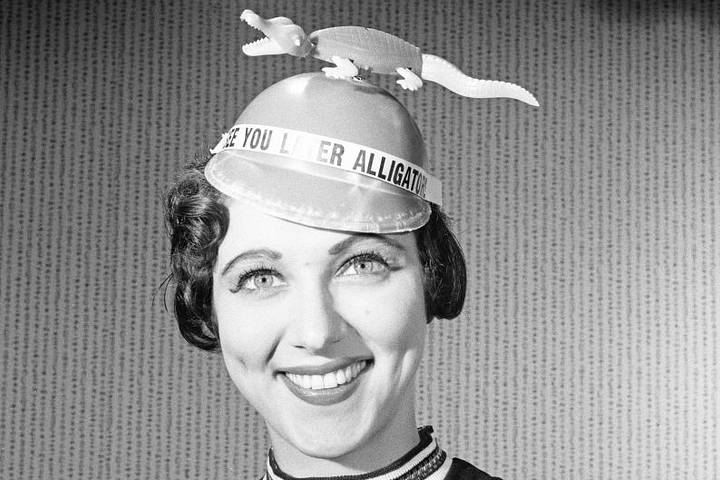
The Oxford English Dictionary‘s earliest record of this phrase dates from just a year before Haley and Charles’ song, when “see you later, alligator” was explained as “meaning goodbye” in a guide to contemporary slang that appeared in a Nevada newspaper article. The linguist and etymologist Pascal Tréguer has since unearthed an earlier record, from a newspaper in Hawaii in 1952, which likewise listed “see you later, alligator” as an example of “the everyday ‘slang’ many high school students use.” But earlier still, the same phrase was used in an article in the Lincoln Heights Bulletin from Los Angeles, California, way back in December 1945:
JINGLE BELLS!! JINGLE BELLS!! Christmas is just around the corner … There are just two weeks shopping time till Xmas Day … so don’t forget all those luscious presents you are buying for the family and friends. See you later alligators!!
Rhyming Slang Roots
Tellingly, this article doesn’t feel the need to explain the phrase’s meaning, but simply uses it as a jokey sign-off. That suggests that way back in the mid 1940s “see you later, alligator” was already a familiar enough way of saying goodbye. So if it doesn’t come from Haley’s song, and it was already in established use a decade earlier, where did it come from? Well, until any further earlier evidence comes to light, the most likely theory here is that “see you later, alligator” is a hangover from a 19th and early 20th century fad for so-called rhyming slang.
Thought to have emerged in London in the mid 1800s, rhyming slang was a faddish way of talking in which commonly used words were replaced with snappy rhyming equivalents. Stairs, for instance, became “apples and pears.” A wife was a husband’s “trouble and strife.” To believe something was to “Adam and Eve” it. Later, during Britain’s transportation era, when convicts were routinely shipped from the UK to see out their sentences elsewhere, rhyming slang spread to Australia too and quickly caught on there. And as any Brit or Aussie will doubtless tell you, many of these phrases are still well known (if not perhaps quite so well used) as they were almost two centuries ago.
In the 20th century, however, a wave of postwar Australian immigration appears to have brought this technique to the western United States. “See you later, alligator” was presumably either imported from Australia or, as is more likely, coined in the U.S. around this time. Rhyming slang itself doesn’t seem to have caught on for long in America, yet it was a fad just long enough—especially among students or teenagers—for a handful of these phrases to fall into use. So, as well as “See you later, alligator,” and its stock reply “In a while, crocodile,” you might once have heard the likes of “Do you know what I mean, jellybean?,” “Don’t get tough, powder puff,” and “What’s buzzin’, cousin?”
Not all of these have stood the test of time, but “see you later, alligator” did. And it’s likely the success of Haley’s record and the movie in which it appeared that helped to reinforce its use and the popularity it has had ever since.
Read More:
•
Where Did the Phrase “See You Later, Alligator” Come From?
•
8 Old West Slang Words That Deserve a Cowboy Comeback
•
8 Expressions Our Grandparents Used That Are Disappearing
•
6 Slang Words From the 1950s We Still Use Today
•
The Top 10 Baby Names of 2026, From Olivia to Dean
Did Ernest Hemingway Really Say “Write Drunk, Edit Sober”? Uncorking the Truth
Papa loved his rum, but his writing routine was strictly dry. Here’s the real, surprisingly sober story behind the famous quote.
ByNitya Rao|Jul 20, 2026, 2:57 PM EDT

Casual penman or professional wordsmith, just about everyone has heard the wacky piece of writing advice, “write drunk, edit sober.” Widely believed to be a way of life for American writer Ernest Hemingway, this famous phrase has served as a green light for wetting your whistle before the ink dries on the page for decades.
The idea is intuitive—loosen your inhibitions to let the words flow, then clean it up once the spins stop. But the backstory is anything but, especially regarding who—or even if someone—actually said it in the first place.
Hemingway’s Real-Life Writing Routine
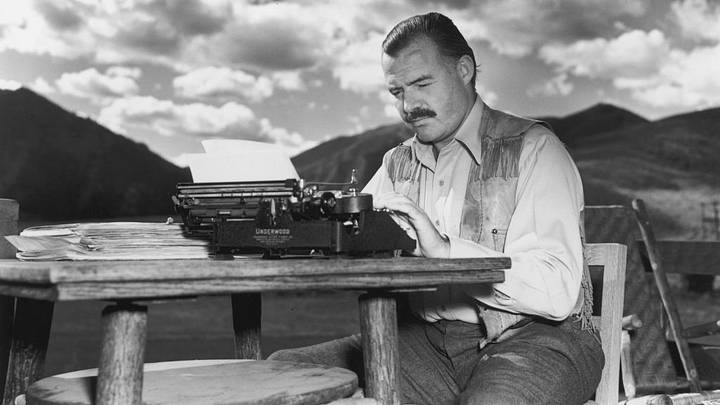
There’s no doubt that Hemingway enjoyed downing a daiquiri or two (or, according to legend, 17 in one sitting). Just as well-known as his works such as The Old Man and the Sea and The Sun Also Rises are his drinking habits, which only got worse after a series of plane and car crashes during his travels. But despite his penchant for adventure and alcohol, Papa was a staunch believer in separating the pen from the pint.
The idea that Hemingway wrote while intoxicated doesn’t hold up to the reality of his actual process. He was undeniably disciplined, waking up before dawn to write while his mind was sharp and, more importantly, sober. He saw writing as a craft that commanded all of his attention, saving his drinking for later on in the day. For Hemingway, a Papa Doble or dry martini was merely a reward once his word count for the morning was met.
His granddaughter, Mariel Hemingway, attests: “He never wrote drunk, he never wrote beyond early, early morning,” she said in an interview. If this is true, then, just how did the edgy quote get attached to his name?
The Faulkner Factor
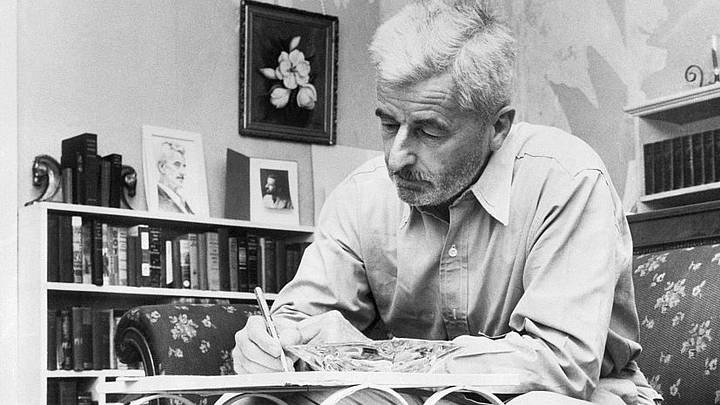
Rivalries didn’t solely reside within Hemingway’s works, but in his real life as well. Throughout his career, the Nobel Prize-winning novelist was pitted against his famous contemporary William Faulkner. The two men critiqued everything about each other, from their contrasting writing styles to their comparable heavy drinking habits.
Not only did Hemingway deny drinking and drafting, but he went so far as to deflect the blame onto his rival. In a Writer’s Digest interview published shortly after his death, Hemingway set the record straight with a sharp retort:
“You’re thinking of Faulkner. He does sometimes—and I can tell right in the middle of a page when he’s had his first one.”
Peter De Vries’ Part
Whether you’re Team Hemingway or Team Faulkner, there’s still no evidence that “write drunk, edit sober” came from either of them. The phrase’s actual roots are entirely fictional.
The quote traces back to a line of dialogue from the 1964 novel Reuben, Reuben by American author Peter De Vries. In the book, a character casually admits: “Sometimes I write drunk and revise sober, and sometimes I write sober and revise drunk.”
Stripped of its backstory, it’s not hard to see why pop culture pins these four words on the talented, albeit tipsy, literary great.
The second half of the quote lends more context to its true meaning: “But you have to have both elements in creation — the Apollonian and the Dionysian, or spontaneity and restraint, emotion and discipline.” Altogether, it’s less of a suggestion and more of an observation on how multifaceted the creative process can be.
Still, Hemingway would agree to disagree. When it came to his typewriter, he knew better than to mix business with booze. Sometimes, a saying survives not because it’s true, but because it’s simply too good a legend to let go.
Next: Join Mental Floss’s Geography Quiz Competition
More Historical Misconceptions:
•
Did Astronaut Jim Lovell Really Say “Houston, We Have a Problem?” Decoding the Real History
•
Did Marie-Antoinette Shout ”Let Them Eat Cake” During the French Revolution? (The Real Story)
•
5 Popular Quotes Commonly Misattributed to Henry David Thoreau
•