
ByMolly Gregory|Apr 7, 2022, 10:01 AM EDT
 Add us as a preferred source

India pale ales—a.k.a. IPAs—have held an important place in the history of beer manufacturing and distribution since the 18th century. IPAs have helped establish trade monopolies, influenced the way beer is flavored around the globe, and kicked off the modern craft beer movement. Today, the style is one of the most popular in the entire industry—whether you want something bitter and abrasive or sweet and tangy, chances are your local brewery will have an IPA that fits whatever your palate desires. And if you just so happen to want your IPA to be brewed with some of your favorite breakfast cereal, you’ll probably be able to find that, too. So celebrate National Beer Day on April 7, 2022, with nine fun facts about the beer you either love to hate … or hate to love.
1. No one knows who invented the first IPA.
George Hodgson of London’s Bow Brewery is often credited with the invention of the first IPA in 1793, but it’s up for debate whether he actually deserves this title. The common story goes that in order for beers to survive the long sea journey to soldiers in British-controlled India, Hodgson came up with a lighter pale ale with some extra hops and a higher alcohol content, resulting in a fresher taste and less spoilage once it arrived in India’s sweltering climate.
However, according to beer historian Martyn Cornell, pale ales had been around for at least a century before this, and brewers were already adding extra hops to their beer by the 1760s to help them last longer in warmer temperatures. There’s even evidence that less-hopped beer was regularly arriving in India without much of a problem—this includes porters, which were actually the most popular style in the country at the time, according to liquor historian Aaron Goldfarb.
2. The East India Company made IPAs popular.
Although Hodgson wasn’t the first brewer to use hops in a beer recipe, his location and generous credit policy are what likely helped him make his product a huge hit. His Bow Brewery was stationed close to the East India Company’s dock, where the majority of the India trading ships came in and out. He began exporting his beer with the EIC, and to sweeten the deal, he sold his casks on an 18-month credit so they wouldn’t have to pay for it until their ships returned from India. The beer was so popular that Hodgson eventually established a monopoly of sorts, even going so far as to break ties with the East India Company to ship the beer out himself.
3. Early IPAs weren’t overly strong.
Though today’s IPAs are usually among the strongest beer when comes to alcohol content, the first versions of the brew were pretty average. Early IPAs were generally 6.5 percent ABV (alcohol by volume), which was the same or even slightly lower than the typical beer at the time. Today’s IPAs average between 6 percent and 7 percent ABV, although these can rank even higher. Molotov Heavy by Evil Twin Brewing Company, for example, is a whopping 18 percent—even higher than a glass of wine.
4. We have the craft beer movement to thank for contemporary IPAs.
England’s IPA craze dwindled by the early 1900s, and consumers began to turn to new beer styles entering the market. But when the craft beer movement started in the 1970s—sparked in the United States by a 1978 Congressional resolution that legalized home brewing—beer enthusiasts began to turn to old recipes to invent new drinks. Craft brewers began using American-style hops to put their own unique twist on 150-year-old recipes, leading to some of the first American-based IPAs, including Anchor Brewing’s Liberty Ale, Sierra Nevada’s Harvest Ale, and Brooklyn Brewery’s East India Pale Ale, which is based on an early IPA recipe from the 19th century.
5. Double IPAs don’t always mean double the alcohol content.
Double IPAs (otherwise known as Imperial IPAs) are American-style IPAs that use double the hops (or even more) of regular IPAs, balanced with extra malt to create a smooth, darker flavor profile than their single-malt counterparts. Even though these IPAs are higher in alcohol content, it’s not by much—double IPAs usually range between 9 percent and 10 percent ABV.
6. The definition of an IPA has expanded in recent years.
There used to be two main IPA styles: English and American. English IPAs tend to have fewer hops, a smoother, more subtle flavor; and lower ABV. American IPAs, on the other hand, feature hops much more prominently and have a more bitter flavor, rather than an aromatic one. Now, though, you’ll find countless subsets within those styles, including New England, East Coast, West Coast, session, Belgian, and milkshake IPAs. Each of these varieties is characterized by its own unique flavoring, brewing, and hop profile. Milkshake IPAs, for example, may be brewed with lactose, vanilla, and fruit, while a session IPA strips out all the adjunct ingredients and focuses on the classic English style with an ABV of around 3 or 4 percent.
7. IPAs have gotten weird.
Craft brewers have gotten pretty experimental over the years, and a few are more innovative than others. In 2019, Smartmouth Brewing created a Lucky Charms-inspired IPA by using toasted marshmallows and the iconic cereal in the mash, lending a nostalgic, sweet flavor to their brew. San Diego’s Stone Brewing company used a drought to their advantage—and to inspire more eco-friendly brewing—by having recycled wastewater as the base for their Full Circle IPA. And Blue Point Brewing Co’s Bubble Brain IPA is designed to taste like the gumballs you had to coax out of a machine for a quarter as a kid.
8. Even celebrities are getting in on the IPA business.
With 8764 craft breweries in the U.S. as of 2020, it’s no surprise that even the rich and famous are getting in on the brewing craze. Former WWE wrestler “Stone Cold” Steve Austin has his own Broken Skull IPA on the market, in conjunction with El Segundo Brewery, and actor Kelsey Grammer’s Faith American Brewing Company has its own Calico Man IPA. The most no-brainer celebrity beer has to be from the Hanson brothers, who own a brewery that puts out the aptly named Mmmhops pale ale and a peach milkshake IPA called Pink Moonlight.
9. The IPA craze isn’t going away anytime soon.
Although it might seem like there’s bound to be a slowdown eventually, IPA sales are only continuing to gain momentum. In 2020, IPAs accounted for nearly 20 percent of all beer sales on Drizly, the popular online alcohol distributor, as opposed to 16.5 percent the year before. According to the Brewers Association, IPAs are the third-most-popular category of beers, behind only light lagers and American lagers.
This article was originally published in 2021; it has been updated for 2022.
Related Tags
What Was Really on the Menu at the First Thanksgiving?
The first Thanksgiving spread was a flavorful illustration of the realities of survival, local resources, shared cultures, and short-lived alliances.
ByLogan DeLoye|Nov 4, 2026, 2:00 PM EST
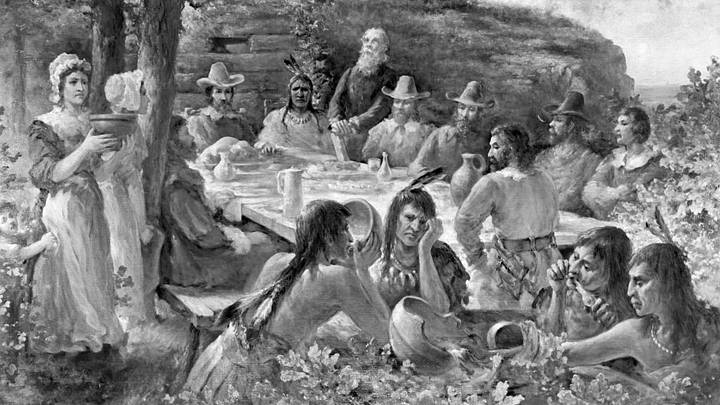
In the fall of 1621, members of the Wampanoag tribe and several English colonists gathered for a feast in Plymouth, then part of the Plymouth Colony in Massachusetts.
Neither Native Americans nor the Pilgrims could have predicted that this one-off meal, celebrating an abundant harvest and a brief alliance, would be printed in history books as the first Thanksgiving. Yet, the occasion was much more historically significant than a spread of food and a side of gratitude.
In 2026, Thanksgiving is a federal holiday: a time to reflect, give thanks, and gather with family over turkey, stuffing, pumpkin pie, and other holiday confections.
But what was the first Thanksgiving really like? And what did they eat?
The First Thanksgiving
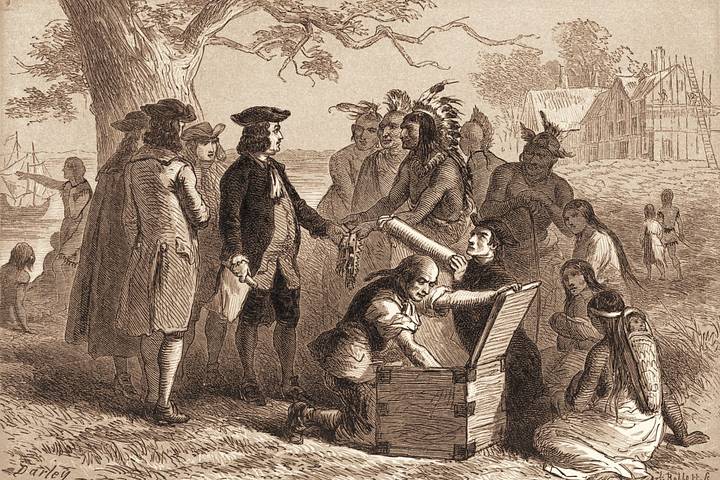
According to the National Archives, the Pilgrims survived the Mayflower’s journey from England and “came ashore on Wampanoag land.” The Wampanoag, having already had contact with Europeans before the Pilgrims arrived (contact that resulted in diseases and the enslavement of some tribe members like Squanto), spoke English by the time of the feast.
To give thanks for a bountiful harvest and their first peace treaty, signed earlier that year (despite hesitation from tribal leaders), both groups sat down for a meal together, made possible by the hunting and planting techniques the Wampanoag shared with the Pilgrims, which greatly alleviated food shortages.
According to historical records cited by Smithsonian Magazine, the feast lasted for three days.
“Many of the Indians coming amongst us, and among the rest their greatest king Massasoit, with some 90 men, whom for three days we entertained and feasted,” English leader Edward Winslow wrote of the occasion.
Although the gathering itself was friendly, the alliance did not last. Just 54 years after the first Thanksgiving, the treaty dissolved, sparking King Philip’s War (led by Massasoit’s son), in which the English defeated the Native Americans. The battle resulted in mass casualties, and the Wampanoag lost their land and freedoms.
Both settlers and Native American tribes held feasts to commemorate significant events, but this Thanksgiving feast did not become an annual tradition. In fact, it all but faded from memory until Abraham Lincoln proclaimed it a national holiday during the Civil War in 1863.
The Menu
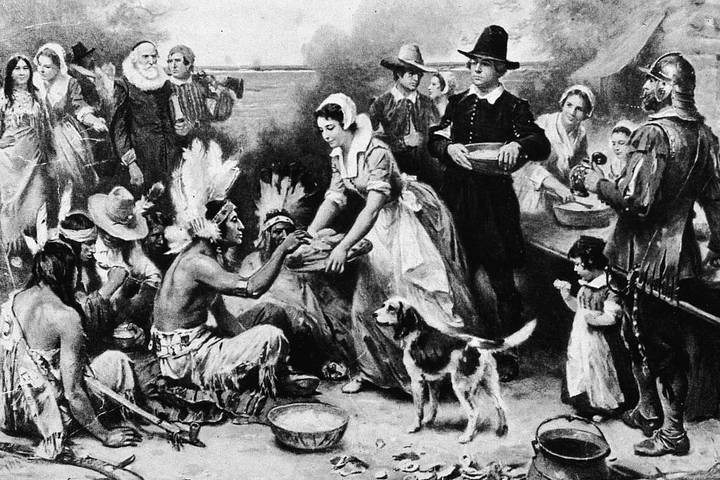
While the treaty and the feast weren’t enough to sustain civility and respect between the groups, the food provided moments of connection and respite, as shared meals do.
Today, our plates (and growling stomachs) are filled with turkey, stuffing, mashed potatoes, green bean casserole, cranberry sauce, dinner rolls, and, of course, pumpkin pie.
In 1621, however, the menu looked very different.
Winslow wrote: “Our governor sent four men on fowling, that so we might after a special manner rejoice together after we had gathered the fruit of our labors. They four in one day killed as much fowl as, with a little help beside, served the company almost a week.”
Based on historical records, Plimoth Patuxet’s Kathleen Walls believes wild fowl (not turkey) was the main course, even though wild turkeys roamed the region. We also know (from Winslow’s account) that Native Americans provided corn and venison.
Swans, pigeons, and waterfowl likely decorated the table during the three-day feast, along with geese and ducks. Other foods probably included cornbread, eels, lobsters, clams, mussels, and fish, thanks to Plymouth’s proximity to the ocean, as well as farmed produce (beans, pumpkins, and squashes) and forest foods like nuts and berries.
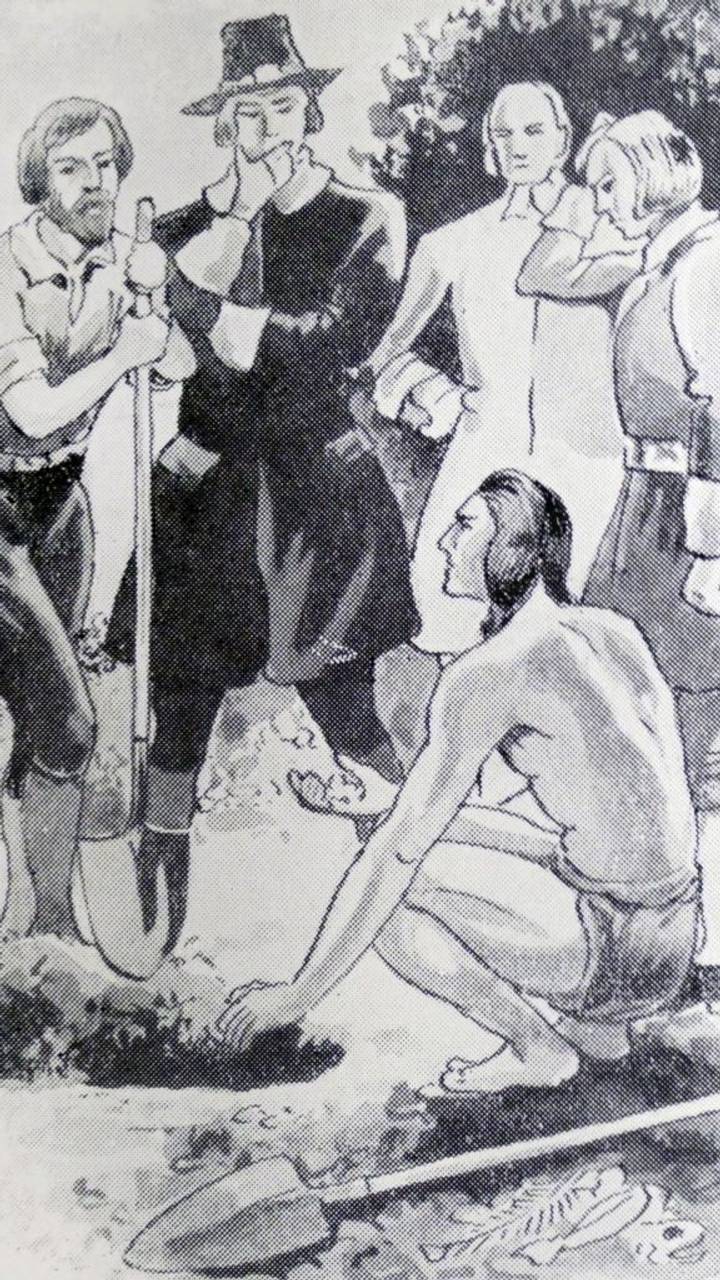
After learning to plant crops from the Wampanoag, the settlers harvested turnips, carrots, and garlic, among other vegetables (which might’ve also been served at the first Thanksgiving).
The Preparation
According to Walls, the Pilgrims had no butter, flour, or sugar, so they did not bake fancy pies or pastries like their relatives in England. They didn’t have potatoes, and they hadn’t learned to boil cranberries for sauce.
Instead, they stuffed birds with “chunks of onion and herbs” before spit-roasting or boiling them, depending on the bird’s size. Some birds were stuffed with shelled chestnuts. Then, the remains were “thrown in a pot and boiled up to make broth the next day,” a recipe called “pottage,” and the fish was smoked.
Read More:
•
20 Thanksgiving Facts to Liven Up Your Meal
•
7 Things to Know About Native American Heritage Month
•
50 November Trivia Questions to Warm Up Your Brain on Chilly Fall Days