The vampire comedy was actor Jim Carrey’s first starring film role.
ByAndrew LaSane|Oct 2, 2024, 9:59 AM EDT
 Add us as a preferred source

The horror comedy Once Bitten (1985), starring Jim Carrey and Lauren Hutton, tells the story of a 400-year-old vampire who feeds on virgins to keep her youthful appearance. Though the film had a decent showing at the box office, it wasn’t a hit with most critics. Let’s take a look back at the cult classic.
- Art served as inspiration.
- The Hollywood seen on screen was completely different than the one in the script.
- The title is a reference to an old idiom.
- Once Bitten was Jim Carrey’s first major film role.
- Writer Jeffrey Hause really wanted Michael J. Fox for the lead.
- Lauren Hutton wasn’t the first choice for the Countess.
- Megan Mullally had a small role.
- The woman walking a lion in Hollywood at night was not in the script.
- They used cold water in the shower scene.
Art served as inspiration.
According to writer Jeffrey Hause, “We decided that the look of our teen sex film was to be inspired by the dark, brooding artwork of Edvard Munch,” the artist behind works like The Scream. Hause, writing on his blog, added, “I wish I was joking about this, but I’m not. … There is still a portrait of Lauren Hutton in the finished film based on the Munch painting … variously titled Madonna or Vampire, painted in 1895.”
The Hollywood seen on screen was completely different than the one in the script.
The writers intended for the film to show a much darker side of Hollywood. The head script reader for Goldwyn wrote in his notes that the project was hilarious, and that “the writers create a Fellini-esque vision of Hollywood that reeks not only of comic atmosphere but somehow captures and hyperbolizes our worst fears about the sleazy parts of town. It is a vision that balances precariously and triumphantly on a razor blade.”
In an email interview with Mental Floss in 2015, Hause shared the original title and direction of the film, and shared his thoughts on how the film turned out: “We had originally called it Nightlife, but Goldwyn didn’t think it sounded like a comedy … our draft really was about L.A. nightlife and trying to be a little creepier in tone.”
“I hope I don’t come off as too mean-spirited or bitter on the website,” Hause said. “I’m grateful and proud that the film was made and feel lucky to have worked with a true comedic genius like Jim Carrey … I just have an idea of what it could have been (teens invading a vampire movie) instead of what it became (vampires invading a teen movie), but other people disagree and their opinions are just as valid as mine—thank God it was made at all!”
The title is a reference to an old idiom.
Blood-sucking films without either Dracula or Vampire in the title often find other ways to reference their mythic subject matter (see 1983’s The Hunger, 1987’s Near Dark, or 2009’s Thirst), but the filmmakers decided to go one step further with Once Bitten. An early version of the expression once bitten, twice shy is found in a 1484 translation of Aesop’s Fables by William Caxton. The translation reads “He that hath ben ones begyled by somme other ought to kepe hym wel fro(m) the same.” Hause told Mental Floss in 2015 that at one point the title had an ellipsis: “At first it was Once Bitten …—dot, dot, dot—which was probably a setup for a sequel, but I guess it didn’t work with the logo they created.”
Once Bitten was Jim Carrey’s first major film role.
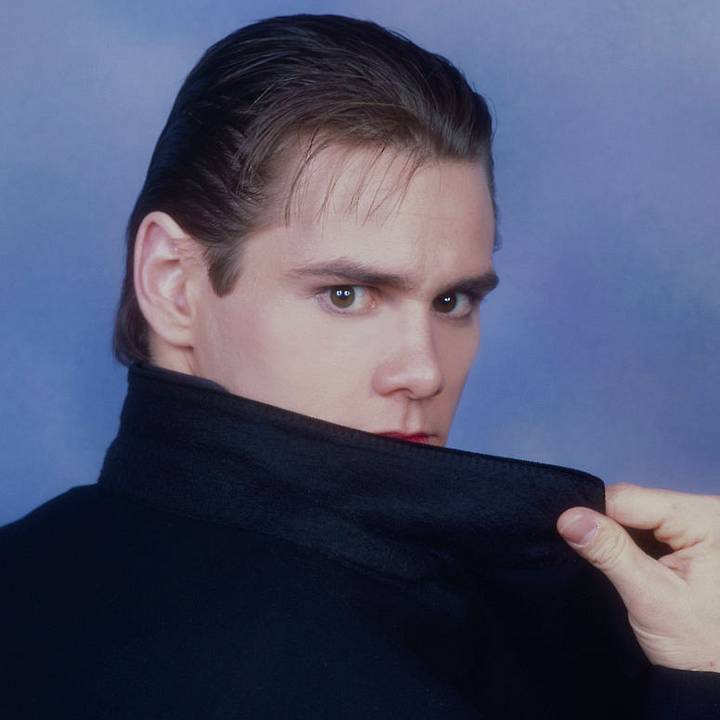
Jim Carrey had appeared in a couple movies as a young comedian, but nothing that would have made him a famous actor. In 1984, he landed a job on a sitcom about a cartoonist at an animation company called The Duck Factory; unfortunately, the series was canceled after one season. That bit of bad news turned out to be a good thing for Carrey, though: It freed him up to audition for the lead role of Mark Kendall in Once Bitten. He had his first on-screen kiss—with model Karen Kopins, who played Robin Pierce—in the movie.
Writer Jeffrey Hause really wanted Michael J. Fox for the lead.
Hause campaigned for Family Ties star Michael J. Fox to be the lead in the film. Sam Goldwyn Jr. of The Samuel Goldwyn Company was not convinced that Fox could carry the movie. Carrey was cast instead, and Hause said that it only took one scene to convince him that the young comedian was right for the part: “We had written a dozen sleazy L.A. bar sight gags into this scene—all cut—but Carrey just had to walk across the bar and look scared: Somehow he made that funny! Every line delivery was fresh and original, and he knew how things looked on camera without having to look through a lens.”
Michael J. Fox didn’t make out so badly; a few months before Once Bitten was released, Fox became a major box office force with both Back to the Future and Teen Wolf.
Lauren Hutton wasn’t the first choice for the Countess.
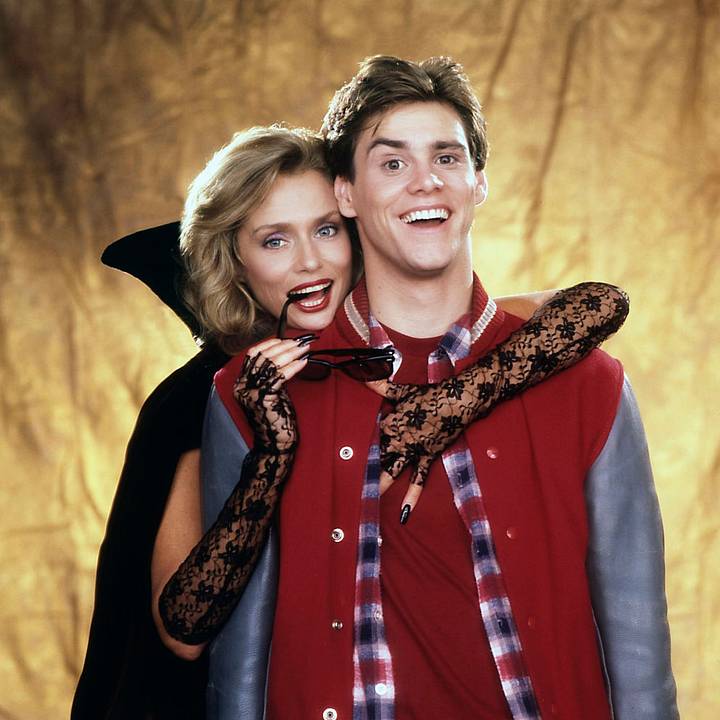
Before the rewrites (and The Samuel Goldwyn Company’s involvement), Hause and his writing partner David Hines wanted Elvira to play the Countess; director Howard Storm, meanwhile, wanted actress Morgan Fairchild for the part. Hutton was eventually cast, and she reportedly took the role against the advice of her agent. Reflecting after the film came out, Hutton said, “What I did wrong with [Once Bitten] was I didn’t stick to my guns. I should have played a vampire of my own invention … I wanted to make a punk vampire. … I wanted her to be in rubber. I wanted her to be every teenage boy’s dirty, horrible, frightening sex dream.”
Megan Mullally had a small role.
After a couple of small TV roles early in her career and a bit part as a call girl in Risky Business (1983), the future Will & Grace star played Suzette in Once Bitten, the girl taking tickets at the school before the infamous dance-off between Mark’s girlfriend, Robin, and the Countess.
The woman walking a lion in Hollywood at night was not in the script.
Hause wrote on his blog that in making the film more commercial and keeping with the times, the studio hired someone to create a montage. “It was a big deal in the 1980s to have video montages in every film. And this film has a terrible one … one thing they added—and don’t ask me why—was the image of a supermodel walking a lion down Rodeo Drive. We had nothing to do with it.”
They used cold water in the shower scene.
In a 1985 interview on The Afternoon Show, Carrey explained that he had no idea that Once Bitten had a shower scene until just before the scene was shot. “This is the fear of I guess every actor, is having to do something in the nude,” Carrey said. “I was totally freaked, the night before, I’m calling up my manager … they told me that they were going to treat it very classy.” Carrey described the scene was “so shocking” due to the fact that they needed to use cold water: “Hot water would steam up the camera lens.”
Read More About Movies:
•
Quiz: Can You Name the Winona Ryder Movie From One Character?
•
20 Movie Stars of the ‘90s Who Disappeared From Hollywood
•
Quiz: Can You Name the ’90s Horror Movie From Its Final Girl?
•
5 Spooky ‘90s Movies That Deserve a Rewatch This Halloween
•
The Spookiest Star Signs, Ranked By Horror Movie Villains
•
Quiz: Can You Match the Monster Movie to the Famous Quote?
•
Quiz: How Many Classic Horror Movies Can You Identify From Their Monsters?
•
The 10 Best Stephen King Movies, Ranked by Rotten Tomatoes
•
Jeff Goldblum’s First Movie Role Was a Far Cry From ‘Jurassic Park’
•
10 Popular Couples Halloween Costumes That Never Go Out of Style
A version of this story ran in 2015; it has been updated for 2024.
Related Tags
Why Do We Put Up Halloween Decorations?
Discover the surprising history of Halloween decorations, from ancient Celtic traditions and carved turnips to the elaborate displays that adorn homes today.
ByEden Gordon|Oct 27, 2026, 2:00 PM EDT
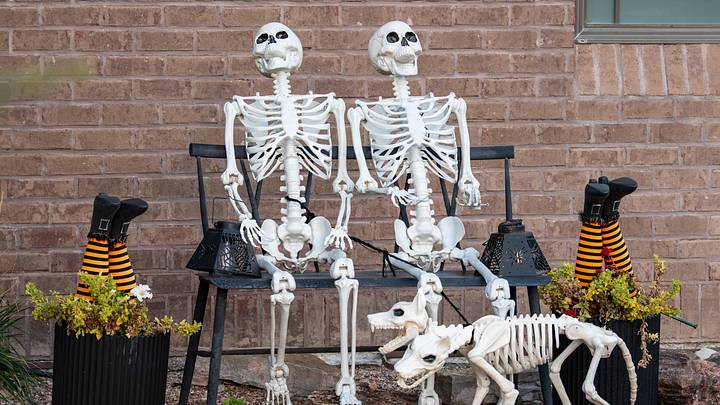
Nowadays, most people associate Halloween with pop-up decorations, pop-culture costumes, and an abundance of candy. But this holiday’s Celtic ancestor was a time of deep reverence and real fear, as many people believed spirits swarmed the earth during this liminal period.
Many of the Halloween staples we know and love today are widely believed to have roots in Celtic traditions—including the practice of putting up spooky decorations. This trend dates back to the ancient practice of carving faces into gourds and squash and displaying them outside homes to keep errant spirits out.
A brief history of Halloween

Most historians trace Halloween’s roots back to the Celtic holiday of Samhain. This festival was one of four major Gaelic holidays, along with Imbolc, Beltane, and Lughnasadh. It was celebrated across present-day Ireland, England, Wales, the Isle of Man, and northern France some 2,000 to 3,000 years ago.
Samhain marked the transition from autumn to winter, and was often honored by sacred communal bonfires lit by Druid priests. Some ancient texts refer to the holiday as a three-day festival during which townspeople were required to appear before their local chieftains.
It was also widely seen as a time when the veil between the world of the living and the dead became thin, allowing ancestors, spirits, monsters, and faeries to cross over and walk among the living. This belief led to the development of many traditions designed to honor the dead and to protect mortals.
In the fifth century CE, as Christianity was in the process of stamping out paganism across Europe, Pope Boniface attempted to turn Samhain into a festival that took place in May and honored saints. Still, autumnal fire celebrations continued to occur. In the eighth century, Pope Gregory III moved the Roman festival of All Saints’ Day to November 1. Later, October 31 became known as All Hallows Eve, and many continued to practice their pagan traditions on that night. Many Irish and Scottish immigrants carried Samhain traditions with them to America in the 19th century, leading to the development of modern-day Halloween.
The roots and surprisingly recent rise of Halloween decorations

The earliest ancestors of our modern Halloween decorations were turnips, gourds, and squash with carved faces, and these were intended to ward off evil spirits during Samhain. In the Middle Ages, turnips were the most popular choice for this task. These were often filled with burning coals and hung from sticks, and were known as jack-o’-lanterns. When immigrants brought these traditions to America, they found pumpkins more common than turnips, so pumpkins became the preferred choice for Halloween carving efforts.
Elaborate, large-scale Halloween decorations as we know them actually didn’t become common until the 1920s and ‘30s. In the decades prior, Americans largely celebrated Halloween with parties and fortune-telling games. In the 1920s, Scottish and Irish immigrants in the U.S. began reviving Old World Halloween traditions of dressing up, visiting homes, and asking for food in exchange for prayers, songs, or other offerings. These visits often became rowdy and prank-heavy, and because of this, communities began setting up organized trick-or-treating systems.
As trick-or-treating for candy became more common in the 1920s, so did Halloween decorations designed to please and entertain young visitors. Their popularity dipped during World War II but exploded as the postwar economy boomed. At this time, decorations were often less scary and more kid-friendly overall, which popularized decorating and helped Halloween become the massive industry that it is today. Many common decorations pay tribute to much older traditions, from ghosts that honor Halloween’s ancient connection to spirits to witches, ghouls, and other creatures from ancient folklore.
Today, people put up Halloween decorations for many reasons. They can offer nostalgic fun, as well as the chance to experience the thrill of a scare without any real danger. They can also connect communities, and sometimes serve as ways to show off wealth and creativity. Decorating for Halloween has also been shown to have some mental health benefits related to the joy it can bring and the benefits of social engagement.
And—if you believe in the old stories—those glowing, singing ghouls and ghosts in front of your home might just also be warding off roving spirits along the way.
Read More:
•
5 Creepiest Baba Yaga Stories From Slavic Folklore
•
Quiz: Can You Match the Monster Movie to the Famous Quote?
•
2026’s Most Spine-Tingling Tourist Destinations for Halloween, Ranked
•
The Spookiest City in Every U.S. State, Mapped
•
10 Halloween Traditions That Don’t Exist Anymore
Quiz: Can You Name the ’90s Horror Movie From Its Final Girl?
Put that ‘90s movie knowledge to the test this Halloween.
ByAlexandria Ingham|Oct 27, 2026, 7:00 PM EDT
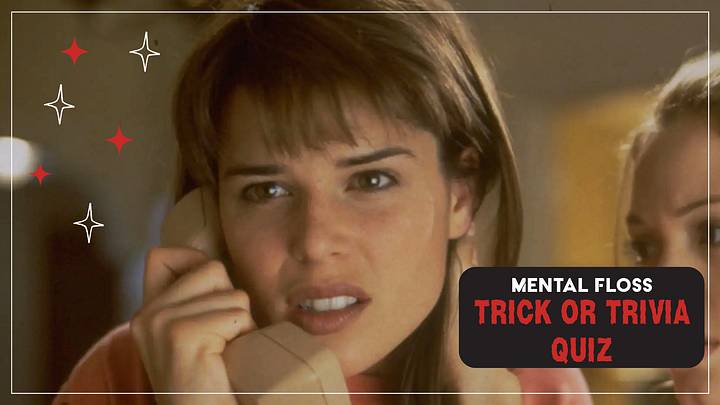
You know the villains, but can you remember the last survivors? The Final Girl is one of the most iconic tropes from horror movies, and the ‘90s had some of the best. Let’s see if you can match the Final Girl to the horror movie.
How did you do? If you got all eight right, we’re impressed, and you’re definitely a horror movie buff. If you didn’t, well, it’s the perfect excuse to have a horror movie binge-watch for Halloween!
More Halloween Quizzes:
•
Quiz: Can You Name the Halloween Costume From These Three Clues?
•
Quiz: Can You Name the ’90s Horror Movie From Its Final Girl?
•
Quiz: Can You Match the Monster Movie to the Famous Quote?
•
Quiz: Can You Match These TV Witches to Their Shows Without Getting Hexed?
•
Quiz: How Many Classic Horror Movies Can You Identify From Their Monsters?
Most Iconic Final Girls of the ‘90s
The 1990s was a transformative decade when it came to horror. After decades of watching the women scream and make silly choices, the women of the ‘90s became more self-aware. In fact, they were able to poke fun at their earlier counterparts, even when they were forced into making the same mistakes. The evolution of the Final Girl delivered fierce and proactive heroines we could root for.
Sidney Prescott is one of the most memorable. Neve Campbell brought this teenager to life in Scream, kicking off a new style of slasher movies. It wasn’t afraid to poke fun at its own genre, while bringing a leading woman who was layered with trauma and heartache. Even when Sidney was forced to run up the stairs instead of out the front door, she continued to make quick decisions and made it clear she deserved to survive.
While Gale Weathers was technically a co-Final Girl, it was Sidney we rooted for the most.
Just a year later, Jennifer Love Hewitt became the Final Girl, Julie James, in I Know What You Did Last Summer. Her character had one of the most iconic pop-culture moments, as she looked at the sky and screamed, “What are you waiting for?” and she didn’t let us down when she returned for the sequels. It would have been great to see her survive with Helen Shivers, but unlike Scream, there can usually only be one Final Girl.https://www.youtube.com/embed/IE1ZeXC4vtg?feature=oembed
Before the teens, there was one Final Girl of the ‘90s who will always stand out as the queen. It’s all about Jodie Foster’s Clarice Starling in The Silence of the Lambs. The FBI trainee proved that women could remain grounded and quick-thinking, even when faced with the horror of a killer coming after her. It’s rare that a horror movie lands any Academy Award nominations, let alone wins, but Foster proved it’s possible.
If you love to test your movie knowledge, check out the Mental Floss quiz page daily for more trivia challenges.
The countdown to Halloween is on, and we’re challenging our readers here at Mental Floss with our Trick or Trivia quiz giveaway. For 13 nights between October 19-31, we’re putting your knowledge of all things spooky to the test. Think you know Halloween? Take at least one quiz and enter to be in the running to win a $200 Barnes & Noble gift card.
More Halloween Reads:
•
What Was Trick-or-Treating Like in the 1950s?
•
What the Night Before Halloween Is Called Across America, Mapped
•
Why Do Werewolves Transform During a Full Moon?
•
Why Do Vampires Sleep in Coffins?
•
Quiz: Can You Name the Halloween Costume From These Three Clues?