Some photographs seem to contain two different eras at once.
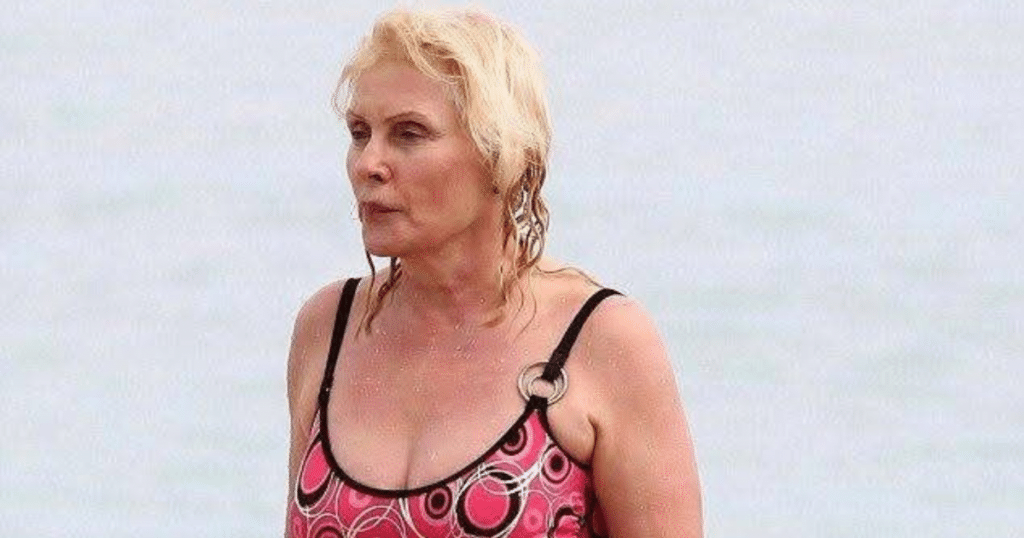
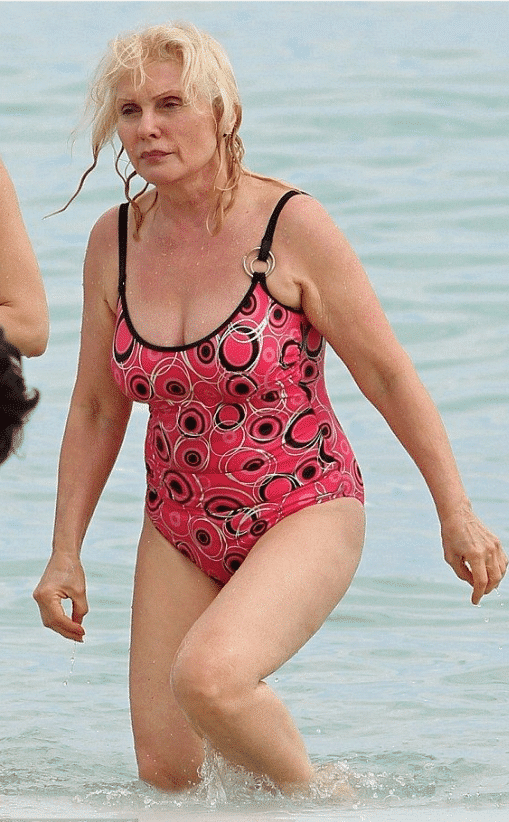
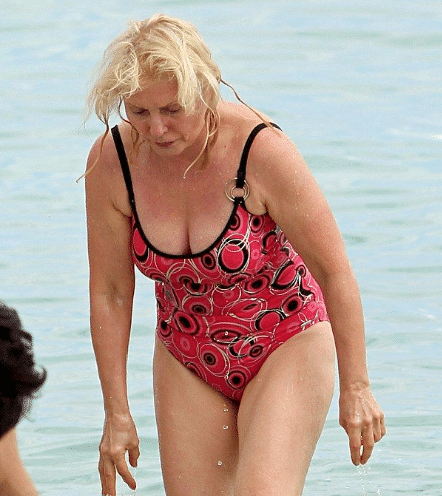
In these archival beach images, Debbie Harry stands in the calm water off Miami Beach wearing a vivid pink one-piece swimsuit patterned with circles and swirling lines.
Her famous blond hair is wet from the ocean rather than arranged beneath concert lights. There is no microphone in her hand, no leather jacket and no crowded New York club behind her.
She is simply taking a swim.
Yet even in such an ordinary setting, there is something immediately recognizable about her presence.
The confidence is still there.
So is the independent spirit that helped transform a former waitress, secretary and downtown performer into one of the most influential women in modern popular music.
The photographs were not taken in 2026, as the recently published source page may lead readers to believe. They were already circulating in February 2014, when Harry was 68 and Blondie was in Miami for a performance at the Fontainebleau.
A Quiet Morning After a Night of Music
Video: DEBBIE HARRY – One of the GREATEST female singers
Blondie performed at the Fontainebleau Miami Beach on February 15, 2014.
Contemporary coverage described the group taking the stage as part of the resort’s BleauLive concert series. Photographs of Harry swimming in the area appeared shortly afterward, identifying her as 68 at the time.
The contrast between the two settings is striking.
Onstage, Harry had spent decades commanding crowded rooms with a cool expression, an unmistakable voice and the confidence of someone who never appeared to be asking permission.
At the beach, the performance disappeared.
Her hair was soaked. The water reached her waist, and the bold geometric swimsuit looked cheerfully suited to the Florida sunshine.
There was no attempt to recreate the carefully styled Debbie Harry remembered from late-1970s magazine covers.
She was living in the age she had reached.
That should not have been surprising.
Yet women who become famous for youthful beauty are often treated as though growing older represents an unexpected change rather than the natural continuation of a life.
When Beach Photographs Belonged to the Family Album
Older readers may remember when vacation pictures were rarely available to strangers.
A camera was packed beside the towels and sunscreen. Someone took a few photographs near the hotel, another beside the water and perhaps one final family picture before the trip ended.
There was no instant preview.
The film had to be developed, and the prints often returned with imperfections. Someone had closed her eyes. A finger covered the edge of the lens, or the ocean tilted dramatically behind the family.
Those pictures were still saved.
They were placed inside albums, tucked into envelopes or mailed to relatives who lived too far away to share the vacation.
No one expected every person at the beach to look like a professional model.
The photographs existed to preserve the day.
Celebrity photography operates differently. A split second can be separated from its original context, recirculated years later and presented as a new revelation.
Debbie Harry’s Miami images deserve a calmer interpretation.
They show an artist enjoying the ocean after a lifetime spent being observed.
The Woman Behind the Famous Blond Hair
Video: Debbie Harry: Behind Blondie’s S*xy “Punk Princess”
Debbie Harry was born Angela Trimble in Miami on July 1, 1945.
She was adopted as an infant and raised by Catherine and Richard Harry in Hawthorne, New Jersey. Long before she returned to Miami as an internationally recognized singer, she grew up within a far quieter suburban world.
Her eventual rise did not follow the standard path of a carefully trained teenage star.
After college, she held a collection of ordinary and unusual jobs. She worked as a secretary, served customers at Max’s Kansas City, performed as a dancer and spent time as a Playboy Bunny.
She also sang with the folk-rock group the Wind in the Willows before becoming involved with New York’s emerging underground music scene.
Those experiences gave her something no record company could manufacture.
By the time fame arrived, she had already lived independently, supported herself and encountered several different versions of New York.
She was not a teenager being instructed how to become interesting.
She had already become interesting on her own.
New York Before It Became a Luxury Backdrop
The New York that shaped Blondie was very different from the polished city often presented in modern advertisements.
During the 1970s, many downtown neighborhoods were economically troubled. Storefronts stood empty, buildings deteriorated and artists found inexpensive spaces in areas that wealthier residents had abandoned.
The conditions were difficult, but the low rents allowed musicians, painters, photographers, filmmakers and writers to live near one another.
Ideas moved quickly through clubs, apartments, studios and late-night restaurants.
Debbie Harry and guitarist Chris Stein formed Blondie in 1974. Drummer Clem Burke and keyboard player Jimmy Destri joined the following year, helping establish the lineup that would become closely associated with the band’s early success.
They played venues including CBGB and Max’s Kansas City, sharing the broader downtown scene with groups such as the Ramones, Talking Heads and Television.
No one yet knew that this relatively small collection of clubs would become one of the most mythologized chapters in American music history.
Blondie Was a Band, Not Just One Woman
Debbie Harry’s appearance attracted enormous attention.
Her bleached hair, striking features and confident clothing gave photographers an image they immediately understood.
That visibility also created confusion.
Many casual listeners assumed “Blondie” was Harry’s stage name rather than the name of the entire group. The band eventually used the phrase “Blondie is a group” to remind audiences that the music depended upon a collective of writers and musicians.
The misunderstanding reveals both the power and burden of a memorable frontwoman.
Harry helped draw attention to the band, but the public’s fascination with her appearance sometimes prevented people from recognizing the musicianship around her—or her own abilities as a songwriter and creative partner.
She was not a decorative figure placed in front of someone else’s music.
She helped shape the words, attitude, melodies and visual world that made Blondie distinctive.
A Band That Refused to Remain in One Category
Blondie emerged from the punk and new-wave environment, but the group never accepted the idea that belonging to one scene required rejecting every other style.
Their music drew upon 1960s girl groups, pop, rock, disco, reggae, electronic music and the growing hip-hop culture of New York.
That flexibility became central to their identity.
The Rock & Roll Hall of Fame describes Blondie as a new-wave vanguard whose experiments with reggae, rap, punk and disco remained anchored in tuneful 1960s pop.
At a time when musical communities could become highly territorial, Blondie treated categories as materials rather than boundaries.
A song could belong in a downtown club and on mainstream radio.
It could contain guitars while encouraging people to dance.
It could sound familiar and futuristic at the same time.
That openness allowed the band to reach listeners far beyond the scene that created it.
The Album That Changed Everything
Blondie’s third studio album, Parallel Lines, arrived in 1978.
Produced by Mike Chapman, it helped transform the group from a downtown favorite into an international success.
The album contained “Hanging on the Telephone,” “One Way or Another,” “Picture This” and the song that changed the scale of Blondie’s career: “Heart of Glass.”
Billboard records “Heart of Glass” as the band’s first No. 1 single on the Hot 100 in 1979.
The track had grown from an earlier song the band had experimented with for years.
Its polished disco rhythm was controversial among some listeners who believed a group associated with punk clubs should not embrace dance music.
Blondie ignored the objection.
The decision proved that musical credibility did not have to depend upon remaining predictable.
When “Heart of Glass” Filled the Dance Floor
For listeners who remember the late 1970s, “Heart of Glass” can bring back an entire atmosphere.
There were mirrored dance floors, colored lights, radios playing from automobile dashboards and record-store windows filled with album covers large enough to function as artwork.
The song sounded sleek and modern.
Harry’s voice appeared cool on the surface, but the lyrics carried disappointment and vulnerability underneath.
That combination became one of her defining qualities.
She could sound detached without becoming emotionless.
The distance in her voice invited listeners to move closer.
The song’s enormous success also placed Harry in a difficult position. She became a symbol of glamour within a culture that often judged women more severely when they appeared to enjoy their own visibility.
She refused to apologize for using style as part of the performance.
A Look That Belonged Entirely to Her
Debbie Harry’s image has been copied so often that it can be difficult to remember how unusual it first appeared.
The hair was not a single, carefully maintained shade of blond.
Dark roots often remained visible, creating a two-tone look that felt intentional, urban and slightly confrontational.
Her clothing combined thrift-store discoveries, designer pieces, men’s garments, torn T-shirts, dresses, boots and futuristic creations.
She could appear glamorous without looking obedient.
The result was neither traditional Hollywood beauty nor a complete rejection of beauty.
It was something more complicated.
Harry understood that femininity could be used creatively without allowing other people to define its meaning.
Fashion was not separate from the music.
It helped establish the emotional world around it.
The Magazine Cover Could Never Explain the Whole Person
Harry’s face appeared across newspapers and magazines during Blondie’s rise.
That visibility brought opportunity, but it also encouraged a shallow reading of her success.
When an attractive woman stands at the front of a popular group, observers may credit her appearance before acknowledging discipline, timing, intelligence or creative judgment.
Harry later reflected on the frustration of being underestimated because of the image that helped make her recognizable.
Her career illustrates a familiar contradiction.
Women in entertainment are often expected to be visually compelling, then criticized when their appearance receives attention.
They are encouraged to create an image, only to be told that the image is the reason their work should not be taken seriously.
Harry continued anyway.
Four Songs That Reached the Top
Blondie ultimately achieved four No. 1 singles on the American Billboard Hot 100: “Heart of Glass,” “Call Me,” “The Tide Is High” and “Rapture.”
The songs demonstrate the band’s extraordinary range.
“Call Me,” created for American Gigolo, carried urgent rock energy.
“The Tide Is High” reinterpreted a Jamaican song through Blondie’s pop sensibility.
“Rapture” brought rap-influenced vocals into a song that reached No. 1 on the American chart, helping introduce many mainstream listeners to names and ideas connected to New York’s emerging hip-hop culture.
The success was not based on repeating one formula.
Blondie kept moving.
When Musical Worlds Were Still Separated
Modern playlists routinely place rock, rap, country, electronic music and vintage soul beside one another.
During Blondie’s early years, radio formats and audience identities were often far more divided.
A rock listener might be expected to dismiss disco.
Mainstream pop stations rarely treated hip-hop as something suitable for their audiences, while punk culture defined itself partly through opposition to polished commercial music.
Blondie moved across those borders before doing so became normal.
The band’s curiosity was sometimes mistaken for inconsistency.
In retrospect, it appears remarkably modern.
They understood that listeners could enjoy a guitar one moment and a dance beat the next.
“Rapture” and a Changing New York
“Rapture” arrived as hip-hop was developing through block parties, clubs and local performances in New York.
Harry’s lyrics mentioned Fab Five Freddy and Grandmaster Flash, names that many mainstream listeners had never encountered.
The song did not create hip-hop, and it should not be credited with achievements belonging to the Black and Latino artists who built the culture.
Its significance came from visibility.
A globally successful white new-wave group acknowledged a creative movement that much of the commercial music industry had not yet learned how to understand.
The No. 1 success of a song containing rap-oriented vocals marked an unusual moment in the gradual crossing of cultural and radio boundaries.
An Artist at Home Among Other Artists
Blondie’s world extended beyond music.
Harry and Stein moved through a downtown community that included photographers, filmmakers, painters and figures connected to early hip-hop and graffiti culture.
Andy Warhol photographed Harry and created a series of portraits based on her image.
Chris Stein was also a photographer, documenting Harry, the band and the surrounding New York scene from the perspective of someone living inside it.
Harry later described Stein’s photographs as especially revealing because their personal relationship allowed him to capture moments unavailable to most photographers.
Those images helped preserve a period that participants did not yet know would become historic.
The Camera Loved Her, but She Understood the Camera
Harry did not merely happen to photograph well.
She understood the relationship between performance and observation.
A singer onstage must decide whether to meet the audience directly, withdraw from it or create tension between the two.
Harry frequently appeared cool and difficult to read.
That restraint made every smile, glance and sudden movement more powerful.
She did not offer the audience complete emotional access.
She made them work for it.
This may be why her photographs from the 1970s remain so compelling.
They preserve beauty, certainly, but they also preserve distance.
The viewer is never entirely sure whether Harry is inviting attention or quietly studying the person behind the lens.
The Band’s First Chapter Came to an End
By the early 1980s, Blondie faced professional and personal difficulties.
Musical tastes were changing, internal pressures had grown and Chris Stein became seriously ill.
The group’s original run ended after the release of The Hunter in 1982.
Harry pursued solo music and acting while also helping Stein during his illness.
The end of the band did not erase what they had created, but it interrupted the story at a moment when their music had already entered popular memory.
For listeners, Blondie became associated with a specific period of radios, record stores and early music television.
The musicians themselves still had decades of life ahead.
A Parallel Career on the Screen
Debbie Harry had been appearing in films since the 1970s, and acting became a more visible part of her work during Blondie’s first long hiatus.
One of her most memorable roles came in David Cronenberg’s Videodrome in 1983.
The film explored technology, media, desire and the disturbing power of images—subjects unusually suited to a performer whose public identity had been shaped so strongly by photography and television.
She later played Velma Von Tussle in John Waters’s 1988 film Hairspray and appeared in James Mangold’s Heavy as well as Cop Land.
Her acting career did not follow the usual path of a singer accepting only glamorous roles.
She appeared in strange, independent and sometimes deliberately unpolished productions.
Why Videodrome Still Feels Remarkably Modern
Videodrome was made before smartphones, social media and the constant circulation of personal images.
Yet its concerns about technology entering the body and altering perception feel increasingly relevant.
Harry’s casting added another layer.
Audiences already knew her as a mediated image—the blond frontwoman seen through concert photography, television appearances and album covers.
The film asked viewers to consider what images could do to the people watching them.
Decades later, Harry’s recycled beach photographs provide a far gentler example of the same basic problem.
An old image can be detached from its date and repackaged as something new.
The camera records one moment.
The internet keeps changing its meaning.
Blondie’s Unexpected Second Life
Blondie reunited during the 1990s after many years apart.
The return was not intended merely as an oldies performance.
The group created new material and released No Exit in 1999, proving that Blondie could reappear without pretending the intervening years had never happened.
Reunions can be difficult.
Musicians must confront old disagreements, changed abilities and audiences who may want only the songs associated with their youth.
Blondie found a way to respect the past while continuing to work.
The later albums did not replace Parallel Lines or Autoamerican.
They extended the story.
The Swimsuit Photographs and an Unequal Standard
The Miami pictures generated the familiar mixture of admiration and judgment that often surrounds older women in public life.
A woman may be praised for aging naturally and criticized for appearing older in the same discussion.
She may be told to remain confident but only if that confidence takes a form strangers consider appropriate.
Men at the beach are rarely expected to explain why their bodies have changed since youth.
Women—particularly those once celebrated for beauty—are often treated differently.
Debbie Harry was wearing a swimsuit in the ocean.
The activity required no public justification.
A Body Is Not a Career Retrospective
A candid photograph cannot measure someone’s talent, health or happiness.
It cannot contain the history of recordings, rehearsals, difficult tours, creative decisions or relationships that sustained a career.
It shows only a body during one fraction of a second.
In Harry’s case, that fraction was taken after nearly four decades of professional music.
By 2014, she had already survived changing fashions, a band breakup, a successful reunion, years of acting work and the experience of being photographed by some of the most celebrated image-makers of her era.
The swimsuit was the least interesting part of the story.
Her Honesty About Growing Older
As she approached her 80th birthday in 2025, Harry spoke candidly about age.
She said she tried not to dwell constantly on the number, while acknowledging that one of the painful parts of getting older was outliving people who had once surrounded her.
She also described experience as a source of greater confidence when performing.
Her perspective was neither falsely cheerful nor defeated.
Age brings loss.
It can also bring clarity.
A performer who has spent decades facing crowds may no longer feel the same need to prove that she belongs there.
The Loss of Blondie’s Heartbeat
Blondie lost one of its central figures when drummer Clem Burke died from cancer in April 2025 at age 70.
The band described him as its heartbeat and praised his energy, talent and work ethic.
Burke had joined in 1975 and contributed to Blondie’s music across the decades, while also working with numerous other artists.
His death changed the meaning of Blondie’s continuing work.
A group that had survived separation and reunion now faced the permanent absence of a musician closely tied to its sound from the beginning.
The loss also gave additional emotional weight to recordings he completed before his death.
The Woman Who Never Belonged to One Decade
Debbie Harry is often presented as an icon of the 1970s.
The description is accurate but incomplete.
Her influence continued through the age of MTV, the alternative music explosion, electronic pop, internet culture and the modern revival of downtown New York style.
Young performers still borrow elements associated with her—platinum hair, dark roots, thrift-store glamour, cool detachment and the freedom to move between rock and dance music.
Yet imitation rarely captures what made the original powerful.
Harry’s style was convincing because it grew from her own experiences rather than from a collection of references chosen by a marketing team.
She did not dress like an icon.
She dressed like Debbie Harry, and the icon emerged afterward.
Why Older Fans Still Feel Protective of Her
For many listeners, Blondie’s songs are connected to personal memories.
“Heart of Glass” may recall a dance floor, a first apartment or a radio playing during a late-night drive.
“The Tide Is High” may bring back a summer when the future still seemed open.
“Call Me” can return someone to a movie theater, while “Rapture” recalls the excitement of hearing something that did not resemble the usual pop record.
Fans do not hear only the music.
They hear the younger version of themselves who first discovered it.
Seeing Harry grow older can therefore create an unexpectedly personal reaction.
She has changed because they have changed too.
Music as a Measure of Time
Popular songs become informal calendars.
A melody can locate a person more precisely than a date.
We remember the house where it played, the people who were present and the automobile whose radio carried it through the evening.
Debbie Harry’s voice has served that function for nearly half a century.
It moved from vinyl records to cassettes, compact discs, digital downloads and streaming services.
The delivery systems changed.
The voice remained recognizable.
What the Beach Pictures Really Preserve
The photographs do not show Debbie Harry at 80 or 81.
They preserve her at 68 during a February 2014 visit to the city where she was born.
The water is pale blue, her hair is wet and the patterned swimsuit reflects the playful visual confidence that had long been part of her style.
There is no mystery requiring a sensational answer.
The woman is Debbie Harry.
She is not hidden by age.
She is not made unrecognizable by the absence of stage makeup.
She is simply seen outside the familiar frame.
A More Meaningful Reason to Look Again
The easiest article would invite readers to compare the beach photographs with images from Parallel Lines and react to the passage of time.
A better article asks what remained.
The independence remained.
The ability to wear something bold without appearing to seek approval remained.
The curiosity that allowed Blondie to move among punk, disco, reggae, pop and rap remained.
Most importantly, the willingness to continue remained.
The Tide Was Never Really About Age
“The Tide Is High” became one of Blondie’s greatest hits because its message was simple and determined.
The song’s narrator refuses to give up merely because circumstances have become difficult.
That spirit appears repeatedly throughout Debbie Harry’s life.
She found success later than many female pop stars.
She survived the collapse of a famous band, rebuilt a career through music and acting, reunited with former collaborators and continued creating after the culture around her had changed almost beyond recognition.
She did not remain young.
She remained herself.
Still Moving Forward
Debbie Harry’s greatest cultural contribution may not be a hairstyle, a swimsuit photograph or even one unforgettable song.
It is the freedom represented by the full body of work.
Blondie demonstrated that a band could refuse strict categories and still reach an enormous audience.
Harry demonstrated that a woman could use beauty without allowing beauty to become her only creative language.
Her career moved through music, film, art, fashion and changing technology without becoming completely owned by any of them.
More than twelve years after the Miami photographs were taken, she remains involved in new musical and film projects.
The stage may look different.
The collaborators may change.
The curiosity continues.
An Icon Does Not Need to Remain Frozen
True nostalgia does not require a person to remain physically identical to the way she appeared when we first discovered her.
It allows us to appreciate the earlier image while respecting everything that followed.
Debbie Harry at CBGB was real.
Debbie Harry standing beneath bright arena lights was real.
So was the woman walking through the Miami surf in a pink patterned swimsuit.
One image does not replace another.
Together, they form the visual record of a life that refused to remain still.
The tide continued rising.
Debbie Harry kept moving through it.