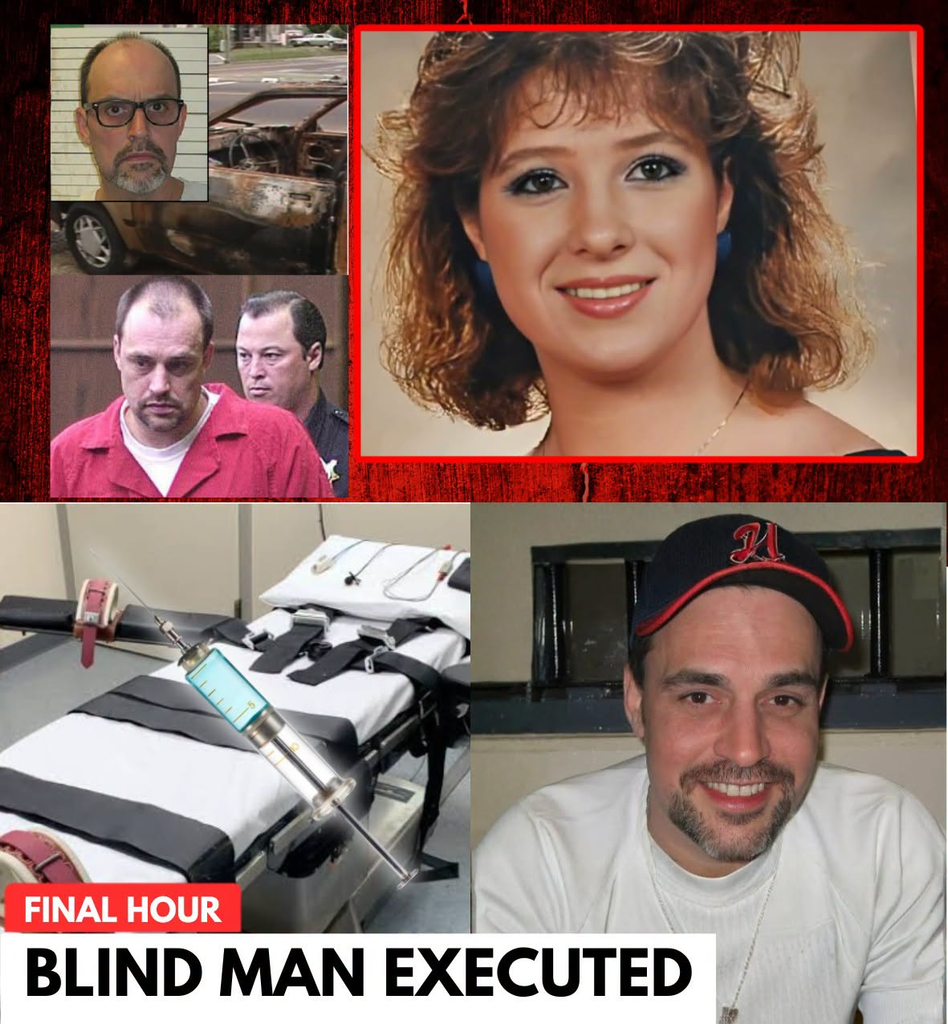
 The final jolt of electricity coursed through the body of Lee Hall at 7:26 p.m. on Thursday, ending a 28-year wait for justice in one of Tennessee’s most horrific murders, but leaving behind a trail of legal controversy and ethical questions that will haunt the state’s death penalty system for years to come.
Hall, 53, was pronounced dead at Riverbend Maximum Security Institution in Nashville after receiving two 1,750-volt charges in the electric chair, making him only the second blind inmate executed in the United States since the death penalty was reinstated in 1976.
The execution proceeded after the U.S. Supreme Court rejected Hall’s final appeal less than an hour before the procedure began, and after Governor Bill Lee declined to intervene despite a last-minute bombshell involving a juror who admitted to harboring deep-seated bias against the condemned man.
Hall’s last words were spoken clearly into the execution chamber as witnesses, including members of his victim’s family, watched through the glass: “People can learn forgiveness and love and will make this world a better place.”
Those words offered no comfort to the family of Tracy Crozier, the 22-year-old woman Hall doused with gasoline and set ablaze in April 1991 after she refused to reconcile with him following their five-year relationship.
The victim’s sister, Stacy Crozier Wooten, released an emotional statement after witnessing Hall’s death, saying the execution brought an end to nearly three decades of suffering for her family.
“The day has come and gone now, today my family has waited on for 28 years. Now our family’s peace can begin, but another family’s hell has to begin,” Wooten said.
“Today will not bring my sister and my father’s daughter back, but now may she find her peace in heaven with our mom.”
 The execution marked the culmination of a case that began on the night of April 16, 1991, when Hall, then 19, spent the day drinking an entire case of beer before arming himself with a Molotov cocktail and driving around Chattanooga searching for his ex-girlfriend.
Hall found Crozier sitting in her car outside her grandmother’s home in the early morning hours of April 17, and when she rejected his pleas to reunite and laughed at his proposal, he snapped.
According to trial testimony, Hall snatched Crozier’s keys from the ignition and threw them away before retrieving the gasoline-filled tea jug he had prepared earlier that evening.
He lit the paper towel fuse and hurled the makeshift firebomb through the driver’s side window, instantly engulfing Crozier in flames.
A neighbor who heard her screams rushed to the scene and dragged Crozier from the burning vehicle, but her skin came off in his hands as he tried to extinguish the flames.
Crozier was transported to Erlanger Hospital with third-degree burns covering 95 percent of her body, yet she remained conscious and aware throughout her ordeal.
Before her death on April 18, 1991, Crozier identified Hall as her attacker, telling medical staff and investigators his name.
Hall was arrested almost immediately and initially denied any involvement before eventually confessing to throwing the firebomb, though he claimed he only intended to burn her car, not her.
A jury rejected that defense in March 1992, convicting Hall of first-degree premeditated murder and aggravated arson, and sentencing him to death.
Hall spent the next 28 years on death row, during which time he went completely blind due to glaucoma that his attorneys argued was improperly treated by prison medical staff.
His legal team fought tirelessly to overturn his conviction, filing appeal after appeal, all of which were denied by state and federal courts.
 The case took a dramatic turn in November 2019 when a woman identified only as Juror A came forward publicly to reveal that she had been repeatedly raped by her former husband before serving on Hall’s jury.
The woman admitted that because of her personal trauma, she hated Hall before the trial even began, yet she never disclosed this during jury selection when asked about experiences that might affect her impartiality.
Hall’s attorneys argued this constituted a clear violation of his constitutional right to a fair trial, and they pointed to a nearly identical case in which another Tennessee death row inmate was granted a new trial just one week earlier.
Despite the compelling parallel, courts rejected Hall’s emergency appeals, with the Tennessee Supreme Court dismissing his claims on December 3 and the Sixth Circuit Court of Appeals denying his follow-up appeal the following day.
The U.S. Supreme Court’s refusal to hear the case on December 5 sealed Hall’s fate.
Hall chose the electric chair over lethal injection, a decision that made him the fourth Tennessee inmate since 2018 to select the outdated method of execution.
Witnesses described seeing smoke rise from the right side of Hall’s head during the execution, which prison officials attributed to steam from the wet sponge used to conduct electricity.
Hall’s body tensed with the first jolt, slumped forward when it stopped, then lifted again with the second surge before being pronounced dead seven minutes after the procedure began.
His attorneys maintained until the end that executing a blind man who lost his sight due to alleged prison neglect was cruel and unusual punishment.
Kelly Gleason, one of Hall’s lawyers, argued that the state was executing a man who had been “blinded by the state’s own negligence.”
Hall’s family released a statement expressing devastation at his death while acknowledging the loss of Crozier.
“Lee loved Tracy more than anything, and they had welcomed her into their family and loved her, too,” the statement read.
They maintained that Hall did not intend to cause Crozier’s death, that he admitted the truth and accepted his punishment, and that he had accepted Jesus Christ during his time on death row.
The family said Hall only wished for the Crozier family to accept his sincere apology and hoped they would find peace and closure.
Hall converted to Christianity during his decades on death row and maintained a clean disciplinary record, never causing problems for prison staff or fellow inmates.
He was 53 years old when he died, having spent more than half his life waiting for the state to carry out his sentence.
 His execution was the fourth in Tennessee since the state resumed capital punishment in November 2018, and the third carried out using the electric chair.
Tennessee remains the only state in America still regularly using the electric chair, a method most states abandoned decades ago due to concerns about its brutality.
The execution has reignited debate about the death penalty, with opponents pointing to the juror bias issue and Hall’s blindness as evidence that the system is fundamentally flawed.
Supporters of capital punishment argue that Hall’s crime was so heinous that the death penalty was clearly justified, regardless of the circumstances of his final years.
The case has also raised uncomfortable questions about whether the state’s alleged neglect of Hall’s glaucoma, which led to his blindness, constituted cruel and unusual punishment.
Legal experts note that the juror bias issue remains unresolved, and the fact that another Tennessee inmate received a new trial for the same issue just days before Hall’s execution has created a troubling inconsistency.
The state of Tennessee has defended its actions, with Governor Lee stating that the justice system had extensively reviewed Hall’s case over the course of nearly three decades.
Crozier’s family expressed relief that the long legal battle has finally concluded, though they acknowledged that no execution can undo the pain they have endured.
Tracy Crozier was born on September 1, 1968, and grew up in Chattanooga, described by those who knew her as friendly, sweet, and trusting.
She met Hall in January 1986 when she was just 17 years old, and within weeks she moved in with him, much to her family’s dismay.
Their relationship lasted five years, marred by Hall’s 𝒹𝓇𝓊𝑔 and alcohol 𝓪𝓫𝓾𝓼𝓮, his obsession with fire, and his increasingly erratic behavior.
Hall had a history of setting fires dating back to his childhood, and psychologists who examined him said he used fire to express distress and process emotions he couldn’t handle.
In the year before Crozier’s murder, Hall set fires four or five times, burning property and watching it go up in flames.
When Crozier finally left him in March 1991, Hall began a campaign of harassment, calling her constantly and begging her to return.
When she refused, he escalated to violence, setting her car on fire twice in an attempt to punish her for leaving.
Crozier remained determined not to return to him, a decision that ultimately cost her her life.
 The case has become a focal point for discussions about domestic violence, stalking, and the failure of the justice system to protect victims before it’s too late.
Crozier’s family has said they hope her story will raise awareness about the dangers of obsessive relationships and the importance of taking threats seriously.
The execution of Lee Hall closes a chapter in Tennessee’s criminal justice history, but the questions it raises will linger for years to come.
Was justice served by executing a blind man who had spent 28 years on death row, or was it an act of state-sanctioned violence that mirrored the violence he committed?
Did the juror’s failure to disclose her bias taint the original trial, or was Hall’s guilt so overwhelming that the outcome would have been the same regardless?
These are questions without easy answers, and they will continue to fuel debate about the death penalty in America.
What is certain is that two families are left grieving, one for a young woman whose life was brutally cut short, and another for a man who spent nearly three decades waiting to die.
Tracy Crozier was 22 years old when she died, her whole life ahead of her, stolen because she had the courage to say no to a man who couldn’t accept rejection.
Lee Hall was 53 when he died, blind and alone, strapped into an electric chair as smoke rose from his head.
The electric chair has gone silent at Riverbend Maximum Security Institution, but the echoes of this case will reverberate through Tennessee’s legal system for generations.
The state has scheduled no further executions, and officials have not announced when the next one might take place.
But the precedent set by Hall’s execution, and the controversies surrounding it, will shape how future death penalty cases are handled.
For now, the families of both Tracy Crozier and Lee Hall must find a way to move forward, carrying the weight of a tragedy that has defined their lives for nearly three decades.
Tracy’s family says they finally have peace, but they also acknowledge that nothing can bring her back.
Lee’s family says they are devastated, but they accept that he paid the ultimate price for his actions.
And somewhere in Tennessee, a young woman’s grave stands as a reminder of what happens when obsession turns to violence, and when the justice system must decide how to respond.
The case of Lee Hall is closed, but the questions it raised remain open, waiting for answers that may never come.
© 2026 MZ News — Blog powered by WordPress.