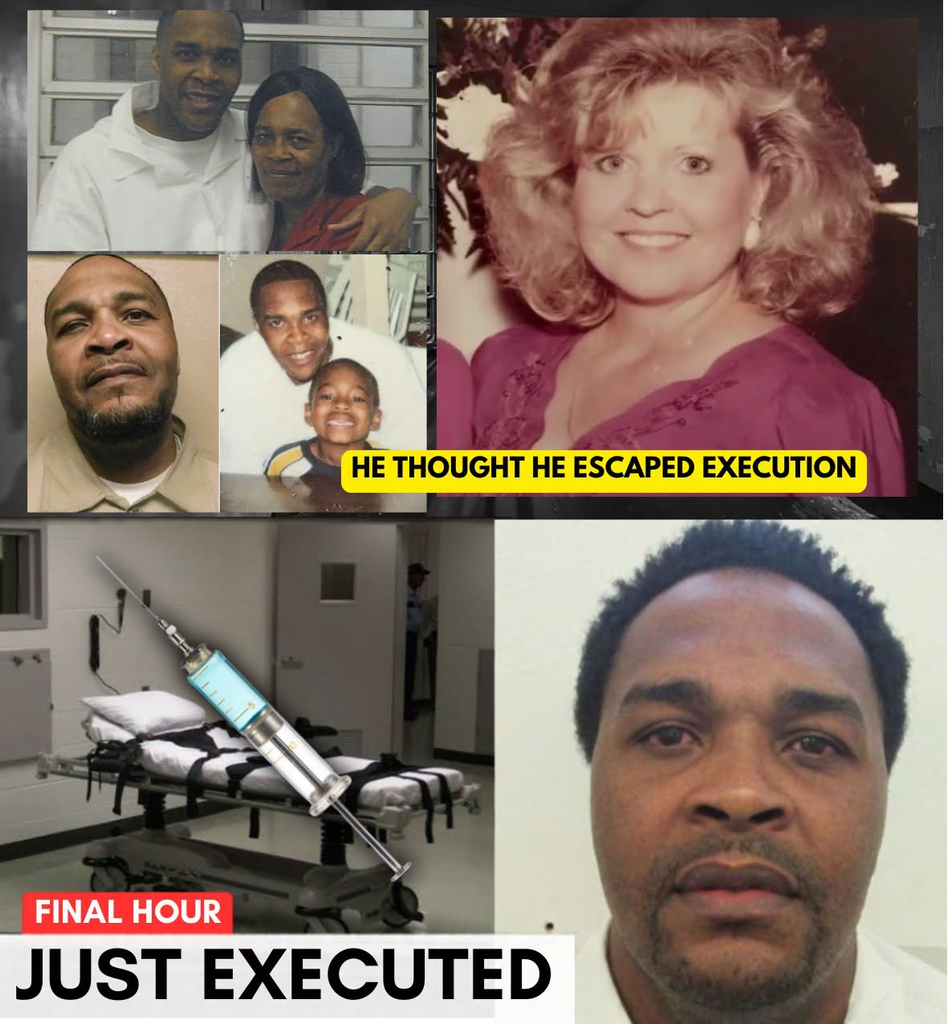
The state of Alabama executed Jeffery Lee on Thursday evening, a little over three months after his original execution was halted by the Supreme Court in a dramatic last-minute intervention. Lee, 55, was pronounced dead at 6:22 p. m.
at the William C. Holman Correctional Facility, marking the conclusion of a legal and moral battle that spanned nearly three decades and 𝓮𝔁𝓹𝓸𝓼𝓮𝓭 deep fractures in the American justice system over judicial override and methods of capital punishment. The execution, carried out via lethal injection, proceeded without the public spectacle of his June attempt, but the weight of the controversy surrounding his case did not dissipate with his final breath.
 Lee’s journey to the death chamber began on December 12, 1998, in the small, rural town of Orrville, Alabama, a community where everyone knew the man behind the counter at Jimmy’s Pawn Shop. That man was Jimmy Ellis, a beloved local figure who led a double life as a touring Elvis Presley impersonator under the stage name Orion, a career that earned him a devoted national following and a posthumous documentary in 2015. Around noon that day, Lee entered the shop, told the employees he would return after getting money from his grandmother, and came back shortly thereafter carrying a sawed-off shotgun.
According to court records and subsequent statements from the Alabama Attorney General’s office, Lee had consumed alcohol and smoked marijuana laced with cocaine before his return.
Lee opened fire almost immediately, striking Ellis first, then turning the weapon on employee Ellen Thompson, shooting her in the face. He then fired on a third person in the store, Helen King, before shooting Ellis a second time. Ellis and Thompson died at the scene.
King survived by playing dead, lying completely still on the floor until Lee left, at which point she locked the doors and called emergency services. Court records show Lee attempted to re-enter the store to retrieve a weapon he had forgotten, but King had already secured the doors. He fled with two accomplices but never managed to open the cash register.
Police apprehended Lee the following day at a motel in Georgia, where he subsequently gave a written confession, admitting that the first shot hitting Ellis was accidental but that everything after that was intentional, a bizarrely specific line of demarcation that offered neither full denial nor full remorse.
The trial in 2000 lasted just two days, with a jury convicting Lee of capital murder and attempted murder. The sentencing phase, however, is where this case transforms into something extraordinary. The jury voted seven to five to recommend life in prison without the possibility of parole, a clear majority, not a hung jury.
Under Alabama law at the time, that vote was merely a recommendation, and the final decision rested with the trial judge, who overrode the jury’s decision and imposed the death penalty. Alabama was one of only three states at the time that permitted such judicial override, a practice that Florida and Delaware abolished in 2016, with Alabama following in 2017, but the change was not retroactive. Lee’s sentence, issued under a law the state later abandoned, remained intact, a legal relic of a system that has since been widely criticized.
For the next twenty-six years, Lee lived on Alabama’s death row, where he underwent a profound transformation. He became a leader of a Christian ministry inside Holman Prison through Kairos, an international prison ministry that sends volunteers into correctional facilities. Friends and family called him G-Love, and a public support campaign grew around him.
In a phone interview with CNN from inside the prison, Lee said it took him years to accept, in his words, the fact that he had killed people, and even then, he still struggled to believe he was capable of it. Alabama Attorney General Steve Marshall, however, remained steadfast, publicly describing Lee as an admitted and convicted double murderer and vowing that the state would do everything necessary to carry out the sentence.
In 2018, Lee made a specific legal choice: if the state came to execute him, he wanted to die by nitrogen hypoxia, not lethal injection. In 2024, Alabama became one of the few states to actually carry out an execution using this method. Once that happened, Lee and other death row inmates filed suit, arguing that the method itself was cruel and unconstitutional.
They won that argument for a time. A federal judge agreed that the nitrogen protocol created an unconstitutional risk of severe pain, and the Eleventh Circuit upheld that decision. Courts even agreed that the alternative Lee proposed, death by firing squad, was feasible, easily implemented, and significantly safer than nitrogen gas.
Alabama scheduled his execution anyway on June 11, 2026, still planning to use nitrogen, as protesters gathered outside the capital in Montgomery.
A religious group placed a billboard near Holman Prison that read, Do Not Strangle Anyone, directed at the corrections officials who would carry out the act. After the time the execution was supposed to begin had passed, the Supreme Court ruled six to three to block Alabama from proceeding. Three of the most conservative justices said they would have allowed it.
That is the phone call heard in the opening of this report, where Lee told his mother he was not afraid of death because he knew where he was going. His legal team released a video of that call that night, showing Lee speaking through a phone, having survived his own execution date. Attorney General Marshall did not see it as a victory, describing the ruling as an abortion of justice, not for the state, he said, but for Jimmy Ellis and Ellen Thompson, and for the families who were ready to witness the final chapter of justice.
Alabama did not wait. The day after the ruling, the Attorney General’s office filed a motion for a new execution warrant, the same sentence, but a different method: lethal injection. Lee’s lawyers opposed it vigorously.
In 2018, Lee had agreed to drop a lawsuit against lethal injection specifically because the state had agreed it would never use that method on him. Now, the state wanted exactly that. Alabama is not looking for a constitutional way to execute Jeffery Lee, his legal team said.
It is looking for a way around the Constitution. A federal judge ruled against him anyway. On July 30, Governor Kay Ivey set a new date: September 17.
In his final twenty-four hours, Lee received seventeen visitors, including family, friends, and members of his legal team. He made three phone calls to his lawyer, his mother, and his son. On the day of the execution itself, his father, mother, son, friends, and a spiritual advisor visited him.
 Two of his lawyers would later witness the execution on his behalf. He did not request a last meal. He refused the food trays offered to him on September 16 and 17.
But he was not fasting either. Over those two days, he ate sporadically: Cheetos, breakfast cereal, macaroni and cheese, rice, milk, salad, chili, applesauce, two slices of bread, broccoli, biscuits with gravy, oatmeal cake, cornbread, a piece of chicken, a brownie, oatmeal, pancakes, sausage with syrup, meatballs, dinner rolls, mashed potatoes, chocolate pudding, and two bottles of water. Not a last meal, but the last two days of a life eaten in small, ordinary pieces.
At approximately 6:04 p. m. , the execution chamber opened to witnesses.
Lee was already strapped to the gurney. Prison warden Terry Raybon read the execution order aloud. At approximately 6:06, Lee was asked if he had any last words.
He did. Everything is fine. I just want to tell my family, I love them.
And to my brothers on death row, I love them. After speaking, Lee closed his eyes and clenched both fists. His spiritual advisor approached the foot of the gurney and prayed with him.
Lee nodded several times as he read what appeared to be scripture. At approximately 6:10, corrections officers checked his responsiveness. His breathing became deeper, then slowed.
By 6:15, his face relaxed. By 6:16, the viewing curtains were closed. The Alabama Department of Corrections recorded his death at 6:22 p.
m.
After twenty-six years since a jury voted for his life, and sixteen minutes after his final words, Jeffery Lee was gone. We began this story with a man who survived his execution for one night in June. By September, the same story ended the way Alabama wanted it to from the start.
So here is where we conclude. If a jury, the people the system was designed to make this decision, voted for life, how much should one person’s objection be allowed to override that? The question is not merely academic.
It is the central ethical dilemma of Lee’s case, and it will linger long after the state has closed the file on his death. The execution of Jeffery Lee was not just the carrying out of a sentence; it was a demonstration of the lengths to which a state will go to ensure its will prevails, even against the explicit recommendation of a jury, even against the rulings of federal courts, and even against the evolving standards of decency that have led other states to abandon such practices.
The families of Jimmy Ellis and Ellen Thompson have waited over two decades for this moment. They have attended hearings, filed statements, and watched as Lee’s case became a rallying point for death penalty opponents nationwide. In the immediate aftermath of the execution, Attorney General Marshall issued a brief statement, saying that justice had finally been served for the victims and their loved ones.
He did not mention the Supreme Court’s June ruling that had temporarily spared Lee, nor did he address the irony that the state had to switch methods to achieve what it considered justice. For Lee’s supporters, the execution represents a failure of the system to listen to its own safeguards. The jury, which heard all the evidence, which deliberated on the facts of the crime and the character of the man, chose life.
A single judge, with no more information than the jury had, chose death. That judge’s decision, made under a law that Alabama itself later deemed unjust enough to repeal, was allowed to stand.
The method of execution also raises serious questions that will not disappear with Lee’s death. The Supreme Court’s June ruling did not declare nitrogen hypoxia unconstitutional in all cases, only that Alabama’s specific protocol posed an unacceptable risk of severe pain. The state’s swift pivot to lethal injection, a method Lee had been promised would never be used on him, suggests a pragmatic approach to capital punishment that prioritizes finality over consistency.
Lethal injection itself has been the subject of numerous legal challenges across the country, with concerns about the availability of drugs, the training of personnel, and the potential for botched executions. Alabama’s history with lethal injection is not unblemished, and the state has faced criticism for prolonged executions in the past. Yet, in Lee’s case, the procedure appeared to go smoothly, with no visible signs of distress reported by witnesses.
 The broader implications of Lee’s execution extend beyond the specifics of his case. It highlights the ongoing tension between state sovereignty and federal judicial oversight in death penalty cases. Alabama has positioned itself as a leader in the push to expand execution methods, including nitrogen hypoxia and, in some proposals, firing squads.
The state has argued that it has a moral obligation to carry out the sentences imposed by its courts, and that federal interference, particularly from the Supreme Court, represents an overreach that undermines the will of the people. Lee’s case became a test of that principle. The state’s willingness to immediately seek a new execution warrant after the Supreme Court’s June ruling, and its success in obtaining one, sends a clear message to other death row inmates: the state will find a way.
For Lee, the final months were a period of intense legal activity and personal reflection. His attorneys filed multiple appeals, arguing that the state’s switch to lethal injection violated his prior agreement and constituted cruel and unusual punishment. They pointed to the fact that Lee had chosen nitrogen hypoxia as a method he believed would be less painful, and that the state had agreed to that choice in exchange for him dropping his lawsuit against lethal injection.
The federal courts, however, were not persuaded. The judge who ruled against Lee’s final appeal noted that the state had a legitimate interest in carrying out the sentence, and that the method of execution, while changed, still met constitutional standards. Lee’s lawyers argued that this reasoning ignored the fundamental issue of broken promises, but their pleas fell on deaf ears.
In his final hours, Lee appeared calm, according to witnesses. He spent time with his family, spoke with his spiritual advisor, and ate small portions of food throughout the day. He did not express fear, echoing his earlier statement that he was not afraid of death because he knew where he was going.
His demeanor was described as peaceful, a stark contrast to the violence of the crime for which he was convicted. This dichotomy, between the man who committed a brutal double murder in 1998 and the man who led a prison ministry and was known as G-Love, is perhaps the most difficult aspect of the case to reconcile. His supporters argued that he had genuinely reformed, that he had found redemption in prison, and that his life had value.
His detractors argued that no amount of good behavior could erase the suffering he caused, and that the families of his victims deserved to see the sentence carried out.
The execution of Jeffery Lee will likely be studied for years as a case study in the complexities of capital punishment in America. It raises questions about judicial override, the reliability of juries, the methods of execution, and the possibility of redemption. It also highlights the deep political divisions that surround the death penalty, with Alabama’s leadership firmly committed to carrying out executions despite national trends toward abolition.
As of 2026, the United States remains one of the few Western democracies that still practices capital punishment, and states like Alabama are at the forefront of efforts to maintain and expand its use. The death of Jeffery Lee is not the end of this story, but rather a chapter in an ongoing national debate about justice, mercy, and the limits of state power.
The witnesses to Lee’s execution included two of his lawyers, who later described the scene in somber terms. They noted that Lee’s final words were directed at his family and his fellow inmates, not at the state or the victims. He did not ask for forgiveness, nor did he express remorse in his final moments.
He simply said that everything was fine and that he loved his family. His lawyers said that he appeared to be at peace, that he had made his peace with God, and that he was ready to go. Whether that peace was genuine or a facade, only Lee knew.
But his calm demeanor in the face of death, after twenty-six years of waiting, is a testament to the human capacity to adapt to even the most extreme circumstances.
The state of Alabama has now executed several inmates using nitrogen hypoxia since 2024, and the method has been met with both praise and condemnation. Proponents argue that it is a more humane alternative to lethal injection, which has been plagued by 𝒹𝓇𝓊𝑔 shortages and botched procedures. Opponents argue that it is experimental, that it has not been adequately tested, and that it carries a significant risk of causing extreme suffering.
The Supreme Court’s June ruling in Lee’s case was a blow to the state’s preferred method, but the state’s quick pivot to lethal injection shows that it is willing to use any method available to carry out its sentences. This flexibility, while perhaps necessary for the state to fulfill its legal obligations, raises concerns about the consistency and reliability of the death penalty system.
For the families of Jimmy Ellis and Ellen Thompson, the execution brings a sense of closure, but it also brings back the pain of the original crime. They have lived with the loss for over two decades, and the legal proceedings have been a constant reminder of what they have lost. In statements following the execution, they expressed relief that Lee was finally held accountable, but they also acknowledged that no execution could bring back their loved ones.
This is the eternal paradox of capital punishment: it seeks to provide justice, but it cannot undo the harm that has been done. The state’s role in carrying out the execution is not about healing, but about enforcing the law, and the law has spoken.
Lee’s case also highlights the role of the governor in the death penalty process. Governor Kay Ivey, who set the new execution date, has been a staunch supporter of capital punishment throughout her career. She has rejected clemency requests in other cases and has shown no willingness to intervene in Lee’s case.
 Her decision to set the September date, just weeks after the Supreme Court’s ruling, was seen by many as a signal that the state would not be deterred by legal setbacks. This political dimension of the death penalty, where elected officials use executions to demonstrate their toughness on crime, is a crucial factor in understanding why Lee’s execution proceeded despite the controversies surrounding his case.
The legal team that represented Lee in his final years was composed of experienced death penalty attorneys who have handled numerous such cases. They argued that Lee’s case was unique because of the jury’s recommendation of life, the state’s broken promise regarding lethal injection, and the questionable constitutionality of nitrogen hypoxia. They filed a series of emergency appeals in the days leading up to the execution, but the courts rejected them all.
In their final statement, they said that the state had succeeded in executing a man who had been sentenced to death by a judge, not a jury, and that the system had failed to protect the most fundamental rights of a condemned prisoner. They vowed to continue fighting for other inmates on death row, but for Lee, the fight was over.
The execution itself was carried out with clinical precision. The witnesses were led into the chamber, where Lee was already strapped to the gurney. The warden read the execution order, and Lee was given the opportunity to make a final statement.
He spoke briefly, then closed his eyes. The lethal injection was administered, and within minutes, Lee was pronounced dead. The entire process, from the opening of the curtains to the pronouncement of death, took approximately eighteen minutes.
There were no visible signs of distress, and the execution was described as routine by officials. This efficiency, while perhaps reassuring to supporters of the death penalty, also serves to normalize the act of killing, reducing it to a bureaucratic procedure rather than a momentous event.
The aftermath of Lee’s execution will be felt in the legal community, where his case will be cited in future challenges to the death penalty. The fact that a jury recommended life, and a judge overrode that recommendation, will be a central argument for those seeking to abolish judicial override in other states. The fact that the state switched methods, from nitrogen hypoxia to lethal injection, will be a point of contention in cases where inmates have made agreements with the state about execution methods.
And the fact that the Supreme Court allowed the execution to proceed, despite its earlier ruling, will be seen as a sign that the Court is willing to defer to state interests in capital cases. These legal implications are significant, and they will shape the future of the death penalty in America.
For the public, Lee’s execution is a reminder of the finality of the death penalty. Unlike a prison sentence, which can be commuted or overturned, an execution is irreversible. The state of Alabama has taken a man’s life, and there is no going back.
This finality is both the power and the peril of capital punishment. It provides closure for victims’ families, but it also carries the risk of executing an innocent person or, as in Lee’s case, executing someone who may have been sentenced by an unfair process. The debate over the death penalty is unlikely to be resolved by Lee’s execution, but it has been given new fuel by the circumstances of his case.
The story of Jeffery Lee is a story of contradictions. A man who committed a heinous crime, but who found redemption in prison. A jury that voted for life, but a judge who chose death.
A state that promised one method of execution, but used another. A Supreme Court that intervened once, but ultimately allowed the execution to proceed. These contradictions are not easily resolved, and they reflect the broader complexities of the American justice system.
As the state of Alabama moves on to its next execution, the questions raised by Lee’s case will continue to linger. How much weight should be given to a jury’s recommendation? What promises must a state keep to a condemned prisoner?
And what does it mean to seek justice when the system itself is flawed? These are the questions that will define the future of capital punishment in America, and they are questions that have no easy answers.
The execution of Jeffery Lee on September 17, 2026, was the culmination of a legal battle that began with a crime in 1998 and a trial in 2000. It was a battle that saw a jury recommend life, a judge impose death, and a state fight for over two decades to carry out that sentence. It was a battle that saw the Supreme Court intervene at the last moment in June, only to allow the execution to proceed in September.
It was a battle that raised fundamental questions about the nature of justice, the role of juries, the methods of execution, and the possibility of redemption. In the end, the state of Alabama prevailed, and Jeffery Lee was executed. But the questions his case raised will not die with him.
They will live on in the courts, in the legislatures, and in the hearts of all those who care about the meaning of justice in a democratic society.
© 2026 MZ News — Blog powered by WordPress.