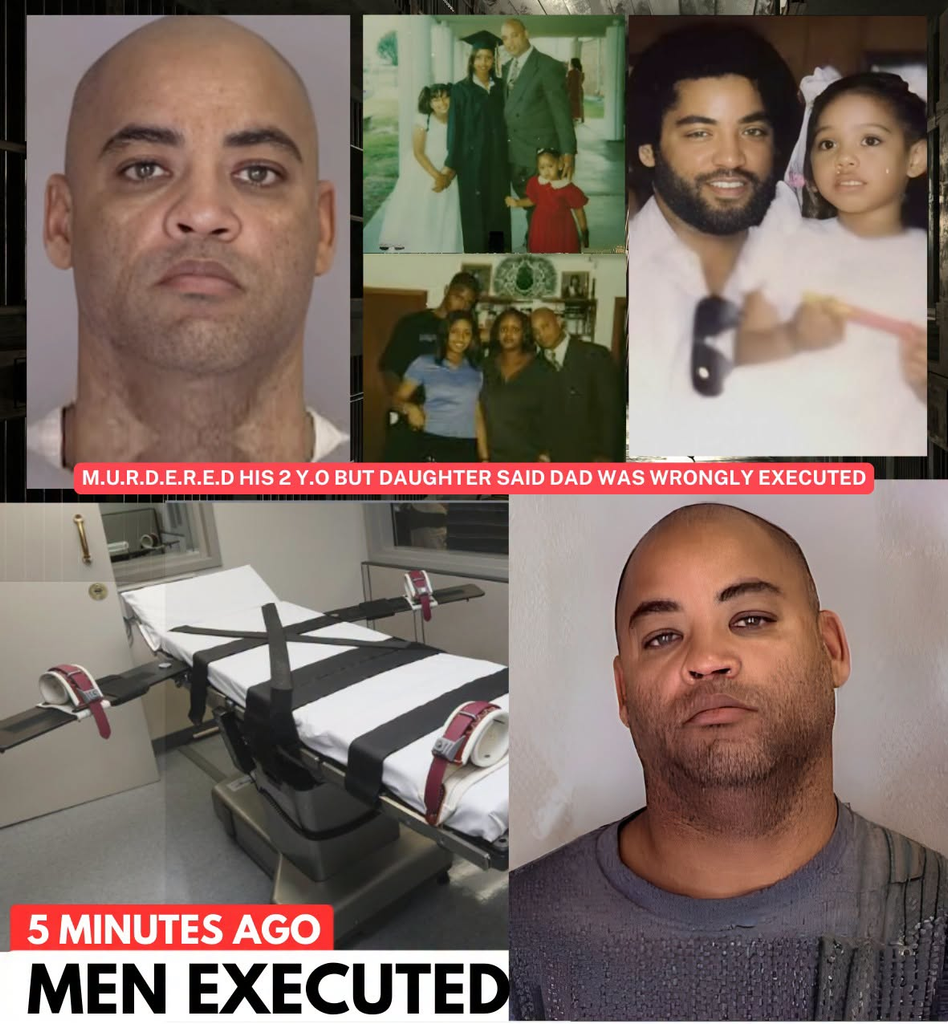
Breaking: Alfred Bourgeois Executed After 16 Years on Federal Death Row for Killing 2-Year-Old daug.
 The federal government executed Alfred Bourgeois on Friday evening, ending a 16-year odyssey through the American capital punishment system that his family and a growing coalition of legal advocates insist was a profound miscarriage of justice. The 56-year-old Louisiana truck driver was pronounced dead at 8:21 p. m.
at the federal death chamber in Terre Haute, Indiana, after receiving a lethal injection of pentobarbital. His final words were not an apology, not a confession, but a defiant declaration that has now become a rallying cry for those who believe the state killed an innocent man. He asked God to forgive those who plotted against him and planted false evidence, then said plainly, I did not commit this crime.
He raised a thumbs-up to his spiritual adviser before the drugs took hold, a gesture of calm that belied the storm of controversy surrounding his case.
The execution marked the tenth federal lethal injection carried out in a single calendar year under the Trump administration, a pace not witnessed in the United States since the presidency of Grover Cleveland in the 1890s. But for Bethany Bourgeois George, Alfred’s eldest daughter, living in Vancouver, Canada, this was not a statistic or a political statement. It was the murder of her father by the state, a man she insists was convicted on the strength of flawed science, concealed witness deals, and the coerced testimony of a traumatized child.
She has spent every day since that December evening poring over court documents, autopsy reports, and sworn affidavits, building a case for posthumous exoneration that has yet to be acknowledged by the White House. Her fight is not for a pardon that would free a living man, but for an admission that the system failed catastrophically.
To understand the gravity of what happened in Terre Haute, one must rewind to the swamps of LaPlace, Louisiana, where Alfred Bourgeois was born on June 20, 1964. He was a working-class man, a long-haul truck driver who spent weeks on the road, a husband and father of two daughters who, by all accounts, was deeply present in his children’s lives. His daughter Bethany remembers him as actively involved, a father who embraced her at her high school graduation dinner in 2002, just weeks before his arrest, a moment she did not know would be their last physical contact for nearly two decades.
Alfred also had a child outside his marriage, a little girl named Jacquelyn Gunter, nicknamed Aja, who had been living with her mother, Katrina Harrison, in Livingston, Texas. Alfred did not even know Jacquelyn existed until a paternity suit in April 2002 confirmed he was her biological father. He had never met the child.
Then, in a decision that would seal his fate, he agreed to take temporary custody of the toddler for the summer.
The family left LaPlace on May 28, 2002, for a trucking orientation in Alabama, then embarked on a long-haul route with the 18-wheeler serving as their home. Jacquelyn, just two and a half years old, was now in the care of a man she had known for only weeks. The prosecution would later paint a picture of systematic cruelty, alleging that Alfred became obsessed with toilet training and punished the child savagely for accidents, forcing her to sit on a training potty for hours, striking her with electrical cords, burning her foot with a cigarette lighter, and hitting her head with a plastic baseball bat.
His wife, Robin, testified to seeing bruises and injuries appear on the child’s body. But the defense would counter with a far more complex narrative, one that began to unravel the prosecution’s case piece by piece.
On June 26, 2002, the family was in Corpus Christi, Texas, where Alfred was making a delivery to the Naval Air Station, a federal installation. Robin awoke to find Jacquelyn unconscious. The child was rushed to Driscoll Children’s Hospital and died the following day.
She was two years old. Alfred told investigators she had fallen from her potty chair, an accident. The medical personnel did not believe him, and he was arrested on June 28, 2002, charged with capital murder under federal law because the incident occurred on federal property.
The government’s case rested on four pillars, each of which, upon closer inspection, appears to crumble under the weight of its own contradictions. The first was medical evidence of a fatal head injury, allegedly caused by Alfred slamming Jacquelyn’s head against the truck window. The prosecution presented Dr.
Rouse, a forensic pathologist, who testified that the child’s brain showed massive trauma. Photographs of the brain were projected for the jury, appearing to show dozens of injuries. But the defense’s experts found a critical flaw: there was no fractured skull.
 The prosecution argued a violent impact against a window, yet the skull was intact. Investigators found no blood, no hair, no biological material in the truck consistent with such an impact.
A 2007 affidavit from Dr. Werner Spitz, a highly respected forensic pathologist and former chief medical examiner, stated that the suggestion of bruising in those photographs was misleading and exaggerated, noting that the images had been enhanced and that dark-skinned individuals often have variations in skin pigment mistaken for injuries. More critically, Spitz concluded that the hematoma, the only internal bleeding present, was at least seven to ten days old at the time of death, not fresh, not caused by a blow delivered on June 26.
This timeline is devastating because it aligns with a family beach trip to California, where Alfred said Jacquelyn had swallowed salt water. Photographs documenting that trip were confiscated by authorities and never produced at trial. They have never been seen again.
The defense’s alternative theory, supported by multiple expert affidavits, was that Jacquelyn died of hypernatremia, severe dehydration caused by ingesting large amounts of salt water, a condition that can cause brain swelling and internal bleeding that mimics physical trauma. The prosecution’s own expert, Dr. Rouse, in communications revealed weeks before the execution, exhibited a hesitancy about her conclusions and expressed a willingness to consider the opinion of another neuropathologist.
The woman whose testimony helped condemn Alfred Bourgeois was no longer certain she had been right, and the government executed him anyway.
The second pillar was the allegation of sexual 𝓪𝓫𝓾𝓼𝓮. The prosecution told the jury that semen was found on rectal swabs taken during the autopsy, using this as emotionally inflammatory evidence that Alfred had violated his own infant daughter. But the sexual assault nurse examiner who examined Jacquelyn at the hospital found no evidence of sexual 𝓪𝓫𝓾𝓼𝓮.
The official autopsy reached the same conclusion. The semen evidence came from a forensic test called a P30 test, designed to detect a prostate-specific antigen believed to be exclusive to male semen. The scientific community has since established that P30 can also be present in female fluids, making the test unreliable.
The FBI has reportedly abandoned the P30 test entirely because it cannot reliably determine the presence of semen. The test used to prove this man sexually abused his daughter is a test the federal government’s own law enforcement agency no longer trusts.
The third pillar was the eyewitness testimony of Alfred’s six-year-old daughter, Alfredesha Bourgeois, who was in the truck. She took the stand at age seven and testified that she saw her father slam Jacquelyn’s head against the window four times. But Alfredesha had not always told that story.
When investigators first spoke to her following the arrest, she said her father was innocent, that her mother had fabricated the story about the fall because she was afraid of going to prison. Then Alfred was arrested, and Alfredesha went to live with her mother, in daily contact with the prosecution and the FBI, isolated from her father’s family for over a year. When she emerged and took the witness stand, her story had fundamentally changed.
There is a moment in her testimony where she said, That was Mommy’s part to say, five words that Alfred’s family has pointed to for over two decades as a window into what actually happened to that child’s testimony. Alfredesha also testified that her father treated her like an angel, that he never hit her or her younger sister, that Jacquelyn followed her everywhere and enjoyed riding in the truck. The same jury heard both stories, somehow true at once in a seven-year-old’s mind.
 The fourth pillar was the testimony of jailhouse informants. Three inmates housed with Alfred before trial testified that he confessed to them, saying he killed his daughter and planned to make it look like an accident, laughing about how large her head had swollen. But here is the constitutional violation: four people who testified against Alfred Bourgeois were in custody and had been promised benefits by the prosecution in exchange for their cooperation.
Those deals were never disclosed to the defense. Under Brady v. Maryland, a foundational Supreme Court precedent from 1963, the prosecution is legally required to disclose any arrangements with witnesses that could affect their credibility.
This is not a technicality; it is the bedrock of a fair trial. Alfred’s appellate lawyers argued that this violation alone should have blown the case apart. The jury that sentenced Alfred Bourgeois to death deliberated for just 90 minutes.
For a capital case with disputed evidence, a contested cause of death, a recanting child witness, and potentially compromised informants, 90 minutes is an indictment of the process itself.
Alfred was convicted on March 6, 2004, and sentenced to death. He was sent to USP Terre Haute, the only federal death row in the country, where he lived for 18 and a half years in a cell alone. The Bureau of Prisons reportedly classified him as the only inmate on the unit not permitted contact with his loved ones.
His daughter Bethany did not hear her father’s voice for nearly 19 years. She was not given four hours on the phone with him until two days before he was killed. During those years, Alfred took up art, drawing detailed renderings of his legal team.
His attorneys described him as a calm, cooperative presence with a good disciplinary record. For a man described by the prosecution as a predatory sadist, he gave the federal prison system remarkably little trouble over two decades. His legal team fought his conviction, challenging the intellectual disability argument, pointing to Alfred’s IQ, which testing placed between 70 and 75, a range that meets current clinical standards for intellectual disability.
The Supreme Court had ruled in 2002 in Atkins v. Virginia that it is unconstitutional to execute someone who is intellectually disabled. The lower courts rejected the argument, saying his behavior didn’t show gross intellectual deficiencies, a reasoning his lawyers called a misapplication of how intellectual disability actually works.
His case was swept up in the broader legal fight over the federal government’s return to executions after a 17-year hiatus. Attorney General William Barr announced in July 2019 that executions would resume, and Alfred Bourgeois was among the first five names on the list. His execution was initially scheduled for January 2020 but was delayed by a legal challenge over the lethal injection protocol.
The Supreme Court was asked multiple times to intervene, and each time, the answer was no. The final filing came on the afternoon of December 11, 2020, and the court denied it hours before the execution. Justices Sonia Sotomayor and Elena Kagan publicly dissented.
Sotomayor wrote that the court was allowing the execution of a man who, by current clinical standards for intellectual disability, had an arguable constitutional claim that had never been fully and fairly heard. Two of the nine justices of the highest court in the land believed this execution should not have happened. It happened anyway.
 The Trump administration executed ten people in a single year, four of them black men. Advocates and civil rights organizations pointed to data from the Death Penalty Information Center showing consistent overrepresentation of black defendants on both state and federal death rows, and studies demonstrating that black men who 𝓀𝒾𝓁𝓁 white victims are statistically far more likely to receive a death sentence than white men who 𝓀𝒾𝓁𝓁 black victims. Alfred’s victim, Jacquelyn Bourgeois, was a black child.
The jury that sentenced him to death was predominantly white. None of that changes what happened to a two-year-old girl who died violently far too young. Jacquelyn Bourgeois died on June 27, 2002, and she deserved to live.
Her mother, Katrina Harrison, was stabbed to death by a boyfriend just months after Jacquelyn’s death, leaving no close family members even present to watch the man convicted of killing her be put to death. But the question this case forces us to ask is whether the person responsible for her death was definitively, provably, beyond a reasonable doubt, the man the government executed.
When Alfred’s ashes arrived at Bethany’s apartment in Vancouver in August 2021, eight months after the execution, the box was heavier than she expected. She picked it up and realized her hands were covered in gray dust. The ashes were seeping through the seams.
She stood there in a Vancouver post office, the remains of her father literally on her hands, and she thought about the last time she had been this close to him, a graduation dinner in LaPlace in 2002, a hug goodbye, and then 19 years of nothing. She did not grieve quietly. She got to work.
Bethany obtained her father’s complete case file from his death row attorneys a month after the execution, autopsy reports, affidavits, witness testimony, clemency petitions, stay of execution filings. She read all of it, and then she built a case of her own. She created a website, alfredbourgeois.
com, gave media interviews, made public appearances, and submitted a formal posthumous pardon request to President Joe Biden in December 2024, when Biden moved to commute the sentences of nearly every remaining federal death row inmate. She wrote to the White House and called her father’s case a moral failure of the justice system. The White House did not respond.
Bethany Bourgeois George continues to fight for a man who cannot fight for himself, in a system that has already rendered its final judgment, in a country where posthumous exoneration is nearly impossible and where the machinery of justice rarely admits when it has made an irreversible mistake. Here is what we are left with: a case built on a forensic test the FBI later abandoned, a medical expert who second-guessed herself weeks before the execution, a child witness whose story changed after a year in the prosecution’s orbit, jailhouse informants whose deals were hidden from the defense, a cause of death disputed by multiple expert neuropathologists, a missing collection of photographs that could have told the world where this family had been the week before Jacquelyn died, and a man with an IQ between 70 and 75 who the United States government executed while two Supreme Court Justices filed a written dissent saying it should not happen. And a daughter in Vancouver who answers questions the justice system never fully asked.
If the P30 test used to prove sexual 𝓪𝓫𝓾𝓼𝓮 is scientifically unreliable and the FBI agrees it is, what was actually proven in that courtroom about Alfred Bourgeois and his daughter? If the hematomas were at least a week old when Jacquelyn died and the family had been to a saltwater beach seven to ten days before her death, at what point does reasonable doubt become something more than reasonable? If a child’s testimony changed from my father is innocent to I watched him do it after a year alone with the prosecution, what does that testimony actually prove?
If four witnesses had secret deals with the government that were never disclosed to the defense, how does any of their testimony survive constitutional scrutiny? And if the government’s own medical expert later expressed doubt about the conclusions she gave under oath, what happens to the conviction those conclusions helped build? We may never have definitive answers.
The man is dead, the courts are closed, the pardon request sits unanswered, but the questions live on. And so does Bethany, a daughter fighting to clear her father’s name, a woman who believes with every fiber of her being that the United States government did not execute a child killer on December 11, 2020. She believes they executed her father.
© 2026 MZ News — Blog powered by WordPress.