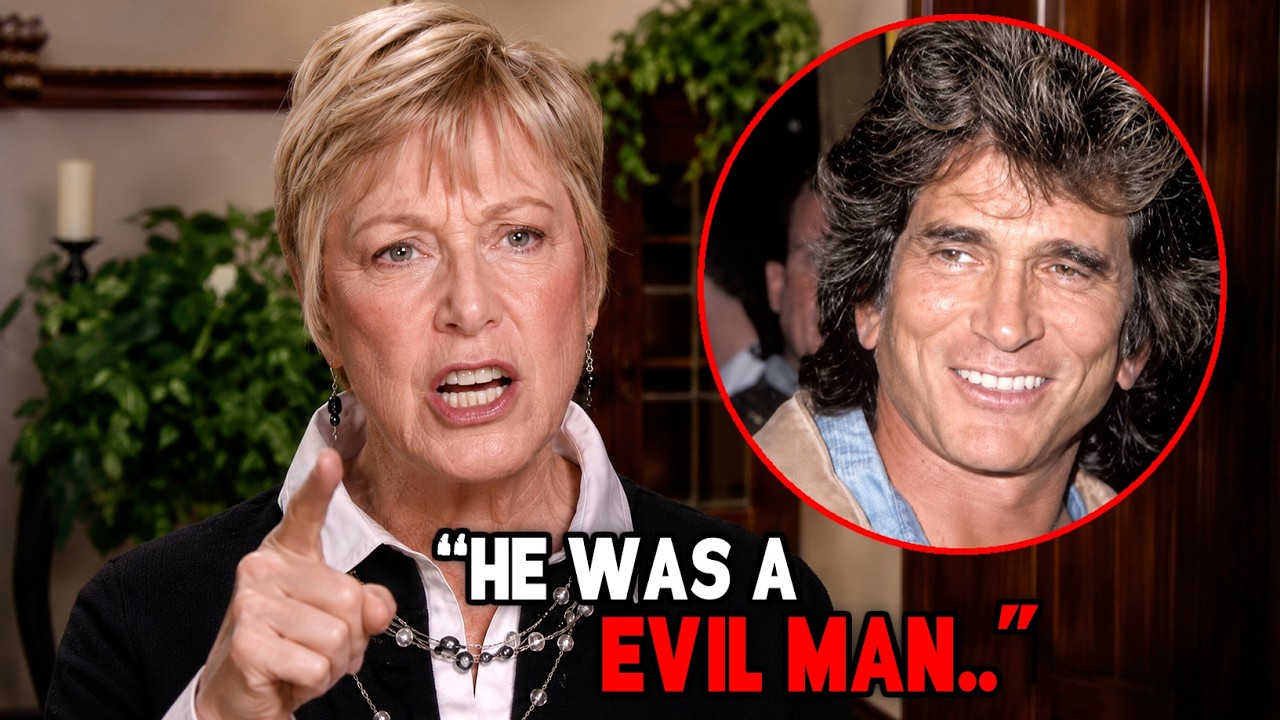
For nine years, Karen Grassle embodied the very essence of American motherhood, a woman whose gentle smile and unwavering strength comforted millions of families every single week. But when the cameras stopped rolling on the set of Little House on the Prairie, the woman behind the bonnet was living a vastly different reality, one marked by professional humiliation, financial warfare, and a private battle with addiction that threatened to consume her. Now, at 84 years old, Grassle has finally broken her decades-long silence, revealing the deeply troubling truth about her working relationship with Michael Landon, the man who played her beloved husband on screen, and the revelations are nothing short of seismic.
The story that Grassle tells in her long-awaited memoir and in recent interviews is not the heartwarming tale of frontier family life that captivated audiences for nearly a decade. Instead, it is a harrowing account of a powerful man who controlled nearly every aspect of her professional existence and used that power in ways that left lasting scars. From the very beginning, according to Grassle, Landon made it clear that her place on the show was conditional, and that her worth, both as an actress and as a person, was subject to his whims and his approval.
Born on February 25th, 1942, in northern California and raised in the coastal town of Ventura, Karen Grassle’s path to stardom was paved with both talent and hardship. Her childhood, while filled with love from her parents, was shadowed by her father’s alcoholism, a presence that would loom over her life in ways she could never have anticipated. The instability and pain she witnessed in those formative years became the very fuel that drove her toward the stage, a place where she could escape into the lives of others and momentarily forget the chaos of her own home.
Grassle’s dedication to her craft was absolute. She studied at Tulane University before transferring to the prestigious University of California, Berkeley, where her exceptional talent earned her a coveted Fulbright Fellowship to study at the London Academy of Music and Dramatic Art. In London during the electric 1960s, she trained alongside some of the most serious artists of her generation, honing her skills in classical theater and developing a depth of craft that would later prove to be both her greatest asset and her greatest source of frustration.
Returning to America, Grassle found herself navigating the brutal realities of Hollywood in the early 1970s, a world that was not immediately welcoming to a serious stage actress. She bounced between theater productions and small television roles, performing Shakespeare in the park alongside future legends like Christopher Walken and Sam Waterston. Despite her undeniable talent and rigorous training, the phone was not ringing with the kinds of offers she had hoped for, and behind the scenes, a darker pattern was emerging.
The drinking that had defined her father’s life had quietly, insidiously begun to take root in her own. Grassle would later describe herself as a high-functioning alcoholic, a woman who could show up, perform, and deliver, all while internally struggling in ways that no one around her could see. By the early 1970s, she was, by her own admission, broke and deeply discouraged, the dream that had carried her from Ventura to London to New York feeling increasingly distant and unattainable.
And then, out of nowhere, the call came. It was about a television pilot based on the beloved Little House books by Laura Ingalls Wilder. They were looking for someone to play Caroline Ingalls, the heart of the Ingalls family.
Grassle’s initial reaction to the script was less than enthusiastic. She found the character of Caroline to be something of a downer, a bit prudish, not at all the kind of complex, dynamic role she had spent years training to play. Yet, something compelled her to audition.
She arrived at the audition with very little money to her name, having spent her last $40 on a simple, modest woolen dress. Her makeup was nearly bare, just a whisper of brown eye shadow. She walked into the room and faced Michael Landon, already a television star and producer, a man who commanded every space he occupied.
According to Grassle, the moment she finished her audition, Landon looked at her and she had the job, just like that. It seemed like a dream come true.
What no one knew at the time was just how complicated that moment would become.
Getting the role meant entering Michael Landon’s world, and that world operated under a very specific set of rules. Little House on the Prairie premiered in 1974 and became an instant cultural phenomenon. Audiences fell completely in love with the Ingalls family, with Pa’s warmth, Ma’s strength, and the way this simple family faced impossible odds with dignity and grace.
Every week, tens of millions of Americans tuned in, and Karen Grassle was now one of the most recognized faces in the country.
It should have been the fulfillment of every dream she had ever had, and in many ways, it was. But the reality behind the scenes at Walnut Grove was far more complicated than the smiling family on screen.
Michael Landon was not just an actor on Little House on the Prairie; he was the star, the producer, the director. He controlled nearly everything about how the show was made, and that kind of absolute power, as Grassle would come to learn, either changes people or simply reveals who they already are.
In the beginning, Grassle respected Landon enormously.
She saw his talent, recognized his extraordinary instincts for television storytelling, and appreciated the work they were doing together. But over time, little by little, she began to see another side of the man who smiled so warmly at the camera. The set of Little House on the Prairie, she would later reveal, could be a very different place once the director called cut, and the trouble started, as it so often does, with money.
The show was not just a success; it was a top ten hit, a cultural institution. Grassle had been one of its pillars from day one, and when the second season came around, she did what any reasonable professional would do. She asked for a raise.
What followed was a confrontation that would define her relationship with Landon for the remainder of the show’s run. Landon said no, and he did so not with professional courtesy, but with a dismissiveness that was both 𝓈𝒽𝓸𝒸𝓀𝒾𝓃𝑔 and degrading.
He argued, in all seriousness, that Grassle’s salary should be comparable to what the child actors on the show were being paid.
Let that sink in for a moment. A woman who had spent years in London training at one of the world’s finest 𝒹𝓇𝒶𝓂𝒶 schools, a woman playing the female lead in a top ten American television show, was being told her work was worth about as much as a child’s. Grassle refused to accept that.
 She fought back, and the moment she did, something shifted between them permanently.
Michael Landon did not respond well to being challenged, not from anyone, and certainly not from a woman. The tension on set became impossible to ignore, and then, according to Grassle’s own account, it escalated into something far worse than a professional disagreement.
Landon began to humiliate her on camera, in front of the crew, with other cast members watching. She described specific scenes, intimate scenes filmed in bed, where she felt deliberately degraded, trapped, and unable to escape because the cameras were rolling and the production had to continue.
“This was so awful for me,” she would later say of those moments, “unbearable.”
Off camera, she described a man who used crude, degrading language about women with apparent comfort, laughing and making disgusting jokes in front of the crew while everyone around him played along. This is the nature of power on a film set. When the most powerful person in the room decides something is funny, everyone else has a choice: laugh along or pay a price.
And Karen Grassle, proud, trained, serious Karen Grassle, refused to laugh.
But what no one fully understood at the time was that she was fighting two battles simultaneously. One was on that sun-drenched set in California, and the other was entirely inside herself.
Behind Ma Ingalls’ steady gaze and gentle smile, Karen Grassle was quietly coming apart. The alcohol that had shadowed her father’s life had become a shadow in her own. She arrived on set some mornings still feeling the effects of the night before, relying on the makeup chair to hide what her eyes couldn’t.
She kept performing, kept delivering, kept showing up because she was, above everything else, a professional. But inside, she was drowning.
By 1977, somewhere in the middle of the show’s run, with millions of viewers watching her every week, Karen Grassle finally reached out for help.
A friend, a decision, a moment of clarity that she would later describe as one of the most important of her entire life. She began the long, painful, humbling journey toward sobriety. And here is where the story becomes something more than just a Hollywood 𝒔𝒄𝒂𝓃𝒹𝒶𝓁.
Because what Karen Grassle did next took extraordinary courage.
She went to the network, NBC, herself. She negotiated directly.
She fought for what she deserved, and she won. She doubled her salary, not because Michael Landon agreed to it, but because she went around him. Think about what that takes.
A woman battling addiction, working in an environment where she was being publicly humiliated by her boss, still had the spine to stand up, go to the network, and demand her worth. That is not Ma Ingalls. That is Karen Grassle, and she is something far more complicated and far more impressive than the character she played.
Little House on the Prairie ran for nine seasons. Nine years of Karen Grassle putting on that bonnet, stepping onto that set, and giving everything she had to a character she had come to genuinely love, even as her relationship with Landon remained cold and strained. And when the show finally ended in 1983, Karen Grassle largely disappeared from the spotlight.
She moved away from Hollywood, returned to the theater, and performed in plays across the country. She built a quieter life, one that was hers, not a character’s. But she carried the story of those nine years with her.
All of it.
The humiliation, the fights, the double standard, the loneliness of battling addiction while pretending to be America’s perfect mother. She carried it quietly for nearly four decades.
And then came a moment, one small, unexpected moment that changed everything. Before the show ended, before things became completely beyond repair, Karen wrote Michael Landon a letter. Not an angry letter, not an accusation, but a letter reaching out, trying to find some kind of peace.
And Landon, the man who had refused her raises, humiliated her on set, and treated her like she didn’t matter, wrote back.
He wrote, by her account, the kindest note she could have imagined. And they spoke on the phone, a long, real conversation.
They talked about the good times, the moments that actually mattered, the connection that had existed between them before the power games poisoned it. “We mended fences,” Karen would later say. “There was forgiveness on both sides.”
And then, very shortly after that phone call, Michael Landon was diagnosed with pancreatic cancer. He died in July of 1991. He was 54 years old, and Karen Grassle, whatever pain he had caused her, was forever grateful that she had made that call before it was too late.
For 30 years after Landon’s death, Karen Grassle said almost nothing publicly about what had happened on that set. She watched others write books about Little House, watched documentaries get made, watched Landon’s legacy get polished and protected, and she stayed quiet. Until 2021.
 At 79 years old, a woman who had been sober for decades, who had rebuilt her life on her own terms, who had nothing left to prove to anyone, Karen Grassle published her memoir, Bright Lights, Prairie Dust. And in it, she told the truth.
Not all of it was comfortable.
Not all of it was flattering to Landon or even to herself. Because Karen Grassle did something rare in Hollywood memoirs. She held herself accountable, too.
She wrote honestly about her drinking, her relationships, her mistakes, the ways she had sometimes been her own worst enemy, alongside every injustice she had suffered at someone else’s hands. When people asked her why she had waited so long, why she was speaking now about a man who had been dead for 30 years, her answer was simple. She had to tell her story.
Not to destroy anyone’s memory, not to win a fight she had already survived, but because silence for her had been its own kind of prison, and at 79 years old, she was done serving time. The most striking aspect of Karen Grassle’s story is the sheer duality of her existence during those nine years. For nine years, she walked onto a television set and played the most comforting, steady, unshakeable woman in America.
And while she was doing that, she was fighting for basic professional respect, battling addiction in secret, and being publicly humiliated by the most powerful man on her set, all without ever letting the audience see a single crack.
That is not a weakness. That is not someone who failed.
That is a woman who showed up every single day and did the work, even when the work was making her disappear. Michael Landon was complicated. The truth about powerful men often is.
He could be generous and cruel in almost the same breath, gifted and petty, beloved and quietly dangerous to the people who depended on him. His legacy, like most legacies, is both things at once, and Karen Grassle’s story does not erase the good he did, but it does insist, firmly and unapologetically, that his story is not the only story. Hers matters, too.
Perhaps the most remarkable part of all of this is that after everything, the fights, the humiliation, the years of silence, the addiction, the struggle, Karen Grassle is still here. Still performing, still speaking, still standing at 84 years old, not bitter, just honest. A nation watched Caroline Ingalls for nine seasons and called her strong, but the real strength was never on the screen.
It was the woman behind the bonnet carrying secrets no audience ever knew, fighting battles no script ever wrote, and choosing, finally, decades later to tell the truth. Not for revenge, not for attention, but because her story deserved to be heard.
The entertainment industry has long been a place where powerful men have operated with impunity, and the stories of the women who worked alongside them have often been silenced, dismissed, or buried.
Karen Grassle’s decision to speak out is part of a larger cultural reckoning, a moment where women are finally being heard when they describe the realities of working in environments where their worth was constantly questioned and their dignity was routinely undermined. Her account of the Little House on the Prairie set is a stark reminder that the wholesome, family-friendly image presented on screen often bore little resemblance to the reality behind the camera.
Grassle’s experience also highlights the particular vulnerability of actresses in the television industry, especially in an era before the protections and advocacy that exist today.
She was in a position where her entire career, her livelihood, and her reputation were tied to the good graces of a man who, by her account, was willing to demean her in front of her colleagues to maintain his dominance. The fact that she was able to not only survive but ultimately thrive, achieving sobriety and successfully negotiating for fair compensation, is a testament to her resilience and her strength of character.
The legacy of Little House on the Prairie is undoubtedly complex.
For millions of viewers, it remains a beloved piece of television history, a source of comfort and nostalgia that represents simpler times and enduring family values. For Karen Grassle, it was a career-defining role that brought her fame and recognition, but it was also a source of profound personal pain. Her willingness to share that pain, to complicate the narrative that has been so carefully constructed around the show and its star, is a significant act of courage.
In the years since her memoir was published, Grassle has continued to speak out, participating in interviews and podcasts where she elaborates on her experiences. She has been careful to acknowledge the complexity of Michael Landon, recognizing his talents and the genuine connection they shared in the early days, while also being honest about the ways he mistreated her. This balanced approach has made her account all the more credible and powerful.
She is not seeking to demonize Landon, but rather to ensure that her own truth is not lost in the shadow of his legacy.
The reaction to Grassle’s revelations has been significant, with many fans of the show expressing shock and sadness at learning about the difficult conditions behind the scenes. For those who grew up watching Little House on the Prairie and who saw the Ingalls family as a model of love and resilience, the news that the actress who played Ma was suffering so greatly is deeply unsettling.
It forces a reevaluation of the show and its stars, and it serves as a powerful reminder that the stories we see on screen are often just that: stories.
Karen Grassle’s journey from a troubled childhood in Ventura to the heights of television fame and back again is a story of survival against considerable odds. She overcame addiction, professional humiliation, and the systemic sexism of the entertainment industry to emerge as a voice of truth and resilience.
Her decision to finally share her story, after decades of silence, is a gift to all those who have ever felt voiceless or powerless. It is a reminder that our stories matter, that our experiences are valid, and that it is never too late to speak our truth.
As she approaches her mid-eighties, Karen Grassle shows no signs of slowing down.
 She continues to act, to write, and to share her experiences with audiences who are eager to hear from her. Her memoir has been praised for its honesty and its refusal to shy away from difficult subjects, and she has become something of a hero to those who have followed her story. She is a testament to the power of resilience, the importance of self-advocacy, and the healing that can come from finally telling the truth, no matter how long it takes.
The story of Karen Grassle and Michael Landon is not just a Hollywood 𝒔𝒄𝒂𝓃𝒹𝒶𝓁. It is a story about power dynamics, about the treatment of women in the workplace, about the hidden costs of fame, and about the strength it takes to overcome adversity. It is a story that resonates far beyond the confines of a television set, touching on themes that are universal and timeless.
And it is a story that, thanks to Karen Grassle’s courage, will no longer be hidden. It will be told, and retold, and it will serve as a reminder that the real lives of the people we admire on screen are often far more complicated than we could ever imagine.
The impact of Grassle’s revelations extends beyond just the legacy of Little House on the Prairie.
It speaks to a broader cultural moment in which women are increasingly coming forward to share their experiences of workplace mistreatment, unequal pay, and professional humiliation. Her story is a powerful example of how systemic issues can manifest in individual lives, and how one person’s courage can inspire others to speak their own truths. In an industry that has often protected powerful men at the expense of the women who worked for them, Grassle’s voice is a vital addition to the chorus of those demanding change.
For fans of the show, learning about Grassle’s experiences may forever change the way they watch Little House on the Prairie. The scenes of domestic bliss and familial love will now be viewed through a different lens, one that acknowledges the pain that was happening just out of frame. It is a sobering reminder that the art we consume is often created in conditions that are far from idyllic, and that the people who bring our favorite characters to life are complex individuals with their own struggles and triumphs.
Karen Grassle’s decision to wait until she was in her late seventies to share her story was a deliberate one. She wanted to ensure that she was in a place of strength and stability, that she had fully processed her experiences, and that she could tell her story with clarity and perspective. She also wanted to protect her own legacy and to ensure that her account would be taken seriously.
By waiting, she has ensured that her voice is heard clearly and that her story has the weight and authority that comes from a life lived with intention and reflection.
The story of the letter she wrote to Landon and the phone call that followed is one of the most poignant aspects of her account. It shows that even after years of mistreatment, Grassle was willing to seek reconciliation and to find peace.
It also shows that Landon, for all his faults, was capable of acknowledging the past and expressing genuine kindness. Their reconciliation, coming so shortly before his death, is a powerful reminder of the importance of forgiveness and the possibility of healing even the deepest wounds.
In the end, Karen Grassle’s story is one of triumph.
She triumphed over addiction, over professional adversity, over the systemic sexism of her industry, and over the personal demons that threatened to consume her. She emerged from the crucible of Little House on the Prairie with her dignity intact and her voice stronger than ever. And now, at 84 years old, she is finally telling the world what really happened.
It is a story that needed to be told, and she has told it with grace, honesty, and an unwavering commitment to the truth.
The legacy of Karen Grassle will not be defined solely by her role as Caroline Ingalls, though that role will always be a significant part of her story. Her legacy will also be defined by her courage in speaking out, her resilience in the face of adversity, and her commitment to living her life on her own terms.
She is a woman who refused to be silenced, who refused to be diminished, and who refused to let the pain of her past define her future. She is an inspiration to us all, and her story will resonate for generations to come.
As the entertainment industry continues to grapple with issues of power, inequality, and 𝓪𝓫𝓾𝓼𝓮, stories like Karen Grassle’s serve as essential reminders of what has been and what must change.
They give voice to those who have been silenced, and they hold accountable those who have abused their power. They also offer hope, showing that it is possible to survive, to heal, and to thrive, even in the face of overwhelming odds. Karen Grassle’s story is a beacon of that hope, and it is a story that will not be forgotten.
The full scope of what happened on the set of Little House on the Prairie may never be completely known, but thanks to Karen Grassle, we now have a clearer picture of the challenges she faced. Her account is detailed, specific, and credible, and it adds an important dimension to our understanding of the show and its star. It is a story that deserves to be heard, and it is a story that will undoubtedly shape the way future generations view this beloved piece of television history.
In sharing her story, Karen Grassle has done more than just reveal the truth about her own experiences. She has given a voice to countless others who have suffered in silence, and she has contributed to a cultural conversation that is long overdue. Her courage is a reminder that the truth, no matter how painful, has the power to heal and to transform.
And her story, finally told after all these years, is a testament to the enduring strength of the human spirit.