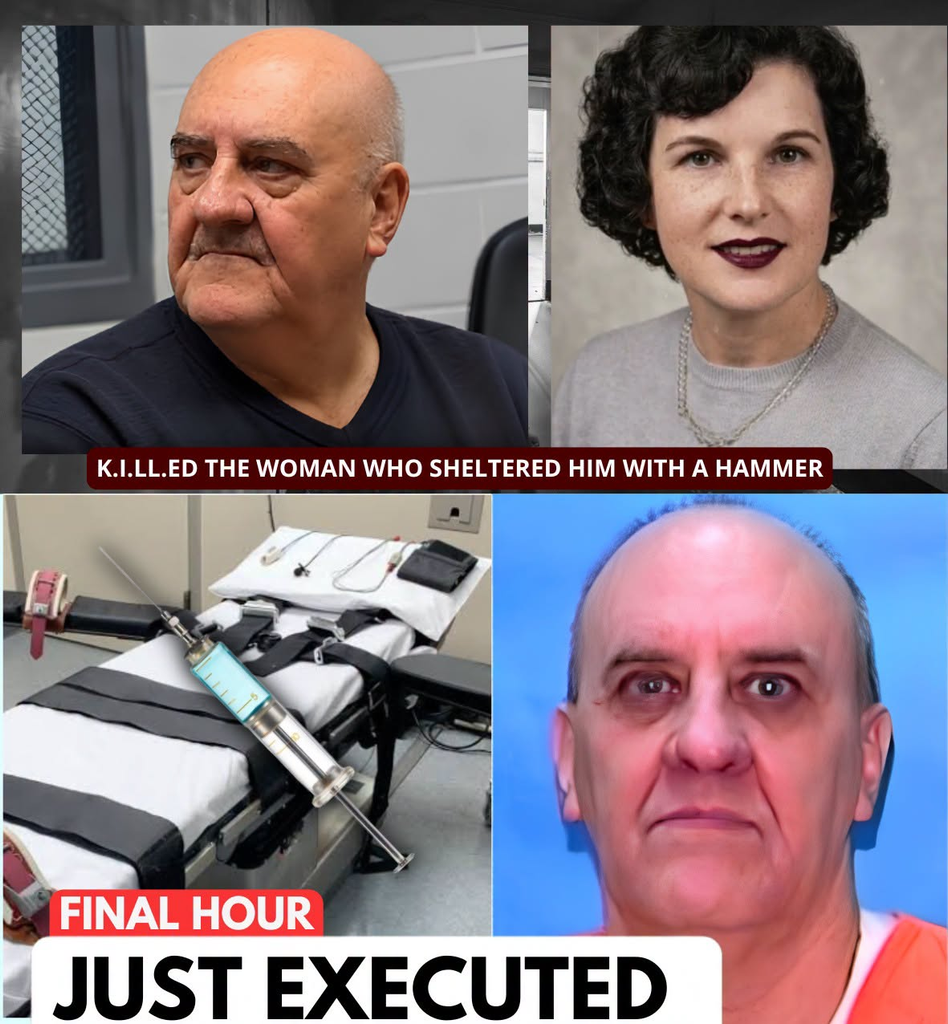
The 1995 Hammer Murder of Carolyn Monfort | Florida Death Row
STARKE, Fla. — The curtains parted at 6:00 p. m. on Tuesday, revealing a 77-year-old man strapped to a gurney in Florida’s death chamber, a man who had spent nearly three decades insisting he did not 𝓀𝒾𝓁𝓁 Carolyn Monfort with a hammer in her laundry room. Curtis Wilkie Beasley’s final words were not a confession, not a plea, but a vague apology offered to a room of witnesses who had waited 31 years for closure. “I want to apologize for all the mistakes I have made,” he said, according to officials who were present.
 He never specified what those mistakes were, and within twelve minutes, the state of Florida had ended his life with a lethal injection, closing a case that had haunted the small town of Dundee since the summer of 1995.
The execution, which was completed at 6:12 p. m. on September 29, 2026, marked the sixteenth time Florida had put a prisoner to death that year, a record-breaking pace that has drawn intense scrutiny from legal scholars and human rights organizations.
But for the family of Carolyn Monfort, the moment was the culmination of a three-decade wait for justice that began when a simple act of kindness turned fatal. Monfort, a 62-year-old property manager, had offered Beasley a place to stay while his truck was being repaired, a decision that prosecutors say led to her brutal bludgeoning death. The execution proceeded despite last-minute appeals from Beasley’s legal team, who argued that his age, failing health, and a non-unanimous jury recommendation made the death sentence unconstitutional.
The story of how Beasley ended up on that gurney began in the quiet, unassuming community of Dundee, Polk County, where Carolyn Monfort was a familiar and trusted figure. She managed an apartment complex owned by her son-in-law, Neil O’Toole, a stable job that kept her connected to the rhythms of the town and its residents. She had a daughter, Jane, and a son, and by all accounts, her life was defined by routine—work, family, and the kind of small-town familiarity where everyone seemed to know everyone else.
It was through that local network that she came to know Curtis Beasley, a man who had attended high school with her daughter’s ex-husband, a connection that made him feel like family, even if he was not.
When Beasley needed a place to stay while doing maintenance work nearby, Monfort offered him a room in her home, a gesture of neighborly kindness that in a town like Dundee probably did not seem like a big decision at all. It was the kind of thing she had likely done before, helping out someone down on their luck, someone she believed she could trust. Beasley, then 46, was a U.
S. Army veteran who had fallen on hard times, living with a friend named Steve Benson and picking up odd maintenance and painting jobs wherever he could find them. One of those jobs was at the apartment complex Monfort managed, and when his truck broke down, she stepped in to help, allowing him to stay in her home and driving him to work each day while the vehicle was in the shop.
There was nothing in the records to suggest that Monfort had any reason to fear him. He was someone her family had known for years, doing ordinary work, staying under her roof until his transportation issue was resolved. Nothing about the arrangement hinted at what was about to happen.
That changed within days. On August 21, 1995, a day that started like any other, Monfort drove Beasley to the apartment complex for work in the morning, just as she had done on previous days. Around noon, Jane O’Toole picked him up and returned him to Monfort’s home, where the two of them were alone for a period of time.
That evening, Monfort met with a man named Rosario, who paid her $800 in cash for the first and last month’s rent on an apartment she managed, a transaction that would become significant not because of anything Rosario did, but because he was the last known person to see Monfort alive.
 Later that evening, several phone calls were made from Monfort’s home, calls to numbers that Monfort did not know but Beasley did. One of those calls reached the United Kingdom, and a phone number linked to those calls was later found written in Beasley’s handwriting on a newspaper in the living room. Sometime after that, Carolyn Monfort was beaten repeatedly with a hammer in the laundry room of her own home.
The hammer’s head eventually broke off from its handle during the attack, and the attacker wrapped the head in two dish towels and left it at the crime scene. That same night, Beasley drove Monfort’s car to visit Dale Robinson, the friend who had lent him money for his truck. He told Robinson the car belonged to a woman he worked for and was staying with, and during the visit, he handed Robinson a $100 bill as part of the loan repayment, money that investigators later concluded likely came from the $800 Monfort had collected from Rosario hours earlier.
Then Beasley left. He did not return to Monfort’s home, and he did not stay in town. For two days, no one heard any news about Carolyn Monfort.
Her daughter’s growing concern, that silent, specific worry a child feels when they cannot reach their mother, led her to return to the house on August 24 and walk into the laundry room. By the time Jane O’Toole found her mother’s body, Curtis Beasley was already gone. He surfaced at a bus station in Miami, hours south, where he told a woman named Mrs.
Malcolm a story about losing his wallet and having his traveler’s checks stolen, small, elaborate lies that earned him shelter for a few days. He later moved in with another family before continuing his flight north, completely out of state.
Investigators eventually tracked him to Alabama, where he had checked into a lodge using the alias William Benson, notably the surname of the friend he had been staying with before moving in with Monfort. He had grown a beard, and his outward appearance suggested he was trying to disappear into an ordinary life somewhere far from Polk County. It did not last long.
Investigators working the case finally managed to piece the puzzle together, using phone records, Monfort’s missing car, and the trail of money through Dale Robinson, which led them to the lodge where he was staying under his new identity. He was arrested, extradited to Florida, and charged with robbery, grand theft auto, and first-degree murder in the death of Carolyn Monfort. He maintained his innocence at every stage that followed, through the investigation, the trial, and ultimately three decades of appeals.
The trial of Curtis Beasley began in 1998, three years after Monfort’s death. The prosecution built its case on a chain of circumstantial evidence: the phone records linking Beasley to Monfort’s home that night, blood found on a shirt identified as his, his flight from the state, his theft of Monfort’s car and money, and his assumption of a false identity in Alabama. In February 1998, a jury convicted Curtis Beasley of first-degree murder, robbery, and grand theft auto.
What followed in the sentencing phase is where this case takes on a dimension that would haunt Beasley until his final appeal, nearly three decades later. The jury’s vote to recommend the death penalty was not unanimous. It came back 10 to 2.
 Under Florida law, that was sufficient. The state only requires the agreement of eight of 12 jurors to recommend death, a lower threshold than any other death penalty state in the country. Alabama, for comparison, requires 10 of 12.
Most states that still use jury recommendations in death sentencing require a unanimous vote. The judge accepted the jury’s recommendation and sentenced Curtis Beasley to death for the murder of Carolyn Monfort, plus 15 years for robbery and 5 years for grand theft auto.
He maintained his innocence throughout the trial, and he would continue to do so for the rest of his life. Beasley filed his direct appeal to the Florida Supreme Court in June of 1998, arguing among other things that the emotional presence of Carolyn’s family in the courtroom had negatively influenced the jury against him, and that the aggravating and mitigating factors in sentencing had not been weighed properly. The Florida Supreme Court upheld his conviction and sentence in October of that year.
For nearly three decades after that, the case of Curtis Beasley moved through the slow machinery of Florida’s post-conviction process, a long period with no execution date, no active death warrant, just years piling up on death row as he aged from a man in his late forties to a man in his seventies.
That changed in August of 2026 when Governor Ron DeSantis signed Beasley’s death warrant, the sixteenth he had signed that year alone in a state that was then recording record-breaking speed in carrying out executions. The execution date was set for September 29, 2026. For Beasley’s legal team, the warrant triggered a final, intense round of appeals, the kind of last-stage legal struggle that often unfolds in Florida’s current death penalty era within weeks rather than years.
With his execution date set, Beasley’s lawyers raised two main arguments in their final appeals. The first argument harkened back to the 10-2 jury vote in 1998. His lawyers argued that the jurors did not all agree he should be executed, and that executing him based on a non-unanimous recommendation, a practice Florida allows but almost no other death penalty state follows, raised serious constitutional concerns.
The Florida Supreme Court rejected that claim, as it had in similar cases before. The second argument centered on Beasley’s age and declining health. His lawyers argued that at 77, with medical conditions that made him, in their words, unable to fully care for himself, executing him would be a disproportionate punishment.
They pointed to an incomplete competency evaluation, one that could not be finished, according to the defense, because Beasley became severely fatigued during testing, exacerbated by the short timeline before the warrant’s execution date.
The Florida Supreme Court rejected this argument as well, ruling that state law does not allow it to recognize age-based protections that the U. S. Supreme Court itself has not established.
 Beasley’s team took the matter directly to the U. S. Supreme Court, filing urgent requests for a stay of execution in the final days before his death.
Those requests were denied. Curtis Beasley woke up around 5:00 a. m.
on September 29, 2026, the day the state of Florida would carry out his death sentence. Over the course of the day, he received three visitors. He also met with a spiritual advisor who would remain with him until the final moments in the death chamber.
According to the Florida Department of Corrections, his last meal included a grilled cheese sandwich, ice cream, and a soft drink. At 6:00 p. m.
, the curtains separating the death chamber from the witness room opened. Beasley was already strapped to the gurney, with an IV line in his arm, while his spiritual advisor sat at his feet. The prison warden asked if he wished to make a final statement.
Beasley said, “I want to apologize for all the mistakes I have made.” The lethal injection began immediately after that.
Witnesses reported that Beasley’s breathing became heavy, then gradually quieted. The warden checked his eyes and called his name. There was no response.
At approximately 6:11 p. m. , a paramedic entered the room.
He was pronounced dead one minute later, at 6:12 p. m. From the moment the curtain opened to the pronouncement of death, the execution process took 12 minutes.
Beasley was the sixteenth person executed in Florida in 2026, and the seventh over the age of 70 executed that year alone, part of a pace of executions that by 2026 had surpassed the record set just one year earlier. Carolyn Monfort was 62 years old when she opened her home to someone she thought she could trust. Thirty-one years later, the state of Florida closed her case file in the only way its law allows, with an execution based on a jury that was not entirely convinced in the first place.
Curtis Beasley went to his death still maintaining his innocence in a case his lawyers described as built entirely on circumstantial evidence, decided by a jury that was not unanimous. The question that lingers in the wake of his execution, and in the wake of Florida’s accelerated death penalty schedule, is whether a non-unanimous jury should be sufficient to carry out a death sentence, or whether Florida, like most of the country, should be required to reach a complete agreement before taking that step.
© 2026 MZ News — Blog powered by WordPress.