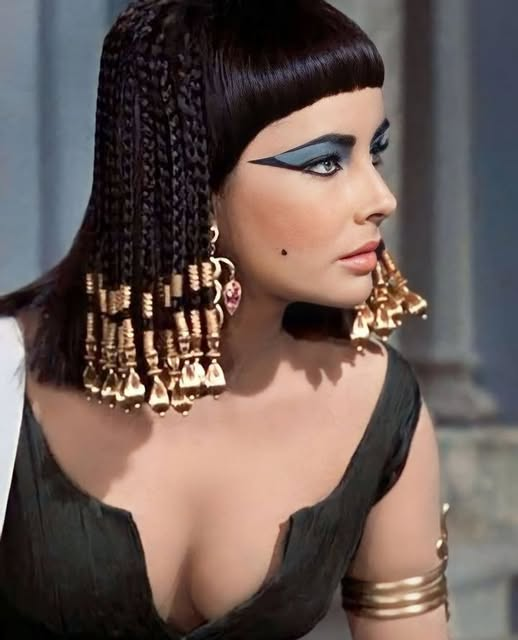
In 1963, Elizabeth Taylor stood at the very pinnacle of her career, captivating the world with a rare combination of talent, beauty, and mystique that no other actress could quite replicate.
With her unforgettable violet eyes, radiant screen presence, and commanding performances, she had already secured her place as one of Hollywood’s most bankable stars.
Yet 1963 would prove to be more than just another successful year; it was a turning point that forever cemented her legacy, both as a Hollywood icon and as a symbol of enduring glamour, resilience, and cultural influence.

Professionally, that year marked the release of Cleopatra, the epic historical drama in which Taylor portrayed the legendary Egyptian queen. The production became infamous for its massive budget, delays, and behind-the-scenes turmoil, but at its core was Taylor’s unforgettable performance.
She imbued Cleopatra with a combination of regal authority, sensuality, and human vulnerability, elevating the role beyond costume spectacle into something deeply compelling.
Her magnetic screen presence ensured that no matter how grand the sets or elaborate the costumes, all eyes remained fixed on her.
For her work, she became the highest-paid actress in the world at the time, a groundbreaking achievement that shattered barriers for women in film and demonstrated her unmatched power within the industry.
Cleopatra was more than a film—it was an event. Its record-shattering production costs and box-office ambitions reflected both the extravagance of Hollywood in the 1960s and the willingness of studios to gamble everything on star power.
While critics debated its merits, audiences were enthralled by the spectacle, and Elizabeth Taylor’s image as Cleopatra became one of the defining visuals of the decade.
The heavy eyeliner, golden headdresses, and flowing gowns turned her into a global fashion influence, inspiring designers, photographers, and ordinary women alike. Even today, images of Taylor in that role remain instantly recognizable symbols of cinematic glamour.

But the impact of Cleopatra went beyond the screen. It was during filming that Taylor’s relationship with her co-star, Richard Burton, began to unfold—an affair that quickly became one of the most talked-about romances in Hollywood history.
Their chemistry was undeniable both on and off the set, and though their love story was often tumultuous, it captivated the world. The Taylor-Burton romance dominated tabloids, magazine covers, and red carpets, turning them into the ultimate celebrity couple of the 1960s.
Their marriage was as passionate as it was volatile, but together they embodied the allure and excess of an era when Hollywood stars were larger than life.
The public fascination with Taylor and Burton also marked a cultural shift. Their relationship blurred the lines between private life and public spectacle, setting the stage for the modern era of celebrity culture.
Every detail of their romance—from their extravagant lifestyle to their fiery arguments—was reported and consumed by millions, making them the first true “super couple” of the entertainment industry.
Taylor, in particular, managed to navigate the scrutiny with remarkable resilience, embracing her humanity rather than hiding behind a carefully manufactured image.

What made Taylor unique in 1963, and indeed throughout her career, was her ability to balance vulnerability with strength. She was undeniably glamorous, draped in diamonds and couture, yet she remained relatable in her openness about love, heartbreak, and personal challenges.
She did not shy away from her imperfections or her passions, and it was this authenticity that allowed audiences to connect with her on a deeper level.
While many stars of the time carefully guarded their public personas, Taylor’s willingness to live fully and unapologetically made her a figure of fascination and admiration.

The year 1963 thus stands as a defining chapter in Elizabeth Taylor’s life—a moment when her artistry, her personal life, and her cultural significance converged on a grand scale. Her performance in Cleopatra demonstrated her extraordinary talent and cemented her as one of the greatest screen actresses of her generation.
Her romance with Burton, though controversial, redefined the idea of the celebrity couple and helped shape the modern media landscape. And through it all, she emerged not just as a star, but as a phenomenon who embodied both the triumphs and contradictions of Hollywood itself.
Decades later, Taylor’s legacy continues to resonate. Her portrayal of Cleopatra remains a landmark in film history, not only for its sheer spectacle but for the way she transformed a historical figure into a living, breathing presence.
Her influence on fashion is still visible in the bold use of eyeliner, statement jewelry, and dramatic silhouettes that echo her iconic look.
And her resilience in the face of media scrutiny paved the way for future generations of performers who would also live their lives under the unrelenting gaze of the public.

Elizabeth Taylor’s story reminds us that true stardom is about more than fame or beauty—it is about impact. In 1963, she showed the world that a woman could command the screen, captivate the press, and live life on her own terms, all while leaving behind a legacy that transcended entertainment.
She was not simply an actress in a grand costume drama, but a queen in her own right: a ruler of cinema, of style, and of the hearts of millions who still remember her as one of the greatest stars the world has ever known.