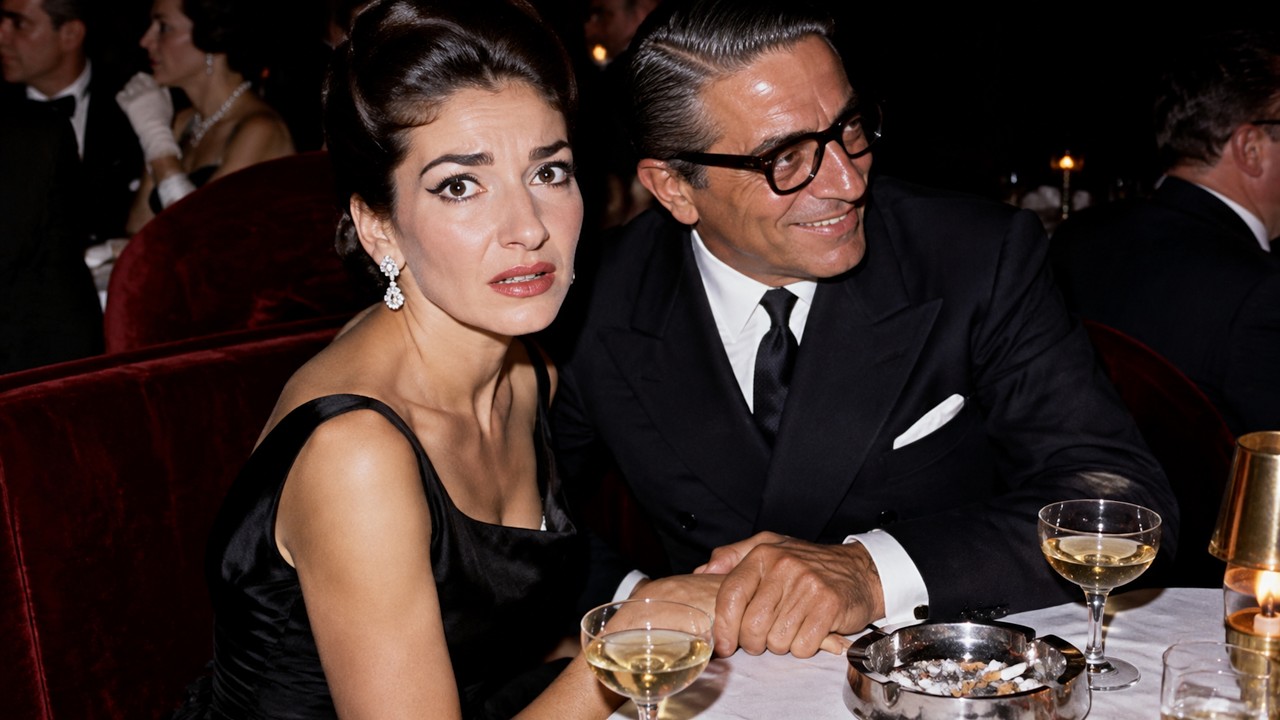
The world called it the greatest romance of the century, a tempestuous 𝒶𝒻𝒻𝒶𝒾𝓇 between the world’s most celebrated soprano and its most flamboyant shipping magnate. But the true record, drawn from private letters, court documents, and the testimony of those who were at the table, reveals a story of systematic control, public humiliation, and a woman systematically stripped of her voice, her fortune, and her dignity. The fairy tale of Maria Callas and Aristotle Onassis was, in reality, a nine-year ordeal that ended with her discarded for a more famous woman, her legacy rewritten by the very man who, by all accounts, destroyed her.
The stage was set on a summer evening in London in 1959. Maria Callas walked onto the stage of the Royal Opera House as Medea, the sorceress who sacrifices everything for a man only to be cast aside for a more advantageous match. It was a role that would prove terrifyingly prophetic.
In the best seats in the house sat Aristotle Onassis, who had purchased a raft of the most expensive tickets for his entourage, turning the opening night into what one account called a society circus. The opera was a tragedy about abandonment, and the man who would abandon her was watching from the front row. Five weeks later, she would board his yacht, and the tragedy would begin to unfold in real time.
The meeting that ignited the 𝒶𝒻𝒻𝒶𝒾𝓇 had occurred two years earlier in Venice, in September 1957, at a party thrown in her honor. The accounts of the exact location differ, with some placing it at the Hotel Danieli and others on the beach of the Excelsior on the Lido. What is consistent is that they spoke Greek all evening, a deliberate act of exclusion that shut out their respective spouses and the rest of the party.
The introduction was made by Elsa Maxwell, the American gossip columnist, who, according to biographer Anne Edwards, was obsessively in love with Callas herself. Maxwell, a professional party-giver whose trade was introductions, had a collection that year with one prize above all others, and she placed the two most famous Greeks in the world in the same room.
Onassis later described the initial attraction to Spyros Skouras in words preserved by his biographer Peter Evans. There was just a natural curiosity, he said. After all, we were the most famous Greeks alive in the world.
It was a statement that revealed his core motivation. He was a refugee from Smyrna who had built a fleet of oil tankers and one of the largest private fortunes on Earth. She was the daughter of Greek immigrants, born in New York in December 1923, who had transformed herself into the most talked-about singer in the world.
Each had become famous by refusing to stay where they were born, but their similarities ended there. His power was financial and absolute. Her power was artistic and, as it would turn out, entirely conditional.
By the time they met, Callas had undergone a physical transformation that made her a photographic icon. Across 1953 and 1954, she had lost a staggering amount of weight, with accounts ranging from 65 to nearly 80 pounds. A large young woman became, in a little over a year, a symbol of glamour.
Several musicians who worked with her came to believe that this transformation began the slow undoing of her voice. The camera loved it anyway, but the vocal price was being paid in secret. Her fame by then had a sharp edge.
In 1958, she had stopped singing Norma in Rome after the first act with the President of Italy in the audience, and the audience reacted with outrage. That November, the general manager of the Metropolitan Opera, Rudolf Bing, fired her by telegram. The press had a word for her, and the word was difficult.
I am not an angel, she once said, and do not pretend to be.
The financial gulf between them was a chasm that defined their relationship from the start. At her debut in Verona in 1947, she had been paid 40,000 lire a performance, about 63 dollars. By the middle of the 1950s, La Scala was paying her 650,000 lire a night, more than a thousand dollars.
In 1959, Time magazine put the fortune of Aristotle Onassis at about 300 million dollars. A soprano at the very top of her profession could have sung every night for the rest of her life and never come close to that figure. This disparity in wealth was not just a matter of lifestyle; it was a matter of control.
She was a woman who earned a fortune, but he was a man who owned the world. And he knew it.
The man she was married to at the time, Giovanni Battista Meneghini, was a brick manufacturer from Verona, born in October 1895. He had found her in the summer of 1947 when she came to the Arena di Verona to sing La Gioconda. She was 23, heavy, and badly short-sighted.
He was 51, a businessman, and a lover of music. They married on April 21st, 1949, with about 27 years between them. In the decade that followed, he sold his business, put the proceeds into property, and made himself her sole agent and impresario, the man who negotiated every contract and collected every fee.
He was famous in the opera houses for one habit in particular. He took her money in cash at the stage door before her performances. At the Metropolitan Opera, the custom so annoyed Rudolf Bing that he once paid Meneghini in five-dollar bills to make the bundle as awkward as possible to carry.
This was the system she lived inside, and it was perfectly ordinary for the time. A husband who managed his wife’s career managed her earnings, too. Contracts went through him.
Accounts were in his hands. Property was bought in his name. The bigger her fees became, the more of her life passed through his hands.
She had, in a sense, always been managed. First by a mother who lied about her age to get her into the conservatory, then by a husband who kept the cash. Every stage of her rise had been organized by someone who also took a share of it.
Years later, in letters only published in 2021 by the biographer Lyndsey Spence, she wrote that her husband had robbed me of more than half my money. Spence, who worked from three collections of Callas’s papers bequeathed to archives in 2019, describes him as unfaithful and, in her phrase, highly predatory. In another letter, Callas wrote a line that sounds less like an accusation than a confession.
I was a fool to trust him.
In 1954, at the height of her rise, the couple had made a joint will, a single sentence in which each left everything to the other. It was the kind of paper a happy marriage signs and forgets. It would come back twice, first to claim her property during their separation, and later to claim her entire estate after her death.
By the summer of 1959, by her own later account, the trouble in the marriage had been building for a long time. She was 35, thinner and more glamorous than the girl he had met in Verona. He was in his 60s.
Then the invitation came. Onassis wanted them both aboard his yacht for a cruise along with the Churchills. Callas, by the account of her close friend Giovanna Lomazzi, did not want to go.
She had already arranged a cruise in the Aegean with friends. It was the husband who changed her mind. It was Meneghini who convinced her to accept the invitation, Lomazzi said.
Then she added the sentence that has followed him ever since. It was Meneghini who unknowingly accompanied his wife into the arms of another man.
On July 23rd, 1959, a photographer at Monte Carlo caught Callas and Onassis together on the deck of the Christina. Monte Carlo was his harbor in more ways than one. Since about 1953, through companies registered in Panama, Onassis had controlled the Société des Bains de Mer, the company that owned the Monte Carlo Casino and the Hôtel de Paris.
He did not visit the Riviera. He owned a large part of it. The yacht was the stage, and it had been built for spectacle.
Before it was a yacht, it had been a Canadian frigate called Stormont, which escorted convoys across the Atlantic during the war. Onassis had bought it as navy surplus and rebuilt it as a floating palace. The swimming pool on the afterdeck had a mosaic floor that rose at the push of a button to become a dance floor.
It was 325 feet long. Winston Churchill, retired, revered, and 84 years old that summer, would make eight cruises aboard her between 1958 and 1963. To be invited was to be told you belonged among the most important people alive.
The hostess was the owner’s wife, Athina Livanos, called Tina, the daughter of a shipowner. She had married Onassis in December 1946 when she was 17 and he was 40. In the society pages, she was the young queen of this floating kingdom.
The society pages did not know the rest. By the middle of the 1950s, by Peter Evans’ account, the Onassis marriage had already become two separate lives after Tina found her husband in bed with a friend of hers at Cap d’Antibes. By the late 1950s, by the accounts of those around her, Tina had begun a discreet life of her own.
The hostess of the most famous private vessel in the world was presiding over a marriage that existed mainly in photographs.
That summer, the guests at her table were Sir Winston and Lady Churchill, members of the Churchill family, Maria Callas and Callas’ husband. The voyage followed the Greek and Turkish coasts for about three weeks. The biographers who later reconstructed the voyage from the memories of those present agree on the shape of it.
When the Christina left Monte Carlo, the host and the soprano were two famous Greeks enjoying each other’s company. By the time the yacht turned for home, it was an 𝒶𝒻𝒻𝒶𝒾𝓇 and the people at the table could see it. Not all of them.
The most famous passenger of all, by the reports, noticed nothing. Winston Churchill sailed on through the summer, attended, driven to the temples, seeing only a holiday. The hostess saw more.
And so, at last, did the husband.
The husband’s moment came in Turkey. Meneghini told Time magazine afterward that it was after a party at the Istanbul Hilton that his wife told him she loved another man. Later, he said, she admitted the man was Onassis.
One account of that night, drawn from Spence’s work, has him calling her an animal and asking how she could let herself go. Her reply, in that account, was three words. I love him.
Gage gives her a longer answer and it sounds like her. Ari and I have been caught up in this twist of fate, she told her husband, and we are unable to combat it. It is a remarkable sentence for a woman to say to the man who has managed her life for 10 years.
There is no apology in it and no plan. It is the language of the operas she sang, the language of fate and helplessness. She had spent her career singing women caught by fate.
Now she had found the words for herself.
Tina left. She took the children and went to Paris. To the reporters, she said one thing and Time printed it.
She completely trusts her husband. It was the line a wife of her class was expected to give. And everyone who read it knew what it meant.
The newsreel cameras had no idea either. On August 13th, 1959, British Movietone released its film of the Christina arriving at the Greek island of Chios. The story’s title is Sir Winston in the Sun.
The film shows two marriages ending and calls it a holiday. Within three weeks of leaving the yacht, the 𝒶𝒻𝒻𝒶𝒾𝓇 was public. On the night of September 3rd, 1959, a photographer named Nicola Giordano waited outside a Milan nightclub into the early hours.
That afternoon, Onassis flew in from Venice on his private plane. At about 10:00 that night, he and Callas walked into the Montemarlo nightclub. They dined.
They danced. They stayed about five hours. When they finally came out, Giordano was still there, and they smiled for him.
The agency’s own caption, written on the back of the print, survives in the Publifoto archive. It calls the picture one of the shots of the Callas-Onassis 𝒶𝒻𝒻𝒶𝒾𝓇. It records that this was the first photograph of the two of them together in public.
The husband found out how the rest of the world would see it soon enough. By the middle of September, the couple announced that they were separated, in Time’s words, definitely and irreparably after about 10 years of marriage. Each told the story that protected them.
Callas said the timing was a coincidence. The split, she insisted, had been building for a long time. She pointed to the friction over her husband’s role as her private impresario, and said she would no longer share her earnings with him.
Onassis called the reports childish. We are simply good friends, he said. He also made a joke, which Time printed.
Sailors, he said, did not usually court sopranos, though he would be flattered to win a woman of her class. It was the kind of line that sounds gallant on the page and lands very differently on the woman it describes. A woman of her class.
 As if she were a ship. He would keep to that story for a long time. Even after she had left her husband for him and was living as his companion, he was still telling people, by Gage’s account, that he loved Maria dearly, but that they were just good friends.
The phrase cost him nothing. For her, it meant that the man she had given up her marriage for would say in public that there was nothing to give it up for.
Meneghini had no talent for jokes. He gave Time the sentence that the papers of the world repeated. I created Callas and she repaid me with a stab in the back.
He insisted that he had never exploited her. And he made one accusation against the shipowner that shows exactly how he understood the world. Onassis, he said, wanted to use her famous name to promote his tankers.
A man who had spent 10 years turning his wife’s name into money could imagine no other reason a man might want her. Then her mother spoke. Evangelia Callas was estranged from her daughter and she spoke, too.
Meneghini, she told the press, had sent her 40 dollars while Maria had sent nothing. Her daughter, she said, will never be happy. Women like her, she added, can never know real love.
Even the woman who had introduced them did not believe in the ending. Asked whether Callas and Onassis would marry, Elsa Maxwell answered in three words, I guess not.
On November 14th, 1959, Maria Callas arrived at the civil court in Brescia with her friend Giovanna Lomazzi at her side. She had come for the hearing in her legal separation case. She had not come for a divorce, because in Italy there was no divorce to be had.
The law that allowed one would not be passed until 1970. That single fact shaped the rest of her life. A separated wife in Italy remained a wife.
She could not remarry. Her husband remained her husband with whatever claims the marriage gave him for as long as the state said so. The property they had to divide was the fortune of a decade at the top.
Time listed it that autumn. A villa at Sirmione, two palaces in Verona, art, jewelry, cars, motorboats, joint bank accounts. What came next was uglier, and it comes to us from the papers Lyndsey Spence worked through.
When Callas returned to Milan, by that account, Meneghini had moved into her house. He invoked their will of 1954, the one sentence in which each had named the other as heir to claim her property. She said she was left homeless.
In 1960, she accused him of being, in her words, not normal, and asked for police protection from his harassment. Her husband, she wrote, was a louse, a man who passes for a millionaire when he hasn’t got a dime. She described him moving her assets into his own name, and she wrote simply, My husband is still pestering me.
He had his own version, which he gave at length in a memoir completed after his death by the writer Renzo Allegri, and published in 1982. In it, he recalls her complaints. You act like my jailer, she told him.
You never leave me alone. She said she was suffocating. He recorded them as her complaints.
Read today, they sound like a woman describing exactly the arrangement the law had placed her in. He insisted that he was the only person in the world who truly knew her. A reviewer for the Washington Post, reading the memoir, reached a gentler and more devastating verdict.
Meneghini, the reviewer wrote, seldom understood exactly what was happening to him. The years tell the story of a marriage that outlived itself on paper. They had married in 1949.
They had signed the joint will in 1954. They separated in 1959. Italy legalized divorce in 1970.
A court in Brescia granted the divorce on July 22nd, 1971, and he appealed it. For 12 years after she walked off the Christina, Maria Callas was still legally the wife of the man she had left. By Spence’s account, he spent much of that time demanding that she pay part of his legal costs.
Across the Atlantic, the other wife from the cruise was moving faster because she could. Tina Onassis filed for divorce in New York on the grounds of adultery and asked for custody of both children. The divorce was final in June 1960.
A rich wife in New York could buy her way out of a marriage in a year. A famous wife in Milan could not buy her way out at any price. Set the two outcomes side by side, and the machinery is plain.
Within a year of the cruise, Aristotle Onassis was a free man. Within two, his former wife had a new husband and a title. Maria Callas, whose love 𝒶𝒻𝒻𝒶𝒾𝓇 had ended both marriages, remained married in law to Giovanni Battista Meneghini for another decade.
Of the two women on that yacht, she was the one who could not move. The law decided what a woman’s choice was worth. And in her case, it was worth very little.
In December 1959, the Italian magazine Annabella reported that Maria Callas looked pale and unwell, and she threatened to sue. Callas denied that she was pregnant. What happened in the first half of 1960 is the most disputed question in her whole life, and every version of it comes from someone who knew her, wrote about her, or had a reason to be believed.
Abortion was illegal in Italy until 1978. Everything we have is second-hand. The first version belongs to Nicholas Gage, and it was published in 2000, more than 20 years after her death, in his book Greek Fire and in excerpts printed by Vanity Fair.
Gage says that a boy was born to Maria Callas in Milan on March 30th, 1960. And that the father was Aristotle Onassis. In his account, Callas was about seven months pregnant at the start of that year and pressed her obstetrician into an early cesarean section.
The child, he says, was named Omero Lengrini. He lived only hours and was buried in a cemetery in Milan. Gage offered evidence.
Documents, he says, were found among her private papers. A death certificate. A blurry photograph that appears to show a dead infant, which he says Callas kept with her always.
His most important witness was the woman who had looked after her since 1953. Bruna Lupoli, her maid, told Gage that Callas never got pregnant except that one time when the baby was delivered in the eighth month and lived for one day. The death, Bruna said, haunted her for the rest of her life.
She made special trips from Paris to Milan to visit the grave.
The second version belongs to her close friend. And it overlaps with Gage at the point that matters most. Giovanna Lomazzi, in her interview of 2017, said that Callas’s only child was the child with Onassis.
But it was born prematurely and died soon after. Lomazzi also said something Gage’s account leaves out. Onassis, she said, told the doctor that would pay any sum as long as it was aborted.
She wanted to give birth to the baby, Lomazzi said. She wanted to create a family. Then, with the honesty of a close friend, she added her own reading of it.
I think that she wanted it only to cement her relationship with Onassis. A popular summary of Lyndsey Spence’s research, published in Australia in 2021, gives a darker and less consistent picture. In it, Callas tells the French newspaper France-Soir, early in 1960, I want to have a baby.
Onassis orders her to end the pregnancy and offers any amount of money. In Brussels, she cancels a concert because of tracheitis, and then she miscarries. Spence herself, in her biography, reaches a third conclusion.
She writes that Callas suffered miscarriages in 1960 and again in 1963, both at times when Onassis was away. After the first, Spence says, Callas no longer wanted to sing. She wanted a family.
Then, there is the case against Gage, and it is strong. Spence argues that a baby called Homero Lengrini really did exist and had nothing to do with Callas. The Clinica Desta in Milan, she points out, served unmarried mothers through a nearby convent.
Lengrini is the name of a hamlet near the Swiss border, the sort of place name given to children registered without a father. And the boy’s mother was reportedly an unmarried teenager. The documents Gage relied on were issued in 1998, 21 years after Callas died.
Her sister, Jackie, wrote to Gage on September 18th, 2000, to say that Maria could not have hidden a late pregnancy. Onassis’ niece said the same. One doctor called a voluntary cesarean in that era a fairy tale.
Another, a former friend of Gage, called the account professionally and scientifically untenable. And Meneghini, in his book, stated flatly that his wife could not have children at all. What is left when the versions are laid out is still a great deal.
She was 36 that spring. Almost everyone close to her agrees that she was pregnant by Onassis at least once. Almost everyone agrees that the ended in loss.
And in every version except Gage’s, the man she loved wanted it ended. And in two of them, he offered money to make it happen.
The calendar of the next five years tells the story of her career’s end better than any adjective. On December 7th, 1960, she opened the season at La Scala in Donizetti’s Poliuto. Her return to that house after two seasons away and the last new role she ever learned.
In 1961, she sang Medea at Epidaurus. In the season of 1961 to ’62, she sang Medea at La Scala. And those were her last performances in the theater that had made her.
After that, for almost two years, there was hardly any opera at all. When she appeared, it was mostly in concert. One of those concerts was in New York on May 19th, 1962 at the birthday gala for President Kennedy at Madison Square Garden.
She sang the Habanera from Carmen. That was the night Marilyn Monroe sang Happy Birthday. And at the private party afterward, in the apartment of the producer Arthur Krim, Callas and Monroe met for the first and only time.
The numbers of her stage life show what was being given up. Between 1947 and 1965, she sang 38 different roles on the stage. She sang Norma alone 84 times.
In the summer of 1960, she sang three Normas for 15,000 dollars and gave the money away. By 1962, at 38, she was singing almost none.
Why did it happen? Part of it was the voice. The trouble had begun before Onassis.
Her own producer at EMI, Walter Legge, had joked to Callas herself that they would need to give away seasickness pills with every side of one of her recordings. Joan Sutherland said that nobody who heard Callas after about 1955 really heard the Callas voice. Her colleague Tito Gobbi disagreed.
I do not think anything happened to her voice, he said. I think she only lost confidence. Lyndsey Spence describes a woman who could no longer reach high notes on some nights and could on others, and who did not know why.
In Copenhagen, Spence writes, people in the audience went home to play her records, saying she was a shell of herself. Years later, doctors would give the disease a name. In 1962, nobody had one.
 Part of it was the life she now led. The biographer Michael Scott wrote that Onassis offered her a way out of a career increasingly undermined by 𝒔𝒄𝒂𝓃𝒹𝒶𝓁 and failing vocal resources. Callas herself reportedly said that Onassis did not want her to sing.
When Franco Zeffirelli asked her in 1963 why she had stopped practicing, she gave him an answer that has been quoted ever since. I had been trying to fulfill my life as a woman.
And part of it was the man. Onassis had little interest in opera. By Gage’s account, he mocked it as a lot of Italian chefs shouting risotto recipes at each other.
His children, by the same account, hated her and called her by a Greek nickname, Kolou, which translates as big ass. Giovanna Lomazzi, who watched those years closely, put it plainly. He treated her badly and he didn’t care anything about music or opera.
Then she said the sentence that sums up the whole decade. For him, Maria Callas was a trophy to exhibit. And finally, Onassis certainly contributed to the end of her career.
A trophy is displayed among other possessions and soon there were others. Lee Radziwill, the younger sister of the first lady, came aboard the Christina as Onassis’ guest and she received his clear special attention while Callas was aboard to see it. Gage dates the first of these cruises to June 1962.
I hate Lee, Callas reportedly said. I hate her. On one cruise in those years, by Spence’s account, Callas moved a piece of furniture aboard the yacht and Onassis corrected her.
You are not the housewife here, he told her. You are only a guest.
In August 1963, Lee Radziwill appeared in public with Onassis at the opening of the Athens Hilton. In October, the first lady, Jacqueline Kennedy, accepted an invitation made through her sister to vacation aboard the Christina. Callas was not aboard.
By one Italian account, Onassis asked her to stay ashore, telling her it was not appropriate to entertain the first lady of America in the company of his mistress. That was the word, if the account is right. Four years into the life she had given up her marriage for, that was what she was called.
She went back to work. In January and February 1964, she sang Tosca at Covent Garden in Zeffirelli’s production. On March 19th, 1965, she returned to the Metropolitan Opera for the first time in 7 years in Tosca.
In the audience, by the account of the conductor, John Mauceri, sat Jacqueline Kennedy beside Elsa Maxwell. Mauceri remembers a high note that went wrong. The New York Times critic, Harold Schonberg, remembered something else.
This was supreme acting, unforgettable acting. Then the end came quickly. In May 1965, she sang Norma at the Paris Opera and stopped after the fifth performance as she had stopped in Rome 7 years before.
On July 5th, 1965, she sang Tosca at Covent Garden. It was her last performance in a staged opera. She was 41.
In 1966, at the American Embassy in Paris, the woman born in New York signed away her American citizenship. It was a legal act with a precise effect. As a citizen of Greece and nothing else, she came under Greek law, and Greek law recognized for its own citizens only a marriage made in the Greek Orthodox Church.
Her wedding to Meneghini had been Catholic. In Greece, from that moment, the marriage could be treated as dissolved. For 7 years, Italy had kept her bound to a husband she had left.
Now, in one country at least, she was free. The renunciation also ended her obligation to pay American taxes on what she earned. But the reason most retellings give is simpler than taxes.
One Italian account says she did it hoping for a marriage that never came. He did not marry her. The door she had opened led nowhere, and the year she opened it was, by the evidence of her own papers, among the darkest of the whole 𝒶𝒻𝒻𝒶𝒾𝓇.
In 2019, three large collections of Callas’s letters and papers were bequeathed to archives. Lyndsey Spence worked through them and her book, published in 2021, changed what can honestly be said about these years. The first thing in the papers is a pregnancy.
Spence writes that Callas became pregnant by Onassis for a third time in 1966 and that she likely ended it with an abortion. This was the story told for decades before Spence. The biographer Arianna Stassinopoulos had written in 1981 that Callas had an abortion that year at Onassis’s request and she gave his reason in a single sentence.
Onassis said he would end their relationship if she kept this child. Nicholas Gage rejected it. His witness was Bruna, who told him, Madame never had an abortion in 1966, 1967, or any other time.
The question is still open. What the accounts of an abortion agree on is that a choice was put to her and that the man making it held all the cards.
The second thing the papers describe is the hardest to hear. Spence writes that letters about Onassis reveal a terrifying ordeal, above all in 1966, when his physical violence threatened Callas’s life. One account of Spence’s research describes a letter recorded in the diary of one of Callas’s closest friends about an encounter with him that year that turned violent enough to put her life in danger.
Spence also writes that he was physically abusive more generally, and that he used verbal 𝓪𝓫𝓾𝓼𝓮 the same way, calling her accusations of infidelity pathetic and telling her she was paranoid. The third thing is the pills. Spence tracked down the neurologist who treated Callas near the end of her life, and she concluded that Callas had suffered from a neuromuscular disorder whose symptoms began in the 1950s.
Symptoms her doctors had dismissed as crazy. In the meantime, she was medicated. Spence writes that a doctor in the 1950s had given Callas what were called liquid vitamins, which one account describes as speed, and that Onassis later introduced her to the barbiturate pentobarbital and to Mandrax, a powerful sedative, and that she became addicted.
The friend’s diary goes further. It alleges that Onassis drugged her, mostly, the diary says, for sexual reasons. Spence’s own words for it are blunt.
It is what, today, we would class as date rape. It rests on one diary. It is an allegation.
It is also written down in a friend’s diary.
None of this was visible from outside. The reviewer, Sally Bedell Smith, writing in The New York Times, summed up what the world did see of the couple in those years. They alternately adored and raged at each other, she wrote, and found excitement in fisticuffs and thundering curses.
It was the kind of line that made the 𝒶𝒻𝒻𝒶𝒾𝓇 sound like grand passion. Two temperamental Greeks on a yacht. The jet-set’s most photographed couple were supposed to fight.
That was part of the glamour. Spence offers a reason he wanted her at all. Onassis, she says, did not want to be with just a bland woman.
He was drawn to her celebrity, and he could control her emotionally in a way he had never been able to control his wife. Set the public image against the private one. On one side, the diva and the tycoon at Maxim’s, on the deck of the Christina, in the society columns of Paris and Monte Carlo.
On the other, a woman of 42 who had given up her stage, her marriage, and her American citizenship, writing letters about a man whose violence frightened her, and sedated with drugs that, by Spence’s account, he had brought into her life. The clearest sentence in the papers is a small one, and it carries no date. Callas wrote it to her secretary.
She did not want Onassis to telephone her, she said, because she did not want him to start again torturing me. It is the voice of a woman who had stopped waiting for the phone to ring and had started dreading it.
In March 1968, by Nicholas Gage’s account, Maria Callas finally asked Aristotle Onassis the question, When are you going to marry me? She had waited nine years to ask it. She had left her husband, given up the stage, and signed away her American citizenship.
At the end of 1967, she had bought an apartment of her own in Paris, on the third floor of 36 Avenue Georges Mandel, paid for with her own money. She was 44. If she was ever going to be his wife, it would have to be soon.
In Gage’s telling, he said yes. He agreed to marry her and took her to London for the ceremony. For the license, she needed her birth certificate, and her birth certificate was in New York, where she had been born.
By the time it arrived, the two of them were quarreling, and whatever he had intended had cooled. The wedding that was supposed to happen in London never happened anywhere. Three months later, the world changed for the woman who would take her place.
On the 5th and 6th of June, 1968, Robert Kennedy was shot and killed. His brother’s widow, Jacqueline Kennedy, was afraid for her children and, by the accounts of her friends, wanted to leave the country.
That August, Callas was aboard the Christina. By Gage’s account, Onassis told her she had to leave the yacht because important visitors were expected. She was humiliated and she went back to Paris.
The visitor was Jacqueline Kennedy. It is the moment the 𝒶𝒻𝒻𝒶𝒾𝓇 turns from cruelty into something like a ceremony. Nine years earlier, she had stepped aboard that same yacht as a guest and stepped off it as his.
Now she was being asked to step off it so that someone more important could step on. Lyndsey Spence records a line he gave her as she went. Go back to Paris and wait for me.
How Callas learned that he meant to marry Jackie Kennedy depends on whom you read and the versions do not fit together. One account says she knew about 3 weeks before the ceremony. Spence’s research says she found out from his butler and from the newspapers.
Another biographer says she knew only a few days ahead. And then there is the version everyone remembers that she opened a Paris newspaper and read it there along with everyone else. The biographers do not bear it out.
What the accounts share is the silence. He did not tell her himself. By Spence’s account, Callas said so.
And the sentence is the saddest thing she has recorded saying about him. The worst is that he never told me anything about his marriage.
On the evening of October 18th, 1968, two days before the wedding, Maria Callas went out in Paris. She wore a bright printed gown and diamonds. She went first to the premiere of a Feydeau farce, and then to the party at Maxim’s for its 75th anniversary.
And she smiled for the photographers because the alternative was to be photographed not smiling. When the reporters asked her about the marriage, she had her line ready. Mrs.
Kennedy, she said, by Gage’s account, had done well to give a grandfather to her children. And Onassis, she added, was as beautiful as Croesus. It is one of the great exits in the history of the society pages.
A woman being publicly discarded in diamonds with a joke about money and age on her way to a party. The photographs from that night are the image the world kept. The private reality, two days later and far away on a Greek island, was a wedding she had not been invited to and had not been told about.
On October 20th, 1968, in the small whitewashed chapel of the Panagitsa on Skorpios, in a light rain, Aristotle Onassis married Jacqueline Kennedy with her children Caroline and John beside her. The reception was held aboard the Christina, the yacht Callas had been sent away from 2 months earlier.
Within weeks of the wedding, by Arianna Stassinopoulos’s account, the bridegroom was standing in the street below 36 Avenue Georges Mandel whistling. He whistled for her, Stassinopoulos writes, and then called her name, and then threatened to drive his car through the front door while her servants told him at the door that Madame was not at home. The New York Times reviewer, Sally Bedell Smith, gave the same scene in fewer words.
 Onassis, she wrote, was back at her door shouting, whistling for Madame to let him in. He kept an apartment on Avenue Foch, a short distance away. He was married to the most famous woman in the world, and he was standing in a Paris street shouting up at a window.
In December 1968, the two of them were photographed together at the opening of a play in Paris. The wedding was 2 months old. The next summer, she made a film between May 7th and August 16th, 1969, in Cappadocia, in Syria, and in Italy.
She played the title role in Pier Paolo Pasolini’s Medea. It was a part without singing, and she did not sing a note of it. On location, she fainted in a dried riverbed in full costume, and when she came round, apologized for the time she had cost the production.
Her fellow actor, Giuseppe Gentile, later recalled that Onassis telephoned her every night during the filming, and that the calls distressed her. She was playing Medea again, this time without her voice. The woman abandoned for a better match, and the man who had done it to her was on the telephone.
The people closest to him said he never let her go. His private secretary, Kiki Feroudi Mousatsos, wrote that they never stopped seeing each other, never. That she arranged many of the secret meetings herself, and that he was proud of keeping the 𝒶𝒻𝒻𝒶𝒾𝓇 going after his marriage.
He couldn’t live without her, she said. Maria was a piece of his soul, of his body, of his brain. His driver, Yacinto Rossa, said they met every month until his death, and called her his one true love.
Onassis himself, speaking to his own semi-official biographer, put it more coldly. There was an affinity between us, he said. No more than a friendship.
The biographer, Peter Evans, who met him in his last years, reached a harder verdict than either. Onassis, Evans wrote, probably loved her more than he ever loved anyone. And he also destroyed her.
Against that stands the record. From the beginning of 1972 to his death, there is not one dated, independently confirmed meeting between them. Spence offers a different picture altogether.
Callas, she writes, had moved on, and the two of them became friends. She was working again in her own way. She gave 23 master classes at the Juilliard School in New York between October 1971 and March 1972.
And from October 1973, she toured the world in recitals with the tenor Giuseppe di Stefano, ending in Sapporo in November 1974. She was living her own life.
In 1974, Barbara Walters asked her about the woman he had married. I’ve never met her, Callas said. We’re not friends.
I’ve just never met her. Asked whether there was bad feeling, she said, Not at all. Why should I?
And on marriage itself, she offered a line that sounds, after everything, like a verdict. I think love is so much better when you’re not married. By then, his world was falling in.
His marriage had become, by the accounts of his biographers, a shell. And in 1974, by Stassinopoulos’ account, he moved to divorce his wife. His closest business associate, Constantine Gratsos, showed her the papers.
They were never filed. On January 23rd, 1973, his only son, Alexander, died at 24 of injuries from a plane crash at Athens the day before. And by every account, the father never recovered.
He developed myasthenia gravis, a disease that drooped his eyelids so badly that by published accounts, he taped them open in order to see. In February 1975, he was flown to the American Hospital of Paris at Neuilly. After about 5 weeks there, on March 15th, 1975, he died.
His daughter, Christina, was with him. His wife was in New York. In those last weeks, Callas was, by one account, in great distress.
Whether Callas saw him at the end is one of the great unresolved questions of the story, and the accounts flatly contradict one another. Moutsatsos says Callas made one secret visit to his room, timed around the visits of his daughter and his wife and that Callas already knew from his doctor that there was no hope. Another account says she was brought up secretly in the service elevator and sat with him for an hour while he was in a coma.
One version derived from Peter Evans has her leaving Paris for Palm Beach 5 days before he died. One summary says Jackie told the staff that Callas was not to be allowed in and Gage reports words Onassis is said to have left her that he had loved her, not always well but as well as he could and that he had tried.
There is one more detail and it needs a hedge. Several accounts say that the only personal thing he took into the hospital for that final stay was a red cashmere blanket Callas had given him. And one reporter wrote that it covered him the moment he died.
The detail is too perfect for comfort and the sources for it are thin. The captain of the Christina, for his part told Gage that Callas was the one who grieved and the one who had loved him most. Moutsatsos said that after the death, Callas lost the will to go on.
She didn’t want to live anymore the secretary said. She lost her appetite to live. The money settled the question that the love could not.
Onassis died with a fortune estimated at about 500 million dollars. His widow, after a dispute with his daughter reached a settlement in 1977 that was widely reported at 26 million dollars. Callas after 9 years at his side and 6 more on the edges of his marriage, received nothing because in law there was nothing for her to receive.
She had no ring, no contract and no standing. One asset he had given her, by one account, was a controlling share in a freighter valued at 3 million dollars. Even that, even that, as it turned out, would not stay hers.
On Friday, September 16th, 1977, Maria Callas asked for an orangeade in her bathroom in Paris, and her maid heard her fall. It was about half past 1:00 in the afternoon. She had eaten breakfast and said she was very thirsty.
Bruna brought the drink and was walking back toward the kitchen when she heard a thud behind her. She ran back and found Callas collapsed on the floor. Ferruccio, the butler, lifted her onto the bed.
By then, she was already gone. She was 53. The last two and a half years had been lived almost entirely inside that apartment.
Arianna Stassinopoulos called it less a home than a tomb for a legend. The director, Michael Cacoyannis, said he always had the feeling that Maria was living in someone else’s perfectly well-run house. Paris Match, two weeks after her death, described her days.
She listened to her own old recordings. She walked her poodles along the same three streets, the Rue de la Pompe, the Rue de Longchamp, and the Rue des Sablons. Her body had been failing for a long time and only near the end had anyone named the reason.
In 1975, a Roman professor, Mario Jacovazzo, was flown to Paris to examine her and diagnosed dermatomyositis, a disease that attacks the muscles. He found her hands full of nodules. She told him they were no longer the hands of Floria Tosca, but the hands of a laborer.
By his account, the steroids he prescribed helped for a time and she stopped taking them because they made her gain weight and went back to Mandrax. In August 1977, in that apartment with the pianist Vasso Devetzi at the keyboard, she sang for the last time anyone documented from Verdi’s La forza del destino, including an aria whose title translates as do not abandon me. On the day she died, Mandrax tablets were on the table by her bed.
By Spence’s account, the sedatives had been supplied by her estranged sister and by Devetzi. No autopsy was performed. The death certificate recorded cardiac arrest and it was signed by the family doctor of her butler.
When Giovanna Lomazzi reached Paris, the housekeeper would not let her in to see the body. I won’t let you see her. she was told.
You must remember her how she was. Lomazzi refused the easy explanation that followed. I exclude suicide.
she said. Then she said something worse. She let herself die.
Lindsay Spence, decades later, put it in medical terms. Her body gave up, she said. There are only so many pills you can take.
The years after her death read like a final account of who held the claims. 53 years of life, a death in 1977 with no will, an estate valued at about 8 million dollars in the press and more than 12 million by her biographers. Because she had died a Greek citizen, Greek law called her mother and her sister as heirs.
Then Meneghini produced the single sentence they had signed in 1954, each leaving everything to the other, and claimed the whole estate as if he was still her husband. The claim was settled out of court, half and half. When he died in January 1981, he left what he held, including that freighter Onassis had given her, to his housekeeper of 40 years, and disinherited his own nephews.
The one gift from her lover that the record traces ended in the hands of her husband’s housekeeper. The funeral was held on September 20th at the Greek Orthodox Cathedral in Paris. Princess Grace of Monaco came, and Italian accounts say she could not hide her anger at how hastily it had all been arranged.
Callas was cremated at Père Lachaise the same day. Her jewelry disappeared from the apartment and has never been accounted for. In December 2000, more than 400 lots of her possessions were sold at auction in Paris, her underwear among them.
Her ashes were stolen and recovered. And in the spring of 1979, they were scattered over the Aegean as she had wished. She had told Bruna, by one account, to scatter them on that sea so that she could embrace her Ari forever.
Lay the machine out one last time and it has five parts. A husband who held her money in his name and came back for her estate with a will. A law that would not let her leave him.
A lover who mocked her art, pressed her, in most accounts, to give up the child she wanted, frightened her badly enough to write about it, and sent her off his yacht when a more important guest was coming. A press that photographed every exit and called it romance. And a medicine cabinet.
Every part of it was run by someone else. She paid for all of it. So, what do we owe her?
We owe her the whole record, including the parts that make us uncomfortable. We watched the diva and the tycoon on the deck of the Christina. We bought the magazines from Monte Carlo and Milan.
We repeated the line that she gave up her voice for love because it was a beautiful line and it asked nothing of us. We chose not to see the letters, the clinic in Milan, the court in Brescia, the woman at the door telling her friend she could not come in. The legend says she died of a broken heart.
Her biographer argues that she died of a body that had been failing for years and of pills at the end of a long stretch of years in which every man and every institution around her took a share. She told her own story in the only language the world would applaud her for. She told it at Covent Garden in 1959, and she told it again on a film set 10 years later in a dried riverbed in full costume.
We applauded both times. Giovanna Lomazzi, who knew her better than almost anyone, described what was left at the end in a single sentence. Callas at that point was a woman without a career, friends, or love.
Go back then to the stage at Covent Garden on June 17th, 1959. A woman in the costume of a sorceress singing about a man for whom she has given up everything. In the expensive seats, the man who bought them and his friends.
The music tells everyone in the house exactly how the story ends. The woman who gives everything is set aside for a better marriage. She was singing it to him.
We were all there, and we called it a love story.