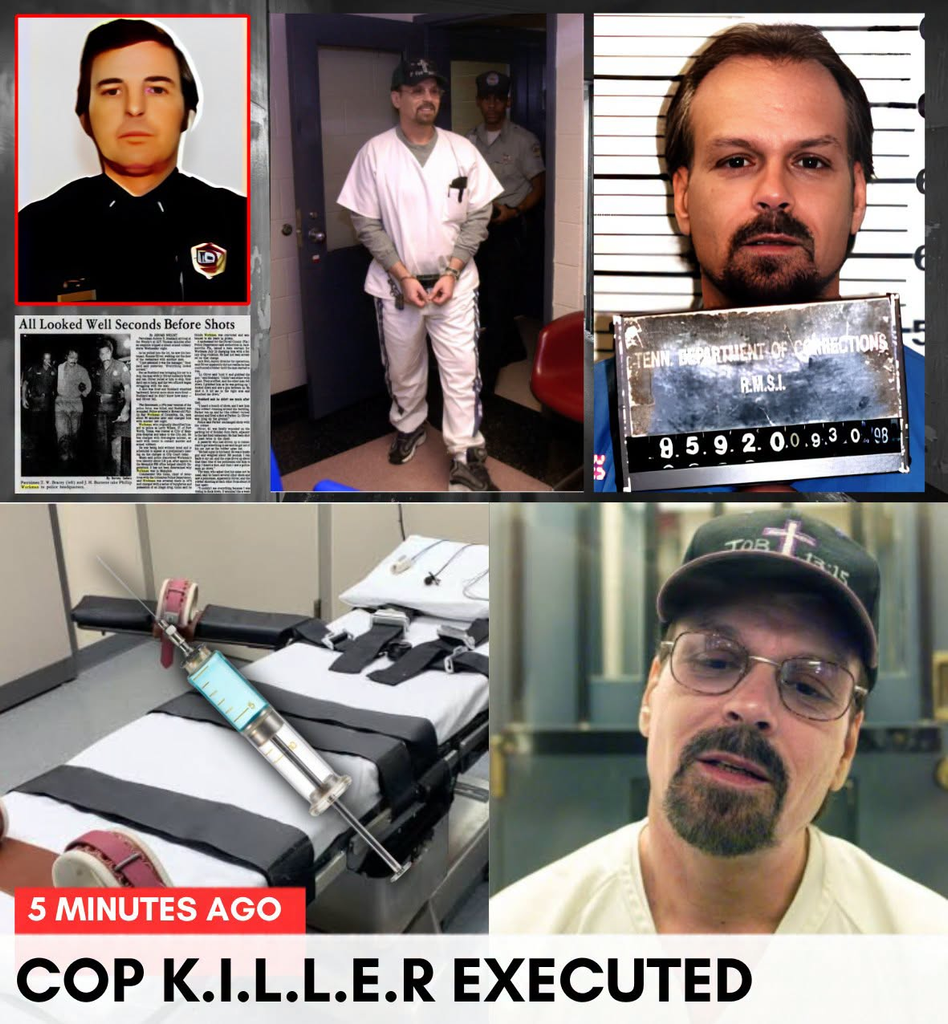
JUST IN: Philip Ray Workman Execution | Cop Killer, Last Meal + Final Words | Tennessee Death Row…
 The final appeal had been exhausted. After more than a quarter of a century of legal maneuvering, the state of Tennessee was prepared to carry out the ultimate sentence against Philip Ray Workman, the man convicted of killing Memphis police Lieutenant Ronald Oliver during a botched robbery in 1981. The case, which had always been fraught with questions about ballistic evidence and the chaos of a multi-officer shootout, was now moving inexorably toward its final, irreversible conclusion.
The only remaining 𝒹𝓇𝒶𝓂𝒶 was not in the courts, but in the mundane, human details of a condemned man’s last hours.As the clock wound down on May 9, 2007, the focus of the national media shifted from the complex legal arguments to the simple, poignant request of a man facing death. Workman had asked for a final meal, a tradition afforded to those about to be executed. But his request was not for a steak or a favorite childhood dish.
He asked for a large vegetarian pizza to be delivered to a homeless person. It was an act of charity that would briefly transform the narrative from one of retribution to one of unexpected, and deeply controversial, compassion.
The Tennessee Department of Correction refused the request, citing policies that prohibit donating final meal requests to individuals outside the prison walls. The bureaucratic denial was swift and absolute. In response, Workman made a decision that would echo far beyond the prison gates: he chose to forgo his last meal entirely.
He would not eat. This simple act of protest, a final statement of defiance and principle, became the story that would dominate the headlines in the hours leading up to his execution.
The news of his refusal spread quickly, igniting a spontaneous and remarkable movement across the state. People who had never met Workman, who may have disagreed with his actions or his conviction, were moved by the simple, human gesture. Churches organized pizza deliveries.
Community groups coordinated with local shelters. Pizzerias across Tennessee were suddenly inundated with orders destined for the homeless, a wave of charitable giving that was directly inspired by a condemned man’s final wish.
One shelter in Nashville reportedly received so many pizzas that it could not distribute them all before they went cold. Other shelters redirected the surplus to different charities across the city. In the end, Workman’s final wish was fulfilled, not by the state, but by the citizens of Tennessee who were touched by his gesture.
It was a strange, unscripted moment of humanity that seemed to stand in stark contrast to the grim proceedings about to unfold at the Riverbend Maximum Security Institution.
The execution itself was carried out with the cold, procedural precision that defines such events. Witnesses were escorted to the viewing room, their presence a solemn testament to the gravity of the moment. The medical team prepared the intravenous lines, and the condemned man was strapped to the gurney.
For the family of Ronald Oliver, this was the culmination of a decades-long fight for justice, a moment they had been promised would come. For Workman’s advocates, it was a tragic end to a case riddled with unanswered questions.
 Before the lethal injection began, Workman was given the opportunity to make a final statement. He spoke quietly, his words directed at those who had come to witness his death. He said he had prayed to Jesus Christ to forgive everyone involved in the execution.
He stated that he held no animosity toward those who were carrying out the procedure, believing they were simply doing their job. His final words were a declaration of his faith: “I commend my spirit to you, Lord Jesus Christ.”
The statement was a stark contrast to the violence that had defined his life and the crime that had put him on this path. It was a moment of quiet resignation, a final act of a man who had spent decades in a cell, grappling with his past and his faith. There were no dramatic outbursts, no desperate pleas.
There was only the quiet acceptance of a fate that had been sealed long ago. Moments later, the drugs began to flow.
The witnesses watched in silence as the lethal injection took effect. Within minutes, it was over. A doctor entered the room, performed a brief examination, and officially pronounced Philip Ray Workman dead just before 2 a.
m. The legal odyssey that had begun with a robbery at a Wendy’s restaurant in Memphis had finally come to an end. Outside the prison walls, the news was relayed to the waiting press, and the story of the man and his final meal was complete.
For those who had supported the execution, the death of Philip Workman represented the long-delayed fulfillment of justice. They argued that the courts had reviewed the case exhaustively, that the conviction was sound, and that the punishment was just. They saw the decades of appeals as a system working as it should, ensuring that no stone was left unturned before the ultimate penalty was carried out.
For them, the death of the man who had caused the death of a police officer was a necessary and righteous conclusion.
For opponents of the death penalty and Workman’s supporters, the execution was a tragedy. They pointed to the lingering questions about the forensic evidence, specifically the claim that the fatal bullet may have been fired by a police officer’s weapon rather than Workman’s . 45 caliber pistol.
 They argued that the state had executed a man while doubt remained about the specific facts of the killing, a violation of the fundamental principle that justice must be certain before it is absolute.
The controversy surrounding the case did not end with Workman’s death. In the years that followed, legal scholars, journalists, and death penalty researchers continued to examine the evidence that had divided so many for so long. Some pointed to the eyewitness testimony presented at trial and concluded that the jury had reached the correct decision.
Others focused on the medical reports and the ballistics arguments raised during the appeals, believing they deserved more weight than they ultimately received.
No one disputed that Philip Workman had committed an armed robbery, nor that he had exchanged gunfire with the police officers who responded to the silent alarm. The death of Lieutenant Ronald Oliver was an undisputed tragedy, a man who had left his home to protect his community and never returned. The core of the debate was always narrower, yet profoundly significant: whether the state could be certain that Workman’s bullet, and not that of a fellow officer, had caused the fatal wound.
This single question transformed a straightforward murder case into one of the most contentious death penalty cases in Tennessee history. It raised fundamental questions about the nature of legal responsibility, the reliability of forensic evidence in chaotic situations, and the standard of certainty required before the state takes a life. The case became a touchstone for debates about the death penalty, not because the courts had failed to rule, but because the underlying questions refused to disappear.
The story of Philip Workman is a stark reminder that the legal system, for all its attempts at objectivity, deals with profoundly human events. A single decision made in a moment of desperation can set off a chain of events that reverberates for decades. The robbery at the Wendy’s restaurant was a crime born of addiction and despair, but its consequences were felt far beyond the parking lot where the gunfire erupted.
It claimed the life of a dedicated officer and set a man on a path toward his own death.
The final meal request, and the spontaneous outpouring of charity it inspired, added a layer of complexity to Workman’s legacy. It was a gesture that seemed to contradict the image of a hardened criminal. It suggested a man who, in his final hours, was thinking not of himself, but of others who were suffering.
For some, this was a cynical act, a last-ditch effort to sway public opinion. For others, it was a genuine expression of remorse and a desire to leave something positive behind.
 The execution of Philip Workman did not resolve the moral and legal questions his case raised. It merely closed the final chapter on his life. The debate over his guilt, the appropriateness of his sentence, and the reliability of the evidence that sent him to his death continues to be a subject of discussion.
His case serves as a powerful example of how a single, violent event can create a legacy of uncertainty that outlives all those involved.
In the end, the story is not simply about a cop killer and his just punishment. It is a story about the fallibility of human memory, the limits of forensic science, and the immense weight of the state’s ultimate power. It is a story about a man who was many things: a son, a soldier, a husband, a father, an addict, a robber, and a condemned prisoner.
It is a story about the families left behind, both the family of the victim and the family of the perpetrator, who were forever bound by a moment of violence.
The memory of Lieutenant Ronald Oliver, the officer who responded to a routine call and lost his life, remains a central part of this narrative. His service and sacrifice are not diminished by the questions surrounding his death. The memory of Philip Workman, the man who spent 25 years on death row, is more complicated.
He was a man who committed a terrible crime, but who also, in his final act, chose to think of the hungry and the homeless.
The case of Philip Ray Workman will likely continue to be debated for years to come. It is a case that defies simple categorization. It is a story of crime and punishment, of justice and doubt, of despair and, in the end, a strange and unexpected act of charity.
It is a story that forces us to confront difficult questions about our justice system and the people who are caught within it. And it is a story that, even after the final injection was administered, refuses to be neatly concluded.
The legacy of that day in Memphis in 1981 is not a simple one. It is a legacy of loss, of a family that lost a husband and father, and of a city that mourned a protector. It is also a legacy of a long and bitter legal battle, a fight for life that ultimately failed.
And it is a legacy of a final, symbolic gesture that, in a small way, brought a community together even as it was preparing to carry out a state-sanctioned death. The questions remain, the debate continues, and the story of Philip Workman endures as a powerful and unsettling chapter in the history of American justice.
© 2026 MZ News — Blog powered by WordPress.