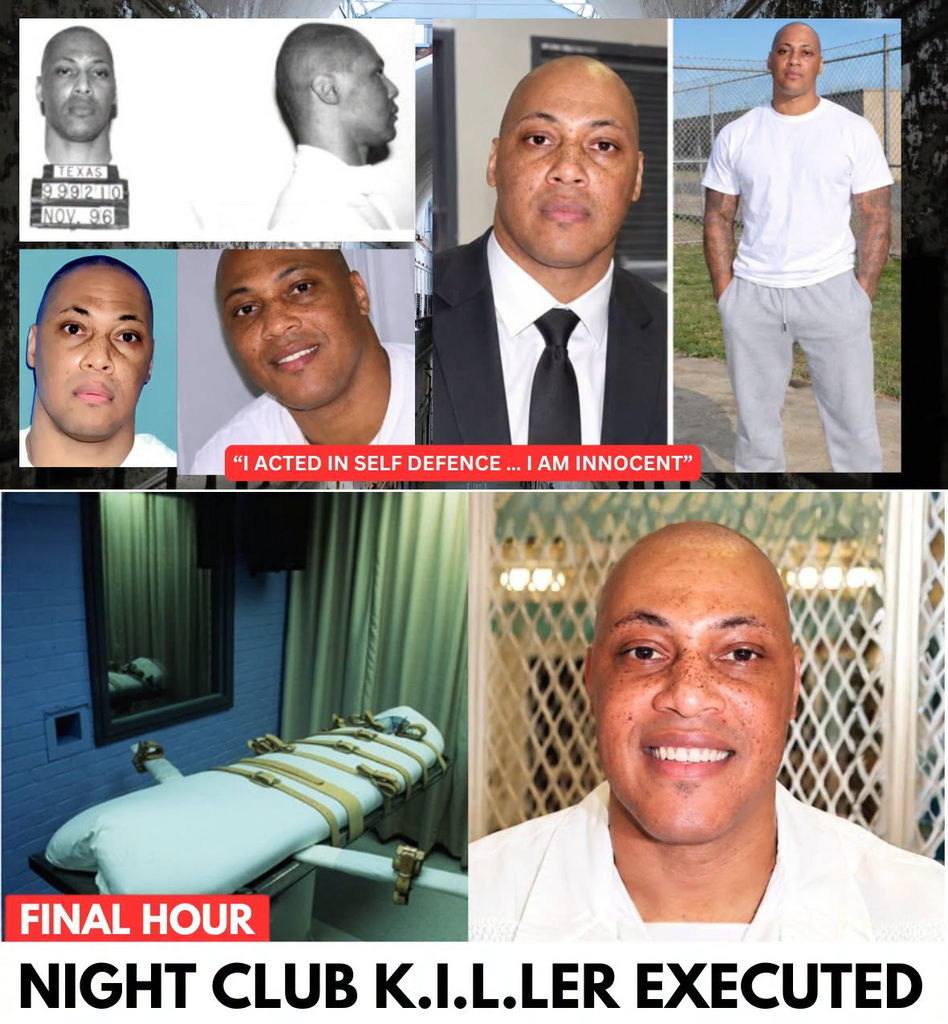
He Claimed Self-Defense | Last Words & Final Moments.
The final legal argument of Frank Moore, a 49-year-old man strapped to a gurney in Huntsville, Texas, was not a farewell but a point of law. As the lethal chemicals were prepared to flow into his veins on the evening of January 21, 2009, he told the assembled witnesses that self-defense in a capital case does not constitute capital murder. It was a claim he had maintained for fifteen years, a legal and factual battle that ended not with an apology or an admission of guilt, but with a statement of principle that the State of Texas had rejected twice in the courtroom and once more in the execution chamber.
The case dates back to the early hours of January 21, 1994, when two young men were shot to death in the parking lot of the Wells of Joy nightclub in San Antonio. Samuel Boyd, 23, and Patrick Clark, 15, were found dead in and near a white car, riddled with bullets from a rifle. Moore never denied pulling the trigger.
 His story was consistent from the moment of his arrest until his final breath: a white car had swerved toward him, the two men inside wanted him dead, and he fired because he believed it was his life or theirs.
Prosecutors painted a starkly different picture of that night. According to their narrative, a fistfight inside the nightclub had ended with two intoxicated young men sitting in a parked vehicle, when a convicted felon approached from behind with a rifle that had just been tossed to him. Between six and ten shots were fired, leaving eleven wounds across the two victims.
The state argued this was not an act of self-defense but a cold-blooded display of power by a man who wanted to prove his dominance on the east side of San Antonio.
Two separate juries heard these conflicting accounts, and both reached the same conclusion. The first jury convicted Moore of capital murder in 1996 and sentenced him to death. However, in 1998, the Texas Court of Criminal Appeals overturned that conviction, not because Moore had proven his innocence, but because the jury had not been allowed to consider lesser offenses.
The court ruled that the evidence of self-defense and the circumstances of the confrontation provided a rational basis for the jury to consider a lesser charge, a procedural error that necessitated a new trial.
A second jury heard the case in 1999 and arrived at the same verdict, imposing the same sentence of death. The legal wrangling that followed lasted another decade, with Moore filing multiple appeals and habeas corpus petitions. He argued that his defense attorneys had failed him, that witnesses who could have supported his account were never called, and that evidence about the victims’ violent histories was improperly excluded.
The courts, however, consistently rejected these claims, often on procedural grounds, noting that the evidence was either too late, too indirect, or insufficiently supported.
To understand the depth of this case, one must examine the life of Frank Moore before that fateful night in 1994. Born on May 16, 1959, in Hot Springs, Arkansas, Moore’s early life was marked by instability. Court records indicate that by the age of fourteen, he had joined the Crips gang in California, a fact Moore never denied.
He described it as a lifestyle for teenagers in his neighborhood, something he breathed in rather than a conscious choice. His wife, Danielle, wrote to the Texas Board of Pardons and Paroles in his final week, describing a boy abandoned by his biological mother who lived alone on the streets of San Antonio for years.
Moore’s criminal record began to accumulate in his early twenties. He was convicted of manslaughter in 1982, though details of that case remain sparse in public records. A year later, he was convicted of attempted murder and sentenced to five years in prison.
He entered prison in 1984 but was released on mandatory supervision in early 1986, only to return within nine months for violating parole. The pattern continued throughout the late 1980s and early 1990s, with Moore cycling in and out of the Texas prison system, often released early due to federal court orders limiting prison populations.
In January 1991, Moore was returned to prison for an eight-year sentence for cocaine possession but was paroled after just four months. Five months later, he was back again, this time on a promotion charge for cocaine, receiving a twenty-year sentence. He served just over two years before being paroled in 1993.
The double shooting at the Wells of Joy occurred approximately ten weeks after that release. During those ten weeks, the record continued to grow. Less than a month before the killings, Moore was arrested for selling crack cocaine to an undercover officer.
Three days after the shooting, he was arrested on a traffic warrant and found to be carrying a pistol in his waistband.
The night of the shooting itself is described in two irreconcilable versions. Angela Wallace, the state’s key witness, testified that she saw Moore and Boyd shaking hands and laughing inside the club. She described Moore as flirtatious, asking her for a last dance and offering his phone number.
As the club closed, she saw Moore, Boyd, Clark, and another man in what she described as a confrontation in the parking lot. Words were exchanged, someone pushed someone else, and then the group dispersed. According to Wallace, a white car entered the parking lot and stopped, but did not swerve toward anyone.
She watched Moore walk to the back of the car, receive a rifle from Ivory Sheffield, and begin firing. When he stopped, he handed the rifle back, and Sheffield walked around asking, “Who wants more of this?”
 The defense presented a different account. Robert Mize, a friend of Moore’s who was also at the club, testified that he saw a fight outside near closing time. He heard someone scream that they were going to get their things, which he understood to mean weapons.
He saw two or three men run across the street and get into a white car. Then, according to Mize, the car sped back across the street and swerved into the parking lot toward him and a group of people that included Moore. The car hit some bushes, then reversed and swerved toward him again.
As he ran, he heard gunshots. Moore himself wrote from death row that he was leaving the club with his brother and cousin when three angry men confronted them, and that Boyd and Clark tried to run them over twice in the white car.
The physical evidence tells a partial story. Boyd was found dead or dying in the passenger seat, while Clark lay dead next to the driver’s door. Shell casings were found in a location suggesting the shots were fired from the rear left of the vehicle.
The medical examiner testified that the bullet trajectories generally went from back to front and left to right. Boyd had been shot six times, Clark five times. Both young men were heavily intoxicated, with Boyd’s blood alcohol level at 0.
28 and Clark’s at 0. 15, along with traces of diazepam. The rifle was a .
30 caliber weapon, and the state estimated between six and ten shots were fired.
The legal proceedings that followed were complex and lengthy. The first trial in 1996 resulted in a conviction and death sentence, but the Texas Court of Criminal Appeals reversed it in 1998, ruling that the jury should have been given the option of convicting Moore of a lesser offense such as voluntary manslaughter. The court’s decision was narrow and procedural, not a ruling that Moore had acted in self-defense.
It simply meant that the jury had been presented with a false dichotomy of capital murder or acquittal, when the law required other options to be on the table.
The second trial in 1999 gave the jury those options. They heard the same witnesses, the same arguments, and the same evidence. Angela Wallace again testified to the friendly evening and the parked car.
Robert Mize again described the white car swerving toward him. A third witness, Frederick Bohler, testified that he saw Moore shoot Boyd and Clark five or six times but said Moore was not provoked and that the victims had ample opportunity to leave. He described the white car sliding across the street, stopping, and then coming back, at one point coming within inches of his leg.
But he did not say anyone in the car fired first or that there were weapons inside. The jury deliberated and again convicted Moore of capital murder, again sentencing him to death.
The appeals process consumed the next decade. Moore filed his first state habeas corpus petition in February 2001, raising thirty-five grounds for relief. A hearing was held, but Moore called no witnesses and presented no evidence, telling his attorney that the claims were explained in the written brief.
The state court recommended denial, and the Court of Criminal Appeals agreed in May 2003. In March 2004, Moore turned to the federal courts, but a federal judge stayed the proceedings while Moore returned to state court to pursue another claim. In March 2006, Moore filed a second state petition, arguing that prosecutors and police had concealed evidence.
The Court of Criminal Appeals dismissed it in September 2006 as an 𝓪𝓫𝓾𝓼𝓮 of the writ, a legal term meaning he was raising claims that could have been raised earlier.
In December 2007, the federal district court denied relief on all claims. In January 2008, it refused to allow him to appeal. In July 2008, the Fifth Circuit Court of Appeals also denied relief, and a request for rehearing was rejected in August.
 The courts consistently found that Moore’s claims were either procedurally barred, lacked sufficient evidence, or were based on witnesses who never actually testified. The Fifth Circuit noted that Moore had not called his trial attorneys to explain their investigative decisions, nor had he called the witnesses he claimed should have testified, making it impossible for any court to know what those individuals would have said.
In 2006, a man named Warren Heuel came forward with an affidavit that seemed to support Moore’s account. Heuel, a retired Navy SEAL who ran a security company guarding apartment complexes near the Wells of Joy, stated that on the day of the shooting, some of his employees had spoken to witnesses before police arrived. According to Heuel, those witnesses said that in the hours before the killings, Boyd, Clark, and others had tried to shoot Moore from a passing car.
He claimed that a man named Ernest Bedford, who was in the white car, had boasted that he and his crew were going to rob or 𝓀𝒾𝓁𝓁 Moore. The affidavit stated that Boyd and Clark had pistols in the car, and that Bedford had gotten out of the car with a gun and fired before Moore returned fire. Heuel also claimed that bystanders took the guns away before police arrived, and that when he tried to tell San Antonio officers, he was ignored and told that Moore was a 𝒹𝓇𝓊𝑔 dealer who should go to prison.
The federal court examined this affidavit and found it problematic. The court noted that Heuel’s account was almost entirely hearsay, coming from employees who spoke to witnesses whose names were never provided. It was vague and contradicted by two other trial witnesses.
The court also noted that the information was not truly new, as Moore had always been in a position to know what happened since he was there. The court’s blunt conclusion was that the best source for a self-defense claim was always Moore himself.
In the fall of 2008, three more witnesses came forward. Roland Flowers, James Neal, and a woman identified as M. Sullivan gave sworn affidavits on Moore’s behalf.
Moore’s attorneys, David Sergi and members of the Texas Innocence Network, filed a third state petition. On December 18, 2008, the Court of Criminal Appeals dismissed it as an 𝓪𝓫𝓾𝓼𝓮 of the writ. The state’s position was consistent: the affidavits might be truthful, but they were not newly discovered evidence.
The people who gave them had been in the neighborhood all along; they simply had not been called to testify.
On January 13, 2009, Danielle Moore sent a letter to the Texas Board of Pardons and Paroles, urging them to commute her husband’s sentence. She described a man who had matured in prison, become religious, and was no longer the person he had been in 1994. She argued that Texas applies the death penalty in a small percentage of murder cases and asked the board for mercy.
No clemency was granted. In his final week, Moore spoke with a reporter from a small visiting cage outside the death row unit. He did not apologize.
He said he had never denied killing them. He said it was self-defense. He described the parking lot fight and the subsequent shooting as one continuous event, saying, “It was like a vicious circle.”
On Monday, January 19, the Fifth Circuit refused to hear his claims. Tuesday was Inauguration Day, and the federal courts in Washington were closed. Moore’s attorneys had requested a thirty-day stay for that very reason, but the request was denied.
On the evening of January 21, about an hour before the scheduled execution, the United States Supreme Court rejected his final appeal, along with a request for a stay based on the new affidavits. There was nothing left to file.
Moore was transferred to the Walls Unit in Huntsville, the old red-brick prison where Texas has carried out executions for decades. State records do not list a special last meal. Witnesses gathered.
For Moore, three friends and his wife, Danielle Rubin Moore, a Belgian woman he had married by proxy, attended. For the families of Samuel Boyd and Patrick Clark, there was a viewing room with a window a few feet from the execution gurney. Letitia, Patrick Clark’s twin sister, was there, as was his sister Peggy.
Moore was strapped down, and intravenous lines were inserted. At approximately 6:12 p. m.
 , he was asked if he wished to make a statement. According to the words recorded by the state, he said, “I would like to say that self-defense in a capital case is not capital murder.”
He then spoke to his wife and family, thanking them for their support and saying he appreciated them. He did not address the families of Samuel Boyd or Patrick Clark, who were watching from behind the window. He did not apologize.
He did not speak their names. It is easy to interpret that silence as indifference, but it is also consistent with what he had said since 1994. In his own account, he was not the aggressor; he was the one who had been attacked.
The drugs began to flow. Nine minutes later, at 6:21 p. m.
, Frank Moore was pronounced dead.
His wife, watching, said he was free now. On the other side of the room, Peggy Clark said she felt more at ease knowing he would never be on the street again, and that justice had been served. Letitia Clark, Patrick’s twin, said she had come looking for a bit of solace and felt she had found a part of it.
She wondered if he would have addressed them and wished he had. Fifteen years to the day had passed. Moore was the second person executed in Texas in 2009 and the 425th since the state resumed capital punishment.
The following evening, Reginald Perkins was scheduled to follow him, with three more executions planned for the next week.
Two juries convicted Frank Moore of capital murder. Every court that reviewed those convictions upheld them. A man who never denied firing the rifle spent fifteen years saying the law had mischaracterized the crime.
That much is not in dispute. What is in dispute is everything that happened in the sixty seconds before the first shot. A parked car or a moving car.
Two unarmed young men or two hiding weapons under the seat. A man who walked toward the back of a vehicle to 𝓀𝒾𝓁𝓁, or a man who fired because he believed they were trying to 𝓀𝒾𝓁𝓁 him. The first jury was never allowed to consider a middle path.
The second jury was given that option and did not take it. The final affidavits came too late to matter in a courtroom, and whether they would have swayed a jury is something no one can say because no jury ever heard them.
On the other side of the story, two people never went home. Samuel Boyd was twenty-three years old. Patrick Clark was fifteen, with a twin sister who stood at a window fifteen years later to watch the man who shot him die.
Whatever they did that night, whatever was in their blood, whatever the juries were or were not allowed to hear about them, they were hit by eleven bullets in a parking lot and neither of them went home. The courts, in the end, were not asked to determine who was the good man. They were asked to determine how to characterize a moment.
Two juries, the Court of Criminal Appeals on direct review, the federal courts, and ultimately the Supreme Court’s refusal to intervene all upheld one version of that night, a version Frank Moore never accepted. He said at the end, “Self-defense in a capital case is not capital murder.” But the State of Texas did not agree.
And at 6:21 p. m. on a Wednesday evening in January 2009, the state carried out its sentence.
© 2026 MZ News — Blog powered by WordPress.