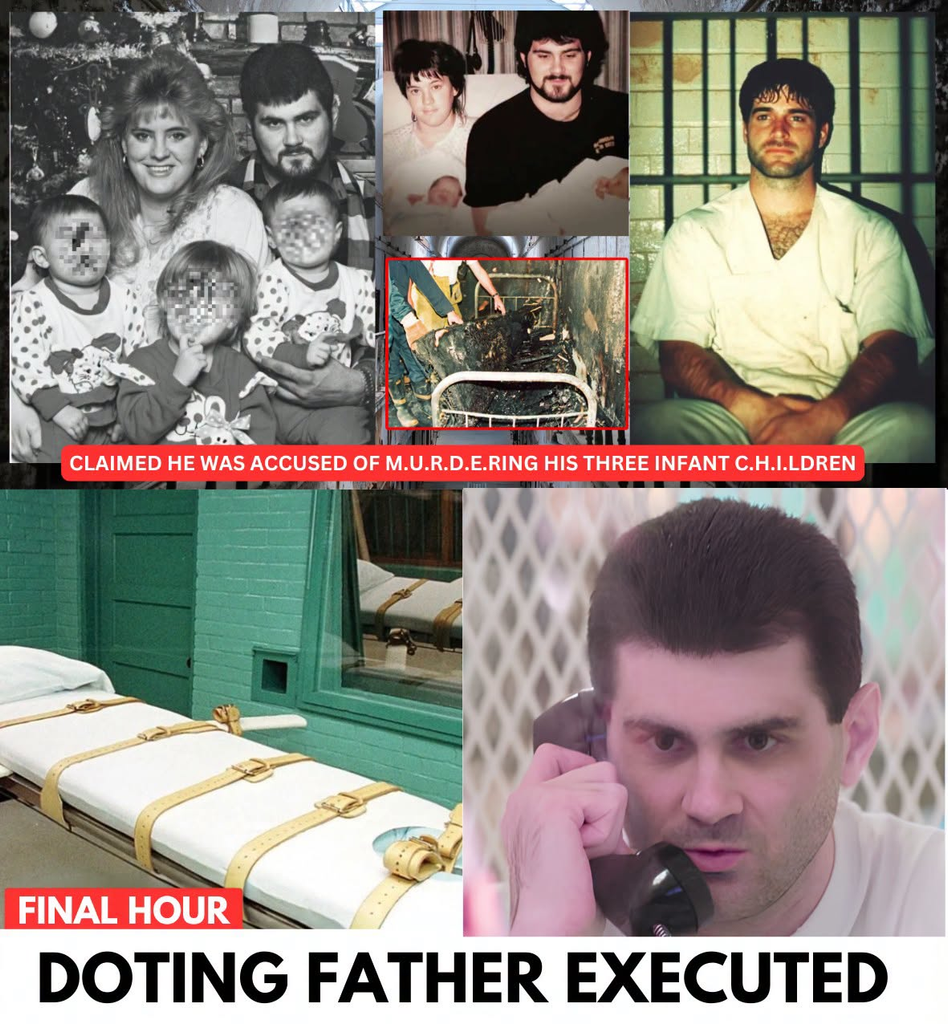
 The clock on the wall in Huntsville, Texas, ticked past 6:00 PM on February 17, 2004, and the state was minutes away from exacting its ultimate price. Cameron Todd Willingham, a 36-year-old former mechanic with a weathered face and a decade of appeals behind him, was strapped to the gurney in the execution chamber. His final statement, captured in the official records of the Texas Department of Criminal Justice, was not a confession or a plea for forgiveness.
It was a stark, unwavering declaration of innocence. He told the witnesses that he was an innocent man, convicted of a crime he did not commit, and that he was being put to death for something that was never his doing. The lethal injection flowed, and within minutes, the man who had spent twelve years on death row for the deaths of his three young daughters was pronounced dead.
The state closed the file on Cameron Todd Willingham, but the story was far from over. In the years that followed, the scientific and legal foundations of that execution would crumble in a way that would force the nation to confront a terrifying question: did Texas execute an innocent man?
The tragedy that set this case in motion began in the small, unassuming town of Corsicana, Texas, a community roughly an hour south of Dallas. In the early 1990s, it was the kind of place where neighbors knew each other’s trucks and the holiday lights on the downtown storefronts were a point of local pride. No one expected that a single-family home on West 11th Avenue would become the epicenter of a national controversy.
Inside that modest, single-story wooden house lived a young family of five. Cameron Todd Willingham, then 23, was a mechanic and odd-job worker who had drifted through Oklahoma and Texas, accumulating a record of minor run-ins with the law. His wife, Stacy, was about the same age, and their marriage was described by many as volatile, marked by arguments and, according to later testimony, physical violence.
They had three daughters: two-year-old Amber, and one-year-old twins, Karmon and Kameron. The family was struggling, living paycheck to paycheck in a rental they could barely afford, and the pressure of the approaching Christmas holiday only added to the tension.
On the morning of December 23, 1991, Stacy left the house. According to the official narrative that would later be constructed, she stepped out for an errand, leaving Todd alone with the three girls. It was a routine morning in a routine week, with no indication of the horror that was about to unfold.
The account of what happened next depends entirely on whose story you believe. Willingham’s version, which he repeated without deviation for the rest of his life, was that he was asleep in the house when he heard one of his daughters screaming. He said he woke to find the home filling with thick, black smoke and realized something was terribly wrong.
He claimed he got up and tried to reach the girls’ bedroom, but the heat and smoke were overwhelming. He said he could barely see, that the air was impossible to breathe, and that he was forced back. He managed to escape the house, and according to his testimony and the accounts of others, he then ran around the exterior, desperately trying to reach the children from another angle.
He broke a window in the back, he said, in a frantic attempt to get to them.
 Neighbors had already noticed the smoke and flames. One woman who lived next door called for help, and the Corsicana Fire Department was dispatched. Willingham, by several accounts, was hysterical, screaming that his children were still inside.
At some point, he moved his car away from the house, a detail that investigators and prosecutors would later scrutinize heavily, viewing it as inconsistent with the behavior of a desperate father. When firefighters arrived, they entered the inferno, but by the time they reached the children’s room, there was nothing they could do. Amber, Karmon, and Kameron were dead.
The medical examiner later concluded that they had not died from burns but from carbon monoxide poisoning, asphyxiated by the smoke. They were overcome by the fumes before the flames ever reached them. This fact is significant, and it is one of the few details in this entire saga that has never been seriously disputed.
The girls lost their lives to smoke inhalation in their own home on a December morning, with a father who survived and a mother who was not there.
Standing in the yard that morning, Cameron Todd Willingham had just lost everything. Whether he was a grieving father in the worst moment of his life or something else entirely is the question that the next thirty years would attempt to answer. But at that moment, there were only the aftermath and the ashes.
The fire was extinguished, and the home was a ruin of charred wood and blackened walls. Three children were dead, and in the cold light of the aftermath, someone had to determine how it started. This is not unusual.
After any fatal fire, investigators attempt to determine the cause. Was it electrical, a heater, a cigarette, a cooking accident, or was it deliberately set? The answer matters for a practical reason, because it determines whether anyone will be held responsible.
In this case, it would mean more than anyone could have imagined.
The men who examined the Willingham home were not amateurs. They were working professionals doing what they had been trained to do. Two of them would become central names in this story.
The first was Douglas Fogg, the assistant fire chief for the Corsicana Fire Department. The second was Manuel Vasquez, a deputy state fire marshal who was called in to assist and who would become the prosecution’s primary fire expert at trial. To understand what they did, you have to understand that era.
In 1991, arson investigation in the United States relied heavily on a body of knowledge passed down among investigators. Much of it came from experience and folklore. Investigators were taught to read a burned room the way a detective reads a crime scene.
Certain patterns on the floor, certain marks on the walls, and certain behaviors of glass and metal were considered indicators that a fire had been deliberately set and fueled by an accelerant. The standard reference for scientific fire investigation, known as NFPA 921, was just being introduced around the same time as the Willingham trial. Many working investigators had not yet absorbed its lessons, and some were openly skeptical of it.
In other words, this case unfolded at a moment when fire science was in the midst of a quiet revolution, and not everyone in the field had caught up.
Fogg and Vasquez walked through the debris and saw what they believed were the signatures of arson. The official investigation would eventually list nearly twenty of them. These included what they described as pour patterns, irregular marks on the floor that they interpreted as places where a liquid had been spread.
They included low-level burning near the ground, which was thought to indicate that a flammable liquid had fueled the fire from below. They included burning under furniture, including under the children’s beds. They pointed to melted aluminum near a doorway, which they considered evidence of an unusually hot fire.
They pointed to crazed glass, the spiderweb-like cracking of glass, which they read as a sign of rapid, intense heat. They believed there were multiple points of origin where the fire had started. Then there was the front porch.
A sample taken from near the threshold tested positive for a petroleum product consistent with something like charcoal lighter fluid. To the investigators, this looked like an accelerant used to start the fire at the front door.
Taken together, the investigators concluded that this was not an accident. In their view, someone had deliberately set the house on fire, and the blaze had been fueled by a liquid poured throughout the home. It was a conclusion based on observations that seemed, to the trained eye of the time, consistent and compelling.
Every piece of the puzzle seemed to point in the same direction, and it was presented with the confidence of professionals who had examined many fires and believed they knew what an intentional fire looked like. But fire investigation conclusions do not stay in the lab. They change the trajectory of everything that follows.
Once the fire was labeled arson, the question was no longer how it started. The question became who started it. And when investigators asked who was in the house, the answer was uncomfortably simple.
There were three small children who could not have started a fire. And there was one adult who walked out alive. The moment the investigators concluded the fire was arson, Todd Willingham ceased to be a grieving father in their eyes and became a suspect.
It is worth pausing on this shift because it shaped the way everything about him was interpreted afterward. A man who loses his children in a fire is expected to behave in certain ways. He is expected to be devastated, desperate, and physically injured from his attempts to save them.
When the explanation is a tragic accident, almost any reaction is understood as grief. When the explanation is arson, every reaction is examined for signs of guilt. Investigators began to scrutinize Willingham’s injuries.
He had burns and singed hair, but they were not as severe as they expected from a man who claimed to have fought his way toward his children’s room. To the prosecution, this seemed suspicious. They wondered, if he had truly tried to save his daughters, why was he not more seriously injured?
They looked at what neighbors and witnesses remembered about his behavior outside the house. Some described a man who seemed upset, but in their view, he was not doing everything he could to get back inside. Some thought his reaction did not match the level of desperation they expected.
The detail of moving his car became part of the picture. So did a report that in the days that followed, he behaved in ways that some found strange.
His actions before and after the incident. You have to take into account his actions during the fire and things of that nature. That makes up the whole story, not just a small part of it.
It is the whole story in all its details. It is important to be careful here and honest about what the records show. Later reporting on this case found that the initial statements of some witnesses differed from what they said later, after the investigation had focused on Willingham.
One neighbor’s first impressions, as later reported, described a man who was hysterical and distraught. Another described someone who had to be held back from returning to the flames. Those initial impressions hardened as the case against him crystallized.
We cannot know precisely how memory and suspicion shaped those later accounts, but we can say that the picture of his behavior changed over time. Then there was the broader background. Willingham was no stranger to trouble.
The trial record included evidence of a criminal history that included arrests and run-ins with the law. Prosecutors presented testimony about his violent temper and violence in his marriage. Witnesses spoke of struggles between him and Stacy, and the prosecution used this to suggest that he was a man capable of terrible things.
 He was a very evil man. He beat Stacy all the time. I mean, you know, I mean, it was a daily thing.
There was also an attempt to define his character through his surroundings. Investigators and prosecutors pointed to posters on the walls of his home, some of which were dark and fantasy-themed, and suggested they reflected a disturbed mindset. Later reports would note that many of these images were taken from rock band artwork, such as Iron Maiden and Led Zeppelin, which were common in the homes of young people of that era.
At trial, they were presented to help paint a picture of an evil person. And there was the matter of motive, which the prosecution never fully resolved. They hinted that Willingham resented his children, that they interfered with his drinking and his free time.
It was a theory offered to fill a gap. Anyone who has followed a criminal case knows that the absence of motive can be a problem, and in this case, that problem never entirely went away. To be clear, these were the prosecution’s arguments presented to the jury, and each one was contested.
The defense challenged that portrait. Willingham himself insisted that he loved his daughters and that he did everything in his power to reach them. But once the fire was deemed intentional, the narrative of his identity was rewritten based on that finding, and prosecutors used it to argue that a troubled, violent man was capable of the unthinkable.
On January 8, 1992, Todd Willingham was charged with the deaths of his three daughters. But even with the fire investigators’ conclusions and the portrait of a troubled man, the prosecution wanted something more. Suspicion is not proof.
They wanted evidence that would allow the jury to hear the story from the inside. And they found it in the Navarro County Jail. His name was Johnny Webb.
Webb was an inmate being held on his own criminal charges. According to the account he would later give in court, he came into contact with Willingham while they were both incarcerated. According to Webb, Willingham talked.
Webb testified that Willingham confessed to him. He said, well, you know, I can’t handle what I did. I said, what are you talking about?
And that is when he confessed to what he had done. According to the trial testimony, as later summarized by the Texas Court of Criminal Appeals, Webb said Willingham described pouring lighter fluid around the house, lighting the fire, and leaving the children behind. In one version of the story, he said Willingham claimed the fire was meant to cover up an injury one of the girls had sustained.
It was a chilling narrative, delivered in simple, direct language.
Think about the impact that testimony would have in a courtroom. A jury might be confused by fire patterns. They might struggle to understand technical testimony about accelerants and flashover.
But a confession is simple. A man told someone what he did. It does not require a degree to understand it.
It removes ambiguity and gives the jurors an answer. So, Webb’s testimony became one of the most important pillars of the prosecution’s case. The fire investigators said the fire was arson.
The informant said the defendant confessed. Between the two, the state had what looked like a complete story, the physical evidence and the words of the accused. But even during the trial, there were hints that the story was not as solid as it seemed.
The defense tried to raise questions about whether Webb hoped to gain something in his own case. The defense sought to introduce evidence of that, including information from another inmate. The trial court excluded it, ruling that the proper foundation had not been laid, and the appellate court later upheld that decision.
The jury never heard that line of attack. We will return to Johnny Webb because his story did not end in that courtroom. In the years that followed, the story changed in ways that left even supporters of the conviction facing difficult questions.
But in 1992, in the heat of a major criminal trial, his words carried immense weight.
By the summer of 1992, the case against Cameron Todd Willingham was ready for a jury, and the prosecution had the most potent combination a prosecutor can have: a seemingly scientific explanation and a confession. Willingham’s trial took place in August 1992, about eight months after the fire. The prosecution called a long list of witnesses, about seventeen in total, including the two fire investigators.
They described the fire patterns, the melted aluminum, the glass, and the porch sample. They explained why, in their professional estimation, the fire could not have been anything but arson. The defense faced a different problem entirely.
They did not call a fire expert to challenge the arson finding. According to later accounts, that was because the defense’s own expert had reached a similar conclusion, leaving the defense without an expert willing to contradict the state. Without a dissenting scientist, the jury heard only one version of what the physical evidence meant.
There was also a decision that would haunt the case for years. Later reports indicated that prosecutors offered Willingham a plea deal that would have spared him the death penalty in exchange for a confession, and he reportedly refused it. He remained adamant about his innocence and refused to admit to something he did not do.
Whether that was stubbornness, principle, or a catastrophic misjudgment is a question people have asked ever since. But it was consistent with what he said from the beginning to the end of his life.
The jury deliberated for about an hour. That is a short time for a death penalty case, especially one involving the loss of three children. When they returned, they announced their guilty verdict.
Then, in the punishment phase, they sentenced him to death. The Texas Court of Criminal Appeals reviewed the case and affirmed the conviction and sentence in 1995. It is important to be precise about what that means.
The appellate court was not re-examining fire science the way scientists would years later. It was reviewing the legal claims Willingham raised, and it concluded that the trial was legally sound and the evidence sufficient. That was a legal conclusion about the case as it was tried, not a modern scientific review of whether the fire was arson.
And so, Todd Willingham was transferred to death row to await his fate. The years passed. His appeals continued through state habeas proceedings and then in federal court, all of them failing.
By the early 2000s, he had exhausted most of his legal options. He had spent more than a decade in a cell, repeating the same thing in every letter and every conversation, that he did not set the fire, that he did not harm his children, and that he was an innocent man.
During those years, a strange figure entered his life. In 1999, a playwright from Houston named Elizabeth Gilbert began corresponding with Willingham. This is not to be confused with the famous travel memoirist.
This Elizabeth Gilbert was a teacher and playwright who became interested in the lives of death row inmates. She began writing to him as a kind of pen pal, assuming, like most people, that a man on death row had probably done what the jury said. But as she got to know him, and as she began reading the trial transcripts herself, something began to bother her.
She noticed inconsistencies, witness accounts that did not quite match, and statements that seemed to have changed over time. She started asking questions, and the more she asked, the less certain she became. Gilbert was not out to free him at first.
By her own account, she did not even start out believing in his innocence. But she became the kind of person who does not stop asking questions, and over time, she turned into a relentless advocate, pushing for a re-examination of the case. That is the turning point in this part of the story.
For years, Willingham had been just another name on a long list of people the state had convicted. Now, there was someone from outside the system questioning whether the foundations of his conviction were sound. And the biggest challenge to those foundations would not come from another witness.
It would come from the fire itself.
To understand why, we have to step away from the courtroom and into the world of fire science. Because that world had changed dramatically by the early 2000s. Fire investigators in the 1990s were largely trained on tradition.
They relied on a set of rules of thumb. If you see this pattern, it means a liquid was poured. If you see that damage, the fire was hot and fast, indicating an accelerant.
These rules were often passed down among investigators, and they were rarely tested in controlled experiments. Then researchers began testing them. They deliberately burned rooms, furnished them, and watched what happened, and what they found shook the foundations of the field.
The key concept is something called flashover. Imagine a fire starting in a room. At first, it burns in one spot.
 Smoke and hot gases rise and collect near the ceiling, and that upper layer gets extremely hot. Eventually, the radiant heat downward becomes so intense that everything flammable in the room ignites almost simultaneously. The entire room becomes a fireball in an instant.
That moment is flashover. What researchers discovered is that a fire after flashover can leave marks that look exactly like the ones investigators were trained to consider indicators of arson. Irregular burn patterns on the floor, low burning near the ground and under furniture, marks that look like puddles or trails of spilled liquid, melted metal, and crazed glass.
All of that can happen in a fire that started accidentally with no accelerant at all.
One of the most famous examples came from a case known as the Lime Street fire in Jacksonville, Florida, where investigators later reconstructed a fire and showed that an ordinary fire reaching flashover could produce many of the supposed signatures of arson. Now, take that knowledge and go back to Corsicana and look again at the evidence against Todd Willingham piece by piece. Start with the crazed glass.
Investigators considered it a sign of an intensely hot fire fueled by an accelerant, but later research showed that crazed glass can form when hot glass is cooled rapidly, for example, by water from fire hoses. Fire scientists who examined homes destroyed by a wildfire in Oakland, California, found crazed glass in places where no accelerants had been used. In other words, the glass did not tell you what caused the fire to start.
Then the melted aluminum. Investigators treated it as evidence of an unusually hot fire, the kind they associated with flammable liquids. But aluminum has a relatively low melting point compared to the temperatures an ordinary building fire can reach.
Ordinary wood and furniture fires get hot enough to melt it. So, the melted aluminum also did not indicate an accelerant. Next, the pour patterns.
This was one of the most important claims. Investigators looked at irregular burn marks on the floor and interpreted them as the traces of a poured liquid. But experiments showed that after flashover, the floor itself can burn in irregular patterns due to the behavior of heat and burning debris in the room.
The patterns that looked like liquid pours could have been caused by the behavior of the fire itself. Then the burning under furniture and the low burns. Again, investigators interpreted these as the work of an accelerant.
But in the intense conditions after flashover, flames and heat can reach low areas and under objects without any liquid being poured there. Then the porch. The presence of petroleum residue near the front door seemed like strong evidence.
But there was a detail that had been overlooked. There was a charcoal grill on the porch with a can of lighter fluid before the fire. Both were destroyed in the blaze.
That meant the lighter fluid residue had a potential innocent source. Also, the firefighters’ water could have moved the residue from one place to another. The finding that looked like evidence of arson had an ordinary explanation that was sitting right there on the porch.
Note what the later experts were saying and what they were not saying. They were not necessarily claiming that the investigators fabricated evidence. The burn patterns were real.
The glass was really crazed. The aluminum was really melted. The problem was the interpretation.
They were saying that the markers the investigators treated as reliable indicators of arson were, in light of modern knowledge, not reliable at all. In early 2004, as Willingham’s execution date approached, Elizabeth Gilbert and his attorneys arranged for a fire expert named Gerald Hurst to review the case. Hurst was a chemist and a veteran fire investigator.
He examined the investigators’ reports and the supporting materials and reached a stark conclusion. There was no scientific basis for saying the fire had been deliberately set. Hurst went through the indicators one by one.
The melted aluminum, the crazed glass, the burn patterns, the low burning, the damage under the furniture, the petroleum evidence, and the supposed speed and heat of the fire. In his view, the original investigators had misunderstood how fires behave. He suggested the fire may have been accidental, citing possibilities like an electrical space heater or faulty wiring.
It is important to be careful about what Hurst said and did not say. He did not claim to know exactly how the fire started. His conclusion was more specific and in some ways more powerful.
The evidence presented as proof of arson did not actually prove arson. Years later, another expert reached a similar conclusion. Craig Beyler, a respected fire scientist, was contracted by the Texas Forensic Science Commission to review the case.
His analysis concluded that the original investigators had no sound scientific basis for their findings and relied on outdated ideas about fire behavior. Others, including a panel formed by the Innocence Project, reached similar conclusions. And so, by the time these reviews were complete, a wide range of experts had said nearly the same thing.
The markers that sent Cameron Todd Willingham to death row were not scientifically proven to indicate arson.
But when Hurst presented his findings in 2004, no one outside of Willingham’s small circle of supporters had heard about them yet. And time was running out. The Hurst report arrived at the worst possible moment.
Willingham’s legal avenues were nearly exhausted. The courts had rejected his appeals. His execution was scheduled for February 17, 2004.
The only hope left was an act of clemency, a stay, or a reprieve from the state’s political leaders. His attorneys sent the Hurst report to the Texas Board of Pardons and Paroles and to the office of Governor Rick Perry. The goal was simple.
To demonstrate that the scientific basis of the case was in serious doubt and to ask for a halt in the proceedings long enough to examine those questions. It did not work. The Board of Pardons and Paroles declined to recommend clemency.
The governor did not issue a stay. According to reports at the time and in the years since, there was little indication that the scientific report was seriously considered before those decisions were made. Perry and his supporters later defended the decision, saying the courts had reviewed the case and that the evidence of guilt, including the informant’s testimony, was substantial.
Critics argued that the state ignored a serious warning when there was still time to act.
In the final days, another development made things even more difficult for Willingham. His ex-wife, Stacy, who had previously supported him, changed her mind. Years after the fire, after reviewing the trial materials, she came to believe he was guilty.
At the last minute, the prosecution presented an affidavit from a family member claiming that Stacy had told them Willingham confessed to her during a prison visit. Willingham denied this. The claim was never proven in court, but it came at the moment when his supporters were trying to convince the state to pause.
It was also reported that Stacy refused his request to be buried next to their daughters. Think about the position Willingham was in. Experts were saying the evidence against him was unreliable.
His lawyers were begging for more time. The state’s leaders were refusing, and his ex-wife, the mother of his children, now believed he had committed the crime. On February 17, 2004, he was taken to the execution chamber in Huntsville.
The atmosphere that evening was described by those who were there as heavy and still. Supporters had gathered. Lawyers were making their final calls.
Somewhere, a fire expert’s report was sitting in the files of the people who had the power to intervene. The process moved forward on schedule. Willingham was given the chance to speak.
In his final statement, he said he was an innocent man convicted of a crime he did not commit. The Texas Department of Criminal Justice records preserve that statement. He had said the same thing for 12 years, and he said it one last time.
At approximately 6:20 that evening, he was pronounced dead. He was 36 years old. After his death, his family had him cremated.
According to reports, some of his ashes were quietly taken to the graves of his daughters, fulfilling his wish.
If this were the end of the story, it would be a tragedy and a controversy, nothing more. But the case did not die with him. In fact, the execution turned out to be the beginning of the real reckoning.
In December 2004, less than a year after the execution, the Chicago Tribune published an investigation into the fire evidence. The paper consulted multiple fire experts to review the case, and they concluded that the determination of arson was seriously flawed. It was one of the first times the broader public saw the arguments laid out in detail.
 After that, the Innocence Project commissioned a panel of leading fire experts to review the evidence. Their conclusion was emphatic. The indicators used to deem the Willingham fire an arson had been scientifically debunked.
Over the next few years, more reviews and reports kept the case in the public eye. Then, in 2009, the story reached a national audience. The New Yorker published a lengthy investigation by writer David Grann titled Trial by Fire.
It laid out the fire science, the informant’s testimony, the shifting witness accounts, and the final days before the execution. It was widely read and even more widely discussed. It brought the questions about the Willingham case into living rooms and newsrooms across the country.
By that time, the Texas Forensic Science Commission was already looking into the matter. It had been created to review complaints about the integrity of forensic science in Texas, and the Willingham fire investigation was one of the cases before it. The commission brought in Craig Beyler to analyze the evidence, and his report was highly critical of the original investigation.
Then came the controversy of its own. In the fall of 2009, shortly before a scheduled hearing where Beyler was expected to present his findings, Governor Rick Perry replaced the commission’s chairman and two other members. The hearing was postponed.
Critics saw this as an attempt to derail the investigation. They argued that a case involving a governor’s decision about an execution should not be examined by a commission whose membership the governor had just changed. Perry and his administration denied that the changes were meant to interfere.
The fact is that the personnel changes happened shortly before the scheduled hearing. The commission ultimately issued a report in 2011. It acknowledged serious problems with the science underlying the original fire investigation, including the use of outdated concepts.
But it declined to make a formal finding of professional negligence or misconduct, citing the limits of its jurisdiction. Here is where many accounts go wrong, and it is important to be clear. The commission did not declare Willingham innocent.
It did not declare the fire accidental. What it did was investigate the criminal cases and acknowledge substantial flaws in the way fire investigations were conducted at that time.
In 2014, the Willingham family and the Innocence Project sought a posthumous pardon, submitting extensive materials arguing that the new evidence undermined the conviction. The Texas Board of Pardons and Paroles did not recommend it. To this day, Cameron Todd Willingham has not received a pardon or an official judicial exoneration.
So, legally, the conviction stands. But scientifically, the basis on which it was built has been widely challenged. Those two facts sit side by side, and they have never been reconciled.
That is one puzzle. And there is a second puzzle. It involves the man who told the jury that Willingham had confessed.
Johnny Webb’s story did not hold up. In March 2000, years after the trial, while Willingham was still alive and appealing his sentence, Webb provided a handwritten affidavit saying he wanted to recant his testimony. In it, he said Willingham was innocent.
It was a stunning reversal. The man whose testimony had been so damaging was now saying it had been wrong. But the recantation did not save Willingham.
Webb later withdrew his affidavit. That created a pattern that makes it difficult to determine the truth of Webb’s position. In 1992, he said Willingham confessed.
In 2000, he said Willingham was innocent. Then he took it back. In the years after the execution, he gave other accounts, sometimes returning to the claim that his original testimony was not true.
At times, he hinted that he had been promised something. He said he was told he would receive favorable treatment in his own case. At other times, he said his memory was poor and that medication he was on while incarcerated affected him.
The question of whether Webb received a benefit became a matter of serious dispute. Records emerged showing that the prosecutor in the Willingham case, John Jackson, had taken steps to help Webb after the trial, including efforts related to getting his sentence reduced. Critics argued that this raised questions about whether the jury had heard the full truth about the informant’s incentives.
If a witness expects a reward for his testimony, the jury is entitled to know that. Jackson denied making any such deal. The State Bar of Texas took the matter seriously enough to initiate disciplinary proceedings.
The allegations included hiding favorable treatment for Webb and making false statements. During those proceedings in 2017, Webb invoked his Fifth Amendment rights repeatedly rather than answer questions. And in May 2017, a jury found that Jackson had not committed professional misconduct.
That finding is significant, and it should not be overlooked. It means that the allegations about a secret deal, however troubling the surrounding records were, were not proven as misconduct in the disciplinary process. A fair account must mention both things.
There were records and statements that raised serious questions about how the Willingham case was handled. And a disciplinary panel found that the prosecutor had not violated the rules.
By this point, the case against Willingham faced two enormous problems. The fire science that supported the arson finding had been heavily discredited, and the credibility of the man who said Willingham confessed had been scrutinized with a story that changed more than once. But that does not mean the story is simple, and it does not mean there is nothing to be said for the other side.
Supporters of the conviction have pointed to several things. They point to the fact that Webb gave testimony about a confession. They point to witnesses who saw Willingham’s behavior at the scene as inconsistent with a father in despair.
They point to his minor burn injuries, his criminal record, and accounts of violence toward Stacy. They point to the fact that the original investigators, including Douglas Fogg, continued to defend their conclusions even after the later scientific criticism. They also point to the claim, never proven in court, that Willingham confessed to his ex-wife.
Those arguments deserve to be heard, and any serious account of the events should include them. But there is one thing that makes this case unusually difficult to resolve. The central question is not whether Willingham was a good man.
It is not whether he had a temper or a criminal record or a troubled marriage. It is whether the fire that killed his daughters was arson at all. Because if the fire was an accident, then the entire murder case collapses, no matter what anyone else thought about the man.
The later scientific reviews have severely undermined the claim that the fire was proven to be arson. But the house has been gone for a long time. The physical evidence is limited, and the man himself is gone too.
That means none of the courts ever had the chance to reconsider the case in full using modern science. There was never a new trial. There was only an execution, and then a long argument.
So, what do we actually know? We know that on December 23, 1991, a fire in a Corsicana home killed three young children, Amber, Karmon, and Kameron, who died of smoke inhalation. We know that investigators concluded the fire was arson based on a list of indicators they believed pointed to a deliberately set blaze.
We know that Cameron Todd Willingham was convicted in 1992 after a trial where the jury heard from the fire investigators and a jailhouse informant, and that deliberations lasted about an hour. We know that his conviction was upheld on appeal, and that he spent more than a decade on death row, maintaining his innocence. We know that shortly before his execution, a fire scientist told the state that the arson evidence was not scientifically sound, and yet clemency was denied.
We know that on February 17, 2004, the execution was carried out. We know that in the years that followed, multiple fire experts, a major newspaper investigation, a prominent magazine article, and a state forensic commission examined the case, and many of them concluded that the original arson findings were based on ideas that had been disproven. We know that the informant’s story changed over time, and that questions about his treatment led to disciplinary proceedings in which the prosecutor was cleared.
And we know that the State of Texas has never officially exonerated Cameron Todd Willingham, and that his request for a posthumous pardon was not granted.
What we do not know is exactly how that fire started. We do not know for certain whether the man who was executed was guilty or innocent of the crime for which he was charged. The evidence that once seemed to answer that question has been dismantled, and what remains is a gap that cannot be closed.
That gap is the reason this case has lingered in the public consciousness. It is not just a story about a man who may have been wrongly convicted. It is a story about how confident certainty can be built on foundations that later prove to be unstable.
The investigators believed they were reading the fire evidence correctly. The jury believed it was hearing the truth. The court believed the trial was fair, and the state carried out its ultimate punishment based on a record that science would later call into question.
If the fire was not proven to be arson, then what exactly sent Cameron Todd Willingham to the execution chamber? It is a question no court has ever been asked to answer, and it is a question left for the people of Texas and for everyone who studies this case to ponder for themselves. On the evening it all ended, Willingham was given one last chance to speak.
He confessed to nothing. He asked for no forgiveness for something he said he did not do. He told the people in the room that he was an innocent man convicted of a crime he did not commit.
Whether you believe him is up to you. But the questions his case raised have outlived him. They have changed the way many people think about fire investigations, about informants, and about how much certainty the justice system should have before it ends a life.
Three little girls lost their lives in a home in Corsicana on a December morning. And their father lost his life twelve years later. And the answer to what really happened inside that house may be something we will never fully know.
© 2026 MZ News — Blog powered by WordPress.